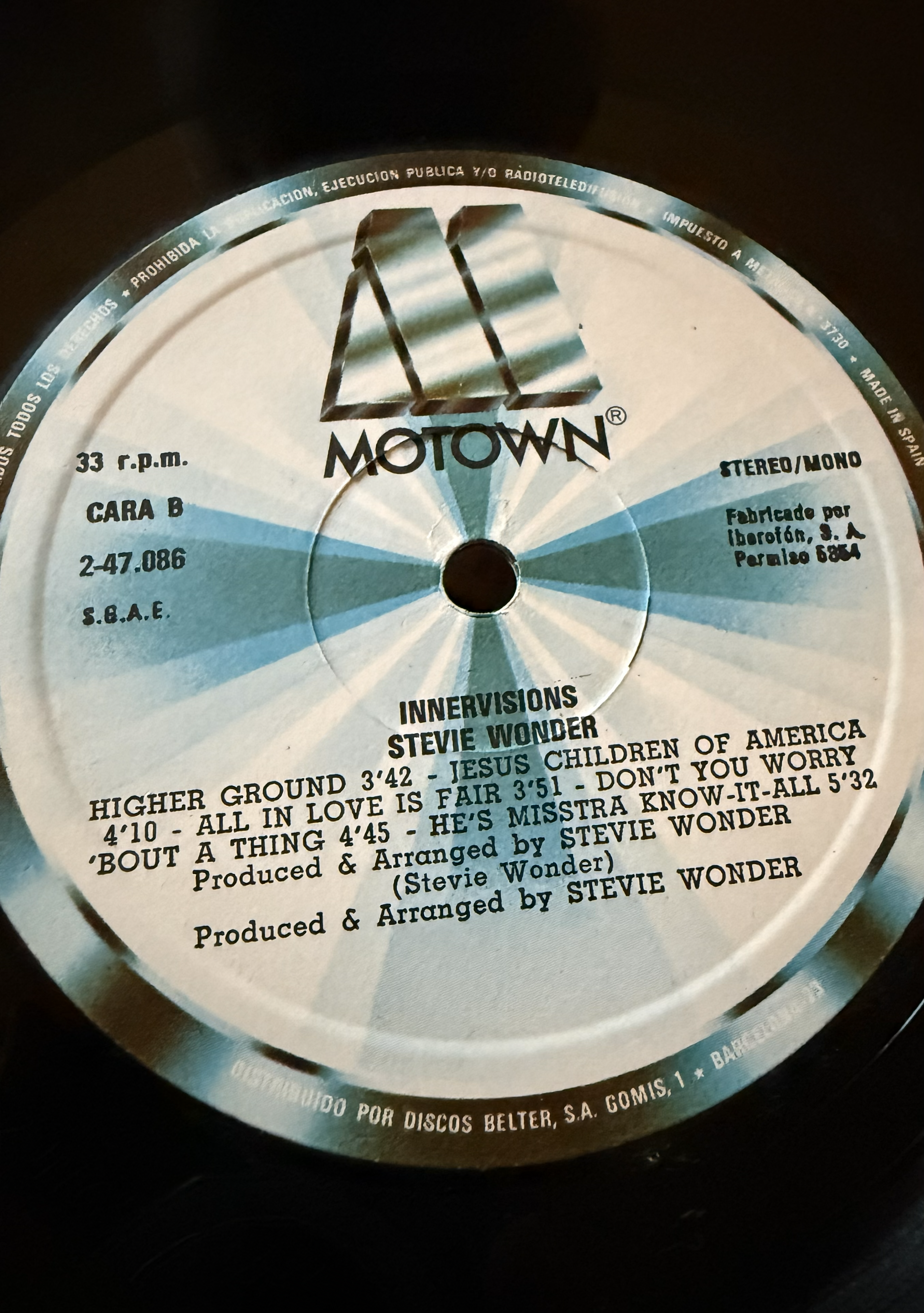
A few months ago, my wife and I picked up an old LP of the Stevie Wonder masterpiece Innervisions from a record store in Hood River. It’s maybe my favorite Stevie Wonder album, and it definitely has my favorite Stevie Wonder song, “Higher Ground.”
My wife and I start most mornings playing one side of a record while we get ready for work, and last Wednesday, feeling beat down by the killing of Renee Good and the apparently bottomless appetite that the Trump administration and the MAGA crowd have for brutalizing people that don’t agree with them—or who in in many cases just look like they maybe weren’t born here—I felt like I would do well to listen to “Higher Ground.”
But when I dropped the record onto the turntable, I noticed something on the record that I hadn’t seen before:
My first thought on really looking at the label was “why the hell does it say Cara B?” That’s when I realized that we had bought a 1973 Spanish pressing of the record! And about thirty seconds after I figured that out, it occurred to me: this album was pressed in Barcelona when Spain was still a fascist dictatorship, during the final years of the Franco regime.
Something about that sight gave me an odd jolt of hope: that even a repressive authoritarian like Franco—head of one of the longest-lived right wing dictatorships in the 20th century—couldn’t keep out the liberating voice of Stevie Wonder. And neither can a predator and thug like Trump, nor the predators and thugs who work for him, prevent people from liberating themselves. Don’t give up, people.
Here’s the song of the moment for me: sleepers, just stop sleeping.
I’ll begin with the obvious: we can’t defend the republic simply by reading books. Reclaiming and repairing American democracy will require mass protest, creative civil disobedience, and serious political organization.
But let’s not minimize the importance of a shared text for the cohesion of a political movement: from The Bible to Common Sense to Uncle Tom’s Cabin, defenders of American democracy in the past found solidarity and a shared language through a text held in common. And beyond that, a book often serves as an extended argument for or against a cause, an intellectual defense of an idea that needs defenders. Most Americans haven’t read The Federalist, but anyone who has read it has access to the first and most brilliant exegesis for the Constitution itself.
I don’t expect any of the books below to have the impact of Common Sense. But I got a great deal out of reading each of them, and I think our movement would be better off if more defenders of constitutional democracy were aware of the ideas here. My reasons for choosing to read them were idiosyncratic, but I want to evangelize for each of these books to you. While they aren’t the only good books I’ve read this year, they each in their own way offer an argument for meeting the current authoritarian moment in the United States.
Autocracy, Inc.: The Dictators Who Want to Run the World, by Anne Applebaum: I get the impression that this book is a compilation of pieces that Applebaum has written in The Atlantic, some of which were extended in this book. Nevertheless, I really recommend taking in her argument all at once here. According to Applebaum, the anti-democratic regimes of the world—from Putin’s Russia and Xi’s China all the way to Maduro’s Venezuela and Mnangagwa’s Zimbabwe—have banded together into a kind of mutual aid society. That is, regimes that see democracy as a threat to their survival are helping one another to evade sanctions, to foment an anti-democratic disinformation network, and to sabotage the democracies of the world. This network of autocrats and strongmen has accomplished a great deal to undermine democracy already, and I came away from this little book believing that the struggle against Vladimir Putin and Xi Jinping is inextricable from the struggle to resist Donald Trump. It’s not totally clear yet how the forces of democracy will succeed at restoring civil society’s fortunes; however, success begins with understanding the nature of the forces attacking us. In a dark time, I take heart in Applebaum’s dedication of the book “for the optimists.” To paraphrase John Lennon, she’s not the only one.
Abundance, by Ezra Klein and Derek Thompson. I picked this up after it seemed like every lefty blogger–and a lot of non-lefties–couldn’t stop talking about it. I find the book’s thesis straightforward and compelling: according to Klein and Thompson, America has lost its initiative to build housing, transportation projects, and energy infrastructure, and progressives bear at least some responsibility for that state of affairs. In the name of environmental protection, labor unionism, and racial justice (a trifecta the authors refer to as “everything bagel liberalism”), we on the left have deployed environmental impact statements, restrictive zoning ordinances, and other restrictions on property use, often with the self-serving secondary purpose of boosting property values in blue cities.
As a progressive, labor unionist, and committed environmentalist, I find this thesis challenging. However, it’s hard to deny that NIMBY attitudes have slowed the construction of affordable housing in many putatively progressive West Coast cities, and these same attitudes have slowed or stalled many energy generation projects, even some solar and wind installations, to say nothing of nuclear energy capacity. On the right, Tyler Cowen has argued that organized labor and environmental groups are the two primary culprits in this slowdown. I would like to hold out the possibility that opposition to more environmentally friendly infrastructure, energy generation, and housing is not baked into the recipe of the labor and environmental movements, but this book issues a challenge to us on the left to support, rather than oppose, a society which builds more for its members. One of the personal goals I’ve set myself over the coming year is to investigate ways that the abundance agenda–which I believe I endorse–can be reconciled with the values of organized labor, social equity, environmental protection, and ecological restoration that I also support. Of course, all life is a series of trade-offs, and not every virtuous goal can be maximized simultaneously. I want to seek out practical compromises for the coming restoration of democracy that will move society forward, and this book is a great call for that.
Why Nations Fail: the Origins of Power, Prosperity, and Poverty, by Daron Acemoglu and James Robinson. I spoke of the explanatory power of this remarkable book in an earlier post on democracy. The timing of its coming into my life was a bit random: I saw it sitting on the bookshelf of the drummer in my band about a week after Donald Trump’s 2024 victory, and I guess I was sensitized to the title. And, knowing John to be a well read guy–one of the two best-read drummers I’ve ever played with–I figured I would give the book a spin. Acemoglu and Robinson are two-thirds of a Nobel prize-winning team of economists for their work studying “the importance of societal institutions for a country’s prosperity,” to quote the The Royal Swedish Academy of Sciences. And this book, which struck me as both readable and magisterial in its scope, has helped me more than anything I have read before to articulate why democracy delivers peace, happiness, prosperity, and well-being better than any other form of government yet tried.
In a time when many Americans on the political right are growing fascism-curious (when they are not out-and-proud tiki torch-carrying fascists); and in a political moment when some on the left are so committed to ideological purity around questions of race, gender, Israel, and capitalism that they would rather lose elections than work with centrists, I found this book wise, humane, and ultimately hopeful. I hope more of my fellow Americans will read it.
In response to Josh Marshall’s question about what kind of political world I want to strive for, I thought I would produce a few statements of value that I have been working out for myself. I hope to present these from time to time over the next months. They may be of no value to anyone besides me; I engage in the exercise primarily to explain a way forward to myself and to make my allegiances public. But if these little value commitments inspire one of my students or readers or friends to do the same for themselves, so much the better.
The first value, and the one I find myself most surprised to have to articulate, is a commitment to democracy. Life in an open, democratic society is one of those baseline assumptions that I grew up with, and until recently, I assumed that all of us in the United States were basically talking about the same thing when we spoke of democracy. One of the great disillusionments of my life has been to learn how many of my compatriots mean something very different than I do when they speak of democracy. Worse still has been to learn how many Americans are out and proud about their hostility to the entire American democratic experiment, from race war accelerationists to Christian nationalist theocrats in search of their “Protestant Franco” to e/acc techbros who believe that democracy is an inconvenience that will wither away like a vestigial tail once the singularity of artificial general intelligence arrives.
To be clear, I am not arguing here for the relative merits of direct democracy vs. a democratic republic, or a presidential system vs. a parliamentary one. While these are interesting questions for defenders of democracy to argue, all of these models depend on free and fair elections, a free press, and the rule of law. Rather, defenders of the American experiment must argue for the virtues of democracy relative to undemocratic forms of government like authoritarianism, dictatorship, oligarchy, and what jurist Wojciech Sadurski terms “plebiscitarian authoritarianism” (a term I prefer to Fareed Zakaria’s confusing “illiberal democracy”).
While I find myself surprised at having to articulate my support for democracy, I suppose I shouldn’t be–I mounted such a defense for my students in the days after the January 6 coup attempt in 2021. And I am reminded of Peter Beinart’s essay in Slateduring the second Iraq War in which he said that “American virtue must be proved, not asserted.” Beinart’s statement is truer today than it was when he wrote it in 2006, and in fact the starting point for this blog post is that democracy is worth defending and working for regardless of the path that the United States is taking as a country.
If I take as a starting point the claim that the virtues of democracy must be proven and not simply asserted, here’s my argument for democracy: whatever its many follies, democracy is civilization’s best attempt so far at broadly shared, pluralistic governance. This approach to governance is the best safeguard–maybe the only safeguard in the long term–against exploitative and extractive social structures where people in power maintain themselves by excluding some segment of the population from political participation, usually with the goal of exploiting that segment’s economic production. This exclusion and exploitation can take many forms–slavery, serfdom, indentured servitude, apartheid, caste systems–but at the root of all these systems is the oppression of some members of society for the benefit of other, more dominant members.
The only real remedy for such exploitation is a political process where power and participation are broadly shared. At this point, one might respond that given such a definition, the US was rarely if ever a democracy to begin with. What should we expect today, some might argue, of a country that began as a slave society and that derived its territory by dispossessing, and often exterminating, the natives that lived here before? My answer to this line of argument is the same, I think, as Barack Obama’s (and Abraham Lincoln’s) position that whatever our many failures in living up to American democratic ideals, the ideals remain worth following. That canny, curious phrase from the preamble to the Constitution, “in order to form a more perfect union,” captures our condition: at best, we can only improve on what came before. But we can, through deliberative, democratic processes, form a union that is more open and pluralist than our society’s prior attempts.
It’s pluralism, which depends on power sharing, compromise, and some degree of turn-taking, that protects the vulnerable and marginalized far more reliably than the noblesse oblige of elites or the tender mercies of some techbro-fantasy philosopher king. Without the pluralism that democracy protects, we have nothing but cynicism and exploitation and plunder.
This argument owes a great deal to Daron Acemoglu and James Robinson’s brilliant book Why Nations Fail. The heart of their book, as I understand it, depends on two central observations of human behavior. The first is economist Joseph Schumpeter’s principle of creative destruction: the idea that technological advances and discoveries of new resources are inherently destabilizing to the status quo because these discoveries shuffle existing power relations. For instance, a new invention that improves productivity in a certain field (e.g. the spinning jenny during the early Industrial Revolution) creates opportunities for new market participants even as it reduces economic power for others (even to the point of immiseration for some). There is a natural tendency for beneficiaries of the status quo to resist these changes: To take just one simple but telling example from the book, it’s no coincidence that on the eve of the American Civil War, the US Patent Office granted a dozen patents per year for technologies related to corn production (a staple of the free North) and only one per year for cotton production technologies (the cash crop of the slave South). In other words, northerners who had to pay field hands for their labor had far more incentive to innovate and improve productivity than did southern planters who were extracting the labor from slaves for free.
Acemoglu’s and Robinson’s second observation relates to the Iron Law of Oligarchy. This is the natural tendency for those in power, no matter their stated political values, to seek to perpetuate their power and to extract wealth from the system for their own benefit. It is this ossification of political power that explains everything from the corruption endemic to undemocratic states to the dismal observation that every successful Marxist revolution in history has ended with a governing elite that betrays its revolutionary principles and in many cases becomes even more autocratic and self-serving than the regime they replaced. Without the power-sharing, compromise, and political turn-taking inherent in democracy, anti-democratic states seem trapped in amber: resistant to innovation, ruled by an elite whose entire focus is the extraction of wealth from the system through the exploitation of people and resources.
Donald Trump is working hard, to the extent that he works hard at anything, to extract revenge from his political enemies and to eliminate the inconvenience of democracy. If he succeeds, he and his family and cronies may rule over us for a very long time: witness the staying power of leaders he admires, from Putin to Xi, to Erdoğan to Orbán. Trump and Trumpism could, through gerrymandering, bullying of once-independent media companies, and the compliance of a corrupt Supreme Court, remain in power almost without any regard for public support or even consent to be ruled.
In the end, the only way for America to survive as a democracy is for Americans to insist on its survival. How we do that is an interesting question: like many of you, I am looking for avenues to rebuild and strengthen civil society. There remain tools at our disposal: in many places, state and local governments; organized labor; civil society organizations; and a vibrant remnant of independent press, as expressed in Substacks and scrappy little journals of ideas. I hope to say more on these tools in months to come.
In the struggle against authoritarianism and anti-democracy, lots of people around the world have gone before us: Nelson Mandela, Vaclav Havel, Nasrin Sotoudeh, Lech Walesa, Narges Mohammadi, Ai Wei Wei. Some, like Alexei Navalny, have paid with their lives and their efforts have not yet borne fruit. But, rather than viewing these people as I once did–as heroic outsiders struggling for freedom in far-away places–I see them now as models to study. There is a worldwide conspiracy against democracy today, and the struggle against Putin’s or Xi’s or Erdoğan’s regime is not so different from the struggle against Trump’s unmaking of the American experiment.
I don’t intend to dehumanize the man. At the bottom of all the chaos he’s catalyzed, Donald Trump is an ordinary mortal. He is a criminal and grifter and predator, but despite all that he remains a human being.
But Donald Trump is also an erupting supervolcano, defacing a continent. He is a plume of gigatons of methane released into the atmosphere by the melting of clathrate ices. He is a comet striking the earth.
In less poetic terms, the Donald Trump presidency is the civic equivalent of what evolutionary biologists call a selective event: a dramatic or even catastrophic change that exposes the organisms of a community to powerful natural selection. Some organisms may survive; many will not. There is a lot about America that I’ve taken for granted my whole life which will disappear, I suspect. I can lament the loss; I can make myself angry thinking about how as a country, we’ve brought the catastrophe down on ourselves. But there’s no sense hand-waving past the magnitude of the changes upon us.
Nor do I have anything to gain by despairing about the situation we face. It’s still important for me to read the news and to engage with the political process, if only because I believe that facing reality is an ethical stance towards the world.
Though it can be fun for science fiction authors to make predictions, I decline to speculate now about what the United States will be like in ten years or even five. Even without the metastasis of Donald Trump, the changes of the next few years would have been cataclysmic: not necessarily all bad, or even mostly bad, but nonetheless deeply altered. As artificial intelligence penetrates ever further into our lives, as the vise grip of anthropogenic climate change tightens the screw one more turn, our lives over the next ten years would have been profoundly different even if the United States had not elected a strongman more in the tradition of a 19th century Latin American country than of a republic with a free press and mature civil society.
Here’s what I will say, though: if America looks unrecognizable after the civic catastrophe of Trumpism, it’s worth establishing for myself–as well as for my students and descendants–what values I will hold to regardless of what’s left of the country when the dust has cleared.
I had the great fortune of doing ecological work on Mount St. Helens from 2009-2011, thirty years after the eruption of 1980. My field site was an area called the Pumice Plain, directly in the pyroclastic flow of the volcano, where 40 meters of 300º-730º C pumice had sterilized the mountainside. For a moment, the Pumice Plain was as barren as the surface of the moon.
And yet, the story of how life reestablished itself on Mount St. Helens was as interesting and impressive as the story of how the Pumice Plain destroyed the forest it replaced. Within a year of the eruption, researchers had found a single dwarf alpine lupine, Lupinus lepidus, had taken root on that barren moonscape:
A descendant of the tough little flower in question.
By the time I got to the Pumice Plain, there were a million of these unassuming, scrappy lupines growing there, as well as Sitka willow saplings and young cedars and Douglas firs and Western hemlocks. Darwin’s entire entangled bank of invertebrates and birds and mammals and amphibians trawled over the new plant life there, trying to work their ecological niches.
I believe that regardless of the forces arrayed against it, democracy is a similarly inexorable force. Whatever remains after the eruption of the years of Trumpism–whether they last from 2016-2028 or from 2016-2116–my allegiances are with the forces of democracy and pluralism. This bedrock commitment stems as much from my faith as a Quaker as it does from my having grown up in a democratic country, and it informs all other civic values that I’ll speak to in coming posts.
I’ve been slow to speak on the current political situation of the United States, partly because so many people smarter and quicker than I have flooded the zone. I’ve never been good at the hot take–for that matter, I’m too slow a processor to ever be very good at blogging, I think–but I have definitely been thinking and reading, and I remain a believer in the old English 101 maxim about writing to discover what you actually think about an issue. So, maybe these few paragraphs (and some of the posts that will follow) will help me get clear on a way forward: how do democracy-minded people move towards a civil society devoted to the rule of law?
(A second reason I want to write, I’m afraid, is that if America really is careening into full-blown authoritarianism or even dictatorship, I also don’t want to remain silent. Let this post, and any others I have categorized under “The Time of Troubles,” be a public record of my beliefs in the event of job dismissals or round-ups or worse. While that seems like an alarmist take today, on 22 January 2025, I have to admit that I’ve already witnessed insanities and inanities that I never imagined I would see in the United States. Who really knows what is coming?)
I’ve been mulling over Josh Marshall’s excellent advice to people on the political Left of late. In his TalkingPointsMemo post of 20 January titled “A Moment of Calm,” he suggests
What is the kind of American society we want to create? What are the problems we see and how do we think they should be addressed? These are elementary questions. But they are good ones to ask ourselves in a moment of uncertainty and chaos like this. Everyone is so spun up on themselves, hungry for the killer strategy or tactic to get back in the political driver’s seat. That’s natural. But desperation doesn’t lead to clear or good thinking. When you have time — and I would argue that at the moment, paradoxically, you do have time — the best place to start is to think clearly about what you’re actually trying to achieve in your own small role in politics. That’s not the end of the story of course. Thinking what your ideal society is doesn’t in itself dictate a political strategy. But you’ll never get where you’re trying to go if you haven’t figured out where that is. And clarity about goals is itself a strategy. Clarity creates coherence and consistency. Voters don’t like political movements that don’t know what they believe or want, that flip from one stratagem to the next with the weather.
This is what I hope to be spending at least some of my precious blogging time on: what is the society I argue for? On what am I basing those recommendations? How do we move towards those goals? These questions may seem precious or even ridiculous in the current political moment. However, I maintain my faith that the American people will sooner or later repent the election of Donald Trump, and I continue to hope that we will repent early enough that we still have recourse to charting a different course for our republic.
For now, I am reminded of one of my intellectual heroes, the great Italian mathematician Vito Volterra. He was one of the authors of the Lotka-Volterra Equations that model predator-prey interactions–astute readers of my book Exit Black may notice that I named one of the book’s characters Viv Volterra to allude to the book’s meditation on the complicated relationship of predators and prey in human society. I suppose, now that I think about it, that this era is the most opportune moment since the days of Jim Crow, the Gilded Age, and the “Indian Wars” of the 19th century to talk about American predators and prey.
But my main reason for thinking about Vito Volterra lately comes from his reaction to Mussolini’s fascist Italy. In 1931, when professors in Italy were expected to sign loyalty oaths to the fascist regime, Volterra was one of only 12 professors who refused to do so. After being dismissed from his position at University of Rome La Sapienza, he began signing his postcards to friends with the words Empires die, but Euclid’s theorems keep their youth forever. And, while Mussolini and his regime outlived Volterra by about five years, Volterra was unquestionably right. His words today are a reminder to keep my eyes on the long game, on those ideas that keep their youth forever.
I’m pleased to announce that my story “Nomenclator of the Revolution” is now appearing in Boston Review. The folks at BR did a lovely job with the layout and the drop quotes, and I couldn’t be happier that the story is available to be read.
From the set of Guillermo del Toro’s Pinocchio, another tale about the relationship of language to authoritarianism. Photo Joe Pitkin.
And here’s a little secret about the story for you all, beloved blog readers: the short poem in the middle of “Nomenclator” is one of my favorite poems that I have ever written, and it’s a piece that I found impossible to place (in fact, I stopped trying to publish any of my poems after receiving about thirty rejections of that one). I remain convinced that it’s a good poem; hopefully it has a better fate as the work of a fictional character in this story.
I’ve spent the last few weeks drafting two new short stories and workshopping a third, so I hope that “Nomenclator” isn’t the last short story you will see from me. However, given the mystical journey of getting stories placed and published, “Nomenclator” may be my last published short fiction for a few months. I hope you enjoy it!
I just got the news that my short story “Nomenclator of the Revolution” will be appearing in the excellent Boston Review‘s online magazine on Friday, August 18!
“Nomenclator” had a mystical journey getting to publication. I drafted it soon after the 2016 U.S. presidential election as a way of exorcising some of the troubles bedeviling me (no reason!) in those days. As is often the case when I’m having a tough time of things, I tried to write something funny–I will leave it to others to judge whether I succeeded. Generous readers might get a whiff of George Saunders’s work (or Donald Barthelme’s or Italo Calvino’s) in what I wrote.
I suppose it’s just as timely a story today, while the National Grifter is threatening the Republic yet again, even as he tries to outrun two three criminal indictments.
I’m also proud of this little story: it’s being published by one of the country’s most prestigious magazines after having been rejected by more than a few less highbrow publications. That’s one more reason for me to wonder whether I could improve the way I market my work. That’s a post for another time, though (the short answer being that I have been historically inept at marketing my work).
“Nomenclator” is the only short story I’m likely to publish this year, since I have been spending so much of my writing time on my novels Exit Black and Pacifica–so check out “Nomenclator of the Revolution” when it drops!
I found myself facing an unexpected challenge as a teacher this week: I had to make a case, for the first time in my life, in favor of democracy as a form of government. It was a hard, and surprisingly emotional, writing task. I don’t know whether it reassured any of my students or shook anyone awake, but I’m glad I wrote it nonetheless.
US Capitol, photo Robert Easton
After she read it, my wife suggested I post it more broadly. So, for anyone who happens to chance across this blog, here is what I wrote my first-year writing students this Monday:
Welcome to week 2, fellow scholars:
While I have been meaning to experiment more with video announcements, I felt that this week, given everything that has been happening in our nation, it was important to me to write out my announcement. Writing helps us to clarify our thoughts, to identify what we really believe, and I can’t think of a time in my life when it was more important to me to clarify to my students what I believe.
I have some information about how the course is proceeding, but before I get to that, I want to begin by addressing the elephant in the room. Last week’s violence at the United States Capitol is unprecedented: never before in the history of the republic has a mob of citizens taken over the seat of American government. While I am sure we all have our own strong feelings about what has happened and what is happening now, I want to make sure that students understand my values and expectations as regards this class.
Let me make my allegiances clear at the outset: I believe in democracy. I am committed to government of the people, by the people, for the people. That principle is much easier to talk about than to practice, as Abraham Lincoln could surely have told us when he coined that phrase in the Gettysburg Address. Make no mistake: our country has a daunting amount of work ahead on questions of race, of political representation, of equal justice and opportunity. But, regardless of the difficulty involved, life in a democratic republic is preferable by far to life in any of the various authoritarian or totalitarian alternatives to democracy.
It is this commitment to democracy that brought me into my career: I would not teach at a community college if I didn’t believe that people can learn how to participate fully in a democratic republic. We study rhetoric, the ancient art of argument, for many reasons, but chief among them is so that we can learn to represent our interests with dialogue rather than with violence. If we do not have enough citizens who can make that simple—yet very difficult—commitment to dialogue over violence, the country will falter. We will not recognize the country that results, I promise you.
What does all of the above say about what happens in this class? In this class, I will guide my teaching practice by the following value: Every student, regardless of age, gender, ethnicity, race, nationality, religion, sexuality, ability, or political beliefs, is welcome here, as long as they conduct themselves with respect for all other students in this class community. In other words, I am making two commitments to you:
No matter who you are, you are welcome here, and
I insist that you treat one another with mutual respect.
Much of what we read, write about, and talk about in this class will relate to social or cultural issues which are by their nature political. Whether your political beliefs on these issues are similar to mine, or similar to the beliefs of others in the class, will have no bearing on your grade or your place in this class. As I said above, all are welcome here. However, I also expect that when you encounter someone else in this class with different political, cultural, or social beliefs than you, you will speak with that person as an equal, as someone worthy of your respect, as one who has as much right to participate in this classroom community as you do. Because part of my job is to maintain this classroom community in a way that provides a healthy learning environment for all, I will not tolerate behavior that belittles, ridicules, or otherwise disrespects any student or their beliefs. I trust you, as fellow scholars and as decent human beings, to commit yourselves to an environment of mutual respect.
It’s hard to have much love for 2020. This year–which, I remind myself when I am feeling down, is only about 77% finished–feels like a self-reinforcing system of catastrophes. I suspect I would find this a tough year even without the basso continuo of a global pandemic: the corner of the world I live in has suffered the most ruinous wildfires in decades; the president of the United States has announced his intention to replace democracy with authoritarianism and minority rule; his party, long ago one of the great intellectual traditions of the country, has shown itself to be led by nihilists, cynics, time servers, and predators. I’ve awakened in the middle of the night more than once this year overcome with the thought that life as we know it is ending, to be replaced by something more solitary, poor, nasty, brutish, and short.
Perhaps my 3:00 am dread is an accurate picture of what is to come. Perhaps, like Job, “the thing which I greatly feared is come upon me” and we are watching the collapse of the American experiment. Or, perhaps, what we are witnessing are the beginnings of the wholesale collapse of the entire human experiment, as the planet’s many life support systems go offline one by one. These outcomes seem possible: the beginning of the end of the republic by next month, the end of human civilization by the end of my children’s lifetimes.
And yet, what wakes me at 3:00 in the morning is not the certainty that those are our fates. Rather, what wakes me is uncertainty, the sense that much of what I could count on for the first half of my life can’t be counted on today. A related dread is the knowledge of the limits of my influence: I can work towards a civic renewal and towards ecological restoration, but the outcome of my work is out of my hands.
Paradoxically, this cloud of unknowing is also where I have taken some comfort. Old things are passing away–because of the pandemic, because of climate change, because of the presidency of an authoritarian strongman. It does not necessarily follow, however, that what will follow must be worse. The United States of America still purports to be a democracy. It is not impossible–if we vote, if we participate, if we work towards it–to build a more just society than the one we live in today, a healthier society, a more sustainable economy, a restored ecosystem.
By whatever name you care to call it–providence, karma, feedback loops–we are in a moment when the world itself seems to be pushing back on the outrages of the last four years, or four centuries: not just the fires and the supra-alphabetical roster of hurricanes, but Donald Trump’s own infection with COVID-19. Because he is a public man, his illness and suffering take on symbolic dimensions, as though he were a character being punished for his hubris in Dante’s Inferno or the Book of Daniel. Trump’s posturing about his strength, even when it’s obvious that he is in pain and struggling for breath, only goes to show that he is as unprepared for his life as a metaphor as he is for his life as President of the United States.
The times are cataclysmic, but they will pass. A new day may be closer than you think. And there will be a moment on the other side of the cataclysm that calls for new balances. It’s time to vote Donald Trump and his enablers out of office. It’s time to push. It’s time to work.
I’ve been working on novels for so many months now that having one of my short stories picked up seems as rare as an eclipse. I suppose that when you only have three short stories that you are trying to get placed, acceptances will be rare events by definition. But I did have good fortune with one of my stories recently–a little tale that is odd enough that a few editors didn’t know what to make of it. Sometimes when a story of mine has been rejected many times, I take a long look at the piece and decide that it’s just not my best work. Other times, though, I take a long look after many rejections and I come away thinking this is a good story, and someday somebody will see that.
My latest story, “The Wingbuilder,” fits into the second category. It’s an homage to Borges (especially “The House of Asterion”), as well as a love-letter to video games like The Legend of Zelda and to the classic Jim Henson movie The Labyrinth. Now that I think of it, it’s also a meditation on solitude that might speak to the condition of some isolated, quarantined readers. It appeared in the estimable magazine Aphotic Realm, and you can see it here. I hope you enjoy it.





 The Subway Test