
Tags
Abundance, Anne Applebaum, Autocracy Inc., book review, books, Daron Acemoglu, democracy, Derek Thompson, Ezra Klein, history, James Robinson, Politics, Why Nations Fail
I’ll begin with the obvious: we can’t defend the republic simply by reading books. Reclaiming and repairing American democracy will require mass protest, creative civil disobedience, and serious political organization.
But let’s not minimize the importance of a shared text for the cohesion of a political movement: from The Bible to Common Sense to Uncle Tom’s Cabin, defenders of American democracy in the past found solidarity and a shared language through a text held in common. And beyond that, a book often serves as an extended argument for or against a cause, an intellectual defense of an idea that needs defenders. Most Americans haven’t read The Federalist, but anyone who has read it has access to the first and most brilliant exegesis for the Constitution itself.
I don’t expect any of the books below to have the impact of Common Sense. But I got a great deal out of reading each of them, and I think our movement would be better off if more defenders of constitutional democracy were aware of the ideas here. My reasons for choosing to read them were idiosyncratic, but I want to evangelize for each of these books to you. While they aren’t the only good books I’ve read this year, they each in their own way offer an argument for meeting the current authoritarian moment in the United States.

Autocracy, Inc.: The Dictators Who Want to Run the World, by Anne Applebaum: I get the impression that this book is a compilation of pieces that Applebaum has written in The Atlantic, some of which were extended in this book. Nevertheless, I really recommend taking in her argument all at once here. According to Applebaum, the anti-democratic regimes of the world—from Putin’s Russia and Xi’s China all the way to Maduro’s Venezuela and Mnangagwa’s Zimbabwe—have banded together into a kind of mutual aid society. That is, regimes that see democracy as a threat to their survival are helping one another to evade sanctions, to foment an anti-democratic disinformation network, and to sabotage the democracies of the world. This network of autocrats and strongmen has accomplished a great deal to undermine democracy already, and I came away from this little book believing that the struggle against Vladimir Putin and Xi Jinping is inextricable from the struggle to resist Donald Trump. It’s not totally clear yet how the forces of democracy will succeed at restoring civil society’s fortunes; however, success begins with understanding the nature of the forces attacking us. In a dark time, I take heart in Applebaum’s dedication of the book “for the optimists.” To paraphrase John Lennon, she’s not the only one.

Abundance, by Ezra Klein and Derek Thompson. I picked this up after it seemed like every lefty blogger–and a lot of non-lefties–couldn’t stop talking about it. I find the book’s thesis straightforward and compelling: according to Klein and Thompson, America has lost its initiative to build housing, transportation projects, and energy infrastructure, and progressives bear at least some responsibility for that state of affairs. In the name of environmental protection, labor unionism, and racial justice (a trifecta the authors refer to as “everything bagel liberalism”), we on the left have deployed environmental impact statements, restrictive zoning ordinances, and other restrictions on property use, often with the self-serving secondary purpose of boosting property values in blue cities.
As a progressive, labor unionist, and committed environmentalist, I find this thesis challenging. However, it’s hard to deny that NIMBY attitudes have slowed the construction of affordable housing in many putatively progressive West Coast cities, and these same attitudes have slowed or stalled many energy generation projects, even some solar and wind installations, to say nothing of nuclear energy capacity. On the right, Tyler Cowen has argued that organized labor and environmental groups are the two primary culprits in this slowdown. I would like to hold out the possibility that opposition to more environmentally friendly infrastructure, energy generation, and housing is not baked into the recipe of the labor and environmental movements, but this book issues a challenge to us on the left to support, rather than oppose, a society which builds more for its members. One of the personal goals I’ve set myself over the coming year is to investigate ways that the abundance agenda–which I believe I endorse–can be reconciled with the values of organized labor, social equity, environmental protection, and ecological restoration that I also support. Of course, all life is a series of trade-offs, and not every virtuous goal can be maximized simultaneously. I want to seek out practical compromises for the coming restoration of democracy that will move society forward, and this book is a great call for that.
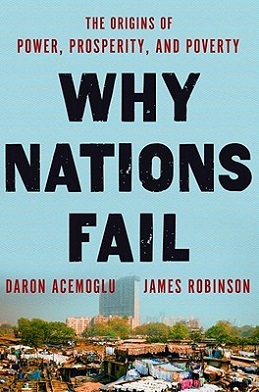
Why Nations Fail: the Origins of Power, Prosperity, and Poverty, by Daron Acemoglu and James Robinson. I spoke of the explanatory power of this remarkable book in an earlier post on democracy. The timing of its coming into my life was a bit random: I saw it sitting on the bookshelf of the drummer in my band about a week after Donald Trump’s 2024 victory, and I guess I was sensitized to the title. And, knowing John to be a well read guy–one of the two best-read drummers I’ve ever played with–I figured I would give the book a spin. Acemoglu and Robinson are two-thirds of a Nobel prize-winning team of economists for their work studying “the importance of societal institutions for a country’s prosperity,” to quote the The Royal Swedish Academy of Sciences. And this book, which struck me as both readable and magisterial in its scope, has helped me more than anything I have read before to articulate why democracy delivers peace, happiness, prosperity, and well-being better than any other form of government yet tried.
In a time when many Americans on the political right are growing fascism-curious (when they are not out-and-proud tiki torch-carrying fascists); and in a political moment when some on the left are so committed to ideological purity around questions of race, gender, Israel, and capitalism that they would rather lose elections than work with centrists, I found this book wise, humane, and ultimately hopeful. I hope more of my fellow Americans will read it.
 The Subway Test
Thanks for the book recs, I’ll have to check out why nations fail. And you’re right, if we’re gonna do this, we have to go hard and be strategic.
LikeLiked by 1 person
It took me several years to admit to myself that the restoration of democracy in the US is a long term slog. Why Nations Fail is wonderful, and I hope you love it. Reading it now, it’s kind of sad to see how much has changed in the US since 2012 when the book was written.
LikeLiked by 1 person
IDK how long it’ll take to bring things back to the way they were even a year ago. UGH
LikeLiked by 1 person