
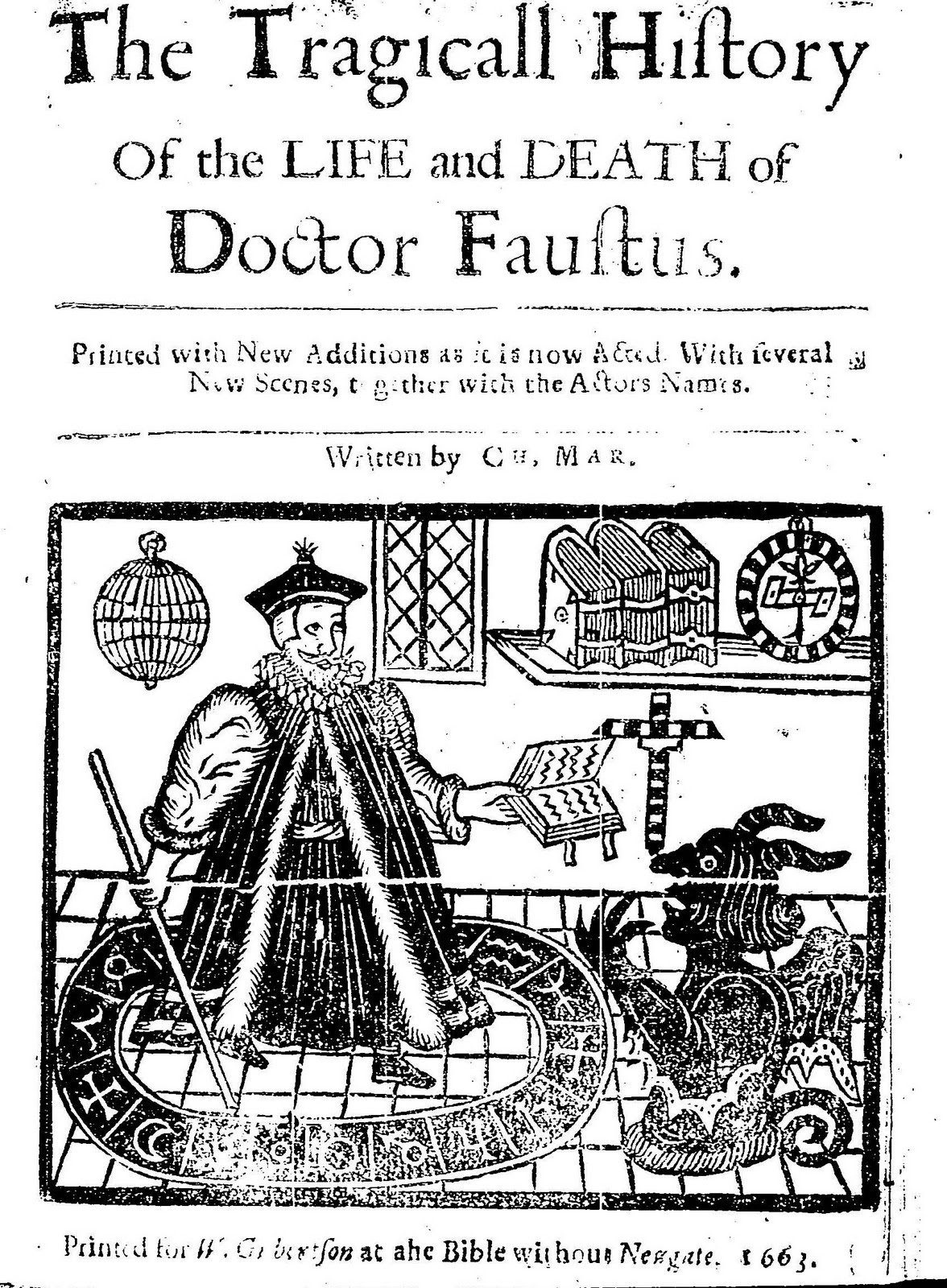
My wife and I went out last weekend to see a Canon Shakespeare Company production of Marlowe’s Doctor Faustus on a whim. I loved that a small scrappy company was taking it on—I had never seen the play, though I once taught the text at my college 20+ years ago. It was wonderful to watch nine actors with little more than a stage dagger and a bunch of borrowed library books for props conjure up this Renaissance classic in a theater called, appropriately, The Wyrd Hut. It was a very Portland experience.
While I often classify Marlowe and Shakespeare together because of the period in which they wrote, every time I actually encounter a Marlowe text, I am reminded that he is no Shakespeare. Comparing the two feels to me a little like comparing Georg Phillip Telemann with Johann Sebastian Bach: they were contemporaries and worked in the same stylistic language, but the depth of Shakespeare’s characters is simply of a different order than Marlowe’s.
Still, for as clunky as some of the characterizations and plot elements are in Doctor Faustus, I realized only on later reflection how perfect that play is for these times. Faustus, the German medieval genius who has grown weary of all the books and fields of knowledge that litter his desk, has decided that his real future is in magic. Why not summon the devil? Why shouldn’t he pledge his soul to Lucifer in exchange for unlimited magical power?
Sound familiar? I was reminded the next morning of Sam Altman’s infamous 2015 quip (which was apparently not a joke) “AI will probably most likely lead to the end of the world, but in the meantime, there’ll be great companies.” It’s easy enough to dredge up similar self-regarding twaddle from Altman’s nemesis Elon Musk: “In less than 20 years, working at all will be optional… like a hobby pretty much…” and “If AI has a goal and humanity just happens to be in the way, it will destroy humanity as a matter of course.”
Faustus shows the same mix of (apparent) brilliance and extreme lack of introspection. And his use of the powers that Mephistopheles lends him has the same disconnect between lofty goals and tawdry, even ridiculous, triviality. Faustus’s dream is to rule the world, to remake reality for his purposes:
FAUSTUS. How am I glutted with conceit of this!
Shall I make spirits fetch me what I please,
Resolve me of all ambiguities,
Perform what desperate enterprise I will?
I’ll have them fly to India for gold,
Ransack the ocean for orient pearl,
And search all corners of the new-found world
For pleasant fruits and princely delicates;
I’ll have them read me strange philosophy,
And tell the secrets of all foreign kings;
I’ll have them wall all Germany with brass,
And make swift Rhine circle fair Wertenberg;
I’ll have them fill the public schools with silk,
Wherewith the students shall be bravely clad;
I’ll levy soldiers with the coin they bring,
And chase the Prince of Parma from our land,
And reign sole king of all the provinces;
Yea, stranger engines for the brunt of war,
Than was the fiery keel at Antwerp’s bridge,
I’ll make my servile spirits to invent.
And yet, once he has the “servile spirit” of Mephistopheles to do his bidding, much of the action has all the gravitas of a Three Stooges short: Faustus becomes invisible so that he can steal the Pope’s hat; Faustus places cuckold’s horns on a mouthy knight; Faustus presents Emperor Charles V with a deepfake of Alexander the Great and his paramour.
And by the end? This brilliant doctor who once dreamed of liberating his country and altering the course of the Rhine has decided to enter into a romance with an illusory Helen of Troy. I am reminded of all of us LLM users in this moment, contemplating a servile spirit that will “read [us] strange philosophy,” unless of course we just want to use all that water and electricity and compute to cook up an AI girlfriend instead.
No spoilers (or no more spoilers), but the play doesn’t end well for Faustus. I’m more guardedly optimistic about how our Mephistophelean AI servants will treat us, as well as how the world may improve for all humanity over time. But we’d be wise to look to Faustus, that brilliant, self-deluding renaissance nerd who sold his soul and got nothing real in return for it.
 The Subway Test
Hey Joe, long time no see! You’re so lucky to live where there is live theatre! I would love to see a play again someday 😌
LikeLiked by 2 people
Carla! Lovely to see you on this post! You’ll have to make the 56-hour drive south sometime…
LikeLiked by 1 person
No biggie hey?! 56 hour road trip 😂
LikeLiked by 1 person
it’s so sad that we have access to AI and that it could do so much god but here we are, using them for stupid crap and sucking up all the electricity and water.
LikeLiked by 3 people
I guess we’re still human, and we want to use AI for stupid human things (among other, more farsighted purposes)…
LikeLiked by 1 person
I loved that play; never saw it performed though; disturbing connections though, as you point out, with the present ; thanks for visiting Joe and leaving your mark 🙂
LikeLiked by 1 person
My pleasure, John–thanks to you as well!
LikeLiked by 1 person
Long time no see you. Welcome back.
Faustus is a great play I agree, for a long ago memory, and I’m here impatiently waiting g fur the raise and ultimately fall of AI😉
LikeLiked by 2 people
Thank you! It’s been a long couple of months 😬.
LikeLiked by 1 person
Excellent review of this play! Now I have to find Dr. Faustus and read it! (Makes note to also find production and see it.)
LikeLiked by 1 person
Thanks for the good word! It’s easier to find a copy to read than to track down a production of it!
LikeLiked by 1 person
Very nice
LikeLiked by 1 person
Thank you, Kashmir!
LikeLike
Need More On this Play, you have written it nicely!!
LikeLiked by 2 people
Thanks so much for reading, Aryan!
LikeLike
Well, Goethe’s Faust is different; he has a connection to his inner world because he knows his inner conflicts. And Faust is saved in the end. In the 17th century, the church’s influence was so strong that Marlowe’s Faust couldn’t have a happy ending.
For us, the parallels between AI and Marlowe’s Faust are not convincing. The historical gap is too big. Marlowe’s Faust was written around 170 years earlier than Goethe’s Faust, and you can see the differences. Faust isn’t damned any more. And the time gap to today is nearly 430 years.
The Fab Four of Cley
🙂 🙂 🙂 🙂
LikeLiked by 4 people
Thanks for reading! It’s been a while since I read Goethe’s Faust, but yes, my recollection is that he is a more sympathetic character than Marlowe’s Faust. I do continue to believe, though, that Marlowe’s play has something to tell us today. Best–Joe
LikeLiked by 1 person
Pingback: The Devil in the Machine – Tecnocibernético
Faust: “I desire to know everything.”
ChatGPT: “Excellent. First, create an account.”
Faust: “What must I sacrifice?”
ChatGPT: “A password containing one uppercase letter, one number, one symbol, and your immortal soul.”
LikeLiked by 2 people
You have to enter it twice to make sure the immortal souls match.
LikeLiked by 2 people
Perhaps you could become what you see or be a creator whom is not a critic. Would you fantasise with others beyond whom you think to be among all your relations and tools onto other bonds where imagination is wealthier among and abound.
LikeLiked by 1 person
Hard to say–I’m not sure what I could become!
LikeLike
Great article!
LikeLiked by 2 people
Thank you, luca!
LikeLiked by 1 person
I think the essay deserves a critical comment because it presents an interesting but somewhat dramatic comparison between artificial intelligence and the Faustian bargain in Doctor Faustus. I found the analogy effective because it made me reflect on how powerful technology can reveal not only human intelligence, but also human ambition and the superficial ways people sometimes use that power. However, I also believe the argument could be more balanced. AI should not be viewed only as a dangerous or almost demonic force, because it can also be useful in education, creativity, communication, and problem-solving. From my point of view, the real issue is not simply whether AI is good or bad, but how we choose to use it, who controls it, and what values guide its development.
LikeLiked by 1 person
Thank you for your thoughtful response! I agree that AI is a much more complex issue than can be captured in a simple “AI good “ or “AI bad” statement. One of the things I love about art, though, is the way it invites us into contemplation through the presentation of characters’ extreme behavior. And here I was happily surprised at how timely this 400+ year old play was. Thanks again for reading and commenting!
LikeLike
Thank you! I really appreciate your insight. I agree that art has a powerful way of making us reflect on complex issues through extreme characters and situations. It’s fascinating how a play written over 400 years ago can still feel so relevant today.
LikeLiked by 1 person
Joe congrats!!!! You made it to the WP Freshly Pressed! Of course you’re all cool about it and didn’t mention it. When i landed here i told everyone i know!!
LikeLiked by 7 people
Oh, I am the opposite of cool about the 1000 likes, though. I just found out about that! Thanks so much for the good word, Carla!
LikeLiked by 1 person
So cool but very deserving 👏🏽👏🏽
LikeLiked by 1 person
Pingback: One Thousand | The Subway Test
Brilliant. Studied this play in college but hadn’t thought about it in a long time and had forgotten the mundane and silly ways Faustus used his power. Surreal how little has changed in human behavior.
LikeLiked by 4 people
I’d forgotten that, too–and it’s really the best part of the play. Thanks for your comment!
LikeLike