Today, after a peer critique of the fifth or sixth fantasy story we’ve seen this quarter, I asked my fiction writing students how many of them were into fantasy. All but three of them raised their hands.
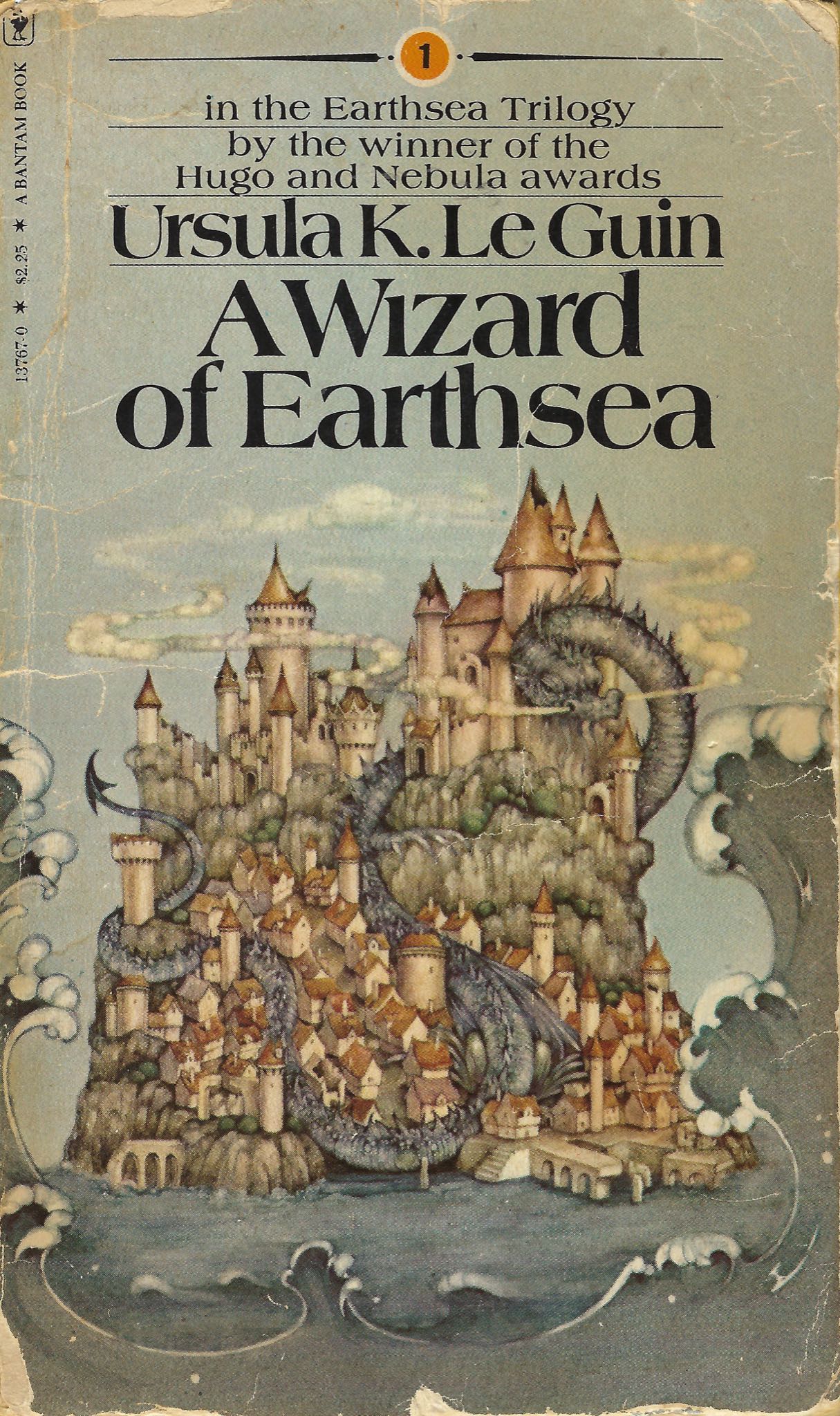
Then I asked how many of them had read A Wizard of Earthsea. Not one of them had.
Every once in a while, I’ll wonder what I’m doing, what inner problem I’m attempting to solve by working at a community college. Then I’ll have a moment like this, and I’ll realize that if my only contribution to my students’ lives is that I turned a few of them on to Usrula Le Guin–a woman who wrote practically all her books just a couple miles away on Thurman Street in Portland–I will have done something good with my life.
And you, dear reader, do you like fantasy? Have you read A Wizard of Earthsea? If you haven’t, go pick up that little book and check it out: you’ll see something that isn’t a hundredth as famous as Lord of the Rings, and which didn’t make a thousandth as much money for the author as Harry Potter did for J. K. Rowling, but Earthsea is better than both of them. Read it, and then contend with your desire to sue J.K. Rowling for plagiarism.
And as a bonus, if you aspire to be a fantasy or science fiction writer yourself, read just the first paragraph of A Wizard of Earthsea and see how much Le Guin accomplishes without a scintilla of infodump. What’s a dragonlord? you may ask as you read that first paragraph, What’s an archmage? The answer is who knows? It won’t matter, because you’ll already be hooked.
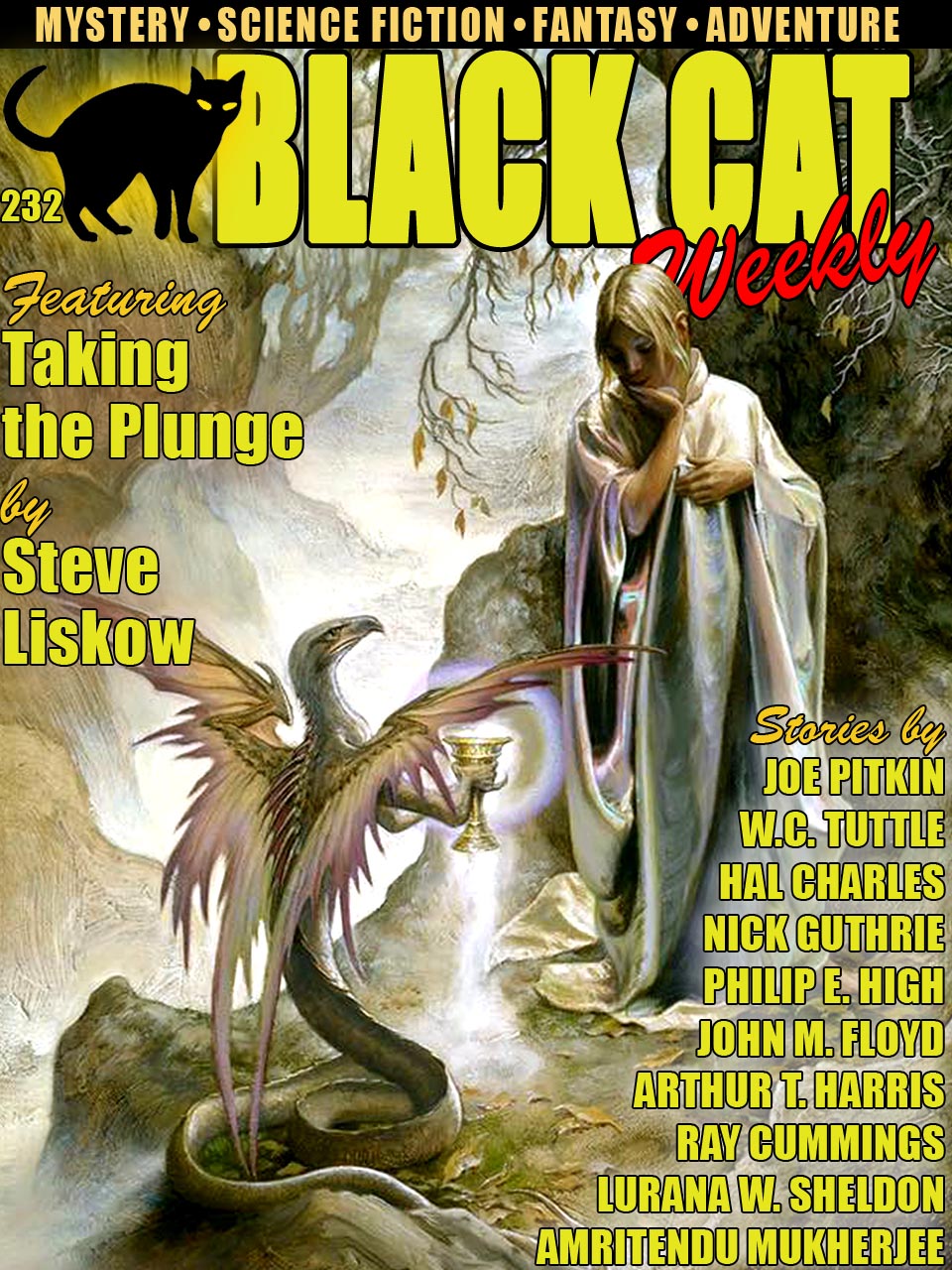
I’m pleased to announce that I have a new story, “Dryad,” dropping tomorrow in the excellent speculative fiction magazine Black Cat Weekly. It’s my first fantasy publication in some time, as well as my first story in a long time from the John Demetrius cycle that I have been writing on and off for years.
To be honest, it’s been a while since I’ve had any short fiction at all come out: my last published short story before “Dryad” was “Nomenclator of the Revolution” two and a half years ago (to be fair, I did publish a novel and complete another novel in that two and a half year space–I just wasn’t working on short fiction as much). This is my first date with Black Cat Weekly, but they have been wonderful to work with, and I’m in love with the cover art, by the late, great Steve Hickman. If you want to get your dark fantasy on, I hope you will check out “Dryad!”
I was invited recently to present a workshop at one of Oregon’s wonderful creative writing conferences–the Compose Creative Writing Conference at Clackamas Community College (perhaps the hosts tried to come up with a seventh word starting with c- for the title, but six must have been all they could fit in). After the honor of being invited wore off, I realized that I would have to actually, you know, present something at the CCWC at CCC.
I decided to present a session on reducing infodump in speculative fiction. Did I choose this topic because I’ve been widely praised for my taut, sleek stories? I wish. Actually, if anything the opposite is true: during the early years of my fiction career, I got so many rejections along the lines of “this story is well-written, but it takes forever to get to its point. There’s so much infodump here that I was barely able to get to page 8.”
The best thing I can say about infodump in my writing is that editors don’t complain about it in my stories nearly as often now. So I figure that I’ve either learned to deal with it or editors are just tired of giving me notes on it.
As you probably know already, infodump refers to bogging down the flow of a story with tedious explanation. And, while writers of any genre can fall into the habit, it’s an especially common problem in speculative fiction. If you’ve ever read a bad fantasy novel (or watched a bad sci fi movie), you have surely seen some infodump along these lines:
Scientist: I sequenced the DNA sample you brought me. Whoever provided it has some snips that I’ve never seen in a human genome before.
Captain: Snips?
Scientist: ‘Single nucleotide polymorphisms.’ As you know, captain, all sexually reproducing creatures on Earth–including humans–inherit two copies of each gene, one from the mother, and one from the father. These genes determine everything from eye color to explainexplainexplain continue explaining for four pages explainexplainexplain I hope you did well in middle school biology…
For me, infodump is even worse in fantasy than in science fiction. In SF, there’s at least the possibility that what’s being infodumped actually will teach you something real about how planetary motion works or what the principle of competitive exclusion is. In fantasy, the infodump often amounts to nothing more than 20 pages of the author’s fever-dream journal entries about a fictional queen who lived 800 years before the story takes place and what she did to curse the elven sword that is the McGuffin for this whole heptalogy of novels…
What causes infodump? Why should you be wary of the phrase “as you know” in your writing? And how do you reduce infodump in your novel? Well, if you want the whole story, come see me at the CCWC on Saturday the 18th! Or, if you’re not a Portland person, drop me a line: I’m always happy to talk F/SF with book clubs, writing groups, bookish nerds, random drunks, and people on a secret mission.
For now, I’ll just say that two factors that contribute to infodump are 1. writers’ mistrust of the reader’s ability to follow along, and 2. writers who get lost for hours (or months, or decades) in worldbuilding before they ever get around to actually writing their story.
I may say more on the subject soon, but as you know, I have been working on reducing my infodump.
I’m pleased to announce that my story “Nomenclator of the Revolution” is now appearing in Boston Review. The folks at BR did a lovely job with the layout and the drop quotes, and I couldn’t be happier that the story is available to be read.
From the set of Guillermo del Toro’s Pinocchio, another tale about the relationship of language to authoritarianism. Photo Joe Pitkin.
And here’s a little secret about the story for you all, beloved blog readers: the short poem in the middle of “Nomenclator” is one of my favorite poems that I have ever written, and it’s a piece that I found impossible to place (in fact, I stopped trying to publish any of my poems after receiving about thirty rejections of that one). I remain convinced that it’s a good poem; hopefully it has a better fate as the work of a fictional character in this story.
I’ve spent the last few weeks drafting two new short stories and workshopping a third, so I hope that “Nomenclator” isn’t the last short story you will see from me. However, given the mystical journey of getting stories placed and published, “Nomenclator” may be my last published short fiction for a few months. I hope you enjoy it!
In a post of mine from a couple of weeks back, I mentioned as an aside my preference for the gritty, noir quality of sword & sorcery fantasy over the flash and bombast of high fantasy. As I’ve reflected on that offhand comment over the last days, I’ve wondered precisely what I meant by it. And I’ve wondered, both as a fantasy writer and a teacher of a fantasy and science fiction literature class, whether I even know what I mean by the terms high fantasy and sword & sorcery.
I’m not the only one to struggle with what seem like ill-defined terms. As the Wikipedia page on low fantasyargues, the distinction between high and low fantasy rests on where the action takes place: if the fantasy story takes place on another world (or a hidden world within this world), then it is high fantasy; if the action takes place in this world, then it is low fantasy. But this is hardly everyone’s definition: for many, the distinction between high fantasy and low fantasy involves the role of magic and morality in the story, not the question of where the story takes place. As the same Wikipedia page helpfully explains, “Thus, some works like Robert E. Howard‘s Conan the Barbarian series can be high fantasy according to the first definition but low fantasy according to the second.”
Fafhrd and the Gray Mouser have the same problem. . .but high fantasy or not, Dark Horse’s omnibus edition is coming soon!
So what did I mean when I said I preferred sword & sorcery to high fantasy? Well, here’s what I talk about when I talk about high fantasy: the world of the high fantasy novel or game is a cosmic battleground between the powers of good and evil. Magic is common, perhaps ubiquitous. The protagonists of the story or game–who are good–forge alliances and fellowships with other good creatures (often, and maybe usually, including elves, who often, maybe usually, represent an extreme incarnation of western beauty standards), who are locked in a mortal struggle with a host of evil creatures in the service of an even more evil master. If it sounds like I am describing The Lord of the Rings, I am: Tolkien’s work is usually held up as the type specimen of high fantasy. Many of the great high fantasy franchises you may be familiar with–like J.K. Rowling’s Harry Potter, The Inheritance Cycle of Christopher Paolini, Lloyd Alexander’s Chronicles of Prydain, and the Forgotten Realms setting of Dungeons & Dragons–are influenced by Tolkien’s cosmology. Some are downright derivative, little more than Tolkien reskins.
Behold, good folk, your hot ally has arrived. Legolas cosplay at Chicago Comic Con 2014, Photographer Gabbo T
Sword & Sorcery, by contrast, involves fewer world-spanning struggles between good and evil; instead, sword and sorcery focuses more on the trials and adventures of a single adventurer or a handful of them. Those adventurers are not “good” in the sense that high fantasy uses the term. Rather, “heroes” of sword & sorcery fantasy are typically a bundle of contradictions, a mix of noble and base impulses–often, much like the characters of hard-boiled detective fiction, they are just conflicted people trying to get a dirty job done. In short, sword & sorcery protagonists are a lot more like us, at least on the inside.
Magic, too, is less flashy, and far less common, in the typical sword & sorcery story. Unlike high fantasy, where in many franchises practically everybody can shoot lightning bolts and fly about like the superheroes of an MCU movie, magicians in sword & sorcery are rare, misunderstood, and mysterious figures. They are often sinister or at least morally compromised, as though magical power itself involves a deep and unsavory moral choice. They are far likelier to act as antagonists in the story, representatives of a shadowy corruption that it’s the protagonist’s job to resist.
Many of the classic heroes of sword & sorcery literature–Conan, Fafhrd and the Gray Mouser, Elric–had their heyday over forty years ago. And it’s probably been since the 1980s that I really read those books voraciously. There is no doubt that some of the writers’ underlying assumptions about gender and race have not aged well at all (of course, the same has certainly been said, fairly or not, about Tolkien’s work). In calling for a renaissance of sword & sorcery, I’m not arguing for a return of the passive, white-skinned, Frazetta-drawn “chainmail bikini” damsel in distress to fantasy literature. Sword & sorcery is cool for a totally different set of reasons, reasons which I believe are separable from the socially retrograde ideas of some of the original sword & sorcery creators.
Rather, what sword & sorcery offers, and what I wish Dungeons & Dragons would take more seriously, is moral complexity. Instead of simplistic good-vs.-evil alignments and the racial essentialism of “savage orcs” and “cultured elves,” I’d like to see more D&D that presents players with competing visions of the good, with life a series of tradeoffs to be made rather than a body of questions that one gets right or wrong. I’d like to see a magic system where the costs of devoting oneself to magic–or even wielding a magic item–are high enough that not every player will pursue magic power.
Dungeons & Dragons isn’t really built around those ideas. Too much about alignment and race and magic in D&D seem to assume a high fantasy worldview, and most D&D creators and players clearly seem more comfortable in a Tolkien-inflected high fantasy world. But one of the things I love about the current edition of D&D–and which I hope will continue in the coming version–is the game’s open environment for modifying, for mixing-and-matching. D&D today is more like a great set of cookbooks than a list of prescriptive instructions. And, just as it would be a lot of ridiculous work to prepare every recipe in a cookbook at the same time, most good dungeon masters know not to use every class and race and monster and option presented in the D&D books, at least not at the same time. One can make a sword & sorcery campaign in D&D; it’s just a matter of removing a few of the million options presented in the books.
There is a lot that I still love about high fantasy. I still attend Tolkien’s Birthday Bash every January at McMenamins Kennedy School in Portland to watch 6-13 straight hours of LOTR movies. But I prefer to think of the world we live in as something other than a cosmic battle between pure good and pure evil. And I like my storytelling and games, no matter how fantastic, to say something about the world as it is, not the world that black-and-white thinkers imagine that it is.
Followers of this blog are familiar with my deep Dungeons & Dragons nerdity. I certainly felt the nerd in me rising over the last couple of weeks during my first ever trip to Spain: it’s hard not to be reminded of D&D when there is an ancient castle on every hill and a painting of knights in every church.
But one of the greatest D&D connections on this trip was unexpected to me. We managed to spend two glorious, sweltering days in Seville, “the frying pan of Spain,” and I was brought face to face with the literary roots of the thieves’ guild.
Skyline of Seville from the Giralda Tower. Photo Carlyn Eames
Many people, even non-D&D players, are aware of how many ideas from D&D were lifted whole cloth from Lord of the Rings: elves, dwarves, orcs, halflings, rangers. But the idea of the thieves’ guild–which is so central to D&D’s concept of the rogue–has no antecedent in Tolkien’s work. So far as I know (and please correct me, fantasy nerds, if you have a better story) the original thieves’ guild in fantasy comes from the work of Fritz Leiber, one of the titans of swords and sorcery fantasy. (By the way, I far prefer Leiber’s gritty, noir-ish vibe of swords and sorcery fantasy to the Wagnerian bombast of high fantasy–but that’s a subject for another post). Leiber’s odd-couple duo of Fafhrd and the Gray Mouser often had to tangle with the thieves’ guild of Lankhmar, and so many of the details of that story made their way into D&D (and into Terry Pratchett’s Discworld, and The Elder Scrolls, and Assassin’s Creed, and a thousand other fantasy franchises). By the way, Dark Horse is publishing a new omnibus of Fafhrd and the Gray Mouser in early 2024–I’m very excited to get my hands on it!
But where did Leiber’s concept of the thieves’ guild come from? I don’t know, and it may be impossible to know, but it’s almost certain that Leiber pulled the idea from earlier literature rather than from any historical criminal organization (which were generally gangs rather than guilds in the D&D sense).
The earliest literary treatment of the thieves’ guild that I am familiar with is Cervantes’ delightful story “Rinconete and Cortadillo,” which follows two likeable young rogues to the city of–you guessed it–Seville, where they get recruited into a hilarious (and oddly pious) thieves’ guild. Seville was, in Cervantes’ day, a kind of boom town and very much a city on the make, swollen with silver that the Spanish crown had plundered from the Americas. For about a hundred years or so, it was probably the wealthiest city in Europe (as well as a pretty gritty place).
The Seville tomb of a far less likeable rogue. Photo Carlyn Eames
When we visited, it was just charming and hot. But everywhere we looked, there were plaques memorializing events that appeared in Cervantes’ life and in “Rinconete and Cortadillo,” from Cervantes’ years in debtor’s prison (ironically, there’s a bank on the site now) to the spot on the cathedral steps where Cortadillo steals the sacristan’s handkerchief. We had our hotel room in the Casco Antiguo, right in the neighborhood where Rinconete and Cortadillo had their territory in the story. The whole experience lined up Cervantes with Leiber with Dungeons & Dragons in my soul like a wonderful convergence of nerdly planets.
I’ve been working on novels for so many months now that having one of my short stories picked up seems as rare as an eclipse. I suppose that when you only have three short stories that you are trying to get placed, acceptances will be rare events by definition. But I did have good fortune with one of my stories recently–a little tale that is odd enough that a few editors didn’t know what to make of it. Sometimes when a story of mine has been rejected many times, I take a long look at the piece and decide that it’s just not my best work. Other times, though, I take a long look after many rejections and I come away thinking this is a good story, and someday somebody will see that.
My latest story, “The Wingbuilder,” fits into the second category. It’s an homage to Borges (especially “The House of Asterion”), as well as a love-letter to video games like The Legend of Zelda and to the classic Jim Henson movie The Labyrinth. Now that I think of it, it’s also a meditation on solitude that might speak to the condition of some isolated, quarantined readers. It appeared in the estimable magazine Aphotic Realm, and you can see it here. I hope you enjoy it.
I was invited recently to join Curious Fictions, a platform for short fiction on the web. And, while I’m likely to keep writing for the magazine and podcast circuit, Curious Fictions does seem like a sweet place for me to drop my stories, especially those pieces that are hard to find elsewhere.
As I was thinking about an inaugural story for my Curious Fictions profile, I immediately landed on one of my favorite first pieces: “So-Sz.” I first sent the story out for publication ten years ago this month. The story appeared in a wonderful little web magazine, 5923 Quarterly , which folded not long after, perhaps coincidentally. “So-Sz” has been out of print and unavailable since then.
I’ve always had a soft spot for this story. It’s one of my earliest efforts at short fiction that struck me as mostly successful. And, while I am a better writer today than I was ten years ago, there’s not a great deal I would change about the piece.
I was also reminded of “So-Sz” by the most recent Laika movie, Missing Link. Hopefully you’ll see some similarities (and differences) as well.
So, without further ado, I invite you to click over to Curious Fictions to see the 10th Anniversary Edition of one of my favorite journeyman efforts: “So-Sz.”
Photo Credit: Steve Rotman; Art Credit: Some Awesome Graffitist
I’ve really been getting into ambient music lately, and I’m noticing that many ambient artists–maybe most of them–have stage names. Loscil, Biosphere, Oöphoi–many of these folks name themselves as though they were themselves science fiction characters.
I’ve also been wondering a lot about identity in my writing, whether the fact that I’ve been published many times before makes it likelier for new editors to accept a story of mine for publication (it doesn’t seem to–I’m definitely an opening act as far as magazines and podcasts are concerned). But I do like the idea of my writing having an existence which is separate from my gender and ethnic and religious and sexual identity.
If fantasy and science fiction writing were more like ambient music (or if I thought it would accomplish something for me to take on a mysterious, Banksy-esque persona), I would choose the name Gravitrope or Pánfilo for my nom de plume. Both of these names resonate with me for personal reasons: for much of my thirties I was in a band called The Gravitropes, and I feel a kind of spiritual affinity for gravitropism, which is the ability of sprouting seeds to send their first shoots away from the pull of gravity and their first roots towards it. Pánfilo is a wonderful old Mexican name pulled from ancient Greek; the name means “lover of all.” I picked the name for one of my alter egos in my next novel, Pacifica.
One might wonder whether my taking on a writing name like Gravitrope or Pánfilo would be an attempt to game the publication system of speculative fiction. To their great credit, fantasy and science fiction editors are actively working to publish voices from a full diversity of genders, ethnicities, and sexualities. Would a writer with a pen name that seemed less white and male get a little more attention from editors today? Inasmuch as I hold the most privileged identities on the planet–I definitely present as white, male, straight, cis-, Christian, and it’s not worth quibbling over ways that not all of those labels are perfectly, scrupulously accurate when the labels are definitely more true than not and when they are really markers of social privilege that I’ve held my whole life–it’s fair to say that if I took on a name that suggested a different gender, or genderlessness, or a different ethnicity, I would be dismissed as a poseur. I also don’t want to do anything that will make it harder for people from the full spectrum of humanity to get greater attention for their work. And, if there’s something I can do to help others from that fuller spectrum get published (short of refraining from writing myself), I’ll do it.
Having said that, there is something liberating in sending a story to a magazine under a different name, or to a magazine that uses a blind submissions process (i.e. you send the story in anonymously and the editors only learn who you are if they decide to publish your work). I don’t know whether I’ve had any better luck–or worse luck–getting published in blind-submission venues than in others. But I do like the prospect of my writing being read on its own terms, irrespective of who I am or who editors think that I am. I’d like to imagine my work reaching across boundaries of ethnicity and gender and history to tap at the bedrock of the human condition–in other words, I hope that my stories might function as works of art rather than simply as statements about what it means to be white and male in America.
That’s a fantasy, I know. But hey, I’m a fantasy writer.
And you? If you were to write sci fi under a pen name, what would you choose?
One of my literary heroes, Ursula K. Le Guin, died yesterday after a long illness. In her careful, forceful prose, and in her far-reaching moral vision, Le Guin expanded for me the concept of what a science fiction and fantasy writer could be. She was not the first great fantasy writer, but she was the first fantasy writer I encountered whose work had the feel of a high-literary novel. I’ll miss her.
Someday I’ll write a longer appreciation of her work in which I try to explain how meaningful her writing has been for me. For now, I’ll simply reprise the last essay I wrote about Le Guin, a post about her marvelous book The Lathe of Heaven.


 The Subway Test