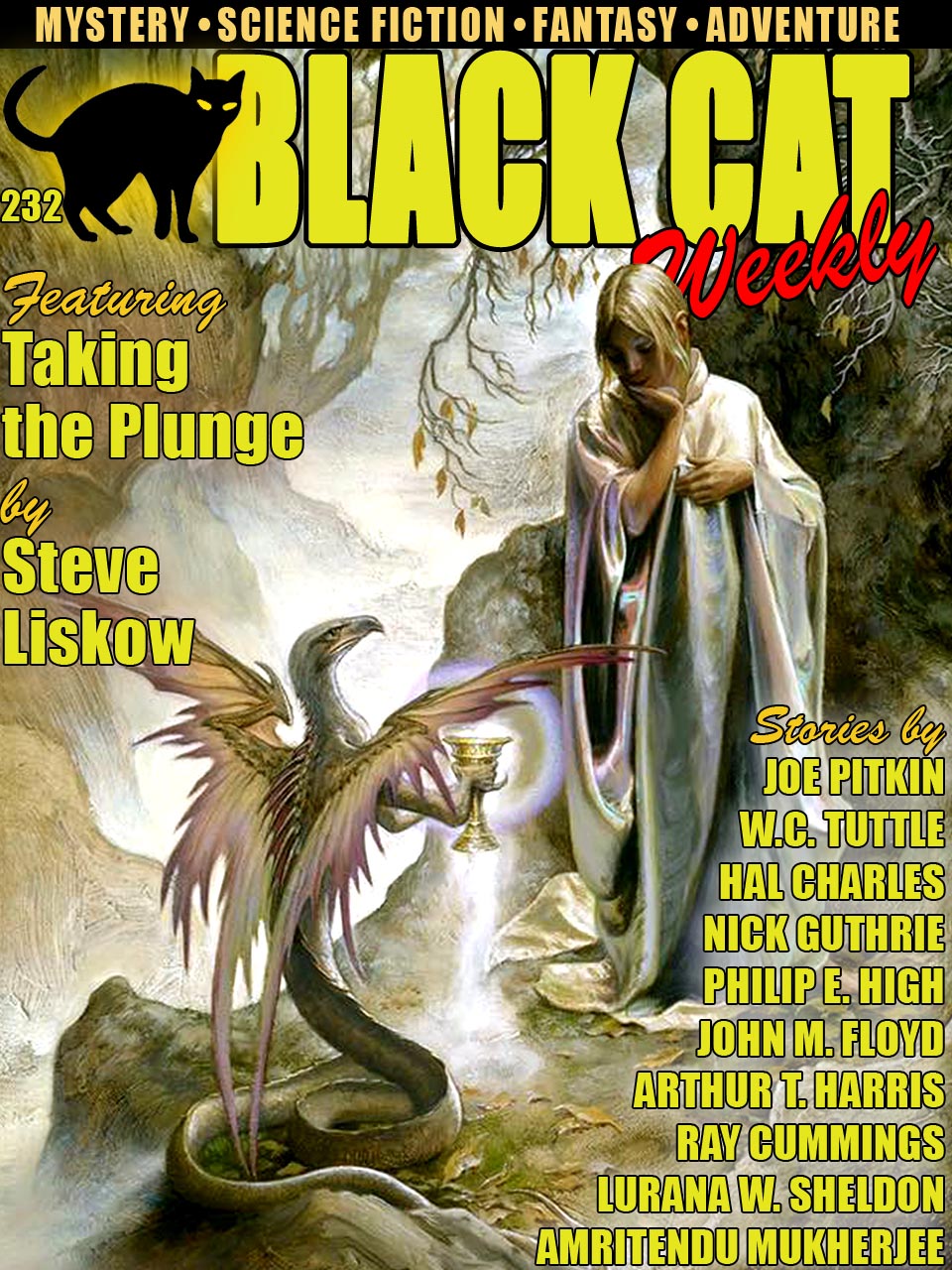
I’m pleased to announce that I have a new story, “Dryad,” dropping tomorrow in the excellent speculative fiction magazine Black Cat Weekly. It’s my first fantasy publication in some time, as well as my first story in a long time from the John Demetrius cycle that I have been writing on and off for years.
To be honest, it’s been a while since I’ve had any short fiction at all come out: my last published short story before “Dryad” was “Nomenclator of the Revolution” two and a half years ago (to be fair, I did publish a novel and complete another novel in that two and a half year space–I just wasn’t working on short fiction as much). This is my first date with Black Cat Weekly, but they have been wonderful to work with, and I’m in love with the cover art, by the late, great Steve Hickman. If you want to get your dark fantasy on, I hope you will check out “Dryad!”
One of the most celebrated poets in America right now, Danez Smith, came to my college to read last week. My job, as a utility infielder on Clark College’s creative writing committee who happens to live near the airport, was to pick up Danez and drive them to their hotel downtown.
The pick-up was a breeze–Danez has clearly done this kind of thing many times–and I was pleased when they got in the car at how easygoing they seemed, as well as how I was not coming off (in my own mind, anyway) as too star-struck.
As I drove, we chatted about America’s two main Portlands–Danez is living in Portland, ME right now–and they pressed me on my mixed feelings about my own Portland (i.e. a great American city driven to a terminally twee nonconformity by, among other things, the show Portlandia). We talked about the amazing restaurant town that Portland, OR, has become, and I was overjoyed to hear that Danez would be eating at Gado Gado, a brilliant Indonesian place in my neighborhood.
And then, while describing to Danez what the gado gado dish consists of, I took the wrong exit on to I-84–instead of the westbound, towards downtown, I took the eastbound, towards Utah. I’ve driven from the airport to I-84 hundreds of times, so I am not sure what made me take the wrong exit just then: maybe my poor memory for foods was taxing my brain as I tried to remember what was in gado gado, or maybe I was more star-struck than I realized.
In any event, the wrong exit I took was one of the worst wrong exits I could take in the whole benighted Portland metro freeway system. Exits do exist on I-84 eastbound between Portland and Utah, but really there are a lot fewer than you would think. I got off the freeway at 122nd street and started making a loop down to the butt end of Sandy Boulevard, where I knew I could get back on to I-205 and thence to westbound I-84. We talked about family, about the trouble that comes for our loved ones at the end of their lives (and, by extension, for us one day). I navigated expertly after my breathtaking blunder back to the freeway, got us back on, and we were back on the track. Danez looked up at one of the exit signs and said “Wait, wasn’t that where we got off the freeway last time?”
Indeed it was, Danez Smith, indeed it was. I’ve just taken 15 minutes of your life force at the end of a very long travel day for you. Forgive me.
The next day, Danez read like a dream. They came up in the slam tradition, and they have a theater background to boot, and it shows: each poem was like some incantation, a crazy pile-up of language that blew us all away. Part of me wished that I was one of the shell-shocked 19 year-olds from Intro to Literature sitting in the audience, encountering their first poetry reading the way I took in mine from William Stafford in 1989. You poor suckers, I wanted to say to them, it’s never going to get better than this. If you go to a thousand more readings, you’ll always be thinking about this one.
Danez is a better and younger poet than me. I had to remind myself of something I tell my creative writing students every term to help them get past the anxiety and professional jealously that comes from reading the work of someone better than you: that both Jimi Hendrix and Neil Young were at Woodstock–in fact, they arrived together in the same hot-wired truck–and that not one of the 500,000 people at Woodstock would have said that Neil Young was the more talented guitarist of the two. But Jimi Hendrix’s greatness does not make Neil Young less great, and Neil Young is no less singular a talent just because he had to share the stage with someone as incandescent as Jimi Hendrix. (Of course, in this extended analogy, I am neither Jimi Hendrix nor Neil Young, but rather an accomplished and nearly unknown player like Dave Schramm or, even more aptly, like a member of the fictional band the Late Greats from the Wilco song).
Here’s Danez’s most famous poem, one they didn’t read last week, but one that will give you a taste of what we heard. Good Jimi Hendrix energy–we were lucky to catch it at Clark College, “The Harvard of Two-Year Colleges,” in scenic Vancouver, Washington:
The best blogger in the world, Kevin Drum, died last Friday after a ten-year journey with multiple myeloma. Though I never met him, I miss him terribly.
Kevin became the voice of the Political Animal blog at Washington Monthlyin 2004–that’s where I discovered him. And while I don’t remember the first time I took notice of his work, I’ve read him daily for at least 20 years, first at Political Animal, then at Mother Jones, and finally at his solo endeavor, Jabberwocking.
Kevin’s work was so thoughtful, so insightful, so wide-ranging and funny, that sometime around 2006 or 2007 I felt inspired to start a blog of my own. I learned almost immediately how hard it is to do what Kevin Drum did every day, multiple times a day. After a few weeks of putting up meandering, useless-to-anyone-but-me musings–maybe six or seven of them in total–I realized that I would never be able to do what Kevin did. In retrospect, the feeling was a little like that scene in the movie Trainwreck where Bill Hader is playing one-on-one basketball against LeBron James: the difference between what I was trying to do and what Kevin was doing was so great that it wasn’t even clear that we were playing the same game.
And now he’s gone. I can’t think of a political commentator in my lifetime that was more fair-minded, more intellectually rigorous, more even-keeled, more decent than Kevin. For 20 years, his mind has been indispensable to me. And, while I am reminded of the Charles de Gaulle quote “the cemeteries of the world are full of indispensable men”–a saying I first encountered in a Kevin Drum post–I regard with loneliness the prospect that we will all have to get along without Kevin’s incomparable gift from now on.
I once had dreams of writing witty, engaging content for this blog once per week. I guess I still nurse that fond hope. But obviously something about my strategy hasn’t been working so far: I believe this is only my fourteenth post this year.
The main reason for the slowdown is what it’s always been: my job. Teaching has been in many ways a wonderful career; in other ways, it has seemed like a wish I made on the monkey’s paw: I loved reading and writing, and so I thought that becoming an English major was a natural fit. And what better job for an English major than teaching community college English?
Little did I know when I was a 23 year-old teaching assistant that there would be weeks upon weeks of my job, year after year, where I would do nothing but read or write–and that none of that reading and writing would be for pleasure. I’ve probably read 20,000 student essays by this point in my career: many were thoughtfully written, and most were at least earnestly written, but not one of them was something I would have picked off of a newsstand shelf for fun. (Nor, to be fair, would my students have written any of them for fun). And every one of those essays, even the most slapped-together, carelessly constructed rush jobs, demanded that I write something real in response. By the time I get home most days, I barely have the mental energy to read the directions on a microwave burrito, much less read a novel, much less write one.
And yet, I can’t bring myself to quit teaching. I love community college students: I love their grit, their humor, their intellect, their disarming mix of cluelessness and commitment. I love seeing students ten or fifteen years later and hearing their excitement when they tell me that they still remember how to use commas around an appositive or that they never again started a conclusion with the words “in conclusion.” Often they remember things that I barely remember saying or things that aren’t really that important in the full analysis of what makes good writing. But some of what they remember is a kind of totem to them, and years later, they are better writers.
There are several weeks every term that I feel the fatal stroke or heart attack is just around the corner for me, that I’m just a day or two away from collapsing at the front of a classroom or dying with a stack of half-graded essays in my inbox. And then, every term (usually around finals week), the mental fog lifts again. I feel like I can go on for one more term, or maybe even for a whole year. I’m always reminded in those moments of the lines from the wonderful Jane Kenyon poem “Back,” which I believe she wrote about the lifting of a depression, but which I feel could apply to any teacher at the end of an academic term:
. . . I fall into my life again
like a vole picked up by a storm then dropped three valleys and two mountains away from home.
I can find my way back. I know I will recognize the store where I used to buy milk and gas . . .
Every day, I walk into class with the greeting “Hello, classmates!” or “Hello, knowledge seekers!” I try to present myself as though I were a wise, relentlessly optimistic trail guide leading them on their mystical journey through that ancient land of rhetoric. Some students surely must know that even thirty years into my career, I’m still faking it. But often enough, students take me up on what I’m offering: they follow along whether they realize or not what a sham all my optimism and confidence are. And some of them–many of them, most of them–finish up in a different place than where they started.
Portrait of the teacher by a beloved ENGL101 student in fall 2023.
Followers of this blog are familiar with my deep Dungeons & Dragons nerdity. I certainly felt the nerd in me rising over the last couple of weeks during my first ever trip to Spain: it’s hard not to be reminded of D&D when there is an ancient castle on every hill and a painting of knights in every church.
But one of the greatest D&D connections on this trip was unexpected to me. We managed to spend two glorious, sweltering days in Seville, “the frying pan of Spain,” and I was brought face to face with the literary roots of the thieves’ guild.
Skyline of Seville from the Giralda Tower. Photo Carlyn Eames
Many people, even non-D&D players, are aware of how many ideas from D&D were lifted whole cloth from Lord of the Rings: elves, dwarves, orcs, halflings, rangers. But the idea of the thieves’ guild–which is so central to D&D’s concept of the rogue–has no antecedent in Tolkien’s work. So far as I know (and please correct me, fantasy nerds, if you have a better story) the original thieves’ guild in fantasy comes from the work of Fritz Leiber, one of the titans of swords and sorcery fantasy. (By the way, I far prefer Leiber’s gritty, noir-ish vibe of swords and sorcery fantasy to the Wagnerian bombast of high fantasy–but that’s a subject for another post). Leiber’s odd-couple duo of Fafhrd and the Gray Mouser often had to tangle with the thieves’ guild of Lankhmar, and so many of the details of that story made their way into D&D (and into Terry Pratchett’s Discworld, and The Elder Scrolls, and Assassin’s Creed, and a thousand other fantasy franchises). By the way, Dark Horse is publishing a new omnibus of Fafhrd and the Gray Mouser in early 2024–I’m very excited to get my hands on it!
But where did Leiber’s concept of the thieves’ guild come from? I don’t know, and it may be impossible to know, but it’s almost certain that Leiber pulled the idea from earlier literature rather than from any historical criminal organization (which were generally gangs rather than guilds in the D&D sense).
The earliest literary treatment of the thieves’ guild that I am familiar with is Cervantes’ delightful story “Rinconete and Cortadillo,” which follows two likeable young rogues to the city of–you guessed it–Seville, where they get recruited into a hilarious (and oddly pious) thieves’ guild. Seville was, in Cervantes’ day, a kind of boom town and very much a city on the make, swollen with silver that the Spanish crown had plundered from the Americas. For about a hundred years or so, it was probably the wealthiest city in Europe (as well as a pretty gritty place).
The Seville tomb of a far less likeable rogue. Photo Carlyn Eames
When we visited, it was just charming and hot. But everywhere we looked, there were plaques memorializing events that appeared in Cervantes’ life and in “Rinconete and Cortadillo,” from Cervantes’ years in debtor’s prison (ironically, there’s a bank on the site now) to the spot on the cathedral steps where Cortadillo steals the sacristan’s handkerchief. We had our hotel room in the Casco Antiguo, right in the neighborhood where Rinconete and Cortadillo had their territory in the story. The whole experience lined up Cervantes with Leiber with Dungeons & Dragons in my soul like a wonderful convergence of nerdly planets.
I’ve had a long spell away from this blog while I was drafting my third novel, Pacifica. But now that Pacifica is (finally, after a thousand sighs) drafted, and as I prepare for the publication of my second novel, Exit Black, by Blackstone this year, I’m able to give a little more attention to this space. I’ve missed being here, and I’ve missed interacting with you through The Subway Test. I hope to connect with you a little more frequently in the coming months!
I’ve been working on novels for so many months now that having one of my short stories picked up seems as rare as an eclipse. I suppose that when you only have three short stories that you are trying to get placed, acceptances will be rare events by definition. But I did have good fortune with one of my stories recently–a little tale that is odd enough that a few editors didn’t know what to make of it. Sometimes when a story of mine has been rejected many times, I take a long look at the piece and decide that it’s just not my best work. Other times, though, I take a long look after many rejections and I come away thinking this is a good story, and someday somebody will see that.
My latest story, “The Wingbuilder,” fits into the second category. It’s an homage to Borges (especially “The House of Asterion”), as well as a love-letter to video games like The Legend of Zelda and to the classic Jim Henson movie The Labyrinth. Now that I think of it, it’s also a meditation on solitude that might speak to the condition of some isolated, quarantined readers. It appeared in the estimable magazine Aphotic Realm, and you can see it here. I hope you enjoy it.
I had the joy of watching 2001: A Space Odyssey on the big screen the first time in my life a little while ago. For those of you living near Portland, The Hollywood Theater purchased a 70 mm print of the film a couple of years back, and they show the movie to a sold-out house a couple of times every year. I had seen the film many times before on video–it’s one of the truly formative pieces of art in my life–but seeing it in a literally larger-than-life format impressed me deeply: the movie reminds me why I work in the genre of science fiction.
One of the most celebrated elements of the film has been its technological accuracy. Stanley Kubrick and Arthur C Clarke, working before CGI or the moon landing, were able to predict so many of the challenges and curiosities of living and working in space. As much as I loved Star Trek and Star Wars growing up, I always had the sense that those two franchises were more science fantasy than science fiction (especially Star Wars). 2001, by contrast, looked like some thrillingly-plausible documentary footage from a future just over the horizon.
But it is not the accuracy of the film that affects me so much now. Rather, 2001 is worth watching because of what Tolkien would have called its mythopoesis: its creation of a new mythology in which we could view our modern predicament. As much as any other work of art I can think of, 2001 gets at the painfully intermediate position of our species as part animal and part divine: the film is a 164-minute meditation on Hamlet’s musing: “What a piece of work is a man! How noble in reason! how infinite in faculties! in form and moving, how express and admirable! in action how like an angel! in apprehension, how like a god! the beauty of the world! the paragon of animals! And yet, to me, what is this quintessence of dust?”
(Another quote, just as apt, comes from Nietzsche’s Thus Spake Zarathustra, the book which also inspired the iconic theme music for 2001: “Man is a rope, tied between beast and overman—a rope over an abyss … what is great in man is that he is a bridge and not an end.”).
While the film is set in space in the near future, as realistically as Kubrick and Clarke could conceive of it, the setting is just as much a place of the inscrutable divine: in other words, its setting is really The Dreamtime, the Underworld, Faerie. Even though the US Space Program was deeply influenced in real life by 2001, the movie is closer to the mystical cave paintings of Chauvet or Lubang Jeriji Saléh than it is to the Space Shuttle and the International Space Station.
Of course, there are many elements of any piece of science fiction that won’t hold up well after 50+ years. In the case of 2001, Kubrick and Clarke seriously underestimated the amount of progress our species would make in some aspects of information technology, while at the same time overestimating the progress we would make in artificial intelligence and manned spaceflight. Those are easy mistakes to make, by the way: I can’t think of any science fiction before the 1980s that successfully anticipated the internet, and of course a movie made in 1968, the year before Apollo 11, would extend the logic of manned spaceflight out to regular orbital shuttles and populous moon bases and manned Jupiter missions.
But the beauty of 2001 is not how much the movie correctly predicted but rather how well it explores the timeless theme of what it means to be a human being. What strange gods called out of the darkness to our rude, frightened hominid ancestors to make us human? What awaits us if we can survive the deadly unintended consequences of our own ingenuity? In wrestling with those questions, 2001 is every bit as bottomless a work of art as Paradise Lost or Faust or the Popol Vuh. One can argue that there are no gods that made us, that the monoliths of the movie will never be found because they never existed in the first place. However, 2001 speaks to something very deep in our cultural DNA (and, for all I know, in our literal DNA): the yearning for our spiritual parents.
Two hundred years from now, if we somehow survive this dreadful bottleneck of overpopulation and ecological collapse, our descendants may be living in domed cities on the moon and Mars; we may be gliding in beautiful submarines through the oceans of Europa and Ganymede. We will still be looking for the monoliths.
About ten years ago, I submitted one of the first science fiction stories I had ever written to an anthology called 2020 Visions, published by the now-departed M-Brane Press. The editor, Rick Novy, was someone I didn’t know, but M-Brane had given me my first publication the year before, and I thought I would try with this new story about a plague carried by super-intelligent starlings.
Rick Novy didn’t take the story, but he gave me some excellent feedback–the piece had way too much infodump, and it took a very long time for the story’s action to get going. And he gave me a lead on another publisher: Stanley Schmidt, then-editor of Analog, might be interested in the story if I tightened it up.
Thankfully, Stanley Schmidt was interested in the piece once I had revised it, and “A Murmuration of Starlings” became the first of five stories that I’ve published in Analog. And it was through Analog that my work did get picked up for anthologies, and later how I was approached by an agent to option one of my stories for a movie.
I’ve published a lot more fiction over the last ten years, and I’m starting this decade with more hope (about my writing, anyway) than I had ten years ago. But one of the thoughts I had this morning as I woke to the year 2020 was that anthology, 2020 Visions, that I couldn’t get published in at the beginning of the last decade. I’m grateful to Rick Novy for the kind feedback and the kinder tip.
I was an indifferent student of math growing up. I wasn’t bad at math exactly, but I didn’t much like the subject (except for geometry, which I took in high school from a brilliant and generous teacher who had left off being a rocket scientist–literally–so that he could teach young people). I pretty much stopped taking math as soon as I was allowed to in high school–I stopped out at algebra III.
A couple of years later, in a spasm of optimism, I signed up to take a 7:00 am calculus class to meet my math requirement in my freshman year of college. I was influenced in this fool’s errand by one of my heroes, my writing professor Tom Lyon, whose hypoglycemia obliged him to teach at 7:00 and 8:00 am exclusively. I believed that something would blossom in me, and I would develop into the scholar and writer I was destined to be, a scholar and writer like Tom Lyon, if I got up every morning for calculus in the early hours.
Alas, my 7:00 am calculus teacher was no Tom Lyon: I remember her as earnest and competent, but not particularly skilled or experienced as a teacher. Probably, given that I was a freshman at a land grant university in a 7:00 am calculus class, she was a relatively new graduate teaching assistant. More importantly, what seeds of knowledge she sowed my way fell on rocky ground, or weedy ground–I remember not a lick of calculus from that class. Practically my only memory of that whole term was one morning watching the sun stream into the room late in the quarter and feeling the joy of being an 18 year-old in springtime.
Somehow I managed to pass that class despite all the time I spent gazing out the window. And 25 years later, somehow I managed to get a master of science degree in environmental science without much knowledge of calculus. I knew enough to be able to recognize that something was a calculus problem–the same way I might recognize that the people next to me are speaking Portuguese–but as for using calculus to model a problem or make a useful prediction about the world, the little glyphs and grammars of differential equations were utterly alien to me.
The gaps in my math knowledge were worse than this, actually: I remember as I was gathering the last data for my thesis that my classmate Alison Jacobs had to explain to me the formula for the slope of a line (y=mx+b) for about 30 seconds before I realized that she was talking about something that I had studied for months and months in junior high school. It comforted me a bit to learn later that the great E. O. Wilson had gotten his PhD in biology at Harvard without calculus–in Letters to a Young Scientist he talks about sitting in calculus class as a 32 year-old assistant professor, trying to atone for his crime of omission. But for me, it has been hard to shake the sense that however well I might use words to describe the thicket of the world, I’ll never know the trails by which I might, using math, penetrate to the heart of things.
I had to climb over my own emotional palisades, then, to set out on a journey to teach myself calculus at age 45. For me, coming back to differential calculus via Khan Academy has felt less like atonement and more like the discovery that someone I had regarded as homely in high school showed up at the 30 year reunion looking like a knockout. Somehow over the thirty years since I first sat in that 7:00 am calculus class, I have discovered that I’m in love with mathematics.
So far as I can tell, there’s no direct benefit to me in learning calculus or any other kind of math. No matter how good I may get at it in middle age, there will always be others around me who know math better and who use it more naturally than I. And what would I use calculus for anyway? I’m no better an English teacher or outcomes assessment specialist because of it. One could argue that I’m a worse English teacher because of it, opportunity costs being what they are–every hour I spend learning about limits and differentiation is an hour I don’t spend honing my knowledge of composition theory or something else I might actually use in the classroom.
But I don’t want to stop myself: I study math because math has become beautiful to me. Perhaps it seems more beautiful to me because it has no obvious use to me. I’m long past the spring term of my life now. Perhaps I can love math now because “the heyday of the blood is tame”–though in so many areas of life I feel I am entering a second youth, or even a long-delayed first youth. I never became, never will become, the scholar that Tom Lyon was in my life. But I’ve come back to scribbling out derivatives at 7:00 in the morning as I did when I was 18. The morning sun in springtime fills me with a different kind of joy.



 The Subway Test