• About
  • My Fiction
  • Reviews

The Subway Test

~ Joe Pitkin's stories, queries, and quibbles regarding the human, the inhuman, the humanesque.

The Subway Test

Category Archives: Science

What Would You Call a Martian Highball?

30 Thursday Nov 2017

Posted by Joe in Musings and ponderation, My Fiction, Science, Science Fiction, Stories

≈ Leave a comment

Tags

cocktails, hard sci fi, Mars, Science Fiction, world building

I’m working on another hard sci fi story again. It’s a genre that I often make a conscious effort to branch out from–part of me feels much more drawn to writing absurdist Borgesian stories, or “The New Weird,” or whatever it’s being called these days. Yet something else draws me back, again and again, to writing hard science fiction, the stuff of space elevators and pressure domes and transhumanism.

One thing about hard sci fi that makes me feel out of my depth is the sheer volume of research that a serious hard sci fi reader expects from a story. And the research is wide ranging: it doesn’t matter whether I happen to know a little about genetic engineering; a good hard sci fi story also demands that I know something about AI and cryptography and planetary physics and orbital insertions.

That’s part of the fun, being able to research Martian concrete one day and asteroid mining the next. It’s also a little daunting to read the hard sci fi work of some of the current masters, folks like Linda Nagata and Ian McDonald and Gwyneth Jones, and see just how deeply researched their futures are, to see how offhandedly they predict something transformational about humanity 200 years in the future and make me wish I had thought of that.

Here’s a simple, dumb example. I’m writing a story set on a Mars colony between 100-200 years in the future. What do people drink there? I have a scene set in a bar, a kind of hangout that might remind people of an underground dive full of beer and curly fries. But it’s occurred to me in the last day or so that beer is a highly unlikely drink for colonists living under pressure domes on Mars: any staple crops like wheat or barley or oats would very likely be used for solid food, not beer. I’m fairly confident people will still want to drink alcohol 200 years in the future on Mars, but if it’s Martian hooch I would guess they’ll want something that yields a lot of alcohol from a relatively small biomass. What would that be? Fruit brandy? Potato vodka? Mezcal?

I still like the idea of a bunch of Martian undergrads downing beers and curly fries, so I may just leave those details in even though they make little sense. One of the characters in the scene is happy to see a Kentucky Bourbon on the menu–I suppose any society that can send 60,000 emigrants to Mars can also export Kentucky Bourbon, which makes more sense than exporting kegs of Earth beer over months and months and at fantastic weight. I’m not sure what to call the cocktail the character orders. Right now I just call the drink an offworlder, which seems a decent enough name, but I’m hoping to find a name with a little more zazz.

Hazel Nicholson

Photo Credit: Hazel Nicholson

What do you think? What would you call a Martian cocktail made with Kentucky Bourbon, perhaps distantly related to an old-fashioned?
Tabby’s Star Update!

22 Monday May 2017

Posted by Joe in Musings and ponderation, Science, SETI

≈ Leave a comment

Tags

Tabby's Star

I learned over the weekend that Tabby’s Star, which I posted about recently, has just undergone (or is still undergoing) one of its unpredictable and so-far inexplicable light fluxes!

Someday the Tabby’s Star mystery will be known, and it almost certainly won’t be aliens. But it’s exciting to watch an entire scientific community train its eyes on one very distant star with bated breath.

Meditations on Tabby’s Star

08 Monday May 2017

Posted by Joe in Musings and ponderation, Science, Science Fiction, SETI

≈ 1 Comment

Tags

Dyson Spheres, Dyson Swarms, sci-fi, SETI, Stapledon Spheres, Tabby's Star

This month’s issue of Scientific American has a good article summarizing the mystery of Tabby’s Star. (it’s behind a paywall, but this SciAm blog post has a rundown of the discovery). I remember talking briefly about Tabby’s Star in fall of 2015 during a reading. I remember thinking at the time that the mystery of it all would be batted away soon enough, that the star’s mysterious dimming pattern would be explained mundanely–perhaps invoking some novel phenomenon which would excite astrophysicists, but which would not become the subject of any science fiction stories to come.

A year and a half later, no such invocation has yet appeared. Humanity has discovered a star whose light emissions defy every existing rational explanation. That’s big. For me as a science fiction writer, it’s exciting to hear serious astronomers considering the possibility of the star’s mysterious dimming as the result of orbiting alien megastructures. I have to remind myself that the extraterrestrial intelligence explanation is really no more plausible than any of the explanations that do not depend on aliens–swarms of comets, a circumstellar disc, an orbiting black hole.

Whatever the explanation turns out to be–and I will say here what I said in 2015: I don’t think it’s aliens–the mere fact that an alien megastructures explanation is being considered seriously fills me with glee. It is the nature of human intelligence to reach out in all directions, seeking fellowship with like minds. Whether we do this by putting up a profile on OkCupid or a handprint on the walls of Lascaux, we are seeking fellows. I wish that Tabby’s Star, over a thousand light years away, is flocked with gigantic solar panels, because such a project could only be undertaken by creatures who–however more powerful than we they may be–think in ways that we can recognize.

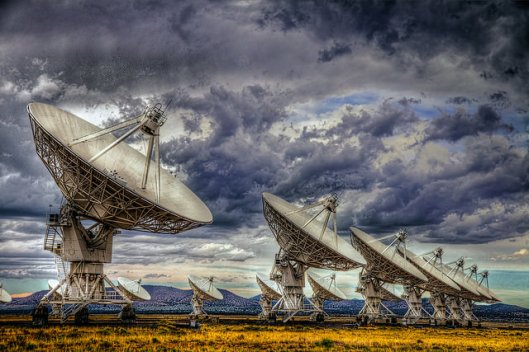
Stormy Signals--Andy Smith

Photo Credit: “Stormy Signals,” by Andy Smith

Much of my own fiction has revolved around this idea. Perhaps all of it has. But two stories of mine especially, “A Murmuration of Starlings” and “Full Fathom Five,” are devoted to the longing of intelligent creatures to connect with one another. And I know I have not exhausted the subject–perhaps there is another such story slouching towards the Bethlehem of my keyboard this year.


I Marched for Science

26 Wednesday Apr 2017

Posted by Joe in Musings and ponderation, Politics, Science, The Time of Troubles

≈ 2 Comments

Tags

scientific literacy, sociology of science, The March for Science

March for Science2

Photo credit–Carlyn Eames

I’m not a professional scientist. I do have enough training to work as a lab tech if there’s ever some neo-Maoist Cultural Counter-Revolution where we’re all rounded up and forced to work in research facilities–it goes without saying that that won’t be happening during this administration. I’d be reluctant to call myself a scientist because I have published no peer reviewed papers, and my field work is competent at best (and often in graduate school I wasn’t at my best).  Having said that, I have actually worn a lab coat and safety goggles as a part of my job–for a week here and there, anyway–and I  have all the love for the scientific enterprise that an enthusiastic amateur science fiction author can have.

Across the republic, the streets were filled with people like me last Saturday at the March for Science. Well, based on the signs people were carrying, I’m sure that a lot of the marchers were bona fide scientists–at least bona fide lab techs and grad students. And, while there has been a healthy debate within the sciences about whether this kind of public advocacy is helpful or harmful to the cause of science, put me down as one who believes it’s valuable for scientists and science-lovers to stand up and be counted.

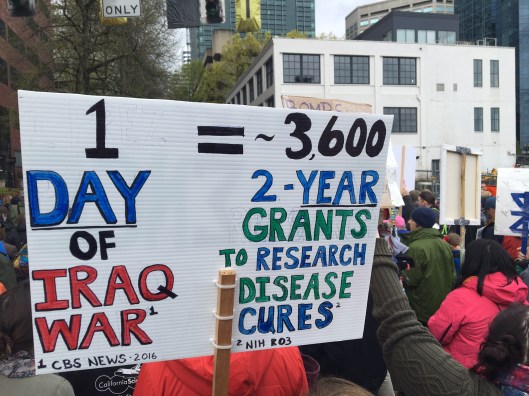
MArch for Science1

I appreciate a properly footnoted sign. Photo credit–the lovely Carlyn Eames

There has been push-back from some scientists–this article at Slate is a typical example–that the march was an orgy of uninformed and misinformed pro-science good-feelery from non-scientists. That is, according to Dr. Jeremy Samuel Faust, the folks marching mostly don’t understand science enough. If marchers did understand the state of science, with its almost guild-like patronage system, its rampant data mining and cherry picking, its Potemkin peer review, they wouldn’t be so eager to draw up witty signs and march in its defense.

Faust does have a point: I suspect few of the people on the march this weekend understand what statistical significance really refers to, and even fewer would be ready to talk about the many misuses of p<.05 that researchers engage in because they’re trying to score a publication (or, more likely, because most scientists are not statisticians and often use statistical tools in ways they were not intended).

And yes, that’s a problem. But that’s not what the march is about. One can support the scientific enterprise, be willing to march in the rain for it, without knowing everything about science. None of the marchers, even the scientists, have a full understanding of all of the sciences humans engage in. The geologists on the march don’t know any more than I do about high energy physics, and the high energy physicists know less about environmental biology than I do.

Many of the scientists out there, even the duffers like me, know that there are deep problems with the sociology of science, with the misuse of methods and publication and statistical analysis. But something the marchers all had in common, scientists and non-scientists alike, was a support for the idea underlying science: that the scientific method can be used to describe our environment and make useful predictions. Faust is right that the scientific method is a roundly abused idea even within the sciences, to say nothing of non-scientists. But one can love and support a good idea without understanding it fully.  Whether any individual marcher can be picked out of the crowd and made to follow the scientific method to Dr. Faust’s satisfaction is beside the point.

The scientific enterprise is flawed, just as representative democracy is flawed. I marched because I believe in the idea of science (and, for that matter, representative democracy). The way to reform the institution of science is the same as the way to reform the republic: it will be saved by people who care for and love those institutions. Science and civil society won’t be reformed if we roll over when the administration attempts to hobble the EPA or reverse even modest US actions to counter climate change.

Newer posts →

Subscribe

  • Entries (RSS)
  • Comments (RSS)

Archives

  • January 2026
  • November 2025
  • September 2025
  • August 2025
  • July 2025
  • May 2025
  • April 2025
  • March 2025
  • January 2025
  • December 2024
  • October 2024
  • September 2024
  • August 2024
  • June 2024
  • May 2024
  • April 2024
  • March 2024
  • February 2024
  • January 2024
  • December 2023
  • October 2023
  • August 2023
  • July 2023
  • June 2023
  • April 2023
  • March 2023
  • May 2022
  • August 2021
  • June 2021
  • January 2021
  • October 2020
  • May 2020
  • March 2020
  • February 2020
  • January 2020
  • July 2019
  • June 2019
  • December 2018
  • October 2018
  • July 2018
  • May 2018
  • April 2018
  • January 2018
  • December 2017
  • November 2017
  • September 2017
  • August 2017
  • July 2017
  • June 2017
  • May 2017
  • April 2017
  • March 2017
  • February 2017
  • January 2017
  • December 2016
  • November 2016
  • October 2016
  • August 2016
  • July 2016
  • June 2016
  • May 2016
  • March 2016
  • February 2016
  • January 2016
  • December 2015
  • November 2015
  • October 2015
  • July 2015
  • May 2015
  • March 2015
  • February 2015
  • January 2015
  • December 2014

Categories

  • A Place for my Stuff
  • Advertising
  • Artificial Intelligence
  • Beta Readers
  • Biology
  • Book reviews
  • Curious Fictions
  • Dungeons and Dragons
  • Exit Black
  • fantasy
  • Games
  • HPIC
  • Journeys
  • Let's All Admire That Fantastic Can
  • Lit News
  • Literary criticism
  • Musings and ponderation
  • My Fiction
  • Pacifica
  • Politics
  • Reading Roundup
  • Science
  • Science Fiction
  • Science Fiction Writers of America
  • SETI
  • Stories
  • Stranger Bird
  • The Ideal Vehicle
  • The Time of Troubles
  • Uncategorized
  • Utopia and Dystopia
  • Welcome
  • YA fantasy

Meta

  • Create account
  • Log in

Authors

  • Joe's avatar

Blog at WordPress.com.

  • Subscribe Subscribed
    • The Subway Test
    • Join 145 other subscribers
    • Already have a WordPress.com account? Log in now.
    • The Subway Test
    • Subscribe Subscribed
    • Sign up
    • Log in
    • Report this content
    • View site in Reader
    • Manage subscriptions
    • Collapse this bar
 

Loading Comments...