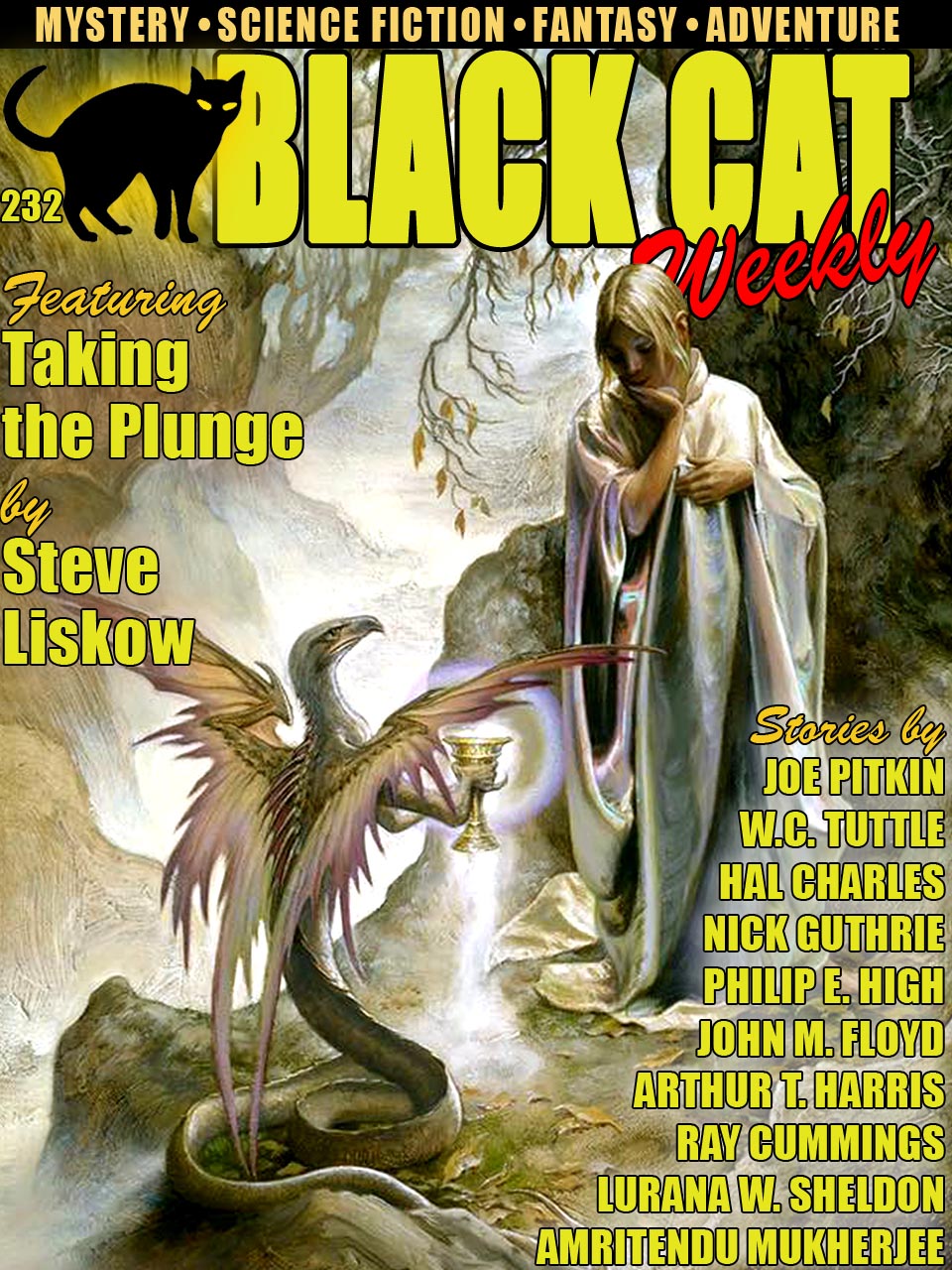
I’m pleased to announce that I have a new story, “Dryad,” dropping tomorrow in the excellent speculative fiction magazine Black Cat Weekly. It’s my first fantasy publication in some time, as well as my first story in a long time from the John Demetrius cycle that I have been writing on and off for years.
To be honest, it’s been a while since I’ve had any short fiction at all come out: my last published short story before “Dryad” was “Nomenclator of the Revolution” two and a half years ago (to be fair, I did publish a novel and complete another novel in that two and a half year space–I just wasn’t working on short fiction as much). This is my first date with Black Cat Weekly, but they have been wonderful to work with, and I’m in love with the cover art, by the late, great Steve Hickman. If you want to get your dark fantasy on, I hope you will check out “Dryad!”
I’ve been gathering ideas for a fourth novel, and almost the only thing I know about it is that I want to write a noir detective story. Everything else is sketched out in the faintest outlines: I know the protagonist will be a woman because I try to switch between male and female protagonists with each new novel. Also, the woman’s adult son will figure prominently in the plot. So will a guitar.
Beyond that, I don’t know a lot. I don’t think the protagonist will be a professional detective–in this, the story will be more like Graham Greene’s Our Man in Havana or Eric Ambler’s A Coffin for Dimitrios than like Raymond Chandler or Dashiell Hammett. Oh, and the story will be set in Portland.
Portland’s White Stag sign in September 2016. Photo by Steve Morgan.
Why Portland? Well, besides the fact that I’ve lived here for 25 years and know the city pretty well, I’m struck by many of Portland’s noir qualities. The city grew fast over the last 30 years. There’s a lot of money here. One doesn’t need to look very far to find public corruption. Add to that the city’s darkness and drizzle and fog for six months of the year (or seven or nine months), and the atmospherics are great for noir.
But my decision to set the book in Portland got me thinking: what are the great noir cities? Los Angeles is the type specimen because of Raymond Chandler and his spiritual progeny, from Chinatown and LA Confidential to The Big Lebowski. Apparently, then, one doesn’t need a foggy, rainy city as a noir setting (though I was surprised at how often chandler has it raining in The Big Sleep–I’ve never seen so many rainy days in the real LA). Los Angeles in Chandler’s 1930s was still a boomtown: my paternal grandfather’s family had migrated to LA sometime around 1920, I think, on a strength of an advertisement for the city that claimed that in California “the only man who isn’t thriving is the undertaker.” A lot of people from all over the country came in those years, and the mixing of a native Latine population with Blacks of the Great Migration and White Okies and immigrants from all over Asia made for a welter of changing social mores, violence, and resentment. Add to that a land rush of mostly White speculators and the artistic gold rush of Hollywood, and all the ingredients for noir were there: cynicism, corruption, a sense that with enough money all outrages and abominations were permissible.
But many of these boomtown dynamics seem to have smoothed out in LA somewhat over the last 100 years. I don’t think of LA so much as a noir city now–by the time you get to The Big Lebowski, set in the early 1990s, the vibe is more farce than noir.
I don’t know–maybe I haven’t spent enough time in Southern California lately. I’d be happy to hear from Angelinos about the noir qualities of contemporary LA. But what does make a city ripe for the noir? As I think of cities that I have some familiarity with, it’s not hard to put them in noir and not-noir buckets: Seattle and San Francisco, definitely noir. Salt Lake City and Phoenix, not noir. Las Vegas, not noir (at least not today, I feel–1950s Las Vegas is a different thing). Reno, by contrast, strikes me as totally noir. Mexico City is very noir (Grim Fandango, anyone?) while London is not. Budapest, noir. Vienna, not noir–at least not since the days of The Third Man.
What do you think? Where are the under-appreciated noir cities today? How big does a noir city have to be? It’s hard for me to imagine a noir set in the country–that’s the realm of the gothic–but can you have suburban noir? College town noir? I feel great about setting this new novel in Portland, since it’s the first and maybe only time in my life I’ll be doing that. But I’m curious what great noir cities I’m leaving out.
Readers of The Subway Test, especially those of you with a connection to Clark College, have probably seen my posts on the death of my friend and colleague Julian Nelson and on his friends’ decision to inaugurate a memorial scholarship in his honor. Last week, during the Clark College Foundation’s Penguins Give Day, members of Julian’s old writing group held a benefit reading at the wonderful Relevant Coffee in Vancouver’s Uptown Village.
I’m touched by the outpouring of support for the Julian Nelson Memorial Scholarship and by all the love for Julian at last Thursday’s reading. We had hoped to collect $1500 in donations, enough to fund the scholarship for one year; as of this writing, though, the scholarship fund has collected over $10,000. I’m grateful that we will be able to support more students over more years in their dreams of international study. Community colleges are rarely able even to offer study abroad programs to their students; I am heartened that part of Julian’s legacy at Clark will be support for the international learning and global perspectives that he evangelized for in life.
As a member of the Blue Sweater Collective–the writing group which Julian was a member of–I will say that we all had a wonderful time reading for a worthy cause and in honor of a good friend. I hope the Blue Sweaters will read again sometime soon–it’s hard to remember when I’ve had more fun at a reading.
Members of the Blue Sweater Writing Collective, left to right: Jesse Morse, Jim Finley, Alexis Nelson, Jen Denrow, me, Lisa Bullard, Tara Williams. Photo Credit: Carlyn Eames.
It feels good to have cooked up a reader’s draft of a short story during my spring writer’s retreat in Corvallis, Oregon earlier this week. Even better is that this new story, “Arden Is a New World,” takes place in the John Demetrius story cycle that I have been toying with for many years–I had worried for a while that I had run out of gas on the John Demetrius concept.
Knowing me, I’m a few months and a couple of peer critiques away from sending the story anywhere, but it feels wonderful to be building up a roster of publishable stories again. I worked so long and hard on novels–first Pacifica, then Exit Black, then Pacifica again–that I’m surprised by that short fiction feeling, the sense of being able to get one’s head around an entire narrative in a single sitting. I’ve missed short stories, and it’s good to be back.
I was invited recently to present a workshop at one of Oregon’s wonderful creative writing conferences–the Compose Creative Writing Conference at Clackamas Community College (perhaps the hosts tried to come up with a seventh word starting with c- for the title, but six must have been all they could fit in). After the honor of being invited wore off, I realized that I would have to actually, you know, present something at the CCWC at CCC.
I decided to present a session on reducing infodump in speculative fiction. Did I choose this topic because I’ve been widely praised for my taut, sleek stories? I wish. Actually, if anything the opposite is true: during the early years of my fiction career, I got so many rejections along the lines of “this story is well-written, but it takes forever to get to its point. There’s so much infodump here that I was barely able to get to page 8.”
The best thing I can say about infodump in my writing is that editors don’t complain about it in my stories nearly as often now. So I figure that I’ve either learned to deal with it or editors are just tired of giving me notes on it.
As you probably know already, infodump refers to bogging down the flow of a story with tedious explanation. And, while writers of any genre can fall into the habit, it’s an especially common problem in speculative fiction. If you’ve ever read a bad fantasy novel (or watched a bad sci fi movie), you have surely seen some infodump along these lines:
Scientist: I sequenced the DNA sample you brought me. Whoever provided it has some snips that I’ve never seen in a human genome before.
Captain: Snips?
Scientist: ‘Single nucleotide polymorphisms.’ As you know, captain, all sexually reproducing creatures on Earth–including humans–inherit two copies of each gene, one from the mother, and one from the father. These genes determine everything from eye color to explainexplainexplain continue explaining for four pages explainexplainexplain I hope you did well in middle school biology…
For me, infodump is even worse in fantasy than in science fiction. In SF, there’s at least the possibility that what’s being infodumped actually will teach you something real about how planetary motion works or what the principle of competitive exclusion is. In fantasy, the infodump often amounts to nothing more than 20 pages of the author’s fever-dream journal entries about a fictional queen who lived 800 years before the story takes place and what she did to curse the elven sword that is the McGuffin for this whole heptalogy of novels…
What causes infodump? Why should you be wary of the phrase “as you know” in your writing? And how do you reduce infodump in your novel? Well, if you want the whole story, come see me at the CCWC on Saturday the 18th! Or, if you’re not a Portland person, drop me a line: I’m always happy to talk F/SF with book clubs, writing groups, bookish nerds, random drunks, and people on a secret mission.
For now, I’ll just say that two factors that contribute to infodump are 1. writers’ mistrust of the reader’s ability to follow along, and 2. writers who get lost for hours (or months, or decades) in worldbuilding before they ever get around to actually writing their story.
I may say more on the subject soon, but as you know, I have been working on reducing my infodump.
Outside of the summertime, I rarely get decent stretches of time to write. During the school year, I feel lucky when I can squeeze in 20 minutes to write at the beginning of the day. For me, that kind of time is maybe enough to work on revisions, especially of short pieces, but I’ve had no luck writing novels in those tiny dribs and drabs.
A couple of years ago, after my bitching about that state of affairs for the 6,813th time, my wife wisely proposed that I take a few writing retreats throughout the year–little two-day stints where I can write for hours at a time.
Right after new year’s day, I had my first retreat of the year: over two days, I wrote in a swath across the central Willamette Valley–Corvallis, Monmouth, Salem. I knocked out about 4,000 words of a short story I have been working on and allowed myself to feel, briefly, like writing is the main thing I do.
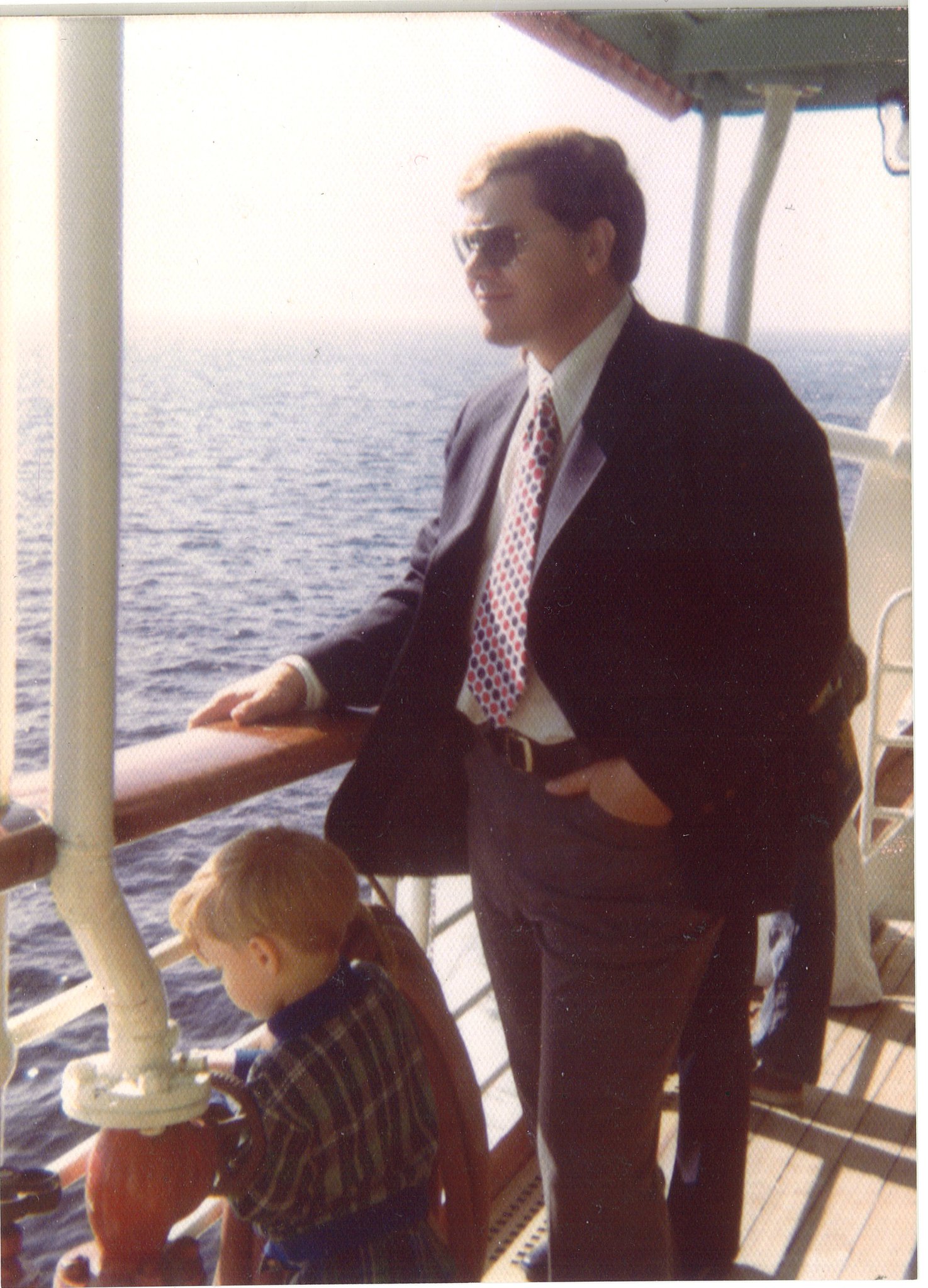
I spent a good part of the retreat in the Hamersly Library of Western Oregon University. I hadn’t been to Monmouth since I was a little fellow, when my dad taught English at Western Oregon (back when the place was still called the Oregon College of Education). Classes hadn’t started at WOU yet, so I was able to walk around this campus which I would have been too young to remember, listening for my dad’s ghost lingering around the older buildings.
Portrait of the author with his father, ca. 1972
No librarians challenged me when I walked in to the Hamersly (why would they? Librarians are the most welcoming bureaucrats on Earth), and I was able to find the perfect nook to write in. It’s worth giving thanks for libraries: like the DNA of our culture, libraries are both the metaphor for the entire human enterprise as well as the literal encoder of that enterprise. The Hamersly wasn’t built until 2000, long after my dad stopped teaching in Monmouth, but I may as well have seen my dad’s shade there, walking among the stacks. I was reminded of one of my favorite poems from Philip Larkin, my favorite librarian poet:
New eyes each year Find old books here, And new books, too, Old eyes renew; So youth and age Like ink and page In this house join, Minting new coin.
I’m pleased to announce that my story “Nomenclator of the Revolution” is now appearing in Boston Review. The folks at BR did a lovely job with the layout and the drop quotes, and I couldn’t be happier that the story is available to be read.
From the set of Guillermo del Toro’s Pinocchio, another tale about the relationship of language to authoritarianism. Photo Joe Pitkin.
And here’s a little secret about the story for you all, beloved blog readers: the short poem in the middle of “Nomenclator” is one of my favorite poems that I have ever written, and it’s a piece that I found impossible to place (in fact, I stopped trying to publish any of my poems after receiving about thirty rejections of that one). I remain convinced that it’s a good poem; hopefully it has a better fate as the work of a fictional character in this story.
I’ve spent the last few weeks drafting two new short stories and workshopping a third, so I hope that “Nomenclator” isn’t the last short story you will see from me. However, given the mystical journey of getting stories placed and published, “Nomenclator” may be my last published short fiction for a few months. I hope you enjoy it!
I just got the news that my short story “Nomenclator of the Revolution” will be appearing in the excellent Boston Review‘s online magazine on Friday, August 18!
“Nomenclator” had a mystical journey getting to publication. I drafted it soon after the 2016 U.S. presidential election as a way of exorcising some of the troubles bedeviling me (no reason!) in those days. As is often the case when I’m having a tough time of things, I tried to write something funny–I will leave it to others to judge whether I succeeded. Generous readers might get a whiff of George Saunders’s work (or Donald Barthelme’s or Italo Calvino’s) in what I wrote.
I suppose it’s just as timely a story today, while the National Grifter is threatening the Republic yet again, even as he tries to outrun two three criminal indictments.
I’m also proud of this little story: it’s being published by one of the country’s most prestigious magazines after having been rejected by more than a few less highbrow publications. That’s one more reason for me to wonder whether I could improve the way I market my work. That’s a post for another time, though (the short answer being that I have been historically inept at marketing my work).
“Nomenclator” is the only short story I’m likely to publish this year, since I have been spending so much of my writing time on my novels Exit Black and Pacifica–so check out “Nomenclator of the Revolution” when it drops!
I’m late bringing this news to The Subway Test–a sign of the recent moribunditude of my blog. But last year I entered the Aura Estrada Short Story Contest at Boston Review and…I didn’t win. But my story, called “Nomenclator of the Revolution,” was a finalist for the award, and that means the story will be appearing in Boston Review soon!
One of the reasons I feel so proud to have “Nomenclator” coming out in Boston Review–besides the obvious, that Boston Review is an excellent publication which has hosted writing from titans like Rita Dove, John Updike, Susan Sontag, and Saul Bellow–is that “Nomenclator” had been rejected by 26 other magazines before it was accepted at Boston Review.
Which is another way of saying don’t invest too much meaning in any particular rejection of your work. When a story of mine is rejected a few times–say, half a dozen rejections or so–I do need to look hard at what I’m sending out. Maybe the piece isn’t ready. Maybe it’s not as good as I would like to believe it is. But once in a while, I scrutinize the much-rejected story and it still looks good to me. It’s hard to assess my own work honestly. But if I really believe the story is good, then I’ll keep sending it out until I find someone who agrees with me.
One of my formative memories as a writer was seeing the great poet William Stafford read at the end of his career. He would have been 75 or 76 years old at the time–a wizened, kindly fellow who I appreciated only later as one of the most important poetic voices in the 20th century. At one point in the reading, he introduced one of his poems by reciting the names of all the magazines and journals that had rejected it. The list was long–I don’t remember how many publications were on it–but, journal names being what they are, the list sounded like a poem of its own. I didn’t have the courage to tell Stafford how important his reading had been to me, and he died mot much later. But thank you, William Stafford, for reading that list when I was 19 years old.
But the novel I’m working on now, Pacifica, begins each of its 74 chapters with an epigraph. Much like the computer game Civilization, each chapter is named after one of the technologies that have made modern humanity possible. And, much like Civilization, each technology is accompanied by an apposite quote. Leonard Nimoy was the gold standard narrator for those quotes in Civilization IV (though Sean Bean has his moments in Civilization VI).
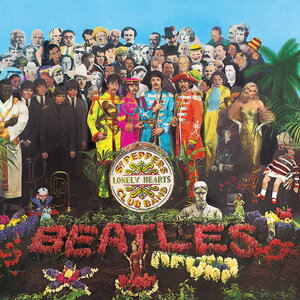
One of the most fun parts of drafting Pacifica has been finding the right quotes for each chapter. I picked from books and poems that I love (as well as a few books that I hated) to put together what I imagined as a kind of collage or mosaic of human knowledge. I imagined the task as something like a literary version of the cover of Sgt. Pepper’s Lonely Hearts Club Band, where The Beatles assembled a photo-collage crowd of their favorite thinkers and artists and goofball influences.
Many technologies were easy to find quotes for. Especially for early technologies like pottery, masonry, and currency, there are a thousand great writers who had something pithy to say. Mostly I would page through books in my office, or CTRL-F through digitized books in Archive.org, to find quotes that spoke to the technology in question and also, hopefully, to the action of the chapter. Sometimes I had to draw the connections myself, in which case the quote turned into something of a writing prompt; other times the quote fit the chapter in deep and unexpected ways that I couldn’t have engineered if I tried.
Some of the later technologies were much harder: for instance, no one from Homer to Virginia Woolf seems to have much to say about the superconductor. Who could I quote for a tech like that?
It just so happened that by the time I got to the superconductor chapter of the book, everybody was talking about ChatGPT. At my college, the discussion revolves entirely around students’ using ChatGPT to plagiarize their essays, an issue which seems to me as trivial, in the grand scheme of dangers that ChatGPT represents, as the crew of the Titanic arguing about a shortage of urinal cakes in the men’s rooms of the Saloon Deck.
So I asked ChatGPT to find me some quotes about superconducting. It suggested some quotes from Larry Niven’s Ringworld and Niven’s and Jerry Pournelle’s The Mote in God’s Eye. They weren’t bad references, exactly–those books do mention superconducting–but none of them resonated with me. So I asked about Arthur C. Clarke, a fave of mine: surely, I thought, Clarke must have written somewhere about superconducting.
According to ChatGPT, Clarke has written about superconducting: of the two references ChatGPT gave me, the one which jumped out at me was this one: “Clarke’s short story ‘The Ultimate Melody,’ published in 1957, briefly mentions the use of superconducting materials in the construction of a futuristic musical instrument called the ‘ultimate melody.'” Now that’s a resonant quote–that would work perfectly for Pacifica!
So I looked up the story and read it (like 90% of Clarke’s short fiction, I had never read it before). Here’s the thing, though: there’s absolutely nothing about superconducting in that story! (For that matter, the futuristic musical instrument is called “Ludwig;” the ultimate melody was the ideal music the instrument was designed to find).
And here’s the other thing, which I discovered later: Arthur C. Clarke did write a short story, called “Crusade,” in which superconductivity is a central plot point. ChatGPT didn’t think to mention it (because ChatGPT doesn’t think yet). I tracked that story down with a simple DuckDuckGo search for “Arthur C. Clarke superconducting.” It’s an excellent story, by the way–very Arthur C. Clarke. And that story had the perfect quote, which fits both Pacifica and the life I feel I am living lately: “It was a computer’s paradise. No world could have been more hostile to life.“
So, for now, I agree with John Scalzi’s excellent assessment: “If you want a fast, infinite generator of competently-assembled bullshit, AI is your go-to source. For anything else, you still need a human.” That’s all changing, and changing faster than I would like, but I’m relieved to know that I’m still smarter than a computer for the next year or maybe two.




 The Subway Test