As you may remember from former posts, I’m a big fan of the book site Shepherd. And, like many of the writers on that site, I was invited by Shepherd founder Ben Fox to talk about my three favorite books of 2024. I was game, partly because I’m happy for any opportunity to link to my own book of this year, Exit Black–I believe it’s one of this year’s best thrillers on economic inequality that you’ll read this year.
I’m not sure what my choices say about me besides the fact that I do a lot of reading outside the genres I write in, but here were my three faves of this year: Edith Wharton’s The Age of Innocence, Toni Morrison’s Jazz, and Laurent Binet’s Civilizations. Why did I love them so? Check out my Shepherd page to find out!
When I was writing it, one of the ideas that guided my upcoming novel Exit Black was that it was to be “Die Hard in space.” Those may have been the exact words that my publisher and my agent used when describing the project to me.
They couldn’t have known when they pitched the project to me that I was not a fan of Die Hard. Practically every one who was a young man in 1988 America loved Die Hard. How could I have hated the most iconic action movie of all time?
The answer to that is mysterious to me. One might think that because of my Quaker religious practice, I blanched at all of the violence in Die Hard. And maybe I did somewhat. However, there are a lot of violent movies that I love–some of them (like Fargo) are arguably more violent than Die Hard. And I loved most of the people in Die Hard--Bruce Willis was really doing something new in action movies with his portrayal of a sometimes panicked, self-doubting John McClane.
I think if I had to pin down my early dislike of Die Hard, it was the studio’s use of Beethoven’s 9th Symphony in the trailers for the movie. That piece of music was a touchstone for me even in my youth–I hated the studio’s use of a sacred cultural treasure (one whose main theme is of peace and universal brotherhood, no less) to sell an action movie about killing a bunch of common thieves (spoiler–sorry). I only watched A Clockwork Orange once in my life because of the same cognitive dissonance around Beethoven’s 9th.
But I was excited to work on a project with my agent and with this publisher, and when they proposed Die Hard in Space I thought I’d better give the movie another look. On watching it again, I was still turned off by the celebration of violence, and there were a number of other elements that I had forgotten but which haven’t aged very well over the last 35 years. But I also saw something there that I hadn’t noticed the first time.
I saw the antagonist, Hans Gruber, with new eyes. He was cool, self-possessed, brilliant but not a blowhard the way a James Bond villain would be. Of course, it was also impossible on this later viewing not to see the arc of Alan Rickman’s career stretching off before him as he glowered like a panther, snarling in Hans Gruber’s faux German.
While I didn’t come to like Die Hard on this second viewing, I was entranced by Hans Gruber. I wanted to write a cool villain like that. I wanted to make a character who readers would hate but who also they would find fascinating, perversely compelling. I wondered if I could build a novel around an antagonist like Gruber, perhaps even someone who would be more antihero than antagonist, like the character of Satan in Paradise Lost.
And that was how I decided to take on the Exit Black project. While even now the book is being marketed as a kind of Die Hard in space, I often tell people I tried to write something more like a Coen Brothers remake of Die Hard: a story with all the ironies and regrettable choices of a Greek tragedy, focusing on a noble, hubristic, ruthless, chillingly violent antihero at the center of the story. Exit Black is a space age remix of the old movie, a kind of Die Hard: The Hans Gruber Story.
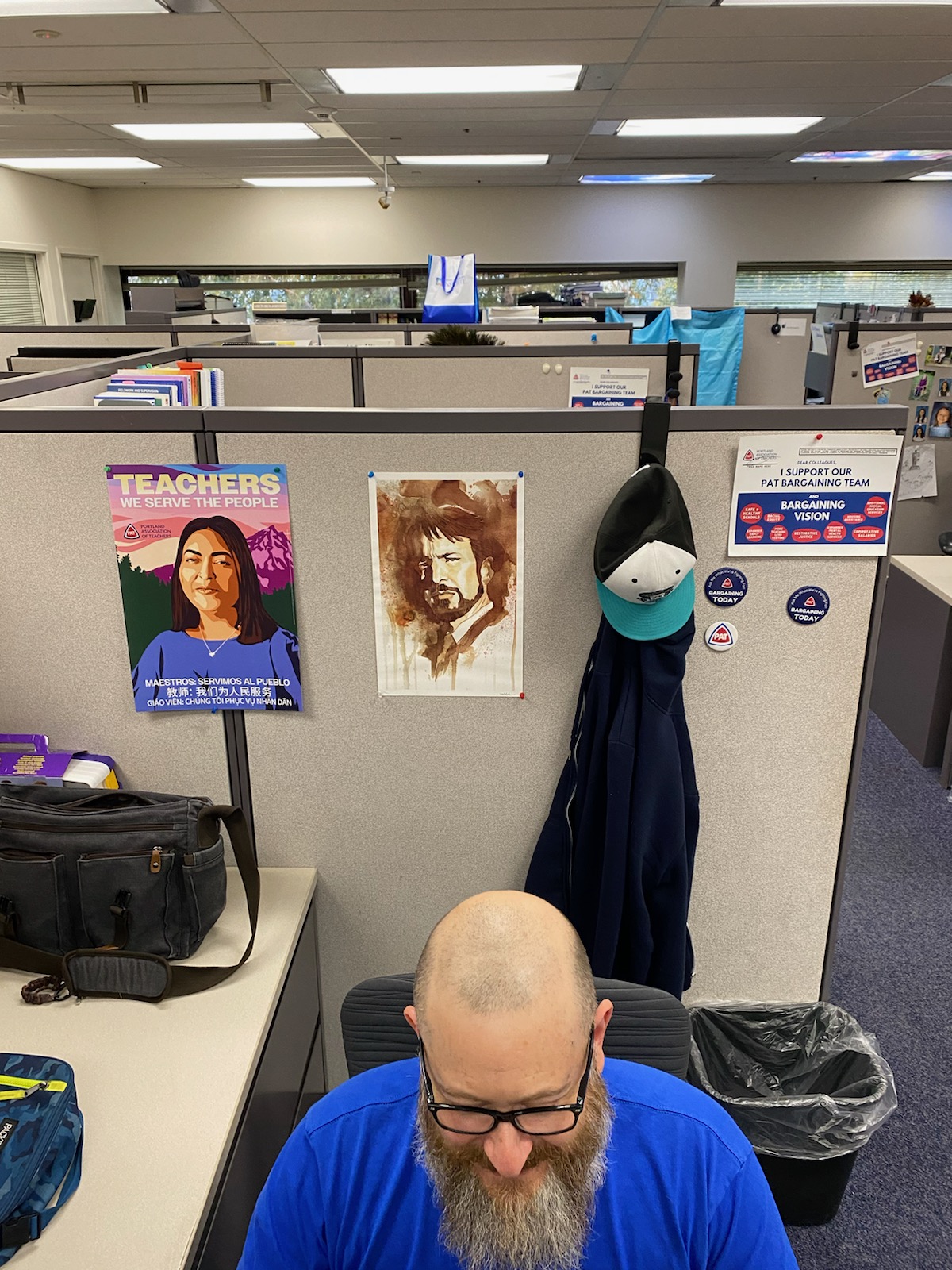
I hope the book will appeal to all of those perpetual teenagers typing away with a portrait of Hans Gruber stuck to their cubicle walls:
D&D friend, fellow unionist, and cubicleman Mike Carlip with portrait of Hans Gruber. Photo credit Carlyn Eames.
Hello, literarians and assorted (and beloved) fellow weirdos!
I received an email from my publisher, Blackstone, yesterday with a publication schedule for my second novel, Exit Black. I’m excited to announce that my little bundle of joy is due to come out in February of 2024 (or, to use Cesare Emiliani’s Holocene Calendar, February 12024). I promise not to pester you about it every day for the next eight months!
I also promise not to ever refer to Exit Black as “my little bundle of joy” again. But it sure is a little bundle of something–little bundle of action? Little bundle of thrills? Little bundle of artfully strung-together words? That last one feels a little too on-the-nose.


 The Subway Test