One of my favorite characters from my novel Exit Black is Kassie Ng, the easily-underestimated Instagram influencer sent to chronicle her adventures on the world’s first orbital hotel. It might surprise no one that her name comes partly from Cassandra of Trojan War fame–my nod, I guess, to Homer. Her last name, though, is an homage to one of my favorite songs, the They Might Be Giants classic “Ana Ng.”
While the original song is amazing and should be much better known than it is (which I suppose one could say of most TMBG songs), perhaps my favorite version of the song is this one, by the masterful banjoist Charles Butler. I noticed today that Charles Butler’s Spotify page has exactly the same number of monthly listeners as this blog has subscribers. So from a writer who could use more readers to a musician who deserves more listeners, I salute you, Charles Butler.
I mean this in both the “free speech” and “free beer” senses of the term: I use The Subway Test to say what I want, and I have no intention of charging you for my words of wisdom.
I have nothing against the Heather Cox Richardsons and Matt Yglesiases and Paul Krugmans of the Substack world– on the contrary, I love what they are doing, and I’m glad they get financial support for it. And I have a soft spot, or at least an “oh, buddy, bless your heart” compassion, for the thousands of people on Substack with a tiny following who are trying to tease those singles or tens of readers into some stream of income for themselves.
But I have a decent job that I like doing, at least most days, and I get paid enough teaching first year composition at a community college to keep body and soul together. I write slowly, and I know that a paid readership wouldn’t improve me on that score. If I had, say, 14 paid subscribers to please with a regular feuilleton of my own wit and incisive commentary, the pressure to please them would not improve my writing, increase my happiness, or add anything of value to your lives.
But for all that, if you read something here that makes you think, “I like that Pitkin–that slowpoke speaks my mind,” there are other ways you can support me.
A like on one of my posts is nice. A comment is even better.
And if you really want to give me some money, feel free to buy my novel Stranger Bird. It’s a charming YA fantasy written during the height of the Harry Potter Industrial Complex–in reaction to those heady times, I looked back to the older style of YA fantasy that Ursula Le Guin, Lloyd Alexander, and Richard Adams were practicing back in the 1960s and 70s. The result is literally magical.
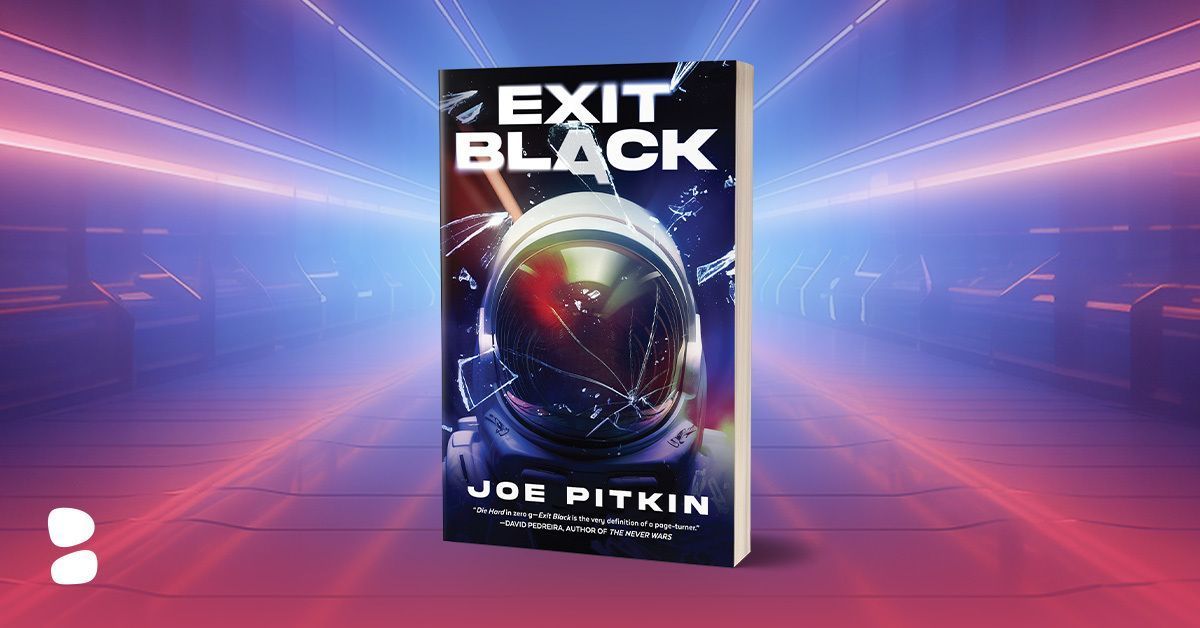
Or, if you’re not so sure about YA fantasy, you could spring for Exit Black, my 2024 meditation on space tourism which is really a meditation on violence, techbros, and American predators and prey. There’s also a great audiobook version of this one, read by the incomparable Catalina Hoyos.
Or, if you really want to support me, start an independent publishing house of impeccable good taste and artistic daring, and pick up Pacifica to be published in your catalog. That’s my top support tier: if you spend thousands of dollars on me, you’ll have a publishing house with at least one title. That one is a reach goal.
That was my publisher’s note to me when we learned that Exit Black cracked the top ten best sci fi audiobooks in 2024 at Discover Sci-Fi. I’m super stoked: while I would have loved for Exit Black to take the #1 spot, of course, there’s no shame losing out to the likes of Adrian Tchaikovsky narrating his own book and Jeff VanderMeer having his work read by Bronson Pinchot. Carolina Hoyos is a hell of a reader, and I was very lucky to have gotten to work with her.
I loved every step of this project with Blackstone Publishing, and to make my Captain Obvious Statement of the Day: Blackstone knows audiobooks. Thanks so much to all of you who voted and all of you who listened. And, if you haven’t listened yet, if you ever feel a hankering for a tale about a bunch of techbros getting their comeuppance, Exit Black couldn’t be more timely.
As a Portlander, I have to contend with the reality of Powell’s City of Books. It’s the largest independent bookstore in the world, and as you might imagine it has a mighty footprint on the Portland literary scene. A friend who worked there told me about 20 years ago that 40% of Amazon’s book orders actually go through Powell’s. I doubt that that is still the case today, but it gives you some idea of the size of the place, as well as the indirect role Powell’s played in the rise of Amazon. One of Portland’s most popular tourist destinations, Powell’s City of Books is its own Portlandia sketch.
For many years, basically from the time I started writing fiction in my thirties, I had a lot of trouble going into Powell’s. Part of the dread I felt was simple cognitive overload. But I was also contending with two related kinds of self-loathing in the City of Books, one as a reader and one as a writer.
As a reader, I would feel depressed in City of Books to come into contact with all the great books that I hadn’t read and would likely never read. As a writer, I would despair that of the tens of thousands of titles that were on the shelves on any given day, nothing I had written had ever shown up there. In my foolishness, the place had become a visual metaphor for two ways I felt I had come up short as a human being.
Eventually the feeling passed, probably just because I got older. It doesn’t upset me so much anymore that I don’t have that many more books to read in my future. Even if I live a fantastically long life, it seems unlikely that I have more than 2000 books left to read, and the number could be far, far lower than that. The key, as my friend and bandmate John Governale has shown me, is not to try to read all the good books out there, but rather just to remember that there is always a great book out there for me–I don’t need to spend any time reading a bad one.
As for the fact that my stuff had never shown up on the shelves of Powell’s City of Books, I eventually got over myself there, too. I think that as I got better as a writer, I started to find more joy in just writing well (as distinct from winning awards or getting prestigious publications or big book contracts). I still love to get published, but even more than that I love the feeling of putting together a story that really works.
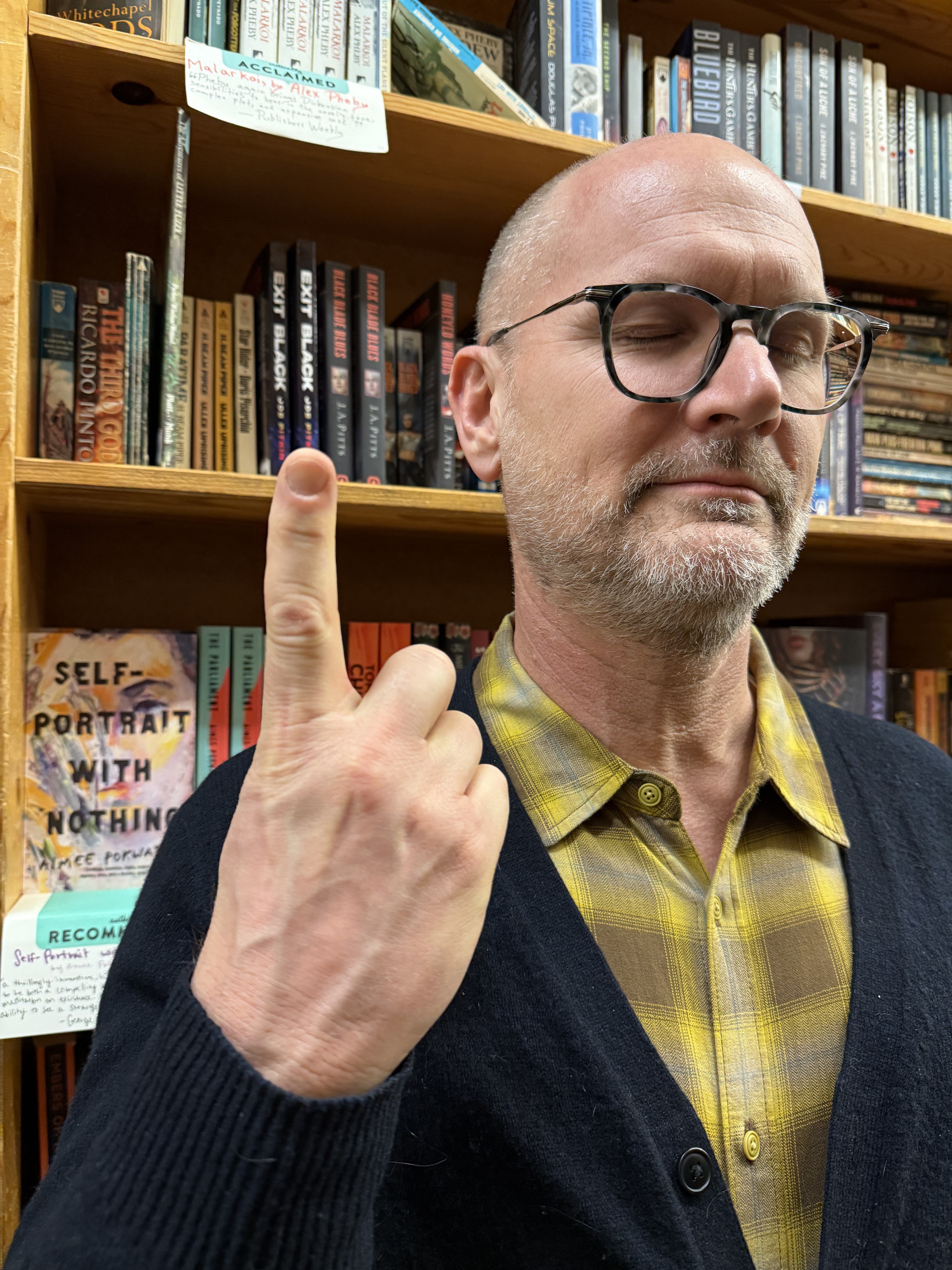
As I tell my students and my kids, there are lots of situations where you start getting good at something right around the time that you don’t have to do that thing anymore. And there was a similar feeling of irony for me when I went into Powell’s City of Books last week and found that my latest novel, Exit Black, is indeed on the shelves there. I still prefer the smaller independent bookstores in my life–Broadway Books, White Oak Books, Annie Bloom’s–but it is a nice feeling to know that a tourist in Portland who wanted to find my work for some reason could find Exit Black right in the Gold Room of Powell’s City of Books, section 722.
I am excited to learn that Exit Black has been nominated for Discover Sci-Fi’s Best Sci-Fi Books of 2024! Exit Black is a nominee in the Best Sci-Fi Audiobook category, a testament to Carolina Hoyos’ tense, too-cool-for-school reading of my work, as well as to Blackstone Publishing’s amazing audiobook chops. If you heard Carolina read my book, or if you are an Exit Black supporter, I’d be honored to have your vote.
The title says it all, really. White Oak Books is one of my favorite new additions to the Uptown Village neighborhood of Vancouver, Washington. I spent a long time living just up the street from their spot when I moved to the Northwest, and there were some years that I would have given my eye teeth to have such a cool bookstore in the neighborhood. I’m happy to support them, and I’m honored that they want to help me publicize my work.
Vancouver friends–and Portland friends willing to have your minds blown by crossing the Columbia River–come hear me read from Exit Black, my new SF thriller from Blackstone Publishing, on Thursday, August 29, at 6:30.
White Oak Books 1700 Main Street Ste D Vancouver, WA 98660-2660
I’ve had my head deep in a novel project this summer–my beloved white whale (or white elephant?) Pacifica–and so I’ve been away for a few weeks from this blog, as well as my garden, and hiking, and sometimes even meaningful human contact.
But! I love hearing from people about my latest novel, Exit Black, which came out in February. This screenshot, from my friend Bill in New York, is one of my favorites:
Yes, Exit Black is on the shelves in the New York Public Library!
For lots of reasons probably having to do with talent, I’m not the kind of writer who is ever going to win a Nebula or a Hugo, much less a PEN award or a Pulitzer. But someday I can tell my grandkids that their grandfather once had a book on the shelf of the New York Public Library. And, grandkids being grandkids, and the future being the future, there’s a good chance they will ask “what’s a library?” or, God forbid, “what’s a book?” Sic transit gloria mundi.
I had every intention of publishing my interview with fellow Willamette Writer (and fellow community college teacher) Avis Adams when she published it almost two weeks ago. Then the end of winter term descended over me like a weighted blanket made of student essays and departmental emails. Now that I have finally wriggled out from under its sweaty embrace, I can give a little more attention to this blog, to promoting Exit Black, and to all things literary.
So, many thanks to Avis for cooking up some delightful interview questions and for offering such a warm reading of my book. Check out her review and my interview at her wonderful blog, Your Next Favorite Author.
One of the things I love most about a small bookstore is its point of view. There’s not enough shelf space to try and be all things to all readers: instead, a small bookstore announces its allegiances, however idiosyncratic, and it stocks the shelves with them.
I had my launch reading for Exit Black at my neighborhood bookstore: Broadway Books in Portland. Much like my publisher, Blackstone, Broadway Books is small, independent, a place of fierce good taste. And, while Broadway has a small FSF section, Exit Black fits there.
It’s like Where’s Waldo? but for my book. . .
It may be that my book barely fits there, that it’s on the shelf only because I am a local boy from just up the street. But they did make space for me on that shelf. And if someday, late in the game, I have the kind of readership that the FSF heavyweights have–the Ursula Le Guins and Octavia Butlers and Terry Pratchetts–I’d like to believe that Broadway Books will keep me on their shelves because my work is congruent with their values.
You can order Exit Black anywhere, of course, but you Portland readers, Portland visitors, and Portland passers-through can find a signed copy of my book at Broadway Books. Let me know if you’re in town; I’ll be happy to grab a tea and talk SF with you.
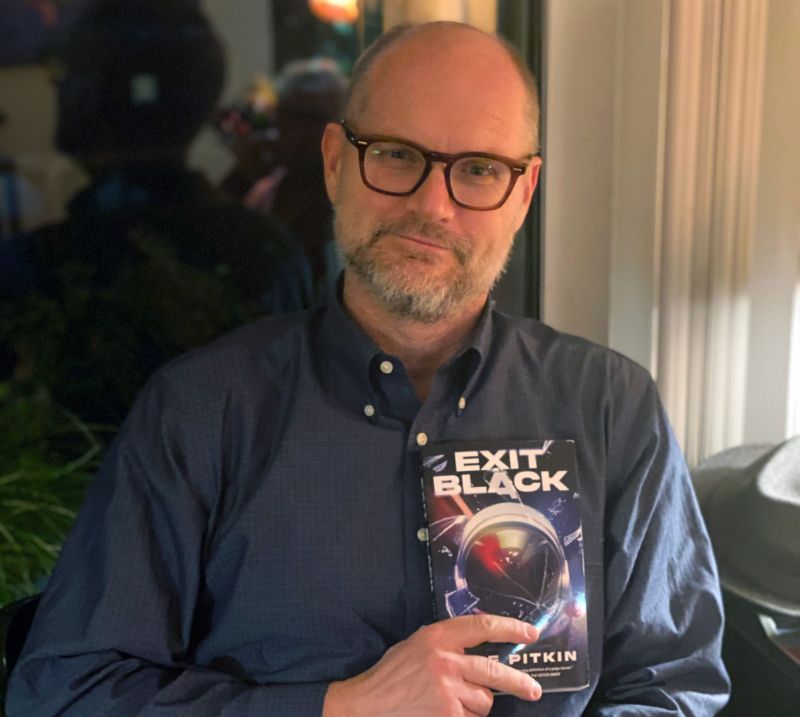
It’s publication day for my latest novel, Exit Black, and I was happy to see that the excellent and tireless arts and entertainment journalist Paul Semel chose today to publish our exclusive interview about the book. You can read the interview here: check it out to see why space tourism is the perfect metaphor for economic inequality, as well as who I would cast in an Exit Black movie! I’m still a little tickled that Paul calls it an “exclusive interview”–I mean, it is an exclusive interview, but he makes it sound like I’ve been playing hard to get all these years.






 The Subway Test