• About
  • My Fiction
  • Reviews

The Subway Test

~ Joe Pitkin's stories, queries, and quibbles regarding the human, the inhuman, the humanesque.

The Subway Test

Category Archives: Biology

“AI Proofing” the Classroom

12 Monday Jan 2026

Posted by Joe in Artificial Intelligence, Biology, Musings and ponderation, Science, Utopia and Dystopia

≈ 14 Comments

Tags

AI, Artificial Intelligence, ChatGPT, education, LLMs, Rhetoric, writing

In my department (and I think in just about every department in every college), the number one discussion in meetings and email discussions for the last three years has been what to do about AI. The main question–sometimes it seems like the only question in my department–has been “how do we AI-proof our classes?”

I get it: students can have ChatGPT cook up a paper for them on any subject in a few seconds. The paper can be well-written enough to get an A if the student asks for that. If the student is too worried about getting caught, they can have ChatGPT serve up a B- or C+ paper instead. While most of us teaching ENGL101 in America have some nose for papers that don’t quite smell like student-written work, any teacher who says they can unfailingly sniff out AI-written prose is lying, at least to themselves if not to you.

So yeah, our teaching lives are different now. Almost everyone who liked being a teacher before, say, 2023 doesn’t like what’s happening now. It occurred to me not long ago that if I had begun my teaching career in 1923 or even 1933, I could have completed a thirty year teaching career without having to live through many (or even any) cataclysmic technological changes. There would have been major social changes to navigate–the Great Depression, WWII, the GI Bill, widespread entry of women in colleges, desegregation–but the technology of teaching and classroom learning wasn’t radically different between 1933 and 1963. Had I started in 1933, I would not have been forced by technological change to reinvent my teaching practice every few years.

When I really did start teaching, though, was 1993. The technological changes we’ve seen since then have been massive. Not all of my students were even using word processors in those first few years–I still took in typewritten papers every once in a while. For that matter, I still distributed handouts that I had made on a mimeograph machine from 1993-95. From then to now, I’ve taught through the total hegemony of the word processor, the internet classroom, YouTube, Khan Academy, social media, learning management systems, the smart phone (as well as the tablet and the ubiquitous Chromebook) before I had ever heard of ChatGPT. And all of those developments have had deep implications for the way I do my work.

But ChatGPT and all its logorrheic LLM siblings have deeper implications still. They are cataclysmic for the work I do.

My colleagues are intelligent and sweet-natured, and I am lucky to be working with them. But, despite their voluble commitment to political progressivism, we all can be some of the most emotionally conservative people around, at least when we all get in a room together. Is there a way we can, you know, find a way to keep teaching the way we’ve been teaching? Let’s just do that! our department seems to be saying, at least if you read our meeting minutes.

I can bitch, and have bitched, about the fact that I have to upend my entire teaching practice to accommodate a tool that will write competent prose and summarize any reading in a matter of seconds. It’s all the more galling that the tool comes to us by way of Elon Musk, Mark Zuckerberg, and the rest of their techbro robber baron buddies and their shareholders. But this is the way creative destruction works: in an open market, entire systems of wealth and production are continually being destroyed by new technology. And if I can’t see ways to use LLMs to support my teaching practice, I’m going to get chewed up and spit out all the more quickly in the coming years.

Sooner or later, AI will be teaching everybody. In the long run, there is no AI-proofing the classroom. A computer that can write competent prose and read anything can also, sooner or later, teach people to read and write. It’s already being used by many teachers as the vaunted “papergrader.com” that some of my waggish colleagues used to pine for 20 years ago. However, I remain optimistic that for at least a little while longer, a human teacher who knows what they’re doing–and who cares about students–can offer something a computer is not yet able to.

So for now, until the computers kick me out of the classroom, here are some of the ways that I’ll be trying to deal with the new regime: taking advantage of the many blessings of AI where I can, minimizing its malign influence whenever possible. I offer these as a starting point for conversation with my colleagues and my students.

  1. Speak Frankly with Students: If my and my colleagues’ stated feelings about AI are any guide, students are getting mixed messages about use cases for AI. And even if we educators weren’t giving mixed messages, students are certainly receiving mixed messages from the culture at large, from the techno-utopian advertising they see from Google and Apple and Meta to creepy cautionary tales like M3gan. Given that my job as a teacher of rhetoric is to help people understand how arguments work, and given that one of the main functions of LLMs is to confect natural-sounding arguments, part of my job now involves helping students consider LLM use cases. I’m far from an LLM hater, despite some of the obvious losses that LLMs present for my work as a writer and teacher of writing. But I’m also deeply skeptical about any utopia that Google et al. are selling. For now, I expect my students not to use LLMs to create text that they pass off as their own. They can expect me not to use LLMs to grade their work. Only one of these expectations is realistic; I know that as a result of their anxiety, laziness, or cluelessness, some students will be trying to pass LLM content off as their own work. I’ll speak to that issue below.
  2. Stop Grading Students; Give Them a Fair Assessment Instead: I’ve been arguing that we should get rid of letter grades since long before I ever heard what an LLM was, but LLMs have only made grade grubbing and credentialism more acute: if it’s so easy to get an A by cheating, why would any student accept a C? And if everyone is getting an A, why do we have grades at all? Replace the anti-educational grading system we have with a straightforward, outcomes-based pass/no pass system based on in-person competency testing. These tests can look like a lot of different things, not just essay tests. But they might especially be essay tests, handwritten in a Blue Book or typed on a computer with a lockout browser. (To that end, by the way, many of my colleagues, especially in the math department, argue that our college needs a proctored testing center. I have no doubt that we will have one sooner or later. But my college has never been a leading-edge institution; we’ll have our testing center only after several other colleges in the state system have started one and the practice becomes an official, shiny Best Practice with our State Board for Community and Technical Colleges).
  3. Implement a No Devices Classroom. One of the central goals of education is to help students cultivate cognitive endurance: “the ability to sustain effortful mental activity over a continuous stretch of time.” I have no doubt that this goal is made more difficult when students have ad libitum access to multiple screens and information feeds in the classroom. And while the research is equivocal for students as a whole, for lower performing students–those who are over-represented in open door community colleges–the research suggests that device bans help students to stay focused on their classwork. If someone is listening to Spotify on their earbuds, managing a text thread, checking TikTok every 5-7 minutes, and squeezing in a round of Candy Crush during down time in the class (however a student might define “down time”), should I be surprised that they are having trouble identifying the main idea of the paragraph we’re all supposed to be looking at?

    One may reasonably ask what AI in the classroom has to do with this fractured attention economy. It’s related in two ways: first, the companies selling AI as an edtech that students should be using in the classroom are often the same companies that benefit from having students constantly plugged in to multiple streams of data simultaneously. Secondly, I believe there is a benefit to having students at least sometimes exert their minds without the cognitive prosthesis of AI, the same way that you’ll get in shape faster riding an old-school “acoustic” bicycle than riding an e-bike (and much, much faster than riding a motorcycle). I’ll admit that this second claim is more vibes-based, and I’ll be happy to revise it in light of high quality research findings. But for now, common sense tells me that it helps for students sometimes to have only their minds to rely on.

    Here’s a very simple example. One of the best ways that a person can prove to someone else that they understand something they’ve read is to summarize that reading. For that matter, summarizing is one of the best ways to prove to yourself that you understand what you’re reading. It’s a foundational tool for managing information, as well as a vital step in making a rhetorical analysis, an academic response, a literary analysis, a research paper, and a whole bunch of other academic assignments. It’s also one of the more difficult skills for a person to learn, especially with readings that are challenging. If I assign students to summarize a tough article, it’s a lot to ask that they struggle for an hour or more with a task that a computer could do for them in ten seconds. I can hardly blame some of them for having ChatGPT serve up a summary for them if I assign it as homework. However, if we write the summary together in the classroom–which has the advantage of our being able to puzzle out together the writer’s organizational schema and the main ideas of paragraphs–we might actually write a true human summary together. That only works when there is one part of our lives where AI is not a constant background (or foreground) presence.
  4. Use LLMs Outside of the Classroom. I’m not ready yet to require that students use LLMs outside of the class–lots of students, especially the more thoughtful ones, are deeply skeptical of LLMs for a lot of reasons. However, I am starting to look for parts of my teaching that I think can be safely off-loaded to AI and which I can recommend to students. One of the big use cases is grammar and punctuation instruction, a part of my teaching that I used to love but which has gotten steadily crowded out by changes to our department’s approach to curriculum.

    ChatGPT is a potentially awesome teacher of sentence grammar. As I tell my students, beyond all the debates in lefty spaces about “Standard Edited English” being a tool of colonialism and white supremacy, there’s great value in being able to understand how sentences are put together, how parts of sentences like phrases and clauses interact. One can say a great deal with nothing more than simple declarative sentences. However, understanding how an appositive or an absolute phrase works (whether or not you know the names for those structures) will make it possible to say and write–and think–ideas that are much, much more subtle, as well as much harder to formulate with only declarative sentences. Explaining grammar and punctuation is one of the few areas of life where I claim to have real expertise; nevertheless, I think that ChatGPT is better than I am at it, and it’s certainly more tireless at it.

    One of the assignments I’ve been giving, and which I plan to use even more widely this term, is to have students upload a paragraph of a reading we are studying (or sometimes a paragraph of their own writing) to the LLM of their choice, with the instructions that the LLM quiz the student on how the sentences are constructed. Sometimes I have LLM quiz students on the types of clauses that are appearing in each sentence; at other times I have the students try to classify sentences as simple, complex, compound, or compound-complex; at other times I have the LLM test students on the placement of commas or other punctuation in their writing. I do this not because I want students to memorize the nomenclature of clauses and punctuation but because the activity forces students to pay attention to the way sentences are constructed, the same way that musicians learn to pay attention to chord progressions and photographers learn to study the composition of a shot. And not only does ChatGPT know at least as much as I do about sentence grammar and punctuation, but it’s infinitely patient. There are similar huge gains available to us if we use LLMs as reading comprehension aids, as critical readers for students’ rough drafts, as explainers of historical and sociocultural context. I wrote about this phenomenon of LLMs-as-the-Computer-from-Star Trek here.

    In fact, practically the only way I want students not to use LLMs is as creators of content that is to be graded. Of course, that’s one of the only things that some students seem to want to use LLMs for, and that’s one of the main reasons to retire this 18th century grading system we inherited from Yale University. As I tell my students multiple times a term, if they are coming to college because they hope a degree leads to a job, they’re only going to get hired to to one of two things: 1. a job the employer would prefer not to do (e.g. toilet cleaning) or 2. a job the employer is not able to do themselves. And if the student has never developed skills that the employer doesn’t already have, they’re going to get the toilet cleaning job. And why go to college for that? As I tell my students, if what you know how to do at the end of your mystical journey in college is to have ChatGPT write a report for you, no one is going to hire you to do that. Every employer in America already knows how to have ChatGPT write a report for them.
  5. Teach In Person. Notwithstanding 30-odd years of advertising and boosterism that online classes were the wave of the future, I’ve always been an online learning skeptic. I wasn’t impressed by the online classes I took as a student; in the few online courses I taught before the pandemic, I was troubled by how many students seemed to struggle who in my professional estimation probably would have done ok in a face to face class. And nothing I saw as an online-only teacher during the pandemic disabused me of my original skepticism. On the contrary, I think at our college we’re still adjusting to student populations who were subjected to the tender mercies of all-online education for a year-plus.

    At this point of human history, when everything I know or might ever know is available for free through LLMs, I have nothing to offer students beyond a human face. But there is still some value in having a human face: we are highly evolved to interact with actual physical human beings. Face to face classes aren’t the only modality that ever makes sense–I would argue that online learning is appropriate for some students (particularly more experienced and self directed students) and for some classes–but for a general education course like ENGL101 at a community college, I believe there should be a presumption of some in-person learning.

    What does this preference have to do with LLMs? While of course it’s easier to ascertain that a student, rather than an LLM bot, is doing the classwork when you can actually see the student doing the classwork, the main reason for preferring face to face learning has nothing to do with enforcing some academic honesty regime. Rather, the main advantage of face to face classes in our current LLM world is that most people still like seeing other people and like being seen by them. It’s shocking and sad how often my students confide in me that what they really hope for out of college is to make a friend. Some of them may already have the supposed companionship of an AI therapist or an AI girlfriend, but what they really want is other human beings: old fashioned sacks of meat with smiles and unexpected phobias who don’t respond to their every question with the words That’s a very perceptive question, Dylan, and it gets to the heart of blah blah blah…

    If you’re out of school, think back to your own school days. What specific instruction, principles, or words of wisdom do you remember from your own classes? If you’re like me, you can barely remember anything: I know that school taught me certain habits of mind and an ethos around using inquiry to explore reality, but beyond that, I forgot nearly everything twenty minutes after the final exam. But I bet there are some people from your classes that you remember. Some of them could be your best friends today. You might even have married one or two of them. That doesn’t happen much in an online class, and it doesn’t happen at all with solitary LLM-driven instruction.

Just like most everyone else who works with a computer, I am facing a job that has changed radically. What I tried to communicate to students for the first 25 years of my career was that reading and writing are valuable, salable skills in their own right. I’m not so sure of that anymore: an LLM can write in any genre and on any subject better than a typical college graduate, and it has read–and digested–far more than any single human being could be expected to have read.

But having said all that, I believe a human teacher of reading and writing has something to offer students. Reading and writing are still the training regimen by which a person learns to think. Whether or not anyone ever pays you to write or read an argument, learning to make an argument yourself remains one of the most important things you can learn to do. Argument is the process by which you make your thinking clear to others, but just as importantly, it’s the way you make your thinking clear to yourself. However ChatGPT has changed things in the classroom, and will continue to change things, it hasn’t abolished this essential reality of our lives.

A New Version of the Old Mug

16 Sunday Jul 2023

Posted by Joe in Advertising, Biology

≈ 9 Comments

Tags

Exit Black, head shot, marketing, Pat Rose, portraiture, sci-fi, Science Fiction, that strumpet Fame

I decided to go in for a new head shot recently. It’s been over six years since my most recent head shots, and not only have I gotten more wizened over that time, but I also have a new book coming out in the next few months.

As with my last photos, my new head shot is he work of the incomparable Pat Rose. You can check out her amazing work here: she’s an institution of Portland portraiture. Having my photo taken by her feels a lot like I imagine sitting for a painted portrait would feel, and at the end of it all she produces an image that is wonderful and painterly as though Jan Van Eyck had painted me.

So, in honor of the coming Exit Black (and of my advancing age), I give you “Portrait of Joe Pitkin, aged 52”. . .

112

28 Monday Jun 2021

Posted by Joe in Biology, Musings and ponderation, Politics, Science, Uncategorized, Utopia and Dystopia

≈ 4 Comments

Tags

climate change, Fox News, Portland heat wave

Today the temperature on our backyard weather station topped out at 112 degrees Fahrenheit. Apparently the reading at the Portland International Airport was 116 degrees. It was the hottest day ever recorded in the history of Portland. Indeed, it was very likely the hottest day that has ever occurred in this valley in the entire history of human habitation at this site. The second hottest day in Portland’s history was yesterday; the third hottest was the day before that.

For years, ever since I knew what climate change was–ever since we used the term global warming instead of climate change–experts have cautioned the public not to point at any specific weather event and say “See? That’s climate change at work.” With my own students, I’ve taken pains to differentiate weather from climate and to help them understand that extreme weather events have always been with us, that extreme weather is a natural consequence of living on a planet with an atmosphere and oceans and an axial tilt. However, extreme weather events do not happen by magic. And I am thankful that more and more Americans seem to have awakened to the reality that these shocking extremes in the weather are being driven by human-caused climate change.

A few years ago, I decided to devote the rest of my career to fighting anthropogenic climate change. Like a lot of people, I feel overwhelmed by how puny my influence is in relation to the scope of the problem. But I can work to address climate inaction at my college, and I can help shepherd into being academic programs devoted to restoration ecology and climate remediation and environmental policy change. And I know that I can work with students in ways both formal and informal to help them see the political and economic transformation ahead of us.

You can see the transformation ahead of us as well. It will cost you and me a good deal of money to address the catastrophe that is upon us. However, you and I will pay it: either we will pay the cost to save human civilization or we will pay for our civilization’s collapse.

I hope that a few locals who have been snookered by Fox News and its ilk into climate change skepticism (some of them students of mine) will be jostled into cognitive dissonance by the heat of the last three days. I have less hope for the cynics and nihilists that broadcast to them or who pretend to represent them politically. But it was ever so: those who today claim that climate science is unsettled are close cousins of those who used to argue that cigarettes don’t cause cancer or that black people were happier as slaves than as free people. For whatever social evil one cares to name, there is a powerful constituency that benefits from its existence and that will fight to keep it. For the last several decades, that force has been concentrated in the Republican Party and its various media outlets. The names may change at some point–just as the Republicans used to be a far more progressive party than today and the Democrats far more socially regressive–but there will always be a group of powerful people ready to defend an exploitative or oppressive status quo.

But here’s the good news, to the extent that any news about what is happening to us can be good: climate change is not going away. The problem will continue to knock at our doors more and more insistently. And in the words attributed to my favorite Republican, “you may fool people for a time; you can fool a part of the people all the time; but you can’t fool all the people all the time.”

What I Got Wrong About Pandemics

13 Friday Mar 2020

Posted by Joe in Biology, Curious Fictions, My Fiction, Science Fiction, Stories, The Time of Troubles

≈ 3 Comments

Tags

invasive species, pandemic, quorum sensing, Science Fiction, starlings

I’ve been obsessively trawling through news feeds for more articles about the novel coronavirus pandemic, as though somewhere in the thousandth article I will find some life-saving pearl of advice that I didn’t see in the previous 999 articles. I can see that what I’m doing is a strategy–shared by many, I suppose–to offer myself the illusion of control in a cataclysm which is fundamentally beyond anyone’s control. (Of course, while the pandemonium is beyond anyone’s control, it’s not beyond everyone’s collective control: I’m very happy to see the people in my community of Portland, Oregon, starting to close up shop, hunker down in our houses, and practice social distancing even without explicit direction from our psychically damaged and malignant president).

As I hunker down here at my dinner table, reflecting on scary days ahead, I am reminded of a pandemic story I wrote years ago, one of my earliest science fiction efforts. The piece is called “A Murmuration of Starlings;” it was my first sale to a major sci fi publication (Analog Science Fiction and Fact). While there are a few elements in the story that I would have handled differently if I were writing it today, on the whole I think it has held up quite well. And there is a lot in “Murmuration” that I anticipated correctly about what a pandemic would be like: the focus on social distancing, the eerie calm in once-bustling places, the bemused emails and phone calls.

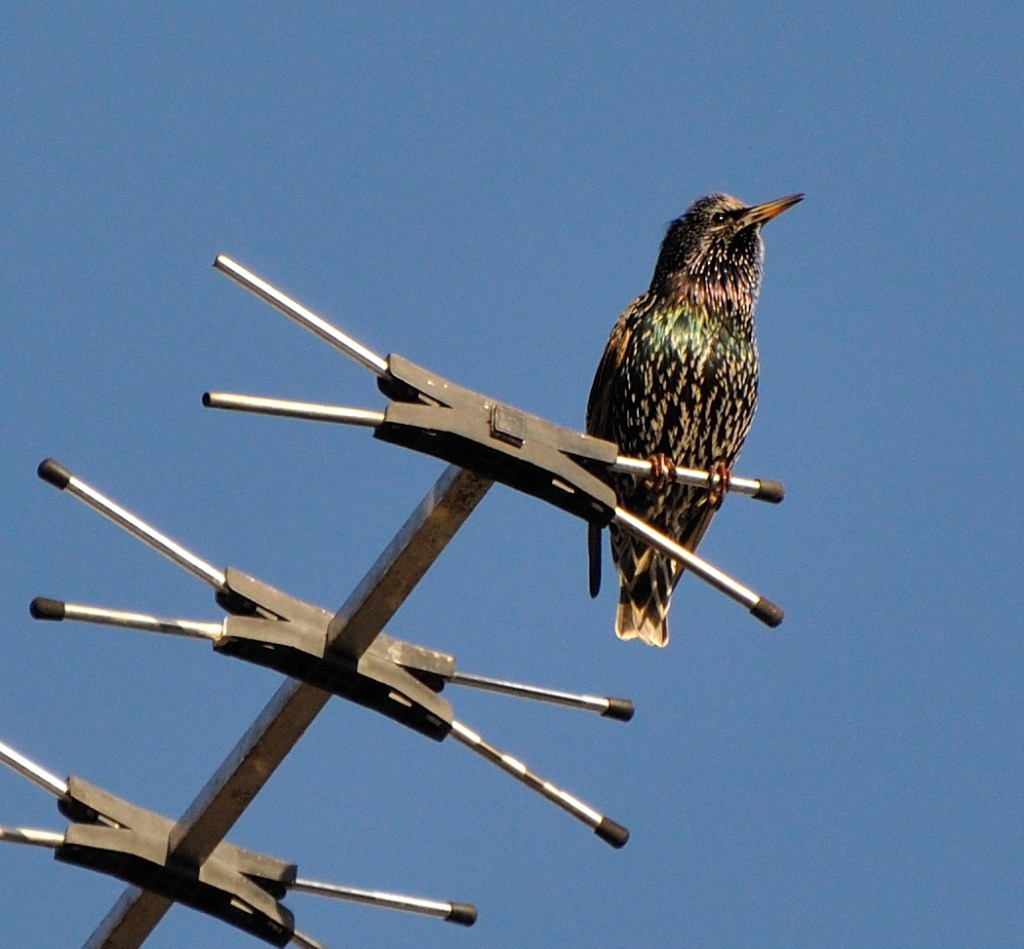
Starling, by M. Shattock

But, now that a pandemic is truly upon us, I’m more interested in the things I got wrong about the story, the things I failed to imagine. It didn’t occur to me to write about economic collapse, though of course that’s one of the things that’s easiest to notice about our current predicament. I didn’t think at all about the case fatality rate of the disease I was writing about: in the story, 90% of people who were infected died, though it seems to me now that a disease that deadly would burn itself out very quickly. It never occurred to me how much chaos and misery could accompany an infection with a 98% or 99% survival rate. I wish, now that I’m living through a real pandemic, that I had said something about the dithering and denial of the authorities in the early days.

If you don’t happen to have the June 2012 issue of Analog Science Fiction and Fact lying around, you can read the story here. I can reassure you that there is a redemptive arc to the story, just the sort of thing a reader might need while hunkering down through a real pandemic.

Thoughts on 2001: A Space Odyssey

23 Sunday Feb 2020

Posted by Joe in Biology, Journeys, Literary criticism, Musings and ponderation, Science, Science Fiction, SETI

≈ 1 Comment

Tags

2001: A Space Odyssey, aliens, mythopoesis, Science Fiction, SETI

I had the joy of watching 2001: A Space Odyssey on the big screen the first time in my life a little while ago. For those of you living near Portland, The Hollywood Theater purchased a 70 mm print of the film a couple of years back, and they show the movie to a sold-out house a couple of times every year. I had seen the film many times before on video–it’s one of the truly formative pieces of art in my life–but seeing it in a literally larger-than-life format impressed me deeply: the movie reminds me why I work in the genre of science fiction.

One of the most celebrated elements of the film has been its technological accuracy. Stanley Kubrick and Arthur C Clarke, working before CGI or the moon landing, were able to predict so many of the challenges and curiosities of living and working in space. As much as I loved Star Trek and Star Wars growing up, I always had the sense that those two franchises were more science fantasy than science fiction (especially Star Wars). 2001, by contrast, looked like some thrillingly-plausible documentary footage from a future just over the horizon.

But it is not the accuracy of the film that affects me so much now. Rather, 2001 is worth watching because of what Tolkien would have called its mythopoesis: its creation of a new mythology in which we could view our modern predicament. As much as any other work of art I can think of, 2001 gets at the painfully intermediate position of our species as part animal and part divine: the film is a 164-minute meditation on Hamlet’s musing: “What a piece of work is a man! How noble in reason! how infinite in faculties! in form and moving, how express and admirable! in action how like an angel! in apprehension, how like a god! the beauty of the world! the paragon of animals! And yet, to me, what is this quintessence of dust?”

(Another quote, just as apt, comes from Nietzsche’s Thus Spake Zarathustra, the book which also inspired the iconic theme music for 2001: “Man is a rope, tied between beast and overman—a rope over an abyss … what is great in man is that he is a bridge and not an end.”).

While the film is set in space in the near future, as realistically as Kubrick and Clarke could conceive of it, the setting is just as much a place of the inscrutable divine: in other words, its setting is really The Dreamtime, the Underworld, Faerie. Even though the US Space Program was deeply influenced in real life by 2001, the movie is closer to the mystical cave paintings of Chauvet or Lubang Jeriji Saléh than it is to the Space Shuttle and the International Space Station.

Of course, there are many elements of any piece of science fiction that won’t hold up well after 50+ years. In the case of 2001, Kubrick and Clarke seriously underestimated the amount of progress our species would make in some aspects of information technology, while at the same time overestimating the progress we would make in artificial intelligence and manned spaceflight. Those are easy mistakes to make, by the way: I can’t think of any science fiction before the 1980s that successfully anticipated the internet, and of course a movie made in 1968, the year before Apollo 11, would extend the logic of manned spaceflight out to regular orbital shuttles and populous moon bases and manned Jupiter missions.

But the beauty of 2001 is not how much the movie correctly predicted but rather how well it explores the timeless theme of what it means to be a human being. What strange gods called out of the darkness to our rude, frightened hominid ancestors to make us human? What awaits us if we can survive the deadly unintended consequences of our own ingenuity? In wrestling with those questions, 2001 is every bit as bottomless a work of art as Paradise Lost or Faust or the Popol Vuh. One can argue that there are no gods that made us, that the monoliths of the movie will never be found because they never existed in the first place. However, 2001 speaks to something very deep in our cultural DNA (and, for all I know, in our literal DNA): the yearning for our spiritual parents.

Two hundred years from now, if we somehow survive this dreadful bottleneck of overpopulation and ecological collapse, our descendants may be living in domed cities on the moon and Mars; we may be gliding in beautiful submarines through the oceans of Europa and Ganymede. We will still be looking for the monoliths.

Review of The Origins of Creativity

14 Saturday Apr 2018

Posted by Joe in Biology, Book reviews, Musings and ponderation, Science Fiction

≈ Leave a comment

Tags

biology, E.O.Wilson, Edward O. Wilson, Lascaux, Literary criticism, Science Fiction, STEM, The Origins of Creativity, Willendorf Venus

Edward O. Wilson’s latest book, The Origins of Creativity, is a return to the trails Wilson explored almost 20 years ago in Consilience: The Unity of Knowledge. In both books, Wilson attempts to bridge the gulf between the sciences and the humanities which has opened over the last century or more. Wilson makes a heroic effort in The Origins of Creativity (touchingly so, given that the great scientist is nearly ninety years old and has given the book some of  the touches of a final work). In the end I was unpersuaded by his exertions, but I am grateful for his return to a theme which is so meaningful for me personally. And, if Wilson’s proclamation of a coming Third Renaissance doesn’t quite convince me, I believe that Wilson still does us yeoman’s service in making an attempt to unify the humanities and the sciences.

Wilson’s starting point is uncomfortable, though obvious, for English teachers everywhere: the science, technology, engineering, and mathematics (STEM) fields have far outstripped the humanities in the public funds they receive, and STEM fields have been vastly more successful at producing lucrative jobs for college graduates. Elected officials regard the arts & humanities as luxuries whose comparatively tiny public budgets are often hard to justify.

Wilson’s diagnosis of the problem is that the humanities are stuck in the cultural cul-de-sac of present day. As Wilson puts it: “The main shortcoming of humanistic scholarship is its extreme anthropocentrism. Nothing, it seems, matters in the creative arts and critical humanistic analyses except as it can be expressed as a perspective of present-day literate cultures.”

While I do think that much of what goes on in the humanities is culturally blinkered, I’m not exactly sure how one would go about making the humanities less anthropocentric. The purpose of art is to explore what it means to be a human being–the humanities are anthropocentric by definition.

It is true that, with the exception of some artists working in the genre of science fiction, most artists and humanities scholars are not deeply educated around science. To put it another way, I think most scientists know way more about the humanities than most humanities scholars do about science. However, I’m not sure how our becoming more literate about evolutionary psychology and paleontology will make artists less anthropocentric. Art is one of the most anthropocentric activities on earth.

Would it help bridge the gulf between the arts and the humanities if the arts expressed something other than “a perspective of present-day literate cultures?” Maybe, but I don’t see it.  True, we would probably gain something by being better educated about the deep, biologically-driven ways that the lives of “present-day literate cultures” are related to the lives of the Lascaux Cave painters and the sculptor of the Venus of Willendorf. It does help us to recognize (and I think most present-day literate people do recognize) that those paleolithic artists were just like us in their humanity–their emotional lives were just as rich and subtle as Margaret Atwood’s. And, I do suppose that realization helps us in humanity’s most pressing moral challenge, that of seeing all humans across time and space as part of a single family, our common fate tied to the health of the ecosystem in which we live.  

Lascaux II

But this realization will not by itself bridge the gulf between the humanities and the sciences. That gulf is there because there is simply too much information to keep tabs on in the sciences for any human being to become an expert in more than a very small number of fields. It may be that our species is gathering scientific insights so quickly now that it’s impossible for a single human to become a true expert even in a single field as broad as chemistry or biology.

I’ll be the first to argue that artists could afford to learn a lot more about STEM fields. After all, science and technology are some of the most important organizing principles of human existence today. But whatever art we produce will still be to a certain extent time-bound: we make the art we do to give our lives a some kind of shape that makes sense to us. Our art remains bound in time and place because the human condition binds us to the time and place we live in.


Loneliness

31 Wednesday Jan 2018

Posted by Joe in Biology, Musings and ponderation, Science, Stories, Utopia and Dystopia

≈ 2 Comments

Tags

loneliness, Scientific American, Stories

all alone.jpg

Sculpture Credit: “All Alone,” by a young Gloria Pitkin

To be a modern human is to contend with loneliness.

While this insight has been with us for decades or even centuries, it’s only recently that a body of research around the causes of loneliness, as well as its effects and its cures, has started to catch the public imagination.

Folks like Kafka and Camus seemed to assume, in the previous century, that loneliness was simply fundamental, part of the warp and weft of human existence. Today, though, researchers have begun to argue that loneliness is no more basic to human existence than tuberculosis–that, in fact, loneliness is a medical condition that can be prevented and cured.

The January issue of Scientific American has an article on loneliness that really spoke to me, perhaps because I was so lonely for so much of my youth. The author, Francine Russo, argues that in much the same way that the disease of consumption was medicalized and clinicalized into tuberculosis, we may be in the process of reconceiving loneliness as a treatable and preventable disease rather than a central reality of the human condition. For an artist like John Keats in the early 19th century, tuberculosis and loneliness were existential threats that he spent his life and work grappling with. Today, TB is (for many people in the developed world, anyway) something that one is vaccinated against.

But what vaccine is available for loneliness? Russo suggests cognitive behavioral therapy (CBT), a technique which has had deeply positive effects on my own life. And yet, in spite of my having experienced both chronic loneliness and CBT first-hand, I lacked the imagination to conceive of loneliness as a disease rather than a consequence of my very flawed character.

The other thing that dawned on me as I read the article was just how often I write about lonely characters in my stories. I just signed off on the galley prints for my latest story, “Potosí,” and realized that the main character spends a good deal of the story in utter solitude. Just like Miranda in “Full Fathom Five,” Epic in “Proteus,” and Sandra in “Lamp of the Body.” Stories with well-adjusted characters and lots of friends seem to be more rare with me.

As with all things Scientific American, the print article isn’t available online, but this closely related SciAm blog post is.


Science Fiction As a Gateway Drug

14 Thursday Jul 2016

Posted by Joe in Biology, Games, Journeys, Musings and ponderation, Science Fiction

≈ Leave a comment

Tags

nerd culture, sci-fi, Sid Meier's Alpha Centauri, utopia

For a few years in boyhood at least, I loved science and technology. One of my fondest childhood television memories was of watching the original Cosmos miniseries with my dad, seeing Carl Sagan in his turtleneck and corduroy blazer as he traveled the universe on his “Ship of the Imagination” over Vangelis’ spacey soundtrack. I can remember my dad scoffing pretty frequently at Sagan’s goofily over-acted facial expressions–Sagan perpetually appeared to be having some kind of ineffable and mystical experience on his dandelion-seed ship–but the show appealed to the ten year-old me, so much so that I believed in 5th grade that I was destined to become a physicist.

I left science behind in junior high school for the same reasons that a lot of kids do: math and science classes were difficult (often not all that well-taught, too); I struggled with the emotions of puberty and my parents’ divorce and didn’t find factoring polynomials to provide much of an escape from my problems. For a couple of years I became a lackluster student in most subjects, but especially so in science and math, culminating in my freshman year of high school with the lowest grade I received in my many years of formal schooling (a D+ in biology).

Somewhere around age 14 I realized that the kids I thought were cool–the orchestra and debate kids who watched Stanley Kubrick movies and listened to classical music for fun–seemed to get As and Bs pretty effortlessly. And I wanted enough to be like them that I wised up in school a little. However, my perception of those cool kids was that coolness was all about literature and music, Camus and Sartre and Kafka and Stravinsky and Bauhaus (the band, not the architectural movement). Coolness had little to do with science and math beyond getting good grades. And so my trajectory through high school, college, and some time beyond kept me almost entirely in the humanities, with results which I probably could have predicted and which might have depressed me if I had predicted them: by age 24 I had a master’s degree in English and was an adjunct faculty member of a tiny community college.

Given where I ended up, how did I come back to science at all? I came back the same way that many, many young people get into the sciences in the first place: through science fiction. In 1998 I purchased one of the seminal computer games of all time: Sid Meier’s Alpha Centauri. Players of Alpha Centauri guide a faction of colonists through the development of humanity’s first settlement beyond the solar system. I was fascinated by the idea of a planet-wide university, of colonists building supercolliders and space elevators and massive ecological engineering projects.I loved the idea of a human society devoted to the acquisition of knowledge and careful stewardship of natural resources–an ideal that sometimes seems far removed from the society I actually live in.

Sid Meier's Alpha Centauri - PC - IGN

I also realized (pretty slowly, after a couple hundred hours of game play) that all of the projects which the game modeled on this fictional alien world were projects that real human beings were actively pursuing on this planet, for good and ill. Among them, there are massive environmental protection projects, ecological restoration projects, and sustainability efforts whose success or failure will determine the future of human civilization. I realized that I wanted to live in a world of science, not merely as an observer, but as an active participant.

In years since, the burgeoning of the internet, with its powerful democratizing effects, its incubation of the citizen science movement, of “outsider science,” of the makers’ movement, has convinced me that the ideal of a human society made entirely of scientists, naturalists, and ecologists could be our society. All people can become scientists. Becoming a scientist requires time and dedication, but it requires no secret gnosis that is kept from non-scientists. Do I want to learn how volcanism works? I have only to read and observe for several hundred hours before I will know a good deal about it (ironically, that’s about how much time I spent playing Sid Meier’s Alpha Centauri). Do I want to learn calculus? Khan Academy is right here on the internet, assuring me that I can learn anything, for free, forever.

You Can Learn Anything | Valley Oaks Charter School Tehachapi

As there is in most science fiction, there’s a lot of hand-waving and pseudo-scientific ersatz explanation in Sid Meier’s Alpha Centauri. Some of the hand-waving, now that I know a little more about science, seems pretty laughable in retrospect. But that hand-waving got me in the door, years after I’d thought I’d closed the door. People like Gene Roddenberry and Sid Meier have done as much to recruit scientists as anyone on earth.


Finn the Human Boy: a Modern Gilgamesh

27 Friday May 2016

Posted by Joe in Biology, Literary criticism, Musings and ponderation

≈ 2 Comments

Tags

fantasy, Finn and Jake, Gilgamesh, monsters, mythopoesis, nerd culture

I’ve been trying to learn a little more about graphic novels–a literary genre that I have almost no experience with–and pulled from the public library shelf Gilgamesh: A Graphic Novel by Andrew Weingarner. I have always been fascinated by the epic of Gilgamesh, the oldest written story known to humanity: I loved the old John Gardner translation of the story, and I had a good time with this graphic retelling. The various cosmic monsters that Gilgamesh battles are drawn very well–they’re intense, original, but also evoke a Mesopotamian vibe.

The central partnership in the story–the ur-dynamic duo that informs so many later character dyads–is that of Gilgamesh and Enkidu: Gilgamesh, the civilized, anxious, ambitious king, and Enkidu, the wild and natural “hairy man.” The duo appears later as Don Quixote and Sancho Panza,  as Prince Hal and Falstaff, as Han Solo and Chewbacca.

And, I realized a little later, as Finn and Jake from Adventure Time.

Besides the cosmetic similarities of the two pairs, Finn the human boy and Jake the magical talking dog are also spiritual and characterological siblings to Gilgamesh and Enkidu. Like Gilgamesh and Enkidu, Finn and Jake are perfectly matched combatants, each unable to defeat the other, whether in combat, in their long-running pranking competitions, or in their frequent video game and Card Wars match-ups. Like Gilgamesh, Finn is a rambunctious upstart, eager to attack real or perceived injustice head-on, usually through violence. Like Gilgamesh, Finn is also beset with anxiety–often as a result of his phobias or bad dreams–yet Finn and Gilgamesh are also paradoxically able to set aside their nagging dread and fight fearlessly, even foolhardily, in battle.

Jake is a striking modern recreation of Enkidu, literally a magic talking animal. In much the same way that Enkidu advises and guides Gilgamesh, Jake is wiser and more experienced than Finn in most matters, especially those relating to the basic animal appetites for sex and sleep and food.

Both duos spend their time hustling from cosmic battle to cosmic battle with monstrous or demonic antagonists. It’s easy to imagine Humbaba, the earlier epic’s demonic guardian of the cedar forest, as a creature drawn for Adventure Time (even Humbaba’s name would fit well in Adventure Time); it’s just as easy to imagine an Adventure Time antagonist like Hunson Abadeer appearing in a sculpture from some Sumerian ruin.

Found on a Mesopotamian fresco…

The mapping of one duo to another isn’t perfect–Gilgamesh is a character rooted in a 3000 year-old value system that doesn’t translate well to our own. He is cruel by our standards: violent, an abuser of women, a despoiler of the environment (ironically, the pre-civilized Enkidu is much easier for contemporary readers to sympathize with). But the Gilgamesh-Enkidu pairing still speaks to us in much the same way that Finn and Jake speak to us, because the relationship is archetypal. The relationship speaks to our odd predicament as creatures that are both animal and transcendent of our animal nature: we are, as Hamlet says, “in action how like an angel! In apprehension, how like a god,” yet we are at the same time deeply aware of our brutish status as just another mammal, tied down to the “Four Fs” of feeding, fighting, fleeing, and reproducing that govern all animal life. For both Gilgamesh-Enkidu and Finn and Jake, we are promised that all good things in life–justice, mercy, peace, love–come to us when these two natures are reconciled and act in partnership. We are warned that madness follows when we act in opposition to it.

A Meditation on Time

18 Thursday Feb 2016

Posted by Joe in Biology, Musings and ponderation, My Fiction

≈ Leave a comment

Tags

big 19th century novels, dystopia, resolutions, that strumpet Fame, utopia, writing practice

I have been taking my sweet time in reading Anna Karenina, a Christmas gift from my lovely stepdaughter. At the rate I’m going, I would guess I have two more months with this delicious, painful, hilarious book. Meanwhile, as I dither through this enormous work of art, it’s been hanging over my head that I don’t keep up my blog as befits a serious writer, dispensing witty remarks and novel observations at least once per week.

I really don’t yearn for “simpler times” (e.g. Tolstoy’s time), in which the world of ideas moved more slowly and people had time–from our perspective, anyway–to write long letters and long novels, to linger over an idea in a journal for months and even years. Many people of Tolstoy’s day didn’t regard their time as leisurely: they felt as rushed and harried as we do now, since the era of railroads and electricity had sped up life for them at an unprecedented rate. Perhaps in a hundred years my descendants will regard my lifestyle as leisurely, since most of us today don’t yet have Adderall prescriptions or cranial implants or other technological prostheses to speed up our rate of pumping out new ideas and reacting to new ideas we see.

This morning as I read my ten pages on the bus, I was taken by Tolstoy’s words about time: Prince Shcherbatsky is reacting to being told that “time is money,” and he says, “Time, indeed, that depends! Why, there’s time one would give a month of for fifty kopeks, and time you wouldn’t give half an hour of for any amount.”

It occurred to me as I sat with that quote today that I have given away lots of time in my life for fifty kopeks, or for less. When I returned to graduate school in my thirties, I was so excited to be able to take classes at public expense (since I am an employee of the state, my classes cost $5 per course)–I often joked with people that I had spent more money on parking tickets than on tuition when I was in grad school the second time. I feel thankful to the Great State of Washington every time I think of what I learned there.

But I also made a huge blunder by valuing my labor at zero in those days. The courses cost $5, so my degree must only cost about $100, no? Yet, of course there was the massive opportunity cost of my shutting myself up for years to read academic papers on ecology and statistical analysis: there were hikes I didn’t take, other skills I didn’t learn, traveling I didn’t do. I’ve written in a couple of my stories from that period about students who get into ecology because they love spending time outdoors in nature, but that their ecological studies lock them up in a lab for months on end doing gas chromatography or grinding up plant tissue samples.

I’ve come home with a fever tonight–ironically, the fever is what has slowed me down enough to be able to meditate about time in this blog post. And I have realized that as I age, I am becoming less and less willing to give up time to others (that is, to people I don’t love) for any amount. Even if by magic I could, I wouldn’t give up this feverish time tonight–unpleasant as it is–for money. I’m sure I have my price for taking on more work, but I’m realizing that the price is much, much higher than a community college would typically pay. I would just rather have the time.

← Older posts

Subscribe

  • Entries (RSS)
  • Comments (RSS)

Archives

  • January 2026
  • November 2025
  • September 2025
  • August 2025
  • July 2025
  • May 2025
  • April 2025
  • March 2025
  • January 2025
  • December 2024
  • October 2024
  • September 2024
  • August 2024
  • June 2024
  • May 2024
  • April 2024
  • March 2024
  • February 2024
  • January 2024
  • December 2023
  • October 2023
  • August 2023
  • July 2023
  • June 2023
  • April 2023
  • March 2023
  • May 2022
  • August 2021
  • June 2021
  • January 2021
  • October 2020
  • May 2020
  • March 2020
  • February 2020
  • January 2020
  • July 2019
  • June 2019
  • December 2018
  • October 2018
  • July 2018
  • May 2018
  • April 2018
  • January 2018
  • December 2017
  • November 2017
  • September 2017
  • August 2017
  • July 2017
  • June 2017
  • May 2017
  • April 2017
  • March 2017
  • February 2017
  • January 2017
  • December 2016
  • November 2016
  • October 2016
  • August 2016
  • July 2016
  • June 2016
  • May 2016
  • March 2016
  • February 2016
  • January 2016
  • December 2015
  • November 2015
  • October 2015
  • July 2015
  • May 2015
  • March 2015
  • February 2015
  • January 2015
  • December 2014

Categories

  • A Place for my Stuff
  • Advertising
  • Artificial Intelligence
  • Beta Readers
  • Biology
  • Book reviews
  • Curious Fictions
  • Dungeons and Dragons
  • Exit Black
  • fantasy
  • Games
  • HPIC
  • Journeys
  • Let's All Admire That Fantastic Can
  • Lit News
  • Literary criticism
  • Musings and ponderation
  • My Fiction
  • Pacifica
  • Politics
  • Reading Roundup
  • Science
  • Science Fiction
  • Science Fiction Writers of America
  • SETI
  • Stories
  • Stranger Bird
  • The Ideal Vehicle
  • The Time of Troubles
  • Uncategorized
  • Utopia and Dystopia
  • Welcome
  • YA fantasy

Meta

  • Create account
  • Log in

Authors

  • Joe's avatar

Blog at WordPress.com.

  • Subscribe Subscribed
    • The Subway Test
    • Join 145 other subscribers
    • Already have a WordPress.com account? Log in now.
    • The Subway Test
    • Subscribe Subscribed
    • Sign up
    • Log in
    • Report this content
    • View site in Reader
    • Manage subscriptions
    • Collapse this bar
 

Loading Comments...