• About
  • My Fiction
  • Reviews

The Subway Test

~ Joe Pitkin's stories, queries, and quibbles regarding the human, the inhuman, the humanesque.

The Subway Test

Category Archives: HPIC

How to Comp

15 Tuesday Aug 2023

Posted by Joe in Advertising, HPIC, Musings and ponderation, My Fiction, Pacifica, Utopia and Dystopia

≈ 13 Comments

Tags

books, marketing, publishing, query letters, sci-fi, Science Fiction, utopia

I’ve known for a long time that writing is a business. But knowing that writing is a business is no guarantee that one knows how the business works. There’s good circumstantial evidence that for the past 20+ years, I haven’t had the foggiest idea about what I’m doing.

Where my writing career is concerned, I’ve tried to follow Steve Martin’s exhortation to be “so good they can’t ignore you.” But what that quote elides is that it’s still up to the writer to give the audience a chance not to ignore you. I could be as good a writer as Emily Dickinson, but if I don’t know how to get people’s attention, my career could still end up like, well, Emily Dickinson’s.

I’m facing this challenge as I go out for a literary agent for my third novel, Pacifica. (I have an excellent agent, Scott Veltri, for TV and movie projects, which is the hope for my novel Exit Black. But Pacifica is not on the list of 10,000 books I would think of for a movie tie-in). As anyone who has ever gone out for an agent knows, a query letter is one of the writer’s few early opportunities to show their understanding of writing as a business. And one of the things I’ve only recently gotten a feel for is the importance of comps for the novel I’m trying to sell.

Comps–short for comparative titles–are a short list of recent books that are similar to the novel you’re selling. And there are apparently rules, or at least norms, regarding the art of good comps. Here are the ones I’ve picked up at conference panels, in writing guides, and intuition:

  • Pick no more than three books (though apparently one of the books can be a movie or tv program)
  • Pick recent, commercially successful works, but
  • Avoid comparing your work to that of literary A-listers (e.g. no Annie Proulxes or Cormac McCarthys)

Are these the rules? If I knew, more people would probably be reading my writing. If you have better intel on how comps work, please jump in the comments or feel free to DM me! I can tell you what wasn’t working for me, though:

  • Not offering a list of comps in my query letter
  • Comparing my work to Ursula K. Le Guin’s (though I don’t think I’m wrong! Read Stranger Bird yourself and you be the judge)
  • Dissing other writers’ work (at the time I was lathered up about what I called the Harry Potter Industrial Complex)

None of these remarks got me an agent, and I suspect now that that was because my approach showed that I didn’t understand how the publishing business works. Agents and publishers want to know comps for a simple reason: they want to know what has already sold well that is similar to the book you are selling. It doesn’t matter if your book is the most exquisitely constructed exploration of the human heart since Anna Karenina–an agent wants to know if your novel will sell.

Is that a mercenary attitude? Maybe. Is it a rule that you must have comps? Absolutely not. But there’s also no rule that says I have to wear pants to a job interview. If I want to wear jorts to my next job interview, that’s my right as an American. However, wearing jorts to an interview will foreclose on just about every job offer outside of a very small set of jorts-positive jobs, many for which a 53 year-old man wouldn’t be an attractive candidate anyway.

My last unsuccessful job interview. Photo credit Carlyn Eames

So, what am I pitching as my comps for Pacifica? My three are Gabrielle Zevin’s Tomorrow, and Tomorrow, and Tomorrow; Anthony Doerr’s Cloud Cuckoo Land, and Russell Brand’s The Magic Kingdom–three very different books (and one of them I wasn’t even crazy about). But they’re three recent, commercially successful books, each with a passing resemblance to my book about a guy who has a religious vision playing video games which spurs him to found several increasingly ridiculous, polyamorous intentional communities. I guess that’s not exactly a concept which sells itself. Hopefully the comps will help me market it.
The New Yorkering of Science Fiction

14 Wednesday Jun 2017

Posted by Joe in Book reviews, HPIC, Literary criticism, Musings and ponderation, Science Fiction

≈ 2 Comments

Tags

fandom, fantasy, Laura Miller, literature, marketing, sci-fi

A couple of weeks ago one of my writing group comrades passed along to me this Laura Miller article from Slate on the incursion of “literary novelists” into the field of science fiction. I often find the premise of such articles cringeworthy–that there are good, serious writers out there who used to write good, serious fiction about failing marriages and suburban malaise but who now have decided, who knows why, to write crap about lasers and robots with big boobs.

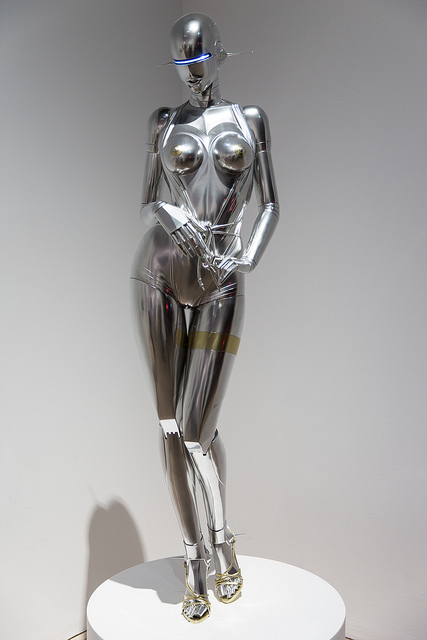
Hajime Sorayama--Sexy Robot

Hajime Sorayama, Sexy Robot–photo credit Moody Man

Miller’s article is more nuanced than that–it acknowledges that the line between literary fiction and science fiction has always been blurry, and that calling a book “literary fiction” is no more a guarantee of its quality than calling a book “science fiction” guarantees that it is trash. Miller’s basic argument is that life is changing so quickly now that a contemporary story is dated almost before it is finished: if I am a literary novelist writing about a Tinder romance that goes sour, who knows what online romance trend will have replaced Tinder by the time I finish my book five years later? Wouldn’t it be better for me, then, to imagine a near-future dating app, so that when my book comes out I seem “buoyantly dystopic” and “a literary polymath” to reviewers?

I don’t dispute Miller’s reasoning: I hadn’t thought about it before, but surely some of the near-futuristic “serious fiction” out there is meant as a commentary on the pace of change in our lives and how maddening it is for us to try and keep up with it all.

But I’d like to suggest another hypothesis to explain the huge influx of Columbia MFA grads and New Yorker raconteurs into the slums of science fiction. Part of the shift, I’m sure, is that the last two generations of writers have grown up watching science fiction movies and TV with good production values and believable special effects. Science fiction was often regarded as shlocky in the pre-CGI era, and certainly before the breakthrough of Star Wars, partly because so many sci fi movies looked so clunky and fake. (Of course, there were excellent exceptions in the years before Star Wars, movies like 2001:A Space Odyssey, Forbidden Planet, and George Pal’s War of the Worlds, but these were rare glints of gold in a sea of Plan 9 From Outer Space dross).

Today, however, it’s possible for even a modestly-budgeted TV show–to say nothing of a big budget movie–to have the kind of truly believable special effects on which good sci fi viewing depends. And the existence of commercially successful, well-made science fiction movies catalyzes the creation of more such work, attracting writers and filmmakers with serious artistic chops–no one needs feel ashamed anymore that they like science fiction (at least the highbrow literary “speculative fiction” of Margaret Atwood or Michael Chabon).

One might argue that the crossover popularity of a writer like Vonnegut is what opened the floodgates to good science fiction. I disagree: Vonnegut was regarded for most of his career as a literary oddball, someone who would be a major writer if only he didn’t write science fiction. And Vonnegut’s popularity in the seventies did not facilitate the mainstream popularity of other science fiction greats like Ursula Le Guin and Stanislaw Lem (both of whom, thank goodness, have since received some of the attention they deserve).

The fact is that until recently, practically the only speculative writers who were unequivocally welcomed into the literary canon were authors from the non-English speaking world: people like Kafka and Borges, and later García Márquez and Calvino. And some would still argue that their inclusion in the canon is proof that what they were writing was something other than sci fi or fantasy–if you want to make a college English professor flip out, try calling “The Metamorphosis” or “The Library of Babel” a science fiction story.

Am I bitter about it? I suppose I must be–why else would I write 700 more words in defense of science fiction writers? In the long run, though, if David Foster Wallace and Jennifer Egan get the highbrow readers to crack a science fiction novel, if that brings them to look, eventually, at Octavia Butler or John Crowley, then who am I to complain?


A Tiny, Imaginary Rubicon

30 Monday Jan 2017

Posted by Joe in HPIC, Musings and ponderation, My Fiction, Stories

≈ 2 Comments

Tags

books, fantasy, Harry Potter, Lloyd Alexander, marketing, publication, Richard Adams, self-publication, Ursula Le Guin, YA fantasy

Some years ago I wrote a young adult fantasy novel called Stranger Bird. That book was my attempt to recreate for my young daughters some of the feeling I had reading fantasy literature as a boy.

I hope and believe I have accomplished that much. But whatever other hopes I nursed for Stranger Bird–publication, a wider readership, a little money–have been a fool’s errand: after the coming of Harry Potter and the Harry Potter Industrial Complex (HPIC), YA fantasy thoroughly changed (mostly, though not in every way, for the better). I wrote Stranger Bird to harken back to an older style of fantasy, more mythical, perhaps a little darker: the Earthsea books of Ursula K LeGuin, Richard Adams’ Watership Down and Shardik, the Prydain series of Lloyd Alexander.

For whatever reason, I haven’t been able to find a publisher for a book like that today. Maybe Stranger Bird just isn’t very good. However, I have several indications that the book hasn’t been rejected on the basis of its lack of literary quality. A couple of times the manuscript got to the desk of the head editor of the house, and one small house did in fact offer to publish it if I would change the style of the book (the changes were a bit much for me, so I declined). I’ve gotten some good external validation of my other work, stories that I consider no better than Stranger Bird: 15 of my stories have been picked up for publication;  my work has been anthologized five times; I’ve picked up nice reviews in Locus and SFRevu and elsewhere.

It’s even fair to say that I started writing fantasy and science fiction short stories to try and gin up a name for myself that would attract the attention of an agent for Stranger Bird–the big publishing houses won’t look at anything not represented by an agent (I was late learning that it’s generally harder to find an agent than a publisher). And yet, after trying with seven publishing houses and 23 agents, I’ve not been able to sell Stranger Bird on my own terms.

I realize now that I’ve been too snooty, and too squeamish, about self-publishing.

My goals are modest. I’ll state them here: I want 100 readers for Stranger Bird. I’m willing to work to find them. And I’m willing to work to make them feel special. Any more than 100 readers will be gravy–I will consider the whole business enterprise a success if I can get 100 people to read the book.

I don’t know yet what I will call my imprint. And I know I have a lot to learn about the business end of publishing–that’s a side of things I have little talent for and almost no experience with.

But I’m committed. A couple of weeks ago I turned in my bio for my next story publication (a John Demetrius story called “Proteus,” appearing in Analog soon), and at the bottom of the bio I added a line I’ve never used before: his YA fantasy novel Stranger Bird will be appearing this year. It felt good, and it felt scary, to add that line. Keep watching this space; I’ve crossed a tiny, imaginary Rubicon.


Subscribe

  • Entries (RSS)
  • Comments (RSS)

Archives

  • November 2025
  • September 2025
  • August 2025
  • July 2025
  • May 2025
  • April 2025
  • March 2025
  • January 2025
  • December 2024
  • October 2024
  • September 2024
  • August 2024
  • June 2024
  • May 2024
  • April 2024
  • March 2024
  • February 2024
  • January 2024
  • December 2023
  • October 2023
  • August 2023
  • July 2023
  • June 2023
  • April 2023
  • March 2023
  • May 2022
  • August 2021
  • June 2021
  • January 2021
  • October 2020
  • May 2020
  • March 2020
  • February 2020
  • January 2020
  • July 2019
  • June 2019
  • December 2018
  • October 2018
  • July 2018
  • May 2018
  • April 2018
  • January 2018
  • December 2017
  • November 2017
  • September 2017
  • August 2017
  • July 2017
  • June 2017
  • May 2017
  • April 2017
  • March 2017
  • February 2017
  • January 2017
  • December 2016
  • November 2016
  • October 2016
  • August 2016
  • July 2016
  • June 2016
  • May 2016
  • March 2016
  • February 2016
  • January 2016
  • December 2015
  • November 2015
  • October 2015
  • July 2015
  • May 2015
  • March 2015
  • February 2015
  • January 2015
  • December 2014

Categories

  • A Place for my Stuff
  • Advertising
  • Artificial Intelligence
  • Beta Readers
  • Biology
  • Book reviews
  • Curious Fictions
  • Dungeons and Dragons
  • Exit Black
  • fantasy
  • Games
  • HPIC
  • Journeys
  • Let's All Admire That Fantastic Can
  • Lit News
  • Literary criticism
  • Musings and ponderation
  • My Fiction
  • Pacifica
  • Politics
  • Reading Roundup
  • Science
  • Science Fiction
  • Science Fiction Writers of America
  • SETI
  • Stories
  • Stranger Bird
  • The Ideal Vehicle
  • The Time of Troubles
  • Uncategorized
  • Utopia and Dystopia
  • Welcome
  • YA fantasy

Meta

  • Create account
  • Log in

Authors

  • Joe's avatar

Blog at WordPress.com.

  • Subscribe Subscribed
    • The Subway Test
    • Join 144 other subscribers
    • Already have a WordPress.com account? Log in now.
    • The Subway Test
    • Subscribe Subscribed
    • Sign up
    • Log in
    • Report this content
    • View site in Reader
    • Manage subscriptions
    • Collapse this bar
 

Loading Comments...