Today, after a peer critique of the fifth or sixth fantasy story we’ve seen this quarter, I asked my fiction writing students how many of them were into fantasy. All but three of them raised their hands.
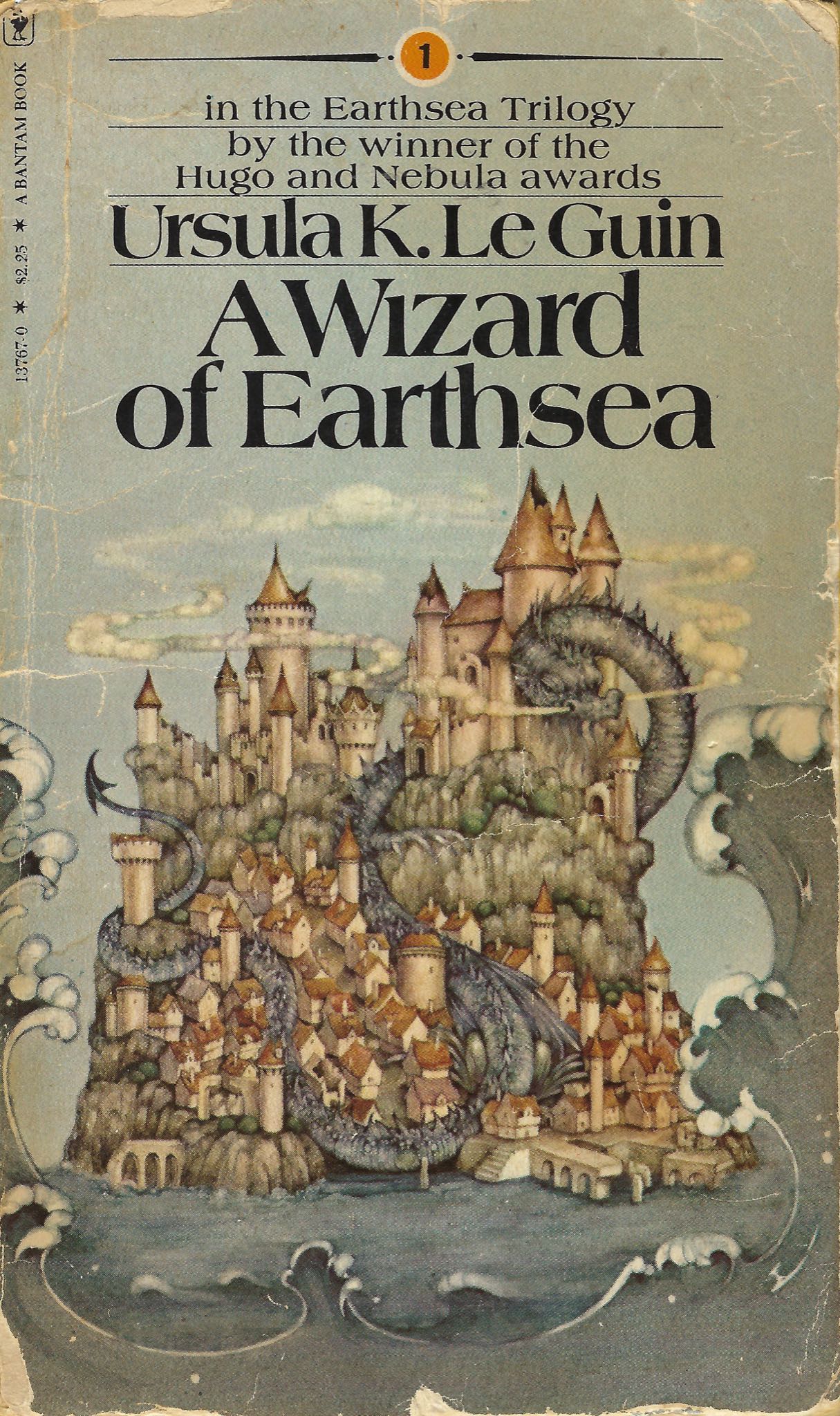
Then I asked how many of them had read A Wizard of Earthsea. Not one of them had.
Every once in a while, I’ll wonder what I’m doing, what inner problem I’m attempting to solve by working at a community college. Then I’ll have a moment like this, and I’ll realize that if my only contribution to my students’ lives is that I turned a few of them on to Usrula Le Guin–a woman who wrote practically all her books just a couple miles away on Thurman Street in Portland–I will have done something good with my life.
And you, dear reader, do you like fantasy? Have you read A Wizard of Earthsea? If you haven’t, go pick up that little book and check it out: you’ll see something that isn’t a hundredth as famous as Lord of the Rings, and which didn’t make a thousandth as much money for the author as Harry Potter did for J. K. Rowling, but Earthsea is better than both of them. Read it, and then contend with your desire to sue J.K. Rowling for plagiarism.
And as a bonus, if you aspire to be a fantasy or science fiction writer yourself, read just the first paragraph of A Wizard of Earthsea and see how much Le Guin accomplishes without a scintilla of infodump. What’s a dragonlord? you may ask as you read that first paragraph, What’s an archmage? The answer is who knows? It won’t matter, because you’ll already be hooked.
As you may remember from former posts, I’m a big fan of the book site Shepherd. And, like many of the writers on that site, I was invited by Shepherd founder Ben Fox to talk about my three favorite books of 2024. I was game, partly because I’m happy for any opportunity to link to my own book of this year, Exit Black–I believe it’s one of this year’s best thrillers on economic inequality that you’ll read this year.
I’m not sure what my choices say about me besides the fact that I do a lot of reading outside the genres I write in, but here were my three faves of this year: Edith Wharton’s The Age of Innocence, Toni Morrison’s Jazz, and Laurent Binet’s Civilizations. Why did I love them so? Check out my Shepherd page to find out!
I was invited recently to present a workshop at one of Oregon’s wonderful creative writing conferences–the Compose Creative Writing Conference at Clackamas Community College (perhaps the hosts tried to come up with a seventh word starting with c- for the title, but six must have been all they could fit in). After the honor of being invited wore off, I realized that I would have to actually, you know, present something at the CCWC at CCC.
I decided to present a session on reducing infodump in speculative fiction. Did I choose this topic because I’ve been widely praised for my taut, sleek stories? I wish. Actually, if anything the opposite is true: during the early years of my fiction career, I got so many rejections along the lines of “this story is well-written, but it takes forever to get to its point. There’s so much infodump here that I was barely able to get to page 8.”
The best thing I can say about infodump in my writing is that editors don’t complain about it in my stories nearly as often now. So I figure that I’ve either learned to deal with it or editors are just tired of giving me notes on it.
As you probably know already, infodump refers to bogging down the flow of a story with tedious explanation. And, while writers of any genre can fall into the habit, it’s an especially common problem in speculative fiction. If you’ve ever read a bad fantasy novel (or watched a bad sci fi movie), you have surely seen some infodump along these lines:
Scientist: I sequenced the DNA sample you brought me. Whoever provided it has some snips that I’ve never seen in a human genome before.
Captain: Snips?
Scientist: ‘Single nucleotide polymorphisms.’ As you know, captain, all sexually reproducing creatures on Earth–including humans–inherit two copies of each gene, one from the mother, and one from the father. These genes determine everything from eye color to explainexplainexplain continue explaining for four pages explainexplainexplain I hope you did well in middle school biology…
For me, infodump is even worse in fantasy than in science fiction. In SF, there’s at least the possibility that what’s being infodumped actually will teach you something real about how planetary motion works or what the principle of competitive exclusion is. In fantasy, the infodump often amounts to nothing more than 20 pages of the author’s fever-dream journal entries about a fictional queen who lived 800 years before the story takes place and what she did to curse the elven sword that is the McGuffin for this whole heptalogy of novels…
What causes infodump? Why should you be wary of the phrase “as you know” in your writing? And how do you reduce infodump in your novel? Well, if you want the whole story, come see me at the CCWC on Saturday the 18th! Or, if you’re not a Portland person, drop me a line: I’m always happy to talk F/SF with book clubs, writing groups, bookish nerds, random drunks, and people on a secret mission.
For now, I’ll just say that two factors that contribute to infodump are 1. writers’ mistrust of the reader’s ability to follow along, and 2. writers who get lost for hours (or months, or decades) in worldbuilding before they ever get around to actually writing their story.
I may say more on the subject soon, but as you know, I have been working on reducing my infodump.
I’ve been hunting for years for a better book recommendation system than Goodreads (and its corporate owner, Amazon). One site that I think really shows promise is Shepherd: it’s better-curated, less compromised, more values-driven. And I’m honored to announce that I have been invited to make a Shepherd recommendation myself. Mine is called “The best fantasy-science fiction books that explore class and inequality,” and I’d love to have people take a look at it.
I’m grateful to have a website taking on the Goodreads/Amazon juggernaut. Goodreads is one of those ideas that struck me as having so much promise when it came out: it seemed (at first, anyway) a place where everyone could share ideas about the books they love. But, far from being a democracy of bibliophiles, Goodreads is a crass book marketing system that has proven easy to game and to abuse, from review bombing to pay-for-reviews to careless and anonymous one-star reviews just for the lulz.
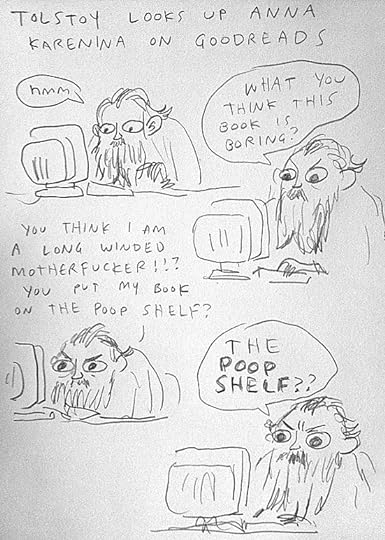
And, while my Goodreads reviews for Exit Black have been decent–more good reviews than bad, and a number of reviews from people who must have actually read the book–I am a little suspicious of a review site where The Martian has a higher rating than Madame Bovary and where only 42% of Anna Karenina reviewers gave that book 5 stars. Seriously?
Cartoon credit: Kate Beaton, Hark! A Vagrant
I accept that for better and worse, Goodreads and Amazon are the ways that authors have to market their books. I don’t have to like that state of affairs, but I do accept it. However, I’m always on the lookout for something better, something more humane, something not yet made grubby by millions of people on the make for a quick buck or trash-talking for the dopamine hit of a bunch of likes. Shepherd might not last. But for now, I really like the way they approach books and the people who write and read them. I hope you’ll go check it out!
I had every intention of publishing my interview with fellow Willamette Writer (and fellow community college teacher) Avis Adams when she published it almost two weeks ago. Then the end of winter term descended over me like a weighted blanket made of student essays and departmental emails. Now that I have finally wriggled out from under its sweaty embrace, I can give a little more attention to this blog, to promoting Exit Black, and to all things literary.
So, many thanks to Avis for cooking up some delightful interview questions and for offering such a warm reading of my book. Check out her review and my interview at her wonderful blog, Your Next Favorite Author.
When I was writing it, one of the ideas that guided my upcoming novel Exit Black was that it was to be “Die Hard in space.” Those may have been the exact words that my publisher and my agent used when describing the project to me.
They couldn’t have known when they pitched the project to me that I was not a fan of Die Hard. Practically every one who was a young man in 1988 America loved Die Hard. How could I have hated the most iconic action movie of all time?
The answer to that is mysterious to me. One might think that because of my Quaker religious practice, I blanched at all of the violence in Die Hard. And maybe I did somewhat. However, there are a lot of violent movies that I love–some of them (like Fargo) are arguably more violent than Die Hard. And I loved most of the people in Die Hard--Bruce Willis was really doing something new in action movies with his portrayal of a sometimes panicked, self-doubting John McClane.
I think if I had to pin down my early dislike of Die Hard, it was the studio’s use of Beethoven’s 9th Symphony in the trailers for the movie. That piece of music was a touchstone for me even in my youth–I hated the studio’s use of a sacred cultural treasure (one whose main theme is of peace and universal brotherhood, no less) to sell an action movie about killing a bunch of common thieves (spoiler–sorry). I only watched A Clockwork Orange once in my life because of the same cognitive dissonance around Beethoven’s 9th.
But I was excited to work on a project with my agent and with this publisher, and when they proposed Die Hard in Space I thought I’d better give the movie another look. On watching it again, I was still turned off by the celebration of violence, and there were a number of other elements that I had forgotten but which haven’t aged very well over the last 35 years. But I also saw something there that I hadn’t noticed the first time.
I saw the antagonist, Hans Gruber, with new eyes. He was cool, self-possessed, brilliant but not a blowhard the way a James Bond villain would be. Of course, it was also impossible on this later viewing not to see the arc of Alan Rickman’s career stretching off before him as he glowered like a panther, snarling in Hans Gruber’s faux German.
While I didn’t come to like Die Hard on this second viewing, I was entranced by Hans Gruber. I wanted to write a cool villain like that. I wanted to make a character who readers would hate but who also they would find fascinating, perversely compelling. I wondered if I could build a novel around an antagonist like Gruber, perhaps even someone who would be more antihero than antagonist, like the character of Satan in Paradise Lost.
And that was how I decided to take on the Exit Black project. While even now the book is being marketed as a kind of Die Hard in space, I often tell people I tried to write something more like a Coen Brothers remake of Die Hard: a story with all the ironies and regrettable choices of a Greek tragedy, focusing on a noble, hubristic, ruthless, chillingly violent antihero at the center of the story. Exit Black is a space age remix of the old movie, a kind of Die Hard: The Hans Gruber Story.
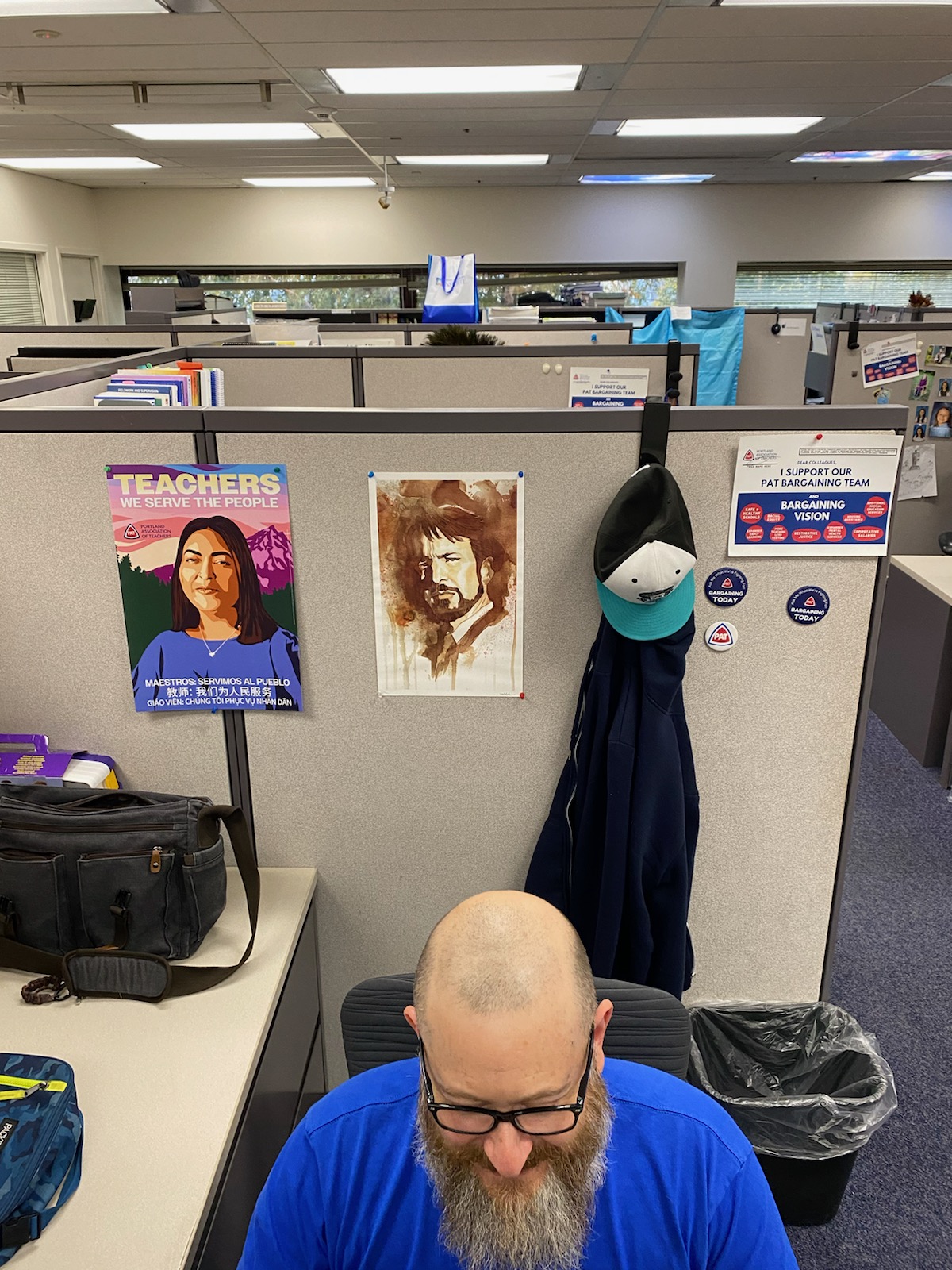
I hope the book will appeal to all of those perpetual teenagers typing away with a portrait of Hans Gruber stuck to their cubicle walls:
D&D friend, fellow unionist, and cubicleman Mike Carlip with portrait of Hans Gruber. Photo credit Carlyn Eames.
In a post of mine from a couple of weeks back, I mentioned as an aside my preference for the gritty, noir quality of sword & sorcery fantasy over the flash and bombast of high fantasy. As I’ve reflected on that offhand comment over the last days, I’ve wondered precisely what I meant by it. And I’ve wondered, both as a fantasy writer and a teacher of a fantasy and science fiction literature class, whether I even know what I mean by the terms high fantasy and sword & sorcery.
I’m not the only one to struggle with what seem like ill-defined terms. As the Wikipedia page on low fantasyargues, the distinction between high and low fantasy rests on where the action takes place: if the fantasy story takes place on another world (or a hidden world within this world), then it is high fantasy; if the action takes place in this world, then it is low fantasy. But this is hardly everyone’s definition: for many, the distinction between high fantasy and low fantasy involves the role of magic and morality in the story, not the question of where the story takes place. As the same Wikipedia page helpfully explains, “Thus, some works like Robert E. Howard‘s Conan the Barbarian series can be high fantasy according to the first definition but low fantasy according to the second.”
Fafhrd and the Gray Mouser have the same problem. . .but high fantasy or not, Dark Horse’s omnibus edition is coming soon!
So what did I mean when I said I preferred sword & sorcery to high fantasy? Well, here’s what I talk about when I talk about high fantasy: the world of the high fantasy novel or game is a cosmic battleground between the powers of good and evil. Magic is common, perhaps ubiquitous. The protagonists of the story or game–who are good–forge alliances and fellowships with other good creatures (often, and maybe usually, including elves, who often, maybe usually, represent an extreme incarnation of western beauty standards), who are locked in a mortal struggle with a host of evil creatures in the service of an even more evil master. If it sounds like I am describing The Lord of the Rings, I am: Tolkien’s work is usually held up as the type specimen of high fantasy. Many of the great high fantasy franchises you may be familiar with–like J.K. Rowling’s Harry Potter, The Inheritance Cycle of Christopher Paolini, Lloyd Alexander’s Chronicles of Prydain, and the Forgotten Realms setting of Dungeons & Dragons–are influenced by Tolkien’s cosmology. Some are downright derivative, little more than Tolkien reskins.
Behold, good folk, your hot ally has arrived. Legolas cosplay at Chicago Comic Con 2014, Photographer Gabbo T
Sword & Sorcery, by contrast, involves fewer world-spanning struggles between good and evil; instead, sword and sorcery focuses more on the trials and adventures of a single adventurer or a handful of them. Those adventurers are not “good” in the sense that high fantasy uses the term. Rather, “heroes” of sword & sorcery fantasy are typically a bundle of contradictions, a mix of noble and base impulses–often, much like the characters of hard-boiled detective fiction, they are just conflicted people trying to get a dirty job done. In short, sword & sorcery protagonists are a lot more like us, at least on the inside.
Magic, too, is less flashy, and far less common, in the typical sword & sorcery story. Unlike high fantasy, where in many franchises practically everybody can shoot lightning bolts and fly about like the superheroes of an MCU movie, magicians in sword & sorcery are rare, misunderstood, and mysterious figures. They are often sinister or at least morally compromised, as though magical power itself involves a deep and unsavory moral choice. They are far likelier to act as antagonists in the story, representatives of a shadowy corruption that it’s the protagonist’s job to resist.
Many of the classic heroes of sword & sorcery literature–Conan, Fafhrd and the Gray Mouser, Elric–had their heyday over forty years ago. And it’s probably been since the 1980s that I really read those books voraciously. There is no doubt that some of the writers’ underlying assumptions about gender and race have not aged well at all (of course, the same has certainly been said, fairly or not, about Tolkien’s work). In calling for a renaissance of sword & sorcery, I’m not arguing for a return of the passive, white-skinned, Frazetta-drawn “chainmail bikini” damsel in distress to fantasy literature. Sword & sorcery is cool for a totally different set of reasons, reasons which I believe are separable from the socially retrograde ideas of some of the original sword & sorcery creators.
Rather, what sword & sorcery offers, and what I wish Dungeons & Dragons would take more seriously, is moral complexity. Instead of simplistic good-vs.-evil alignments and the racial essentialism of “savage orcs” and “cultured elves,” I’d like to see more D&D that presents players with competing visions of the good, with life a series of tradeoffs to be made rather than a body of questions that one gets right or wrong. I’d like to see a magic system where the costs of devoting oneself to magic–or even wielding a magic item–are high enough that not every player will pursue magic power.
Dungeons & Dragons isn’t really built around those ideas. Too much about alignment and race and magic in D&D seem to assume a high fantasy worldview, and most D&D creators and players clearly seem more comfortable in a Tolkien-inflected high fantasy world. But one of the things I love about the current edition of D&D–and which I hope will continue in the coming version–is the game’s open environment for modifying, for mixing-and-matching. D&D today is more like a great set of cookbooks than a list of prescriptive instructions. And, just as it would be a lot of ridiculous work to prepare every recipe in a cookbook at the same time, most good dungeon masters know not to use every class and race and monster and option presented in the D&D books, at least not at the same time. One can make a sword & sorcery campaign in D&D; it’s just a matter of removing a few of the million options presented in the books.
There is a lot that I still love about high fantasy. I still attend Tolkien’s Birthday Bash every January at McMenamins Kennedy School in Portland to watch 6-13 straight hours of LOTR movies. But I prefer to think of the world we live in as something other than a cosmic battle between pure good and pure evil. And I like my storytelling and games, no matter how fantastic, to say something about the world as it is, not the world that black-and-white thinkers imagine that it is.
Followers of this blog are familiar with my deep Dungeons & Dragons nerdity. I certainly felt the nerd in me rising over the last couple of weeks during my first ever trip to Spain: it’s hard not to be reminded of D&D when there is an ancient castle on every hill and a painting of knights in every church.
But one of the greatest D&D connections on this trip was unexpected to me. We managed to spend two glorious, sweltering days in Seville, “the frying pan of Spain,” and I was brought face to face with the literary roots of the thieves’ guild.
Skyline of Seville from the Giralda Tower. Photo Carlyn Eames
Many people, even non-D&D players, are aware of how many ideas from D&D were lifted whole cloth from Lord of the Rings: elves, dwarves, orcs, halflings, rangers. But the idea of the thieves’ guild–which is so central to D&D’s concept of the rogue–has no antecedent in Tolkien’s work. So far as I know (and please correct me, fantasy nerds, if you have a better story) the original thieves’ guild in fantasy comes from the work of Fritz Leiber, one of the titans of swords and sorcery fantasy. (By the way, I far prefer Leiber’s gritty, noir-ish vibe of swords and sorcery fantasy to the Wagnerian bombast of high fantasy–but that’s a subject for another post). Leiber’s odd-couple duo of Fafhrd and the Gray Mouser often had to tangle with the thieves’ guild of Lankhmar, and so many of the details of that story made their way into D&D (and into Terry Pratchett’s Discworld, and The Elder Scrolls, and Assassin’s Creed, and a thousand other fantasy franchises). By the way, Dark Horse is publishing a new omnibus of Fafhrd and the Gray Mouser in early 2024–I’m very excited to get my hands on it!
But where did Leiber’s concept of the thieves’ guild come from? I don’t know, and it may be impossible to know, but it’s almost certain that Leiber pulled the idea from earlier literature rather than from any historical criminal organization (which were generally gangs rather than guilds in the D&D sense).
The earliest literary treatment of the thieves’ guild that I am familiar with is Cervantes’ delightful story “Rinconete and Cortadillo,” which follows two likeable young rogues to the city of–you guessed it–Seville, where they get recruited into a hilarious (and oddly pious) thieves’ guild. Seville was, in Cervantes’ day, a kind of boom town and very much a city on the make, swollen with silver that the Spanish crown had plundered from the Americas. For about a hundred years or so, it was probably the wealthiest city in Europe (as well as a pretty gritty place).
The Seville tomb of a far less likeable rogue. Photo Carlyn Eames
When we visited, it was just charming and hot. But everywhere we looked, there were plaques memorializing events that appeared in Cervantes’ life and in “Rinconete and Cortadillo,” from Cervantes’ years in debtor’s prison (ironically, there’s a bank on the site now) to the spot on the cathedral steps where Cortadillo steals the sacristan’s handkerchief. We had our hotel room in the Casco Antiguo, right in the neighborhood where Rinconete and Cortadillo had their territory in the story. The whole experience lined up Cervantes with Leiber with Dungeons & Dragons in my soul like a wonderful convergence of nerdly planets.
I’m late bringing this news to The Subway Test–a sign of the recent moribunditude of my blog. But last year I entered the Aura Estrada Short Story Contest at Boston Review and…I didn’t win. But my story, called “Nomenclator of the Revolution,” was a finalist for the award, and that means the story will be appearing in Boston Review soon!
One of the reasons I feel so proud to have “Nomenclator” coming out in Boston Review–besides the obvious, that Boston Review is an excellent publication which has hosted writing from titans like Rita Dove, John Updike, Susan Sontag, and Saul Bellow–is that “Nomenclator” had been rejected by 26 other magazines before it was accepted at Boston Review.
Which is another way of saying don’t invest too much meaning in any particular rejection of your work. When a story of mine is rejected a few times–say, half a dozen rejections or so–I do need to look hard at what I’m sending out. Maybe the piece isn’t ready. Maybe it’s not as good as I would like to believe it is. But once in a while, I scrutinize the much-rejected story and it still looks good to me. It’s hard to assess my own work honestly. But if I really believe the story is good, then I’ll keep sending it out until I find someone who agrees with me.
One of my formative memories as a writer was seeing the great poet William Stafford read at the end of his career. He would have been 75 or 76 years old at the time–a wizened, kindly fellow who I appreciated only later as one of the most important poetic voices in the 20th century. At one point in the reading, he introduced one of his poems by reciting the names of all the magazines and journals that had rejected it. The list was long–I don’t remember how many publications were on it–but, journal names being what they are, the list sounded like a poem of its own. I didn’t have the courage to tell Stafford how important his reading had been to me, and he died mot much later. But thank you, William Stafford, for reading that list when I was 19 years old.
I had the joy of watching 2001: A Space Odyssey on the big screen the first time in my life a little while ago. For those of you living near Portland, The Hollywood Theater purchased a 70 mm print of the film a couple of years back, and they show the movie to a sold-out house a couple of times every year. I had seen the film many times before on video–it’s one of the truly formative pieces of art in my life–but seeing it in a literally larger-than-life format impressed me deeply: the movie reminds me why I work in the genre of science fiction.
One of the most celebrated elements of the film has been its technological accuracy. Stanley Kubrick and Arthur C Clarke, working before CGI or the moon landing, were able to predict so many of the challenges and curiosities of living and working in space. As much as I loved Star Trek and Star Wars growing up, I always had the sense that those two franchises were more science fantasy than science fiction (especially Star Wars). 2001, by contrast, looked like some thrillingly-plausible documentary footage from a future just over the horizon.
But it is not the accuracy of the film that affects me so much now. Rather, 2001 is worth watching because of what Tolkien would have called its mythopoesis: its creation of a new mythology in which we could view our modern predicament. As much as any other work of art I can think of, 2001 gets at the painfully intermediate position of our species as part animal and part divine: the film is a 164-minute meditation on Hamlet’s musing: “What a piece of work is a man! How noble in reason! how infinite in faculties! in form and moving, how express and admirable! in action how like an angel! in apprehension, how like a god! the beauty of the world! the paragon of animals! And yet, to me, what is this quintessence of dust?”
(Another quote, just as apt, comes from Nietzsche’s Thus Spake Zarathustra, the book which also inspired the iconic theme music for 2001: “Man is a rope, tied between beast and overman—a rope over an abyss … what is great in man is that he is a bridge and not an end.”).
While the film is set in space in the near future, as realistically as Kubrick and Clarke could conceive of it, the setting is just as much a place of the inscrutable divine: in other words, its setting is really The Dreamtime, the Underworld, Faerie. Even though the US Space Program was deeply influenced in real life by 2001, the movie is closer to the mystical cave paintings of Chauvet or Lubang Jeriji Saléh than it is to the Space Shuttle and the International Space Station.
Of course, there are many elements of any piece of science fiction that won’t hold up well after 50+ years. In the case of 2001, Kubrick and Clarke seriously underestimated the amount of progress our species would make in some aspects of information technology, while at the same time overestimating the progress we would make in artificial intelligence and manned spaceflight. Those are easy mistakes to make, by the way: I can’t think of any science fiction before the 1980s that successfully anticipated the internet, and of course a movie made in 1968, the year before Apollo 11, would extend the logic of manned spaceflight out to regular orbital shuttles and populous moon bases and manned Jupiter missions.
But the beauty of 2001 is not how much the movie correctly predicted but rather how well it explores the timeless theme of what it means to be a human being. What strange gods called out of the darkness to our rude, frightened hominid ancestors to make us human? What awaits us if we can survive the deadly unintended consequences of our own ingenuity? In wrestling with those questions, 2001 is every bit as bottomless a work of art as Paradise Lost or Faust or the Popol Vuh. One can argue that there are no gods that made us, that the monoliths of the movie will never be found because they never existed in the first place. However, 2001 speaks to something very deep in our cultural DNA (and, for all I know, in our literal DNA): the yearning for our spiritual parents.
Two hundred years from now, if we somehow survive this dreadful bottleneck of overpopulation and ecological collapse, our descendants may be living in domed cities on the moon and Mars; we may be gliding in beautiful submarines through the oceans of Europa and Ganymede. We will still be looking for the monoliths.






 The Subway Test