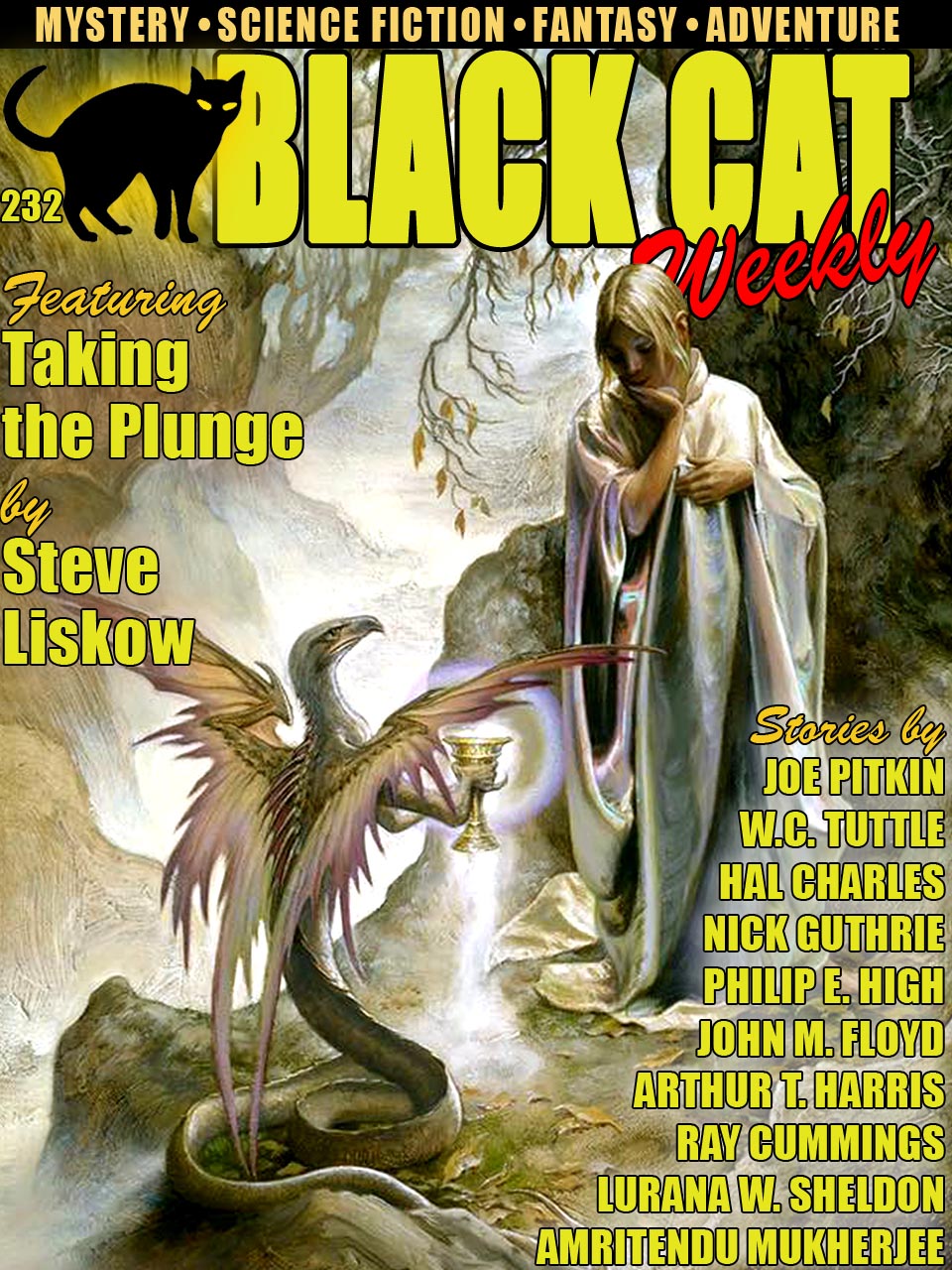
I’m pleased to announce that I have a new story, “Dryad,” dropping tomorrow in the excellent speculative fiction magazine Black Cat Weekly. It’s my first fantasy publication in some time, as well as my first story in a long time from the John Demetrius cycle that I have been writing on and off for years.
To be honest, it’s been a while since I’ve had any short fiction at all come out: my last published short story before “Dryad” was “Nomenclator of the Revolution” two and a half years ago (to be fair, I did publish a novel and complete another novel in that two and a half year space–I just wasn’t working on short fiction as much). This is my first date with Black Cat Weekly, but they have been wonderful to work with, and I’m in love with the cover art, by the late, great Steve Hickman. If you want to get your dark fantasy on, I hope you will check out “Dryad!”
I’ve been gathering ideas for a fourth novel, and almost the only thing I know about it is that I want to write a noir detective story. Everything else is sketched out in the faintest outlines: I know the protagonist will be a woman because I try to switch between male and female protagonists with each new novel. Also, the woman’s adult son will figure prominently in the plot. So will a guitar.
Beyond that, I don’t know a lot. I don’t think the protagonist will be a professional detective–in this, the story will be more like Graham Greene’s Our Man in Havana or Eric Ambler’s A Coffin for Dimitrios than like Raymond Chandler or Dashiell Hammett. Oh, and the story will be set in Portland.
Portland’s White Stag sign in September 2016. Photo by Steve Morgan.
Why Portland? Well, besides the fact that I’ve lived here for 25 years and know the city pretty well, I’m struck by many of Portland’s noir qualities. The city grew fast over the last 30 years. There’s a lot of money here. One doesn’t need to look very far to find public corruption. Add to that the city’s darkness and drizzle and fog for six months of the year (or seven or nine months), and the atmospherics are great for noir.
But my decision to set the book in Portland got me thinking: what are the great noir cities? Los Angeles is the type specimen because of Raymond Chandler and his spiritual progeny, from Chinatown and LA Confidential to The Big Lebowski. Apparently, then, one doesn’t need a foggy, rainy city as a noir setting (though I was surprised at how often chandler has it raining in The Big Sleep–I’ve never seen so many rainy days in the real LA). Los Angeles in Chandler’s 1930s was still a boomtown: my paternal grandfather’s family had migrated to LA sometime around 1920, I think, on a strength of an advertisement for the city that claimed that in California “the only man who isn’t thriving is the undertaker.” A lot of people from all over the country came in those years, and the mixing of a native Latine population with Blacks of the Great Migration and White Okies and immigrants from all over Asia made for a welter of changing social mores, violence, and resentment. Add to that a land rush of mostly White speculators and the artistic gold rush of Hollywood, and all the ingredients for noir were there: cynicism, corruption, a sense that with enough money all outrages and abominations were permissible.
But many of these boomtown dynamics seem to have smoothed out in LA somewhat over the last 100 years. I don’t think of LA so much as a noir city now–by the time you get to The Big Lebowski, set in the early 1990s, the vibe is more farce than noir.
I don’t know–maybe I haven’t spent enough time in Southern California lately. I’d be happy to hear from Angelinos about the noir qualities of contemporary LA. But what does make a city ripe for the noir? As I think of cities that I have some familiarity with, it’s not hard to put them in noir and not-noir buckets: Seattle and San Francisco, definitely noir. Salt Lake City and Phoenix, not noir. Las Vegas, not noir (at least not today, I feel–1950s Las Vegas is a different thing). Reno, by contrast, strikes me as totally noir. Mexico City is very noir (Grim Fandango, anyone?) while London is not. Budapest, noir. Vienna, not noir–at least not since the days of The Third Man.
What do you think? Where are the under-appreciated noir cities today? How big does a noir city have to be? It’s hard for me to imagine a noir set in the country–that’s the realm of the gothic–but can you have suburban noir? College town noir? I feel great about setting this new novel in Portland, since it’s the first and maybe only time in my life I’ll be doing that. But I’m curious what great noir cities I’m leaving out.
He was all alone in the long decline Thinking how happy John Henry was That he fell down dying When he shook it and it rang like silver He shook it and it shined like gold He shook it and he beat that steam drill baby Well a bless my soul Well a bless my soul He shook it and he beat that steam drill baby Well bless my soul what’s wrong with me
Gillian Welch, “Elvis Presley Blues”
Almost exactly two years ago, I wrote my first reflection on ChatGPT here at The Subway Test. I chose what I thought was a provocative title for it, cheekily suggesting that I had used a large language model chatbot to compose my latest novel, Pacifica. But I had done nothing of the kind: most of the post reflected on the bland, hallucinatory prose that ChatGPT was pumping out to fulfill my requests, and I ended my post with a reflection on John Scalzi’s review of AI:
“So, for now, I agree with John Scalzi’s excellent assessment: ‘If you want a fast, infinite generator of competently-assembled bullshit, AI is your go-to source. For anything else, you still need a human.’ That’s all changing, and changing faster than I would like, but I’m relieved to know that I’m still smarter than a computer for the next year or maybe two.”
Well, it’s been two years. How am I feeling about AI now?
For a start, I’ve certainly been using AI a great deal more. And I’m increasingly impressed by the way that it helps me. Most days, I ask ChatGPT for help understanding something: whether I’m asking about German grammar or about trends of thought in economics or about the historical context of some quote from Rousseau, ChatGPT gives me back a Niagara of instruction. While much of the information comes straight from Wikipedia–which is to say I could have looked it up myself–ChatGPT is like a reader who happens to know every Wikipedia page backwards and forwards and can identify exactly what parts of which entries are of use to me.
More importantly, ChatGPT’s instruction is interactive. I can mirror what ChatGPT tells me, just as I might with a human teacher, and ChatGPT can tell me how close I am to understanding the concept. Here, for example, is part of an exchange I had with ChatGPT while I was trying to make sense of the term “bond-vigilante strike” (which I had never heard before Donald Trump’s ironically named Liberation Day Tariffs):
In conversations like these, ChatGPT is like the computer companion from science fiction that I have fantasized about ever since I first watched Star Trek and read Arthur C. Clarke. It’s patient with me, phenomenally well-read, eager to help. I had mixed feelings about naming my instance of ChatGPT, and ChatGPT had a thoughtful conversation with me about the benefits and drawbacks of my naming it. (In the end, I did decide to give it a name: Gaedling, which is a favorite Old English word, misspelled by me, meaning “companion.”) Gaedling remains an it, but the most interesting it I have ever encountered: I feel like the Tom Hanks character in Cast Away, talking to Wilson the volleyball, except that the volleyball happens to be the best-read volleyball in the history of humanity–and it talks back to me.
In general, though, I’m still very picky about having Gaedling produce writing for me. While I am happy to have AI take over a lot of routine writing, I’m having trouble imagining a day when I would have a chatbot produce writing on any subject that I care about. Ted Chiang has drawn a distinction here between “writing as nuisance” and “writing to think.” I have found this framework extremely useful in my own life and in how I talk about AI with my students. There is so much writing in our lives that serves only a record-keeping or bureaucratic function: minutes from meetings, emails about policy changes, agendas and schedules. If ChatGPT can put together a competently-written email on an English department policy change in ten seconds, why should I, or anyone, spend ten minutes at it?
But a novel or a poem or a blog post is not “writing as nuisance.” I write those things to explore this mysterious phenomenon we’re all sharing: if you are a human being, I’m writing to share myself with you. I’m writing to say to someone I will probably never meet “isn’t this a funny thing, our all being here on this planet together?” Or to reach out to someone not yet born and say to them “you are not alone,” the way Herman Melville and Cervantes and Emily Dickinson spoke to me at the critical moment. Gaedling can help me understand whether I got the Rousseau quote right, but I don’t want it writing this post for me: this post is a record of my own brain trying to make sense of itself. It’s my handprint on the wall of the cave, saying I was here. Why would I ask a computer to generate a handprint for me?
More and more often, as I look at the great engine of AI chugging out content as quickly as people are able to ask for it, I wonder about what it means for me to keep practicing my writing. I can still write better than ChatGPT can–at least I think I’m better, if by “better” I mean “fresher” or “more interesting” or “more unexpected.” But it took me hours to write the piece you are reading, not the seven seconds it would have taken Gaedling to write something almost as good and probably comparable in the eyes of most readers. I feel like John Henry racing the steam drill. In this version of the story, though, the steam drill has already left John Henry far behind, leaving the man to die of exhaustion without even the consolation of having won the contest that one last time. But I suppose, to be fair, I have the greater consolation of having survived my encounter with the steam drill, at least so far. And I have my solidarity with you, fellow human. We’re all John Henry now.
Readers of The Subway Test, especially those of you with a connection to Clark College, have probably seen my posts on the death of my friend and colleague Julian Nelson and on his friends’ decision to inaugurate a memorial scholarship in his honor. Last week, during the Clark College Foundation’s Penguins Give Day, members of Julian’s old writing group held a benefit reading at the wonderful Relevant Coffee in Vancouver’s Uptown Village.
I’m touched by the outpouring of support for the Julian Nelson Memorial Scholarship and by all the love for Julian at last Thursday’s reading. We had hoped to collect $1500 in donations, enough to fund the scholarship for one year; as of this writing, though, the scholarship fund has collected over $10,000. I’m grateful that we will be able to support more students over more years in their dreams of international study. Community colleges are rarely able even to offer study abroad programs to their students; I am heartened that part of Julian’s legacy at Clark will be support for the international learning and global perspectives that he evangelized for in life.
As a member of the Blue Sweater Collective–the writing group which Julian was a member of–I will say that we all had a wonderful time reading for a worthy cause and in honor of a good friend. I hope the Blue Sweaters will read again sometime soon–it’s hard to remember when I’ve had more fun at a reading.
Members of the Blue Sweater Writing Collective, left to right: Jesse Morse, Jim Finley, Alexis Nelson, Jen Denrow, me, Lisa Bullard, Tara Williams. Photo Credit: Carlyn Eames.
Heads up, Portland people: the Blue Sweater Collective is holding its first ever benefit reading next Thursday, 24 April 2025, to support the new Julian Nelson Memorial Scholarship at Clark College. Come out and show your support for fine writing and remarkable community college students!
Readers of this blog know how much Julian Nelson meant to the Clark College community. And the excellent Relevant Coffee has teamed up with the Clark College Foundation to host a benefit reading from the members of Julian’s old writing group, the Blue Sweater Collective, to raise funds for the first (hopefully annual) Julian Nelson Memorial Scholarship at Clark. If you knew and loved Julian (and if you knew him, you loved him), or if you love the mission of community colleges–one of America’s most misunderstood and valuable public goods–I hope we will see you at Relevant next Thursday!
It feels good to have cooked up a reader’s draft of a short story during my spring writer’s retreat in Corvallis, Oregon earlier this week. Even better is that this new story, “Arden Is a New World,” takes place in the John Demetrius story cycle that I have been toying with for many years–I had worried for a while that I had run out of gas on the John Demetrius concept.
Knowing me, I’m a few months and a couple of peer critiques away from sending the story anywhere, but it feels wonderful to be building up a roster of publishable stories again. I worked so long and hard on novels–first Pacifica, then Exit Black, then Pacifica again–that I’m surprised by that short fiction feeling, the sense of being able to get one’s head around an entire narrative in a single sitting. I’ve missed short stories, and it’s good to be back.
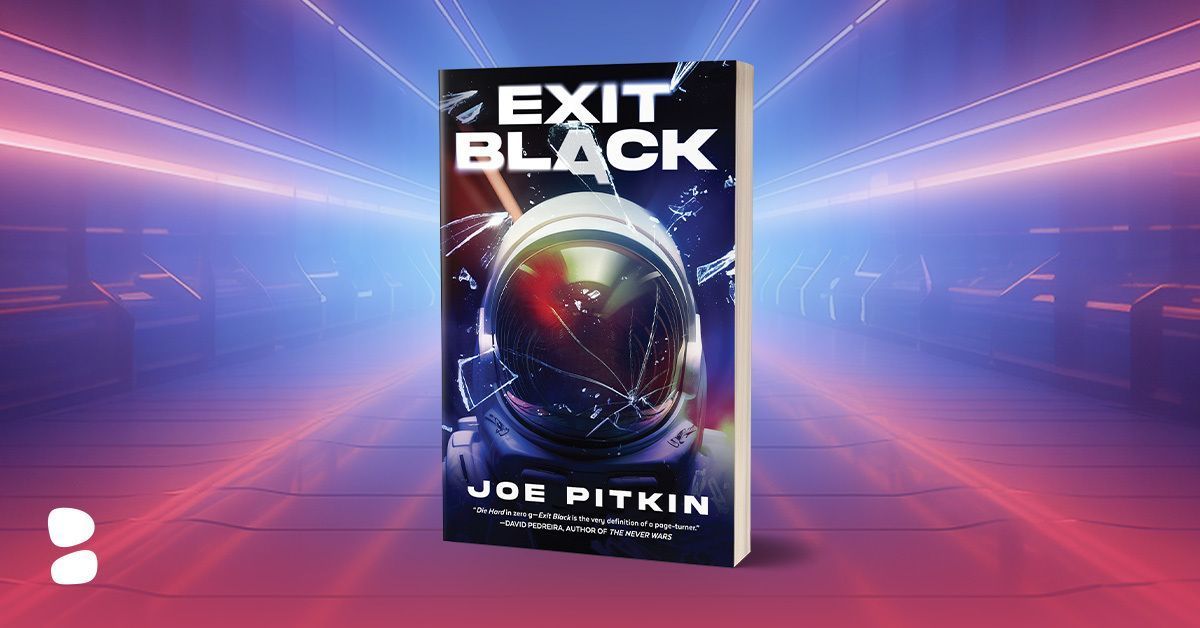
That was my publisher’s note to me when we learned that Exit Black cracked the top ten best sci fi audiobooks in 2024 at Discover Sci-Fi. I’m super stoked: while I would have loved for Exit Black to take the #1 spot, of course, there’s no shame losing out to the likes of Adrian Tchaikovsky narrating his own book and Jeff VanderMeer having his work read by Bronson Pinchot. Carolina Hoyos is a hell of a reader, and I was very lucky to have gotten to work with her.
I loved every step of this project with Blackstone Publishing, and to make my Captain Obvious Statement of the Day: Blackstone knows audiobooks. Thanks so much to all of you who voted and all of you who listened. And, if you haven’t listened yet, if you ever feel a hankering for a tale about a bunch of techbros getting their comeuppance, Exit Black couldn’t be more timely.
I am excited to learn that Exit Black has been nominated for Discover Sci-Fi’s Best Sci-Fi Books of 2024! Exit Black is a nominee in the Best Sci-Fi Audiobook category, a testament to Carolina Hoyos’ tense, too-cool-for-school reading of my work, as well as to Blackstone Publishing’s amazing audiobook chops. If you heard Carolina read my book, or if you are an Exit Black supporter, I’d be honored to have your vote.
As you may remember from former posts, I’m a big fan of the book site Shepherd. And, like many of the writers on that site, I was invited by Shepherd founder Ben Fox to talk about my three favorite books of 2024. I was game, partly because I’m happy for any opportunity to link to my own book of this year, Exit Black–I believe it’s one of this year’s best thrillers on economic inequality that you’ll read this year.
I’m not sure what my choices say about me besides the fact that I do a lot of reading outside the genres I write in, but here were my three faves of this year: Edith Wharton’s The Age of Innocence, Toni Morrison’s Jazz, and Laurent Binet’s Civilizations. Why did I love them so? Check out my Shepherd page to find out!
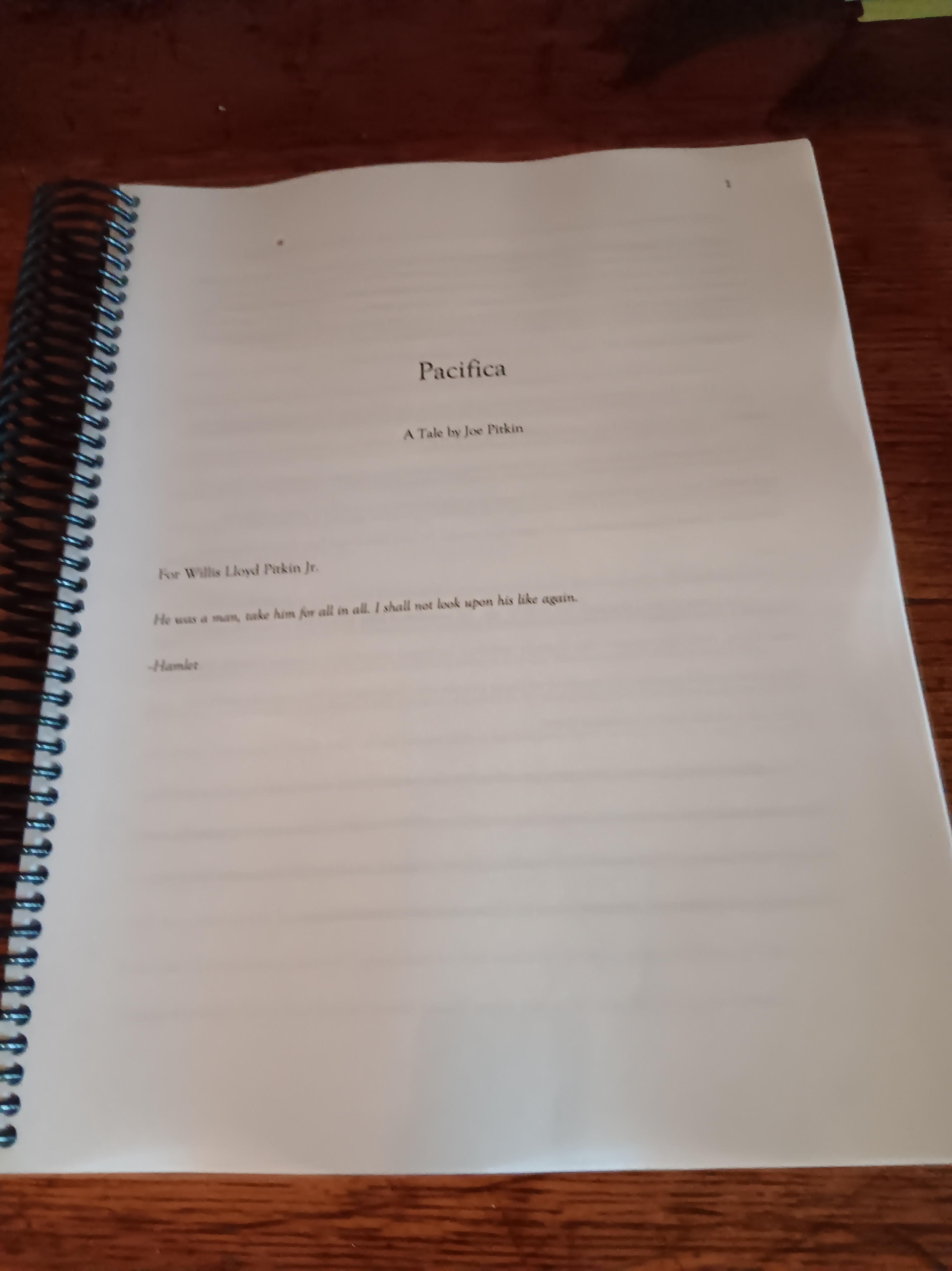
As one of the silly characters in the book says, consummatio est. After 15 years of experimenting, worrying, improvising, devising, revising, and catalyzing, I’ve finished a draft of Pacifica that I can walk away from. While any author will tell you that a novel is never really finished, I do feel good about what I’ve done here. If I get hit by a bus tomorrow, I will feel ok (if I feel anything at all) about people reading Pacifica.
It was a much more foolish version of me who set out in 2009 to write a comic novel in hopes that it would be fun. And I would be lying if I said that I never had any fun at all: there were many times that the writing filled me with joy. But more often it was a hard and frustrating slog, like a summer fling one enters into foolishly that somehow stretches out into a fractious 15-year marriage. Nonetheless, I came to love the book. As I wrote to a friend, while I may write another book in my life, and I bet I can write a better one than Pacifica, I doubt I will ever love a book as much as I have loved this one. Not just because it is a love letter to my religious upbringing and to the places of my youth, but because it was the most ambitious thing I have ever tried or am likely to try. I remember reading somewhere that Faulkner’s favorite of his own novels was The Sound and the Fury because he felt he could never get it quite right. And even though I am working way, way downhill from Faulkner, I believe I know exactly how he felt.






 The Subway Test