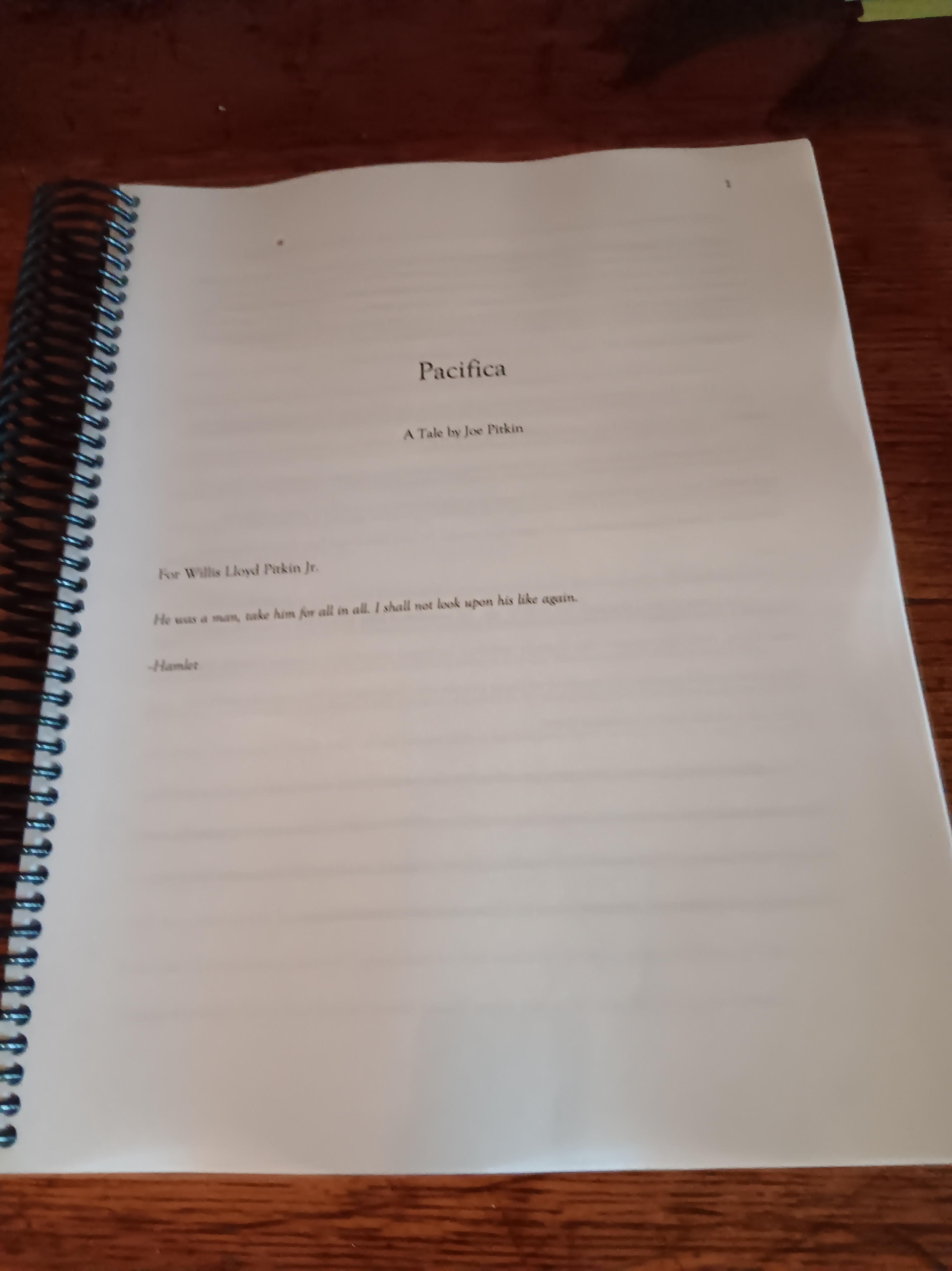
As one of the silly characters in the book says, consummatio est. After 15 years of experimenting, worrying, improvising, devising, revising, and catalyzing, I’ve finished a draft of Pacifica that I can walk away from. While any author will tell you that a novel is never really finished, I do feel good about what I’ve done here. If I get hit by a bus tomorrow, I will feel ok (if I feel anything at all) about people reading Pacifica.
It was a much more foolish version of me who set out in 2009 to write a comic novel in hopes that it would be fun. And I would be lying if I said that I never had any fun at all: there were many times that the writing filled me with joy. But more often it was a hard and frustrating slog, like a summer fling one enters into foolishly that somehow stretches out into a fractious 15-year marriage. Nonetheless, I came to love the book. As I wrote to a friend, while I may write another book in my life, and I bet I can write a better one than Pacifica, I doubt I will ever love a book as much as I have loved this one. Not just because it is a love letter to my religious upbringing and to the places of my youth, but because it was the most ambitious thing I have ever tried or am likely to try. I remember reading somewhere that Faulkner’s favorite of his own novels was The Sound and the Fury because he felt he could never get it quite right. And even though I am working way, way downhill from Faulkner, I believe I know exactly how he felt.
I’ll admit it: when I learned that my newest novel, Exit Black, was going to be published in trade paperback, rather than hardback, I was a little crestfallen. I grew up having inherited a whole raft of English major-y prejudices about what kinds of books are good and what kinds are trash. And, literally to judge a book by its cover, hardback books were the best kind of books.
I’ve written about this a little in Pacifica, which is in some ways a love letter to books, in my description of the semi-mythical Book Room:
Among good students at Sterne College, and even among lackluster ones, the Book Room was legendary. No acquaintance of Jude’s had ever reported having seen this inner sanctum of the library, where the leather-bound volumes of some donor’s bequest were shelved, not by Dewey Decimal or Library of Congress, but (according to college folklore) in the manner that had been used by Hypatia and Eratosthenes in Alexandria.
For better or worse, my real novels wouldn’t find shelf space in the Book Room. But, on getting the news from my publisher about Exit Black‘s being relegated to trade paperback status, I did at least feel like it was the right occasion to pull up an excellent old Beatles song, and one of my favorite Paul McCartney bass lines of all time:
So, dear Sir, Madam, or Mixter, will you read my book? It took me years to write; will you take a look?
I’ve known for a long time that writing is a business. But knowing that writing is a business is no guarantee that one knows how the business works. There’s good circumstantial evidence that for the past 20+ years, I haven’t had the foggiest idea about what I’m doing.
Where my writing career is concerned, I’ve tried to follow Steve Martin’s exhortation to be “so good they can’t ignore you.” But what that quote elides is that it’s still up to the writer to give the audience a chance not to ignore you. I could be as good a writer as Emily Dickinson, but if I don’t know how to get people’s attention, my career could still end up like, well, Emily Dickinson’s.
I’m facing this challenge as I go out for a literary agent for my third novel, Pacifica. (I have an excellent agent, Scott Veltri, for TV and movie projects, which is the hope for my novel Exit Black. But Pacifica is not on the list of 10,000 books I would think of for a movie tie-in). As anyone who has ever gone out for an agent knows, a query letter is one of the writer’s few early opportunities to show their understanding of writing as a business. And one of the things I’ve only recently gotten a feel for is the importance of comps for the novel I’m trying to sell.
Comps–short for comparative titles–are a short list of recent books that are similar to the novel you’re selling. And there are apparently rules, or at least norms, regarding the art of good comps. Here are the ones I’ve picked up at conference panels, in writing guides, and intuition:
Pick no more than three books (though apparently one of the books can be a movie or tv program)
Pick recent, commercially successful works, but
Avoid comparing your work to that of literary A-listers (e.g. no Annie Proulxes or Cormac McCarthys)
Are these the rules? If I knew, more people would probably be reading my writing. If you have better intel on how comps work, please jump in the comments or feel free to DM me! I can tell you what wasn’t working for me, though:
Not offering a list of comps in my query letter
Comparing my work to Ursula K. Le Guin’s (though I don’t think I’m wrong! Read Stranger Bird yourself and you be the judge)
Dissing other writers’ work (at the time I was lathered up about what I called the Harry Potter Industrial Complex)
None of these remarks got me an agent, and I suspect now that that was because my approach showed that I didn’t understand how the publishing business works. Agents and publishers want to know comps for a simple reason: they want to know what has already sold well that is similar to the book you are selling. It doesn’t matter if your book is the most exquisitely constructed exploration of the human heart since Anna Karenina–an agent wants to know if your novel will sell.
Is that a mercenary attitude? Maybe. Is it a rule that you must have comps? Absolutely not. But there’s also no rule that says I have to wear pants to a job interview. If I want to wear jorts to my next job interview, that’s my right as an American. However, wearing jorts to an interview will foreclose on just about every job offer outside of a very small set of jorts-positive jobs, many for which a 53 year-old man wouldn’t be an attractive candidate anyway.
My last unsuccessful job interview. Photo credit Carlyn Eames
So, what am I pitching as my comps for Pacifica? My three are Gabrielle Zevin’s Tomorrow, and Tomorrow, and Tomorrow; Anthony Doerr’s Cloud Cuckoo Land, and Russell Brand’s The Magic Kingdom–three very different books (and one of them I wasn’t even crazy about). But they’re three recent, commercially successful books, each with a passing resemblance to my book about a guy who has a religious vision playing video games which spurs him to found several increasingly ridiculous, polyamorous intentional communities. I guess that’s not exactly a concept which sells itself. Hopefully the comps will help me market it.
I experienced a weird constellation of three events last week. First, my editor, my agent, and I hashed out the jacket copy for my upcoming novel, Exit Black. It was weird to realize that I was basically helping write ad copy for a book that I labored over for two years. Second, I sent out a query to a literary agent for the book I drafted after Exit Black, called Pacifica. (My current excellent and extant agent, Scott, works on film and TV projects, and Pacifica definitely isn’t movie material, so I am looking for a bookish agent as well).
And third, I was driving down Broadway in Portland when I saw this bumper sticker ahead of me:
Millennials and Zoomers–and their parents who might have watched Spongebob Squarepants with them twenty years ago–will recognize this as Squidward Tentacles’ self portrait, “Bold and Brash.” I was happily shocked to see it on a bumper sticker. And I realized when I saw it that this publication process I am experiencing with my books is drawing up all of my deeply Squidwardian impulses: my vanity, my hunger for approval, my inner conflict about how art intersects with commerce. Squidward, c’est moi.
If you need a blast from the past, or you somehow never saw the original, here is a clip of me Squidward from the episode “Artist Unknown:”
But the novel I’m working on now, Pacifica, begins each of its 74 chapters with an epigraph. Much like the computer game Civilization, each chapter is named after one of the technologies that have made modern humanity possible. And, much like Civilization, each technology is accompanied by an apposite quote. Leonard Nimoy was the gold standard narrator for those quotes in Civilization IV (though Sean Bean has his moments in Civilization VI).
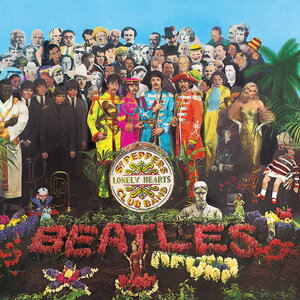
One of the most fun parts of drafting Pacifica has been finding the right quotes for each chapter. I picked from books and poems that I love (as well as a few books that I hated) to put together what I imagined as a kind of collage or mosaic of human knowledge. I imagined the task as something like a literary version of the cover of Sgt. Pepper’s Lonely Hearts Club Band, where The Beatles assembled a photo-collage crowd of their favorite thinkers and artists and goofball influences.
Many technologies were easy to find quotes for. Especially for early technologies like pottery, masonry, and currency, there are a thousand great writers who had something pithy to say. Mostly I would page through books in my office, or CTRL-F through digitized books in Archive.org, to find quotes that spoke to the technology in question and also, hopefully, to the action of the chapter. Sometimes I had to draw the connections myself, in which case the quote turned into something of a writing prompt; other times the quote fit the chapter in deep and unexpected ways that I couldn’t have engineered if I tried.
Some of the later technologies were much harder: for instance, no one from Homer to Virginia Woolf seems to have much to say about the superconductor. Who could I quote for a tech like that?
It just so happened that by the time I got to the superconductor chapter of the book, everybody was talking about ChatGPT. At my college, the discussion revolves entirely around students’ using ChatGPT to plagiarize their essays, an issue which seems to me as trivial, in the grand scheme of dangers that ChatGPT represents, as the crew of the Titanic arguing about a shortage of urinal cakes in the men’s rooms of the Saloon Deck.
So I asked ChatGPT to find me some quotes about superconducting. It suggested some quotes from Larry Niven’s Ringworld and Niven’s and Jerry Pournelle’s The Mote in God’s Eye. They weren’t bad references, exactly–those books do mention superconducting–but none of them resonated with me. So I asked about Arthur C. Clarke, a fave of mine: surely, I thought, Clarke must have written somewhere about superconducting.
According to ChatGPT, Clarke has written about superconducting: of the two references ChatGPT gave me, the one which jumped out at me was this one: “Clarke’s short story ‘The Ultimate Melody,’ published in 1957, briefly mentions the use of superconducting materials in the construction of a futuristic musical instrument called the ‘ultimate melody.'” Now that’s a resonant quote–that would work perfectly for Pacifica!
So I looked up the story and read it (like 90% of Clarke’s short fiction, I had never read it before). Here’s the thing, though: there’s absolutely nothing about superconducting in that story! (For that matter, the futuristic musical instrument is called “Ludwig;” the ultimate melody was the ideal music the instrument was designed to find).
And here’s the other thing, which I discovered later: Arthur C. Clarke did write a short story, called “Crusade,” in which superconductivity is a central plot point. ChatGPT didn’t think to mention it (because ChatGPT doesn’t think yet). I tracked that story down with a simple DuckDuckGo search for “Arthur C. Clarke superconducting.” It’s an excellent story, by the way–very Arthur C. Clarke. And that story had the perfect quote, which fits both Pacifica and the life I feel I am living lately: “It was a computer’s paradise. No world could have been more hostile to life.“
So, for now, I agree with John Scalzi’s excellent assessment: “If you want a fast, infinite generator of competently-assembled bullshit, AI is your go-to source. For anything else, you still need a human.” That’s all changing, and changing faster than I would like, but I’m relieved to know that I’m still smarter than a computer for the next year or maybe two.
I’ve had a long spell away from this blog while I was drafting my third novel, Pacifica. But now that Pacifica is (finally, after a thousand sighs) drafted, and as I prepare for the publication of my second novel, Exit Black, by Blackstone this year, I’m able to give a little more attention to this space. I’ve missed being here, and I’ve missed interacting with you through The Subway Test. I hope to connect with you a little more frequently in the coming months!
I’m back after a month away from The Subway Test, the longest hiatus I’ve given this blog in a year or more. As I wrote a month ago, I needed time to focus on getting the manuscript of my novel Stranger Bird ready for publication. It’s been a long few weeks, but the manuscript is finally in the hands of my layout editor, Erica, and I’m glad to be back working on other kinds of creative projects.
More than practically any other issue or idea in my life, I’ve struggled with time. I certainly contended over the last four weeks with a sense of time scarcity, even time starvation. Some of that feeling of lack comes from my own prodigious talents at wasting time. I’ve felt often enough that my time slips away from me like water out of a cracked bucket, lost to internet surfing and daydreaming, to chatting with colleagues and wandering about campus like a dilatory schoolboy.
Yet I don’t waste time every day–some days, some weeks even, I can approach my work with a grim and joyless puritanism, with the motto that if it’s fun, I can’t do it. I rarely feel much jealousy for the wealthy and powerful, but one thought that bedevils me with some frequency is the sense that, in spite of the fact that wealthy and powerful people have the same 24 hours a day that I do, those people have accomplished so much more than I in my 47 years on the planet. If I want to start feeling bad about myself, that’s the expressway to Self Loathington. Sometimes while I am on that expressway I can approach my work with a withering focus for a while, before my natural curiosity about whatever I’m not working on at the moment takes over once again.
One of the main characters in my novel Pacifica is a kind of spiritual self-portrait: a middle-aged librarian named Pánfilo (one of those wonderfully antique Mexican names that I love, from the Greek meaning “lover of all”). As I wrote in my first description of him,
Over the course of his forty-nine years of life, Pánfilo Gonzalez had completed seven hundred and twenty two college credits at nine universities, colleges, conservatories, institutes, and graduate optometry schools. Yet for all that, he had never taken a single college degree. He had come close several times—he would have received his Bachelor of Arts in History at Utah State University if he had just finished his physical education requirement and paid off his university parking tickets—but instead he had hired on to the Sterne College library as a janitor with nothing more than a high school diploma from the Escuela Nacional Preparatoria “José Vasconcelos.”
While in real life I have (barely) managed to take college degrees, as I approach Pánfilo’s real age I feel more and more like him.
Photo credit: TaxCredits.net
It is only now that I am halfway or so through my life that I feel some understanding of that phrase “time is money.” As a kid I always regarded it as one of those cartoonish shorthands TV writers would use to establish that a character was a successful businessman. I was not particularly interested in money, and so the phrase only served to make such characters as Mr. Slate from The Flintstones and Mr. Cogswell from The Jetsons unattractive to me. But it has dawned on me slowly over the last few years that if time is money, money is also time. Independently wealthy people may have the same 24 hours per day that I do, but they are much more able to spend their 24 hours doing only what they feel like doing. That so many of them spend their time working phenomenally hard, as though they are driven to it, suggests to me that there is something more to the “time is money” equation that I am not getting, or that perhaps they are not getting.
One of the internet wanderings I’ve made in the last few years that has had the most value for me attempts to quantify just how much money an hour is worth. The page is here at the excellent site clearerthinking.org–answer a few questions about how much you make, how busy you are, and how much you’d charge to do certain kinds of work, and the site will estimate for you just how much you should value your time. I learned a lot about myself after a few minutes at this site: it helped me realize that I’ve been way too willing to take on extra work in my job, and way too reticent about hiring out jobs like housecleaning and yard work. I have a long way to go to adjust my life so that I’m optimizing the number of hours I spend on preferred activities (primarily unpaid work like writing), but the site has really helped me understand just how much an hour is really worth to me.
I finished the roughest draft of a novel I’ve ever roughed out in a rough world. It is so rough that I couldn’t bring myself to write Pacifica: first draft at the beginning of the notebook–instead I titled it Pacifica notes. It’s a ridiculous mix of fatuous underwriting and deep purple gasbaggery. But, if you don’t mind characters appearing, disappearing, and changing gender midway through, it’s also a finished draft.
So far as I can tell, I wrote about 60,000 words–shorter than Stranger Bird, but still a novel. I would guess there are 15,000 words I’ll toss out immediately and maybe that many new words to add. And it’s still too early to tell whether it will ever amount to anything.
But, while I feel more exhausted than excited, it does feel at least a little good to have a story of that scope and sweep, and with a beginning, middle, and end on paper.


 The Subway Test