• About
  • My Fiction
  • Reviews

The Subway Test

~ Joe Pitkin's stories, queries, and quibbles regarding the human, the inhuman, the humanesque.

The Subway Test

Category Archives: Reading Roundup

When Danez Smith Came to Clark College

18 Tuesday Nov 2025

Posted by Joe in Journeys, Musings and ponderation, Reading Roundup

≈ 1 Comment

Tags

art, books, Clark College, Danez Smith, poetry, poetry readings, writing

One of the most celebrated poets in America right now, Danez Smith, came to my college to read last week. My job, as a utility infielder on Clark College’s creative writing committee who happens to live near the airport, was to pick up Danez and drive them to their hotel downtown.

The pick-up was a breeze–Danez has clearly done this kind of thing many times–and I was pleased when they got in the car at how easygoing they seemed, as well as how I was not coming off (in my own mind, anyway) as too star-struck.

As I drove, we chatted about America’s two main Portlands–Danez is living in Portland, ME right now–and they pressed me on my mixed feelings about my own Portland (i.e. a great American city driven to a terminally twee nonconformity by, among other things, the show Portlandia). We talked about the amazing restaurant town that Portland, OR, has become, and I was overjoyed to hear that Danez would be eating at Gado Gado, a brilliant Indonesian place in my neighborhood.

And then, while describing to Danez what the gado gado dish consists of, I took the wrong exit on to I-84–instead of the westbound, towards downtown, I took the eastbound, towards Utah. I’ve driven from the airport to I-84 hundreds of times, so I am not sure what made me take the wrong exit just then: maybe my poor memory for foods was taxing my brain as I tried to remember what was in gado gado, or maybe I was more star-struck than I realized.

In any event, the wrong exit I took was one of the worst wrong exits I could take in the whole benighted Portland metro freeway system. Exits do exist on I-84 eastbound between Portland and Utah, but really there are a lot fewer than you would think. I got off the freeway at 122nd street and started making a loop down to the butt end of Sandy Boulevard, where I knew I could get back on to I-205 and thence to westbound I-84. We talked about family, about the trouble that comes for our loved ones at the end of their lives (and, by extension, for us one day). I navigated expertly after my breathtaking blunder back to the freeway, got us back on, and we were back on the track. Danez looked up at one of the exit signs and said “Wait, wasn’t that where we got off the freeway last time?”

Indeed it was, Danez Smith, indeed it was. I’ve just taken 15 minutes of your life force at the end of a very long travel day for you. Forgive me.

The next day, Danez read like a dream. They came up in the slam tradition, and they have a theater background to boot, and it shows: each poem was like some incantation, a crazy pile-up of language that blew us all away. Part of me wished that I was one of the shell-shocked 19 year-olds from Intro to Literature sitting in the audience, encountering their first poetry reading the way I took in mine from William Stafford in 1989. You poor suckers, I wanted to say to them, it’s never going to get better than this. If you go to a thousand more readings, you’ll always be thinking about this one.

Danez is a better and younger poet than me. I had to remind myself of something I tell my creative writing students every term to help them get past the anxiety and professional jealously that comes from reading the work of someone better than you: that both Jimi Hendrix and Neil Young were at Woodstock–in fact, they arrived together in the same hot-wired truck–and that not one of the 500,000 people at Woodstock would have said that Neil Young was the more talented guitarist of the two. But Jimi Hendrix’s greatness does not make Neil Young less great, and Neil Young is no less singular a talent just because he had to share the stage with someone as incandescent as Jimi Hendrix. (Of course, in this extended analogy, I am neither Jimi Hendrix nor Neil Young, but rather an accomplished and nearly unknown player like Dave Schramm or, even more aptly, like a member of the fictional band the Late Greats from the Wilco song).

Here’s Danez’s most famous poem, one they didn’t read last week, but one that will give you a taste of what we heard. Good Jimi Hendrix energy–we were lucky to catch it at Clark College, “The Harvard of Two-Year Colleges,” in scenic Vancouver, Washington:

Three books that have affected me this year

17 Wednesday Sep 2025

Posted by Joe in Book reviews, Musings and ponderation, Politics, Reading Roundup, The Time of Troubles

≈ 3 Comments

Tags

Abundance, Anne Applebaum, Autocracy Inc., book review, books, Daron Acemoglu, democracy, Derek Thompson, Ezra Klein, history, James Robinson, Politics, Why Nations Fail

I’ll begin with the obvious: we can’t defend the republic simply by reading books. Reclaiming and repairing American democracy will require mass protest, creative civil disobedience, and serious political organization.

But let’s not minimize the importance of a shared text for the cohesion of a political movement: from The Bible to Common Sense to Uncle Tom’s Cabin, defenders of American democracy in the past found solidarity and a shared language through a text held in common. And beyond that, a book often serves as an extended argument for or against a cause, an intellectual defense of an idea that needs defenders. Most Americans haven’t read The Federalist, but anyone who has read it has access to the first and most brilliant exegesis for the Constitution itself.

I don’t expect any of the books below to have the impact of Common Sense. But I got a great deal out of reading each of them, and I think our movement would be better off if more defenders of constitutional democracy were aware of the ideas here. My reasons for choosing to read them were idiosyncratic, but I want to evangelize for each of these books to you. While they aren’t the only good books I’ve read this year, they each in their own way offer an argument for meeting the current authoritarian moment in the United States.

Autocracy, Inc.: The Dictators Who Want to Run the World, by Anne Applebaum: I get the impression that this book is a compilation of pieces that Applebaum has written in The Atlantic, some of which were extended in this book. Nevertheless, I really recommend taking in her argument all at once here. According to Applebaum, the anti-democratic regimes of the world—from Putin’s Russia and Xi’s China all the way to Maduro’s Venezuela and Mnangagwa’s Zimbabwe—have banded together into a kind of mutual aid society. That is, regimes that see democracy as a threat to their survival are helping one another to evade sanctions, to foment an anti-democratic disinformation network, and to sabotage the democracies of the world. This network of autocrats and strongmen has accomplished a great deal to undermine democracy already, and I came away from this little book believing that the struggle against Vladimir Putin and Xi Jinping is inextricable from the struggle to resist Donald Trump. It’s not totally clear yet how the forces of democracy will succeed at restoring civil society’s fortunes; however, success begins with understanding the nature of the forces attacking us. In a dark time, I take heart in Applebaum’s dedication of the book “for the optimists.” To paraphrase John Lennon, she’s not the only one.

Abundance, by Ezra Klein and Derek Thompson. I picked this up after it seemed like every lefty blogger–and a lot of non-lefties–couldn’t stop talking about it. I find the book’s thesis straightforward and compelling: according to Klein and Thompson, America has lost its initiative to build housing, transportation projects, and energy infrastructure, and progressives bear at least some responsibility for that state of affairs. In the name of environmental protection, labor unionism, and racial justice (a trifecta the authors refer to as “everything bagel liberalism”), we on the left have deployed environmental impact statements, restrictive zoning ordinances, and other restrictions on property use, often with the self-serving secondary purpose of boosting property values in blue cities.

As a progressive, labor unionist, and committed environmentalist, I find this thesis challenging. However, it’s hard to deny that NIMBY attitudes have slowed the construction of affordable housing in many putatively progressive West Coast cities, and these same attitudes have slowed or stalled many energy generation projects, even some solar and wind installations, to say nothing of nuclear energy capacity. On the right, Tyler Cowen has argued that organized labor and environmental groups are the two primary culprits in this slowdown. I would like to hold out the possibility that opposition to more environmentally friendly infrastructure, energy generation, and housing is not baked into the recipe of the labor and environmental movements, but this book issues a challenge to us on the left to support, rather than oppose, a society which builds more for its members. One of the personal goals I’ve set myself over the coming year is to investigate ways that the abundance agenda–which I believe I endorse–can be reconciled with the values of organized labor, social equity, environmental protection, and ecological restoration that I also support. Of course, all life is a series of trade-offs, and not every virtuous goal can be maximized simultaneously. I want to seek out practical compromises for the coming restoration of democracy that will move society forward, and this book is a great call for that.

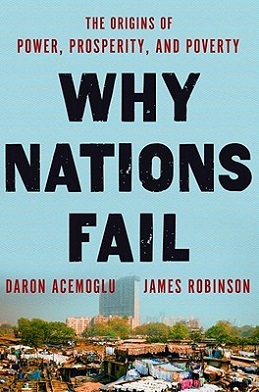
Why Nations Fail: the Origins of Power, Prosperity, and Poverty, by Daron Acemoglu and James Robinson. I spoke of the explanatory power of this remarkable book in an earlier post on democracy. The timing of its coming into my life was a bit random: I saw it sitting on the bookshelf of the drummer in my band about a week after Donald Trump’s 2024 victory, and I guess I was sensitized to the title. And, knowing John to be a well read guy–one of the two best-read drummers I’ve ever played with–I figured I would give the book a spin. Acemoglu and Robinson are two-thirds of a Nobel prize-winning team of economists for their work studying “the importance of societal institutions for a country’s prosperity,” to quote the The Royal Swedish Academy of Sciences. And this book, which struck me as both readable and magisterial in its scope, has helped me more than anything I have read before to articulate why democracy delivers peace, happiness, prosperity, and well-being better than any other form of government yet tried.

In a time when many Americans on the political right are growing fascism-curious (when they are not out-and-proud tiki torch-carrying fascists); and in a political moment when some on the left are so committed to ideological purity around questions of race, gender, Israel, and capitalism that they would rather lose elections than work with centrists, I found this book wise, humane, and ultimately hopeful. I hope more of my fellow Americans will read it.

My Best Reads of 2024

11 Wednesday Dec 2024

Posted by Joe in Book reviews, Exit Black, Literary criticism, Musings and ponderation, My Fiction, Reading Roundup, Science Fiction

≈ Leave a comment

Tags

books, sci-fi, sci-fi thriller, Science Fiction, Shepherd, Thriller

As you may remember from former posts, I’m a big fan of the book site Shepherd. And, like many of the writers on that site, I was invited by Shepherd founder Ben Fox to talk about my three favorite books of 2024. I was game, partly because I’m happy for any opportunity to link to my own book of this year, Exit Black–I believe it’s one of this year’s best thrillers on economic inequality that you’ll read this year.

I’m not sure what my choices say about me besides the fact that I do a lot of reading outside the genres I write in, but here were my three faves of this year: Edith Wharton’s The Age of Innocence, Toni Morrison’s Jazz, and Laurent Binet’s Civilizations. Why did I love them so? Check out my Shepherd page to find out!

Reading Roundup 2017

31 Sunday Dec 2017

Posted by Joe in Dungeons and Dragons, fantasy, Literary criticism, Reading Roundup, Science Fiction

≈ Leave a comment

Tags

books, D&D, fantasy, literature, Politics, Reading Roundup, sci-fi, Science Fiction, Stories

I guess I couldn’t get any later with my yearly reading roundup. And, since joining Goodreads last month, the thought of chronicling my reading habits for the last year feels a bit redundant. However, these posts have been fun to write for the last three years, and it helps me to consider in full the books I’ve read over the last year, if only to re-evaluate the stuff I’m reading.

I had a paltry reading harvest this year–13 books in all–though partly this number hides the many short stories, longform journalism pieces, and political blog posts I waded through this year. Having said that, I hope 2018 holds a little less covfefe coverage for me and a few more actual books by thoughtful people.

So, without further prologue, here is my crop of 2017 reads:

Chabon, Michael. The Yiddish Policemen’s Union.  This is one of the most inspiring high-wire acts I’ve read in all of fantasy fiction. Actually, I’m not sure exactly how the book is marketed—it’s an alternate history detective story—but here Chabon manages to weave a truly absorbing and moral tale set in a counter-historical Jewish homeland (which happens to be Sitka, Alaska). Also, Chabon’s writing is much like Eddie Van Halen’s guitar playing for me: while it’s often not exactly to my taste, every page or two I find myself asking “how did he do that?” as Chabon drops off another metaphorical description of the Alaska sky or a tough chess move.

Dick, Philip K. Do Androids Dream of Electric Sheep? There’s a rough-cut, coarse grained quality to PKD’s writing that gives this book the feel of a brilliantly inventive first draft. For all I know, perhaps it was: PKD was forced by poverty to churn out pulp books at a fantastic rate, under the influence of a good deal of amphetamine. The book is different in almost every way from Blade Runner, the film that was based on it and which provided my first exposure to PKD’s work. The book has a bit more of a Ray Bradbury-ish quality—sci-fi objects like ray guns and electric sheep are not portrayed as believable objects so much as mythical symbols, the kind of objects one would find in a dream. Blade Runner has a good deal more world-building in it. However, the book is the dream that the movie was made from.

Dick, Philip K. The Man in the High Castle This granddaddy of “what if Hitler had won?” novels is my favorite Philip K Dick book. The novel follows the loosely connected stories of several Americans living in a California that has become a protectorate of Imperial Japan. The story has the kind of trippy plot twists that Dick was famous for, but this story seemed tethered enough to a believable reality that it was much easier for me to inhabit this world than, say, Ubik or Do Androids Dream of Electric Sheep? The book is a creature of its time and some of the characterization of non-white peoples—especially the Japanese imperialists—hasn’t aged well; however, I would argue that those depictions are more ham-fisted than aggressively racist. While I’m not normally a fan of alternate histories, this one really got to me.

Dozois, Gardner, editor. The Year’s Best Science Fiction #33. It’s been years since I’ve read a “year’s best” anthology; however, I read this one cover to cover in hopes of learning more about the field I’m writing in. As with any book by a medley of writers, some of these stories spoke to me more than others. There were some good stories from writers I knew about—Kelly Link, James S.A. Corey, and Pablo Bacigalupi all had solid entries—but I was more blown away by several new (to me) writers: Ian McDonald, Gwyneth Jones, Carter Scholtz, Chaz Brenchley, Nick Harkaway, and Kelly Robson. The best of these stories do what I hope (and often fail) to do in my own work, bringing believable characters and well-turned dialogue to stories with the whiz-bang plots and settings of sci-fi. I have such a broad reading appetite, and I’m such a slow reader, that I probably won’t read another best-of anthology in the coming year. However, I have learned a lot about the short sci fi market here, and I do hope to come back to Gardner’s anthology again.

Dungeons and Dragons. Player’s Handbook, Dungeon Master’s Guide, and Monster Manual (three books). I’ve been a Dungeons & Dragons player since Christmas Day 1980. However, this is the first time that I’ve read the three core reference books for D&D from cover to cover. At the time, I had some hope of writing a set of longer and more involved posts about D&D (in addition to this one and this one), and so I told myself that I was doing research. It helped, too, that the books are generally quite well-written and that they provide an old player like me some insight into the evolving sociology of D&D.

Overall I loved most of the changes that these 5th edition books bring to the game. There is a long-running tension in the D&D community between those who like their games full of rules and statistics and those who favor the role-playing and interactive story-telling aspect of the game. (Of course, there are also many gamers, perhaps most, who play somewhere between these two extremes. As you can probably imagine, as a sci-fi and fantasy writer I play D&D for the story-telling). To my great joy, 5th Edition D&D is clearly an attempt to make role-playing and story-telling the center of the gaming experience. The focus on characters’ backgrounds and motivations and personal flaws, the reward of “inspiration points” to players who engage in particularly good role-playing, the inclusion of a more nuanced and morally complex alignment system—all of these innovations have turned 5th edition D&D into a game about inhabiting a character and playing a role. Yes, there are a few ways that the game has had its rules overly stripped down and simplified, but overall I’m much happier to see D&D moving towards a model of interactive storytelling.

I’m also pleased to see that the creators of this edition have worked hard to remedy the racist and sexist depictions of the first editions of D&D. So far as I remember, not a single illustration from 1st edition D&D depicted a non-white adventurer, and the descriptions of “savage” humanoids like hobgoblins and orcs were full of signifiers that associated these evil creatures with Asian hordes and African tribesmen (some of this racism was inherited directly from D&D’s source material. It’s no coincidence that the only African-American actors in The Lord of the Rings movies played orcs). Similarly, depictions of females in 1st edition D&D were almost always of the “chainmail bikini” variety—for example, on the cover of the original Dungeon Master’s Guide here:

dmg1e

5th edition has thankfully put real armor on the women, and the illustrators have broadened the color palette for illustrations, including (at last) for dwarves, elves, halflings, and all the other good-aligned creatures that might take up arms against a sea of goblins:

5thedfemale

Heath, Chip, and Dan Heath. Switch: How to Change Things When Change Is Hard. I’m generally skeptical of self-help books (especially those that are given to me at work), but I really loved the authors’ light tone here, as well as the well-researched underpinnings for what they were suggesting (hint: it’s in the title). I’m going to try these precepts in my own life and at work.

Kawasaki, Guy, and Shawn Welch. APE: How to Publish a Book. One of the best books on writing that I’ve ever encountered. Very different from the Brenda Ueland/John Gardner types of writing books, this one really focuses on the business end of publishing and promoting a book. I’ve built my publishing plan for Stranger Bird around these guys’ suggestions.

Hamilton, Alexander, John Jay, and Hames Madison: The Federalist Papers. Reading these fabulous essays was a bit of a slog, owing to the authors’ 18th century style. They were also at times hilarious: I wish I had counted the number of times Hamilton accuses the opponents of the constitution of wantonness, calumny, affectation, or speciousness (in the end he half-apologizes for his “intemperances of expression”). More importantly, though, I was struck by the genius of how the Constitution was framed, how an entire government could be brought about with so few moving parts in it. Of the three authors, Madison was my favorite: a gentle author, brilliant and deeply read, but also horribly compromised by his own slaveowning. Here (and elsewhere) we learn about Madison’s wish that slavery be abolished as inimical to a republican form of government; yet, like Jefferson and almost all the other founders, he did not free his own slaves in his lifetime or in his will. His Federalist 54, where he tries to explain the Three-Fifths Compromise, is one of the most fascinating and troubling things I’ve read from any of the founders. I have another take on these remarkable essays here.

Miéville, China. The City and the City.  I liked this book pretty well, though it suffered somewhat in comparison to Chabon’s The Yiddish Policemen’s Union, which I had read the month prior. Miéville turns in an interesting murder mystery in one of the most compelling imagined settings I’ve encountered recently, a double city in the Balkans somewhere where the inhabitants of each half are required by law not to see the inhabitants of the other half. Equal parts Kafka and Philip K Dick, this book offers a thought-provoking meditation on life in the Balkanized spaces of the world, the Jerusalems and Berlins and El Paso-Juárez double places.

Newton, Cam. Deep Work. I loved this book on first reading, though as Newton’s ideas have sat with me some of them haven’t aged well. I definitely agree with his overall thesis, though: that people who are able to focus for long periods of time on truly “deep work” (i.e. work that would be hard for others to do) can find themselves in great demand. This kind of focus is an increasingly rare skill. It is definitely having an effect on my work and home life.

Rulfo, Juan. Pedro Páramo. This slim story took me forever to finish, pokey as I am at reading in Spanish. I found the style much more accessible than Fuentes’ style in Artemio Cruz, and Rulfo’s story is both hilarious and frightening, like a gothic Poe tale retold by a Mexican John Kennedy Toole. The story was difficult, too, though—lots of unannounced time shifts, POV shifts, moments where it was unclear whether the speaker was living or dead. I may well teach this book sometime for my sci-fi and fantasy class. Anyone who liked the movie Coco should read this darker take on the subject.

Garamendi--de Pedro Paramo

Photo: “De Pedro Paramo 1/3,” Antonio Garamendi


The Founding Bloggers

23 Wednesday Aug 2017

Posted by Joe in Book reviews, Literary criticism, Musings and ponderation, Politics, Reading Roundup, The Time of Troubles

≈ 1 Comment

Tags

Alexander Hamilton, books, Hamilton, James Madison, John Jay, Lin-Manuel Miranda, Politics, The Federalist Papers, Trump

When a musical like Hamilton comes along, a rational response to the buzz is for folks to, you know, want to see Hamilton. Others might be overwhelmed enough by the positive press to look to Hamilton‘s source material, the gargantuan Ron Chernow biography of the man on the ten dollar bill.

Others, the cheapskates and musical theater philistines, might turn instead to The Federalist Papers.

Yes, I started reading The Federalist Papers because I heard Hamilton rapping on NPR for a minute and I realized that I hadn’t really read anything Hamilton had written.

I suppose if I’m really honest with myself, I do have to admit that fear for the future of America, at least as much as Lin-Manuel Miranda, is really what sent me to The Federalist Papers. As I watch the current president’s bumbling yet earnest assault on the Constitution–his flouting of the emoluments clause, his apparent ignorance of the establishment clause, his barrelling through each conversation as though the separation of powers didn’t exist–I realize that I don’t know enough about the document that the president is trying to subvert.  I have read the Constitution, and I’ve sure been going back to my pocket copy a lot lately, but like a powerless fanboy, I want to know more, to know it better. And The Federalist Papers, I’ve been told, are the inspired commentary on the US Constitution, the brilliant liner notes to that Sergeant Pepper’s Lonely Hearts Club Band of legislation.

I’m about a third of the way through so far, and it’s very slow going. All three of the authors–Alexander Hamilton, James Madison, and John Jay–learned to write in an age when a man showed his genius by teasing each sentence into a froth. Each sentence has a multi-layered, architectural quality, like the 18th century wigs that Hogarth lampoons in Five Orders of Perriwigs.

William_Hogarth_-_The_Five_Orders_of_Perriwigs

By William Hogarth – Scanned from The genius of William Hogarth or Hogarth’s Graphical Works, Public Domain, https://commons.wikimedia.org/w/index.php?curid=2714934

Of the three, John Jay is the most straightforward of the writers, the one least inclined to pile on the relative clauses. Imagine my dismay, then, to learn that John Jay wrote by far the fewest of the papers–only five of the 85–before illness forced him to give up the project. Hamilton, who wrote by far the most of the papers, is also the hardest to read. Every sentence of Hamilton’s is like listening to a Yngwie Malmsteen guitar solo: his paragraphs are spattered with commas, packed with dependent clauses that double back on themselves and seem to eat their own tails. And they are also filled with some of the most brilliant and vigorous writing I’ve ever seen.

This sentence, from Federalist #29, is typical Hamilton:

There is something so far-fetched and so extravagant in the idea of danger to liberty from the militia, that one is at a loss whether to treat it with gravity or with raillery; whether to consider it as a mere trial of skill, like the paradoxes of rhetoricians; as a disingenuous artifice to instil prejudices at any price; or as the serious offspring of political fanaticism.

Wow–I had to crawl through this sentence few times before I could tell what Hamilton was actually arguing: that militias are no danger to public liberty. However, one look at the rigging of this sentence is enough to warn me not to treat his ideas with raillery. A sentence like this demands to be treated with gravity.

I was also fascinated to see, in this sentence and elsewhere, how current Hamilton’s ideas are. Dust off the perriwig of his prose, and you can see that we are still  debating “the idea of danger to liberty from the militia” in this era of Cliven Bundy.

But what has impressed me the most so far about these letters is the high-wire act their authors pulled off. The three men, all writing under a single pseudonym–“Publius”–managed to pump out 85 of these essays over just ten months. That’s one letter every three or four days, each one a Niagara of commentary intended, I imagine, to bury the Constitution’s opponents under a flood of historical references, musings on American geography, and speculations on human behavior.

The newspapers these essays appeared in, The New York Packet and the Independent Journal, were two of that enormous flock of early American newspapers. I remember reading somewhere that most such papers had a circulation of about 1000. Publius was, in other words, much like an early blogger: a pseudonymous team of writers with a tiny audience, writing their asses off to produce brilliant content several times a week.

Dilettante that I am, I have nothing comparable to offer the country here at The Subway Test. I post a couple of times per month, sometimes about politics but usually not. Usually my topic is, in Homer Simpson’s words, “what some nerd thinks about Star Trek.” Yet I can reach back those 230 years to the brilliance of Publius and see that I am pushing my little cart up the great track they laid. If you want to resist the depredations of the current presidency, you have to educate yourself. Read The Federalist Papers. It is one of those books that will comfort you with the underlying genius of the republic. More importantly, it will help you understand what the hell you are defending when you stand up to the current president.

The Year In Reading: 2016

28 Wednesday Dec 2016

Posted by Joe in Literary criticism, Reading Roundup, Stories

≈ 2 Comments

Tags

books, Reading Roundup, sci-fi

At the end of 2015, I posted a roundup of what I had read that year, with a mini-review of each book. The post went over quite well, so I thought I would reprise this heavy year’s reading as well. Here’s the piebald mix:

Adler-Olson, Jussi The Keeper of Lost Causes.  I’m not normally a fan of mystery stories, but I was entertained enough by this example of Nordic crime fiction to keep reading and to finish it. The conceit of torturing someone through increasing the atmospheric pressure in a cell made out of a pressure vessel was both interesting and creepy, and the vibe of the book spurred my to try writing a sci fi murder mystery of my own. (The draft of that story has been disappointing, but I will see if it’s salvageable)

Bradbury, Ray. The Martian Chronicles.  This story cycle had a few truly excellent works in it (I’m thinking especially of the first three Mars expeditions). Other tales seemed emotionally lame—either overwrought or full of implausible motivations. Much as War of the Worlds seemed like a meditation on British Imperialism, this book seems like a metaphor for the conquest of the American West, as well as an early work on nuclear apocalypse. I’m glad I read this book—and I feel it gives me some external validation to keep going with my own story series on John Demetrius—but overall I felt a bit flat about the experience.

Calvino, Italo. The Baron in the Trees.  One of the sweetest, most heart-warming books I’ve ever read. Baron Cosimo di Rondo climbs a tree during a temper tantrum when he is twelve years old and he never comes down. For the next fifty-odd years, through the height of the Enlightenment, the French Revolution, and the disappointments of Napoleon, Cosimo reads, philosophizes, carries on love affairs, and corresponds with the great minds of his day, all from his home in the branches. Calvino, for much of his youth a communist, apparently wrote this book as a response to the Soviet repression of the Hungarians in 1956 (an event which caused him to leave the communist party and never join another). It’s a story of how one can keep to one’s philosophical commitments in the face of the many let-downs that the world has in store for us.

Catmull, Ed. Creativity, Inc.  What an inspiring book: this account of what it takes to run a creative company (in this case, two companies–Pixar and Disney Animation) filled me with ideas for my work at my own college and for my creative work as well. Catmull is big-hearted, generous, modest, and also committed to excellence in his work. I’m so glad my wife put me on to this book; I never would have sought it out myself.

Cline, Ernest: Ready Player One. This gift from my sister was a very enjoyable little read. The writing was in some ways terrible—Cline trades in clichés and underwriting—but the story is quite well-plotted and gave me many geeky moments with its references to D&D, old 80s movies and music, and early video/computer games like Zork. Good fluffy fun.

Fuentes, Carlos. La Muerte de Artemio Cruz. After four attempts over the course of six years, I have finally finished this short, sad work. I’m a very slow reader in Spanish under the best of circumstances, and this work, written with Faulknerian paragraph-sentences, unclear points of view, and unannounced time shifts, really put my creaky Spanish to the test. Yet in spite of its brevity, it’s a monumental novel, the history of Mexico in miniature, a chronicle of thwarted ambitions and broken promises and, underneath all that, an indomitable dignity. The Wikipedia page for the novel claims that the book was heavily influenced by Citizen Kane, and I can dig that, but just as much I see the influence of The Sound and the Fury and As I Lay Dying. It’s a poignant and unflinching look back at the life of a tough, bad hombre.

Grossman, Lev. The Magicians. I had seen a lot of good buzz around this series, but I found this book pretty hard to like. The characters were so, so privileged and self-involved, so jaded and irresponsible with their powers, that it seemed like nobody had anything on the line in this book. The characters seemed far more Jay McInerney than J.K. Rowling—I just never felt invested in any of them.

Holdstock, Robert: Mythago Wood. While interesting and sometimes fascinating, this book was ultimately a big disappointment to me. I loved the idea of a primeval forest with its own mythopoetic, psychological characters drifting out of it like ghosts. Shades of Solaris, there. However, the dialogue was pretty wooden, and I was shocked at how many plot points were totally contrived or were abandoned so carelessly (I know that the book is one of a series, but still—there’s no excuse for the lame non-explanation of Keeton’s leaving, nor the off-handed dismissal of the three following warriors who had barely figured in the story up to that point). I don’t remember who put Holdstock in the same league as LeGuin, Crowley, and Marion Zimmer Bradley, but this book does not lend much support to that claim.

Liu, Cixin: The Three Body Problem. I have mixed feelings about this one. The story is a truly original first contact tale, and I was blown away by the episodes that involved computing (both the episodes in the Three Body game and the creation of the sophon). However, I also found the characterizations wooden and the characters’ motivations at times truly unbelievable. How much of that stems from the translation, or from the different aesthetic of Chinese fiction, and how much of my trouble stems from the weak writing that afflicts so much science fiction?

Palmer, Parker. Let Your Life Speak.  I’m surprised that it has taken me so long to read Parker Palmer, probably the most famous living Quaker in the United States. This book seemed to take the form of half a dozen loosely-related Pendle Hill Pamphlets, most of them inspiring or heartening, and none of them useless. This is a great book about vocation, looking at our work through the lens of how we can best serve others and live out of our deepest identities. This may on the face of it sound totally contrary to the advice of another book I loved, So Good They Can’t Ignore You, but I would call these books complementary: Cam Newton’s focus was on building skills and getting paid for them, while Palmer’s seems to be on discernment about what our gifts are and how to use those gifts to serve others. Palmer is a true Hufflepuff—I needed his advice as I struggle with my own Hufflepuffery.

Sorokin, Vladimir. Day of the Oprichnik.  Near-future sci fi from one of contemporary Russia’s most celebrated authors. In the Russia of the 2020s, a Francisco Franco-esque figure has taken power, re-instituting the Tsardom and the ostentatious rites of the Orthodox Church. The oprichnina—Sorokin takes the name from the secret police of Ivan the Terrible—go about knocking heads, terrorizing people, and taking some weird-ass drugs.  The book is one part Atwood’s The Handmaid’s Tale one part Gogol’s Dead Souls, with a dash of Burgess’ A Clockwork Orange thrown in. Violent, intense, and a solid read.

Stapledon, Olaf. Star Maker. One of the oddest works of sci fi I’ve ever encountered. This read more like an extended essay or history than like a true story. Yet this history of the universe as told through the eyes of hive mind energy beings was quite imaginative and often interesting. I can see how Stapledon influenced Stanislaw Lem, Arthur C. Clarke, and Freeman Dyson, among many others.

Tolstoy, Leo. Anna Karenina.  One of the great reading experiences of my life. Slower than War and Peace—Anna Karenina took me about three months to finish—but I was amazed by the large-heartedness of the book. There were practically no unsympathetic characters at the end (except for the pharisaical religious woman who insinuates herself into Karenin’s life, I can’t think of a truly unsympathetic character). Even Karenin becomes, halfway through the book, a figure of deep love and pity. I was happy to see the book end—it’s a real emotional drain to read it—but I was amazed by Tolstoy’s powers of characterization here, as well as his plotting (the book reads like a collection of about 40 linked short stories).

OLYMPUS DIGITAL CAMERA

Wells, H.G. The War of the Worlds.  So different from the film treatments. But such a story! I can see why Wells was so influential. I love how the narrator characterized himself as a writer “on philosophical themes.” The whole book seems like an allegory for the failings of British Imperialism—one of the best sci fi stories I’ve ever read.

Witwer, Michael: Empire of Imagination. This was a fluffy, entertaining history of the creation of Dungeons & Dragons by Gary Gygax. I didn’t realize exactly how much of a rockstar Gygax had been in the 80s (nor how much of the rockstar lifestyle he copied). I did know something of the rags-to-riches-to-rags arc of his story, but there were some wonderful details here, as well as a bit of redemption in Gygax’s later years (even if the telling of it seemed a bit contrived). A fun memory trip.

Zinn, Howard. A People’s History of the United States. I wrote a longer review of this book a couple of weeks ago.  While I was familiar with every period Zinn wrote about in People’s History, I don’t think I had ever seen all these periods stitched together into a single overarching vision. Basically, Zinn’s contention is that the true history of the United States is not defined by the actions of presidents and congresses who have worked at practically every turn to enrich a tiny economic elite–by preserving slavery, by massacring the natives, by invading Mexico and Cuba and The Philippines, by overthrowing democratically elected governments in Guatemala and Chile and Iran. Rather, American history is made up of the often overlooked struggles of the oppressed, the working class, the unrepresented. It is a history of people fighting, over centuries sometimes, to be included in the opening phrase of the Constitution: “We the People.” It’s an inspiring–if sometimes flawed–vision. I believe that what it offers, in a crowded field of history texts, is a truly alternative analysis of the history of the nation.

Subscribe

  • Entries (RSS)
  • Comments (RSS)

Archives

  • November 2025
  • September 2025
  • August 2025
  • July 2025
  • May 2025
  • April 2025
  • March 2025
  • January 2025
  • December 2024
  • October 2024
  • September 2024
  • August 2024
  • June 2024
  • May 2024
  • April 2024
  • March 2024
  • February 2024
  • January 2024
  • December 2023
  • October 2023
  • August 2023
  • July 2023
  • June 2023
  • April 2023
  • March 2023
  • May 2022
  • August 2021
  • June 2021
  • January 2021
  • October 2020
  • May 2020
  • March 2020
  • February 2020
  • January 2020
  • July 2019
  • June 2019
  • December 2018
  • October 2018
  • July 2018
  • May 2018
  • April 2018
  • January 2018
  • December 2017
  • November 2017
  • September 2017
  • August 2017
  • July 2017
  • June 2017
  • May 2017
  • April 2017
  • March 2017
  • February 2017
  • January 2017
  • December 2016
  • November 2016
  • October 2016
  • August 2016
  • July 2016
  • June 2016
  • May 2016
  • March 2016
  • February 2016
  • January 2016
  • December 2015
  • November 2015
  • October 2015
  • July 2015
  • May 2015
  • March 2015
  • February 2015
  • January 2015
  • December 2014

Categories

  • A Place for my Stuff
  • Advertising
  • Artificial Intelligence
  • Beta Readers
  • Biology
  • Book reviews
  • Curious Fictions
  • Dungeons and Dragons
  • Exit Black
  • fantasy
  • Games
  • HPIC
  • Journeys
  • Let's All Admire That Fantastic Can
  • Lit News
  • Literary criticism
  • Musings and ponderation
  • My Fiction
  • Pacifica
  • Politics
  • Reading Roundup
  • Science
  • Science Fiction
  • Science Fiction Writers of America
  • SETI
  • Stories
  • Stranger Bird
  • The Ideal Vehicle
  • The Time of Troubles
  • Uncategorized
  • Utopia and Dystopia
  • Welcome
  • YA fantasy

Meta

  • Create account
  • Log in

Authors

  • Joe's avatar

Blog at WordPress.com.

  • Subscribe Subscribed
    • The Subway Test
    • Join 144 other subscribers
    • Already have a WordPress.com account? Log in now.
    • The Subway Test
    • Subscribe Subscribed
    • Sign up
    • Log in
    • Report this content
    • View site in Reader
    • Manage subscriptions
    • Collapse this bar
 

Loading Comments...