Why Fantasy?

Tags

, , ,

When people ask what I write, I almost always say science fiction. I almost never say fantasy, even though in many ways fantasy is my first love, going all the way back to reading The Hobbit and Watership Down and Roald Dahl when I was a kid. I’ve wondered lately why that is: am I embarrassed that I read and write and teach fantasy fiction?

In spite of all the blessings of nerd culture entering the mainstream, I guess I do feel more guarded about my love of fantasy. Both fantasy and sci-fi are snobbishly dismissed as escapist genre writing by some who have a very specific, Harold Bloomish notion of what literature is (I say “Bloomish” because the real Harold Bloom has been a vocal supporter of the work of fantasists like John Crowley and Ursula LeGuin). But even in the realm of nerd fiction, I get the impression that it’s more popularly acceptable for adults to be into science fiction than into fantasy. Perhaps that’s changed in the current market of the Lord of the Rings-Industrial- Complex and Game of Thrones. But I think there’s still a residual shame for many folks about their love of fantasy. Science fiction is about heavy, heady ideas: the ethics of progress, the shape we want our future to take. What’s fantasy about? Dragons?

podcastleHere’s an answer that took me a while to come to, but which makes me more ready to tell strangers that I write fantasy: fantasy–if it’s good–looks at the human experience sideways. All art is about what it means to be human, but fantasy (like surrealism or avant-garde music) takes a look at the human experience from an oblique angle, representing our fears and desires as creatures and powers that don’t exist in the everyday. This is what mythical stories did for earlier people, and fantasy for me is an attempt to apply mythical thinking to fiction, in a world where change comes too quickly and radically for traditional myth-making structures to keep up.

I’ve definitely written more science fiction than fantasy, but this last week I had a fantasy story picked up at the first place I’d sent it (PodCastle, the amazing fantasy podcast). I’m excited to hear it read, and to have others hear it, and I’m ready to say to people, when they ask, that I write science fiction and fantasy, and to be able to say why I do.

Is Your Story a Lager or an Ale?

Tags

,

I’m generally not interested in giving writing advice on this blog. But every once in a while a fellow writer will drop in on this site; some of these fellows are creative writing students of mine. If you’re interested in free advice from a barely-published writer, I just want to say one word to you. Just one word. Are you listening?

Lagers.

If I had to condense what I’ve learned about writing fiction into a single piece of advice, it would be that I got much better as a writer when I learned to lager my work. That is, like a patient brewer, I’ve learned to put just about any story that I’m working on into cold storage for a while before I decide whether it’s finished (the cold storage is what makes a lager a lager; beers that aren’t made that way are called ales).

story_lagering

So here’s my process: I get a story idea. I work on it for weeks or months, drafting and redrafting. Usually after about three drafts (sometimes two), I put the story away for a while. Three to six months seems like a goodly length. When I pull the story out again after that, I will nearly always see some changes, often pretty deep changes, that I want to make to the story before sending it out. That 3-6 month waiting process–the lagering–is what tightens up the story for me. For whatever reason, I have to let my work sit that long before I can tell what work needs to be done on it.

How did I learn this process? Well, I could have learned it from any number of creative writing workshops or texts–lagering is not some exotic technique. But, as with most things I’ve learned about writing, I had to learn this practice Robinson Crusoe-wise, through trial and error and my own experience. The technique came to me after a couple of different incidents: once when I had a story published, then looked at the story again on the website a couple of years later and realized that there were some things I would really have done differently with that story if it weren’t already in print now. Another experience that gave me the lagering insight was when I put away a much-rejected story, having concluded that (since no one seemed to want to print it) it must not be a very good story. It was only after pulling it out years later that I concluded that, actually, it is a very good story–or at least the best kind of story I’m capable of–and that 12 rejections or 15 or whatever are not necessarily evidence that the story sucks. Some stories are just harder to place in a magazine. I decided to keep at it, and I did find a good home for it (that story is “Better than Google,” by the way, in Eclectica).

You don’t need to take my word for it. Find out for yourself, Robinson Crusoe-like. But when you discover lagering your work, one of the footprints you’ll see down there in the cellar is mine.

The Banality of Self-Promotion vs. the Bogosity of Being Too Cool

Tags

, , ,

Photo credit: David Goehring

Photo credit: David Goehring

I’m a writer. Becoming a writer was actually a lot simpler than I had imagined when I was a youth: basically I just wrote and read and wrote until I felt ok calling myself a writer. I’ve had a few minor crises about it–a crisis of genre, a struggle coming to terms with rejection–but becoming a writer was actually a breeze in most ways.

One way becoming a writer hasn’t been easy, though, has been learning to backburner a whole skillet of other interests in order to make time for writing. Making music, playing sports, continuing education, gaming–all these activities are sadly diminished for the time being and possibly for a long time to come, so that I can scrape together a few hours per week to write. But I’m even ok with that–being a writer means writing, after all, so to call myself a writer I do have to actually make the time to write.

And here’s the part about being a writer that I struggle with still: striking a balance between writing and self-promotion. I don’t have an agent. I don’t make enough from my writing to pay an agent. So if I want anyone to read my work, I have to send it out to magazines, or read it to people, or have someone want to read it for their podcast. And that takes a lot of time, time that I’d love to spend on the actual writing.

I do want people to read my stuff–I’m not Emily Dickinson. It took me a while to realize that the desire to have readers is different from (or at least doesn’t have to be the same as) the desire to be famous. I’m not nearly as interested in being famous. But I do love to have readers. As one of my ESL students wrote in an essay years ago, “when I am writing to you, I am saying please understand me.”

How much time should an artist spend on self-promotion? I’ve just spent a whole weekend sending stories out, trolling through Duotrope, writing a blog post about self-promotion. And not writing stories. How much time do you spend at your work (not necessarily your job, but your work)? How much time do you spend talking about your work?

Ursula Le Guin: an Evangelist for the Tao

I just finished The Lathe of Heaven on a bumpy flight to Houston. It’s one of a small handful of books I’ve read that was short enough and compelling enough for me to read in a single sitting (right up there with Catcher in the Rye, Cat’s Cradle, and Grendel). And, while it’s not my favorite favorite Le Guin novel of all time (that would be The Left Hand of Darkness, I think), it’s creepy and canny and at times biting. More impressive for me, it breaks the first cardinal rule of fiction that I give my creative writing students: no “so it was all a dream!” stories. Ursula Le Guin gets away with it because, hey, she’s Ursula Le Guin.

(That wasn’t a spoiler, by the way–you find out that there’s a lot of dream reality in the first 10 pages or so).

I’m curious why more isn’t made in sci fi circles of Le Guin’s Taoist sympathies. I’m not criticizing her sympathies–I’m an enthusiastic amateur student of Taoism–but I haven’t heard people talk about her work as Taoist in the way that people talk about Tolkein and C.S. Lewis as Christian writers or Pullman as an atheist writer. Yet, despite the relative quiet about Le Guin’s beliefs, this book is Taoist in the way that Flannery O’Connor’s work is Catholic or Bernard Malamud’s work is Jewish.

Like any book, The Lathe of Heaven is to some extent a product of its time: the Taoism of the narrator is offered as a needed medicine to a “Judeo-Christian rationalist” tradition that sent the US military into Vietnam and fouled the air with pollution and greenhouse gases. But it reads very well for a 45 year-old work of science fiction–that only happens with the best sci fi (or the best anything, I guess).

New Fiction on the Intertubes!

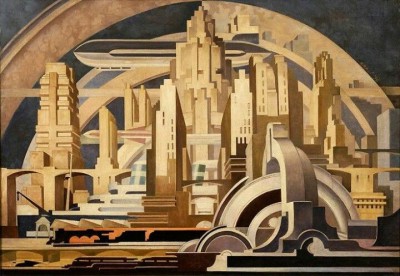
My newest story, “Lamp of the Body,” is online at Bewildering Stories, edited by the indefatigable Don Webb. It’s set in a retrofuturistic Portland, the kind of city Portland would be if every building was Art Deco or Streamline Moderne. There’s a security cam on every corner and a cadre of unhappy inspectors watching the feeds. When I saw Tullio Crali’s  Cityscape, I knew that was the city where “Lamp of the Body” took place.

tullio cralli cityscape

I hope you like it. It’s good to have some new material out there for people to read.

On Rejection

Tags

, ,

I have an account on Duotrope that keeps tabs on how frequently magazines and websites pick up my stories for publication. Depending on where I’ve sent stuff and how recently I’ve gotten a story accepted somewhere, my acceptance rate oscillates somewhere between 5% and 15%. Which is to say, from a glass-half-empty angle, that 17-19 out of every 20 submissions I make get rejected.

And that’s ok. It took me 2687821250_097aee5078_ma while to understand that rejection is the typical outcome for submissions, even for writers much better than me. I know that every book and class on creative writing includes that warning early on: get used to rejection. But, like a lot of people, I saw those warnings (maybe 34 of those warnings) and yet still harbored the sneaking suspicion that my work was so special that somehow I wouldn’t need to get used to rejection.

I can say now that I have been used to rejection for a good long while. The part that I didn’t anticipate, though, is that you can get used to rejection and still find it painful. Having a story rejected is a little like being told “no, I will not go to prom with you.” The nineteenth time I hear that isn’t nearly as painful as the first time I heard it, but I still really hoped that the nineteenth person was going to say yes.

All of this is a long way of saying that I understand why people self-publish. I’ve sure considered self-publishing, too. But why not? What do I lose by forgoing the rejection process? What do I gain by sending work out to gatekeepers I don’t know and who are almost certain to reject it?

And you, reader? What do you lose? What do you gain?

Is Birdman Sci-Fi?

Tags

,

Birdman has had quite an effect on me since my wife and I saw it last week. While it didn’t quite hold together as totally as I’d hoped, it’s a truly ambitious movie. See it if you want to watch some very talented artists really putting themselves out there.

The movie got me thinking (again) about genre: is Birdman a sci-fi movie? I’ll avoid dropping any spoilers, but much of the movie seems to deal with what Philip K. Dick scholars call “The Reality Problem.” I spent a long time wondering whether Michael Keaton’s character, Riggan Thomson, was delusional or whether the reality being presented to the audience—Riggan’s powers, his visions, his constant companion and interlocutor—should be taken at face value. And is a movie only science fiction when the character really has telekinetic powers? If we decide Riggan was delusional, does Birdman become an art film instead?

I know terms like “science fiction” and “art film” are really marketing categories designed to sell movies to target demographics. And I hate how habituated I am to those categories. But that doesn’t mean the categories are meaningless: there is such a category as “science fiction.” Where does Birdman fit? And what other recent movie seems this hard to categorize?

Fan Mail

Tags

, ,

Last weekend I received the second piece of fan mail I’ve ever received in my life. I was touched and flattered, of course, but it reminded me of a long-ago resolution I’d made–when I received my first fan mail–and failed to keep. I remembered that I have never once reached out to another author myself.

I can think of many, many authors whose work has meant a great deal to me but who haven’t received the kind of attention that Cormac McCarthy or Ursula LeGuin get. Kij Johnson and John Crowley come immediately to mind. One of them will get an email from me this week–I resolve it. Or re-resolve it.

New Stories Up

Tags

After a little self-googling, I’ve learned some bad news and some good news about my fiction (at least from the perspective of someone who wants people to read my work). The bad news: most of the stories I’ve written are no longer available for free on the internet (if they ever were available). The good news: some stories have a remarkably long shelf-life online, longer than Twinkies.

I’ve put the four stories you can get for free under the “My Fiction” link at the top of the page. I have another story forthcoming, and I’ll be spending part of the Xmas break sending new stories (and maybe even some reprints) out for consideration at other magazines. I hope you’ll see more stories here soon.

A Place for my Stuff!

Tags

There are many reasons I make a bad blogger. For one, I write slowly, and much of what I write is tough to read until it’s been revised and revised again, put through the rock tumbler of my brain for days or weeks or months. Also, I’m wary about taking on a writing project that might suck away precious time that I could be working on stories, poems, songs–basically writing that isn’t blogolalia.

But I’ve set up this site anyway because a few people have asked me where they can find my writing. So, here it is: The Subway Test. This is, as George Carlin so wisely put it, a place for my stuff.

Welcome to The Subway Test. I hope (and predict) it will remain a small-batch site for my friends and family. But if a stranger comes here, curious about a story I’ve written and hoping to find another, I consider you my friend, too.