
• About
  • My Fiction
  • Reviews

The Subway Test

~ Joe Pitkin's stories, queries, and quibbles regarding the human, the inhuman, the humanesque.

The Subway Test

Tag Archives: Politics

Three books that have affected me this year

17 Wednesday Sep 2025

Posted by Joe in Book reviews, Musings and ponderation, Politics, Reading Roundup, The Time of Troubles

≈ 3 Comments

Tags

Abundance, Anne Applebaum, Autocracy Inc., book review, books, Daron Acemoglu, democracy, Derek Thompson, Ezra Klein, history, James Robinson, Politics, Why Nations Fail

I’ll begin with the obvious: we can’t defend the republic simply by reading books. Reclaiming and repairing American democracy will require mass protest, creative civil disobedience, and serious political organization.

But let’s not minimize the importance of a shared text for the cohesion of a political movement: from The Bible to Common Sense to Uncle Tom’s Cabin, defenders of American democracy in the past found solidarity and a shared language through a text held in common. And beyond that, a book often serves as an extended argument for or against a cause, an intellectual defense of an idea that needs defenders. Most Americans haven’t read The Federalist, but anyone who has read it has access to the first and most brilliant exegesis for the Constitution itself.

I don’t expect any of the books below to have the impact of Common Sense. But I got a great deal out of reading each of them, and I think our movement would be better off if more defenders of constitutional democracy were aware of the ideas here. My reasons for choosing to read them were idiosyncratic, but I want to evangelize for each of these books to you. While they aren’t the only good books I’ve read this year, they each in their own way offer an argument for meeting the current authoritarian moment in the United States.

Autocracy, Inc.: The Dictators Who Want to Run the World, by Anne Applebaum: I get the impression that this book is a compilation of pieces that Applebaum has written in The Atlantic, some of which were extended in this book. Nevertheless, I really recommend taking in her argument all at once here. According to Applebaum, the anti-democratic regimes of the world—from Putin’s Russia and Xi’s China all the way to Maduro’s Venezuela and Mnangagwa’s Zimbabwe—have banded together into a kind of mutual aid society. That is, regimes that see democracy as a threat to their survival are helping one another to evade sanctions, to foment an anti-democratic disinformation network, and to sabotage the democracies of the world. This network of autocrats and strongmen has accomplished a great deal to undermine democracy already, and I came away from this little book believing that the struggle against Vladimir Putin and Xi Jinping is inextricable from the struggle to resist Donald Trump. It’s not totally clear yet how the forces of democracy will succeed at restoring civil society’s fortunes; however, success begins with understanding the nature of the forces attacking us. In a dark time, I take heart in Applebaum’s dedication of the book “for the optimists.” To paraphrase John Lennon, she’s not the only one.

Abundance, by Ezra Klein and Derek Thompson. I picked this up after it seemed like every lefty blogger–and a lot of non-lefties–couldn’t stop talking about it. I find the book’s thesis straightforward and compelling: according to Klein and Thompson, America has lost its initiative to build housing, transportation projects, and energy infrastructure, and progressives bear at least some responsibility for that state of affairs. In the name of environmental protection, labor unionism, and racial justice (a trifecta the authors refer to as “everything bagel liberalism”), we on the left have deployed environmental impact statements, restrictive zoning ordinances, and other restrictions on property use, often with the self-serving secondary purpose of boosting property values in blue cities.

As a progressive, labor unionist, and committed environmentalist, I find this thesis challenging. However, it’s hard to deny that NIMBY attitudes have slowed the construction of affordable housing in many putatively progressive West Coast cities, and these same attitudes have slowed or stalled many energy generation projects, even some solar and wind installations, to say nothing of nuclear energy capacity. On the right, Tyler Cowen has argued that organized labor and environmental groups are the two primary culprits in this slowdown. I would like to hold out the possibility that opposition to more environmentally friendly infrastructure, energy generation, and housing is not baked into the recipe of the labor and environmental movements, but this book issues a challenge to us on the left to support, rather than oppose, a society which builds more for its members. One of the personal goals I’ve set myself over the coming year is to investigate ways that the abundance agenda–which I believe I endorse–can be reconciled with the values of organized labor, social equity, environmental protection, and ecological restoration that I also support. Of course, all life is a series of trade-offs, and not every virtuous goal can be maximized simultaneously. I want to seek out practical compromises for the coming restoration of democracy that will move society forward, and this book is a great call for that.
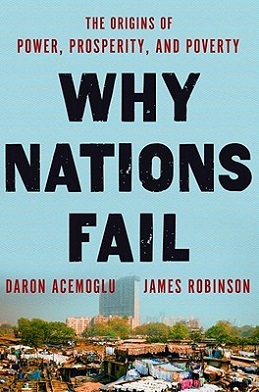
Why Nations Fail: the Origins of Power, Prosperity, and Poverty, by Daron Acemoglu and James Robinson. I spoke of the explanatory power of this remarkable book in an earlier post on democracy. The timing of its coming into my life was a bit random: I saw it sitting on the bookshelf of the drummer in my band about a week after Donald Trump’s 2024 victory, and I guess I was sensitized to the title. And, knowing John to be a well read guy–one of the two best-read drummers I’ve ever played with–I figured I would give the book a spin. Acemoglu and Robinson are two-thirds of a Nobel prize-winning team of economists for their work studying “the importance of societal institutions for a country’s prosperity,” to quote the The Royal Swedish Academy of Sciences. And this book, which struck me as both readable and magisterial in its scope, has helped me more than anything I have read before to articulate why democracy delivers peace, happiness, prosperity, and well-being better than any other form of government yet tried.

In a time when many Americans on the political right are growing fascism-curious (when they are not out-and-proud tiki torch-carrying fascists); and in a political moment when some on the left are so committed to ideological purity around questions of race, gender, Israel, and capitalism that they would rather lose elections than work with centrists, I found this book wise, humane, and ultimately hopeful. I hope more of my fellow Americans will read it.

Value #1: Democracy

26 Saturday Jul 2025

Posted by Joe in Musings and ponderation, Politics, The Time of Troubles

≈ 5 Comments

Tags

authoritarianism, civil society, democracy, Donald Trump, history, Politics

In response to Josh Marshall’s question about what kind of political world I want to strive for, I thought I would produce a few statements of value that I have been working out for myself. I hope to present these from time to time over the next months. They may be of no value to anyone besides me; I engage in the exercise primarily to explain a way forward to myself and to make my allegiances public. But if these little value commitments inspire one of my students or readers or friends to do the same for themselves, so much the better.

The first value, and the one I find myself most surprised to have to articulate, is a commitment to democracy. Life in an open, democratic society is one of those baseline assumptions that I grew up with, and until recently, I assumed that all of us in the United States were basically talking about the same thing when we spoke of democracy. One of the great disillusionments of my life has been to learn how many of my compatriots mean something very different than I do when they speak of democracy. Worse still has been to learn how many Americans are out and proud about their hostility to the entire American democratic experiment, from race war accelerationists to Christian nationalist theocrats in search of their “Protestant Franco” to e/acc techbros who believe that democracy is an inconvenience that will wither away like a vestigial tail once the singularity of artificial general intelligence arrives.

To be clear, I am not arguing here for the relative merits of direct democracy vs. a democratic republic, or a presidential system vs. a parliamentary one. While these are interesting questions for defenders of democracy to argue, all of these models depend on free and fair elections, a free press, and the rule of law. Rather, defenders of the American experiment must argue for the virtues of democracy relative to undemocratic forms of government like authoritarianism, dictatorship, oligarchy, and what jurist Wojciech Sadurski terms “plebiscitarian authoritarianism” (a term I prefer to Fareed Zakaria’s confusing “illiberal democracy”).

While I find myself surprised at having to articulate my support for democracy, I suppose I shouldn’t be–I mounted such a defense for my students in the days after the January 6 coup attempt in 2021. And I am reminded of Peter Beinart’s essay in Slate during the second Iraq War in which he said that “American virtue must be proved, not asserted.” Beinart’s statement is truer today than it was when he wrote it in 2006, and in fact the starting point for this blog post is that democracy is worth defending and working for regardless of the path that the United States is taking as a country.

If I take as a starting point the claim that the virtues of democracy must be proven and not simply asserted, here’s my argument for democracy: whatever its many follies, democracy is civilization’s best attempt so far at broadly shared, pluralistic governance. This approach to governance is the best safeguard–maybe the only safeguard in the long term–against exploitative and extractive social structures where people in power maintain themselves by excluding some segment of the population from political participation, usually with the goal of exploiting that segment’s economic production. This exclusion and exploitation can take many forms–slavery, serfdom, indentured servitude, apartheid, caste systems–but at the root of all these systems is the oppression of some members of society for the benefit of other, more dominant members.

The only real remedy for such exploitation is a political process where power and participation are broadly shared. At this point, one might respond that given such a definition, the US was rarely if ever a democracy to begin with. What should we expect today, some might argue, of a country that began as a slave society and that derived its territory by dispossessing, and often exterminating, the natives that lived here before? My answer to this line of argument is the same, I think, as Barack Obama’s (and Abraham Lincoln’s) position that whatever our many failures in living up to American democratic ideals, the ideals remain worth following. That canny, curious phrase from the preamble to the Constitution, “in order to form a more perfect union,” captures our condition: at best, we can only improve on what came before. But we can, through deliberative, democratic processes, form a union that is more open and pluralist than our society’s prior attempts.

It’s pluralism, which depends on power sharing, compromise, and some degree of turn-taking, that protects the vulnerable and marginalized far more reliably than the noblesse oblige of elites or the tender mercies of some techbro-fantasy philosopher king. Without the pluralism that democracy protects, we have nothing but cynicism and exploitation and plunder.

This argument owes a great deal to Daron Acemoglu and James Robinson’s brilliant book Why Nations Fail. The heart of their book, as I understand it, depends on two central observations of human behavior. The first is economist Joseph Schumpeter’s principle of creative destruction: the idea that technological advances and discoveries of new resources are inherently destabilizing to the status quo because these discoveries shuffle existing power relations. For instance, a new invention that improves productivity in a certain field (e.g. the spinning jenny during the early Industrial Revolution) creates opportunities for new market participants even as it reduces economic power for others (even to the point of immiseration for some). There is a natural tendency for beneficiaries of the status quo to resist these changes: To take just one simple but telling example from the book, it’s no coincidence that on the eve of the American Civil War, the US Patent Office granted a dozen patents per year for technologies related to corn production (a staple of the free North) and only one per year for cotton production technologies (the cash crop of the slave South). In other words, northerners who had to pay field hands for their labor had far more incentive to innovate and improve productivity than did southern planters who were extracting the labor from slaves for free.

Acemoglu’s and Robinson’s second observation relates to the Iron Law of Oligarchy. This is the natural tendency for those in power, no matter their stated political values, to seek to perpetuate their power and to extract wealth from the system for their own benefit. It is this ossification of political power that explains everything from the corruption endemic to undemocratic states to the dismal observation that every successful Marxist revolution in history has ended with a governing elite that betrays its revolutionary principles and in many cases becomes even more autocratic and self-serving than the regime they replaced. Without the power-sharing, compromise, and political turn-taking inherent in democracy, anti-democratic states seem trapped in amber: resistant to innovation, ruled by an elite whose entire focus is the extraction of wealth from the system through the exploitation of people and resources.

Donald Trump is working hard, to the extent that he works hard at anything, to extract revenge from his political enemies and to eliminate the inconvenience of democracy. If he succeeds, he and his family and cronies may rule over us for a very long time: witness the staying power of leaders he admires, from Putin to Xi, to Erdoğan to Orbán. Trump and Trumpism could, through gerrymandering, bullying of once-independent media companies, and the compliance of a corrupt Supreme Court, remain in power almost without any regard for public support or even consent to be ruled.

In the end, the only way for America to survive as a democracy is for Americans to insist on its survival. How we do that is an interesting question: like many of you, I am looking for avenues to rebuild and strengthen civil society. There remain tools at our disposal: in many places, state and local governments; organized labor; civil society organizations; and a vibrant remnant of independent press, as expressed in Substacks and scrappy little journals of ideas. I hope to say more on these tools in months to come.

In the struggle against authoritarianism and anti-democracy, lots of people around the world have gone before us: Nelson Mandela, Vaclav Havel, Nasrin Sotoudeh, Lech Walesa, Narges Mohammadi, Ai Wei Wei. Some, like Alexei Navalny, have paid with their lives and their efforts have not yet borne fruit. But, rather than viewing these people as I once did–as heroic outsiders struggling for freedom in far-away places–I see them now as models to study. There is a worldwide conspiracy against democracy today, and the struggle against Putin’s or Xi’s or Erdoğan’s regime is not so different from the struggle against Trump’s unmaking of the American experiment.

Donald Trump is a Selective Event

25 Tuesday Mar 2025

Posted by Joe in Musings and ponderation, Politics, The Time of Troubles, Utopia and Dystopia

≈ 7 Comments

Tags

democracy, democratic republic, Donald Trump, Politics, primary succession

I don’t intend to dehumanize the man. At the bottom of all the chaos he’s catalyzed, Donald Trump is an ordinary mortal. He is a criminal and grifter and predator, but despite all that he remains a human being.

But Donald Trump is also an erupting supervolcano, defacing a continent. He is a plume of gigatons of methane released into the atmosphere by the melting of clathrate ices. He is a comet striking the earth.

In less poetic terms, the Donald Trump presidency is the civic equivalent of what evolutionary biologists call a selective event: a dramatic or even catastrophic change that exposes the organisms of a community to powerful natural selection. Some organisms may survive; many will not. There is a lot about America that I’ve taken for granted my whole life which will disappear, I suspect. I can lament the loss; I can make myself angry thinking about how as a country, we’ve brought the catastrophe down on ourselves. But there’s no sense hand-waving past the magnitude of the changes upon us.

Nor do I have anything to gain by despairing about the situation we face. It’s still important for me to read the news and to engage with the political process, if only because I believe that facing reality is an ethical stance towards the world.

Though it can be fun for science fiction authors to make predictions, I decline to speculate now about what the United States will be like in ten years or even five. Even without the metastasis of Donald Trump, the changes of the next few years would have been cataclysmic: not necessarily all bad, or even mostly bad, but nonetheless deeply altered. As artificial intelligence penetrates ever further into our lives, as the vise grip of anthropogenic climate change tightens the screw one more turn, our lives over the next ten years would have been profoundly different even if the United States had not elected a strongman more in the tradition of a 19th century Latin American country than of a republic with a free press and mature civil society.

Here’s what I will say, though: if America looks unrecognizable after the civic catastrophe of Trumpism, it’s worth establishing for myself–as well as for my students and descendants–what values I will hold to regardless of what’s left of the country when the dust has cleared.

I had the great fortune of doing ecological work on Mount St. Helens from 2009-2011, thirty years after the eruption of 1980. My field site was an area called the Pumice Plain, directly in the pyroclastic flow of the volcano, where 40 meters of 300º-730º C pumice had sterilized the mountainside. For a moment, the Pumice Plain was as barren as the surface of the moon.

And yet, the story of how life reestablished itself on Mount St. Helens was as interesting and impressive as the story of how the Pumice Plain destroyed the forest it replaced. Within a year of the eruption, researchers had found a single dwarf alpine lupine, Lupinus lepidus, had taken root on that barren moonscape:

A descendant of the tough little flower in question.

By the time I got to the Pumice Plain, there were a million of these unassuming, scrappy lupines growing there, as well as Sitka willow saplings and young cedars and Douglas firs and Western hemlocks. Darwin’s entire entangled bank of invertebrates and birds and mammals and amphibians trawled over the new plant life there, trying to work their ecological niches.

I believe that regardless of the forces arrayed against it, democracy is a similarly inexorable force. Whatever remains after the eruption of the years of Trumpism–whether they last from 2016-2028 or from 2016-2116–my allegiances are with the forces of democracy and pluralism. This bedrock commitment stems as much from my faith as a Quaker as it does from my having grown up in a democratic country, and it informs all other civic values that I’ll speak to in coming posts.

Goodbye, Kevin Drum

12 Wednesday Mar 2025

Posted by Joe in Journeys, Musings and ponderation, Politics

≈ Leave a comment

Tags

blogging, Kevin Drum, Politics

The best blogger in the world, Kevin Drum, died last Friday after a ten-year journey with multiple myeloma. Though I never met him, I miss him terribly.

Kevin became the voice of the Political Animal blog at Washington Monthly in 2004–that’s where I discovered him. And while I don’t remember the first time I took notice of his work, I’ve read him daily for at least 20 years, first at Political Animal, then at Mother Jones, and finally at his solo endeavor, Jabberwocking.

Kevin’s work was so thoughtful, so insightful, so wide-ranging and funny, that sometime around 2006 or 2007 I felt inspired to start a blog of my own. I learned almost immediately how hard it is to do what Kevin Drum did every day, multiple times a day. After a few weeks of putting up meandering, useless-to-anyone-but-me musings–maybe six or seven of them in total–I realized that I would never be able to do what Kevin did. In retrospect, the feeling was a little like that scene in the movie Trainwreck where Bill Hader is playing one-on-one basketball against LeBron James: the difference between what I was trying to do and what Kevin was doing was so great that it wasn’t even clear that we were playing the same game.

And now he’s gone. I can’t think of a political commentator in my lifetime that was more fair-minded, more intellectually rigorous, more even-keeled, more decent than Kevin. For 20 years, his mind has been indispensable to me. And, while I am reminded of the Charles de Gaulle quote “the cemeteries of the world are full of indispensable men”–a saying I first encountered in a Kevin Drum post–I regard with loneliness the prospect that we will all have to get along without Kevin’s incomparable gift from now on.

Rest in Peace, Man

Empires Die, But Euclid’s Theorems Keep Their Youth Forever

22 Wednesday Jan 2025

Posted by Joe in Exit Black, Musings and ponderation, The Time of Troubles

≈ 1 Comment

Tags

DJT, Donald Trump, Politics, Volterra

I’ve been slow to speak on the current political situation of the United States, partly because so many people smarter and quicker than I have flooded the zone. I’ve never been good at the hot take–for that matter, I’m too slow a processor to ever be very good at blogging, I think–but I have definitely been thinking and reading, and I remain a believer in the old English 101 maxim about writing to discover what you actually think about an issue. So, maybe these few paragraphs (and some of the posts that will follow) will help me get clear on a way forward: how do democracy-minded people move towards a civil society devoted to the rule of law?

(A second reason I want to write, I’m afraid, is that if America really is careening into full-blown authoritarianism or even dictatorship, I also don’t want to remain silent. Let this post, and any others I have categorized under “The Time of Troubles,” be a public record of my beliefs in the event of job dismissals or round-ups or worse. While that seems like an alarmist take today, on 22 January 2025, I have to admit that I’ve already witnessed insanities and inanities that I never imagined I would see in the United States. Who really knows what is coming?)

I’ve been mulling over Josh Marshall’s excellent advice to people on the political Left of late. In his TalkingPointsMemo post of 20 January titled “A Moment of Calm,” he suggests

What is the kind of American society we want to create? What are the problems we see and how do we think they should be addressed? These are elementary questions. But they are good ones to ask ourselves in a moment of uncertainty and chaos like this. Everyone is so spun up on themselves, hungry for the killer strategy or tactic to get back in the political driver’s seat. That’s natural. But desperation doesn’t lead to clear or good thinking. When you have time — and I would argue that at the moment, paradoxically, you do have time — the best place to start is to think clearly about what you’re actually trying to achieve in your own small role in politics. That’s not the end of the story of course. Thinking what your ideal society is doesn’t in itself dictate a political strategy. But you’ll never get where you’re trying to go if you haven’t figured out where that is. And clarity about goals is itself a strategy. Clarity creates coherence and consistency. Voters don’t like political movements that don’t know what they believe or want, that flip from one stratagem to the next with the weather.

Josh Marshall, “A Moment of Calm”

This is what I hope to be spending at least some of my precious blogging time on: what is the society I argue for? On what am I basing those recommendations? How do we move towards those goals? These questions may seem precious or even ridiculous in the current political moment. However, I maintain my faith that the American people will sooner or later repent the election of Donald Trump, and I continue to hope that we will repent early enough that we still have recourse to charting a different course for our republic.

For now, I am reminded of one of my intellectual heroes, the great Italian mathematician Vito Volterra. He was one of the authors of the Lotka-Volterra Equations that model predator-prey interactions–astute readers of my book Exit Black may notice that I named one of the book’s characters Viv Volterra to allude to the book’s meditation on the complicated relationship of predators and prey in human society. I suppose, now that I think about it, that this era is the most opportune moment since the days of Jim Crow, the Gilded Age, and the “Indian Wars” of the 19th century to talk about American predators and prey.

But my main reason for thinking about Vito Volterra lately comes from his reaction to Mussolini’s fascist Italy. In 1931, when professors in Italy were expected to sign loyalty oaths to the fascist regime, Volterra was one of only 12 professors who refused to do so. After being dismissed from his position at University of Rome La Sapienza, he began signing his postcards to friends with the words Empires die, but Euclid’s theorems keep their youth forever. And, while Mussolini and his regime outlived Volterra by about five years, Volterra was unquestionably right. His words today are a reminder to keep my eyes on the long game, on those ideas that keep their youth forever.

Portrait of Vito Volterra by Unknown author – http://www.phys.uniroma1.it/DipWeb/dottorato/SCUO_VOLTERRA/scuola_volterra.html, Public Domain, https://commons.wikimedia.org/w/index.php?curid=16117839

The Author Gratefully Acknowledges

06 Saturday Oct 2018

Posted by Joe in My Fiction, Politics, Science, Science Fiction, Stories, The Time of Troubles

≈ Leave a comment

Tags

Bill Gates, hard sci fi, Politics, sci-fi, Science Fiction, social justice, Stories

My story “Potosí” recently came out in Analog, and it’s gotten lots of the positive and negative attention that I had hoped it would. In the case of this story, I looked forward to some negative attention, as “Potosí” is a not-so-veiled indictment of the Trumpian worldview, and some readers of science fiction, unfortunately, are also white supremacists. (This is not to say, by the way, that everyone who hated the story is a white supremacist. People could have any number of reasons for disliking the story; however, a few people who hated it had objections which were rooted in a white supremacist worldview).

I’ve also been happy with how the story looks in Analog. Even though the magazine is print-only, it’s still nice in this internet age to see one’s name in print. However, I do have one regret about how the piece looks: my bio was omitted from the end of the story. That’s normally not a big deal at all for me–I suspect the editors left it off for space-saving reasons, and the folks at Analog have done more than just about anyone to promote my work. They were even kind enough to run a full page biosketch on me a couple of years ago. But there was a line in my bio for this story that I really wanted to appear in the magazine. Here is is:

“The author gratefully acknowledges the assistance of Phil Ekstrom in working out the physics of this story.”

Phil is a friend of mine whose knowledge of physics not only exceeds my own (that’s an exceedingly easy accomplishment), but his knowledge of physics also exceeds my knowledge of any field at all, including writing. He’s a man of great accomplishment in a wide number of fields of physics and engineering; while it’s hardly his greatest achievement, some will recognize his work in the photo below: Phil was one of the people who wired up the young Bill Gates’ and Paul Allen’s first computer.

young gates and allen

A teenage Bill Gates looks to the top of an imagined stack of 100 billion dollar bills –Getty Images

“Potosí” involves a decent amount of classical mechanics–most of the story takes place in the microgravity of a small asteroid being pushed this way and that by space tugs, mass drivers, and the imaginary forces of human greed and anger. I’m reasonably good at describing  the greed and anger part, but I needed a lot of help with the physical forces. I can tell Phil has years of experience explaining things to undergraduates of varying talent; he certainly needed to call on those skills in order to explain my story to me.

The story has some (I hope small) violations of physical laws, where I did a little handwaving in order to accomplish an artistic goal. But to the extent that “Potosí” is any example of hard sci-fi–as opposed to the science fantasy of Star Wars or the kilomoles of handwavium in Star Trek–I have Phil Ekstrom to thank for giving the story some semblance of rigor. Thanks, Phil.

Reading Roundup 2017

31 Sunday Dec 2017

Posted by Joe in Dungeons and Dragons, fantasy, Literary criticism, Reading Roundup, Science Fiction

≈ Leave a comment

Tags

books, D&D, fantasy, literature, Politics, Reading Roundup, sci-fi, Science Fiction, Stories

I guess I couldn’t get any later with my yearly reading roundup. And, since joining Goodreads last month, the thought of chronicling my reading habits for the last year feels a bit redundant. However, these posts have been fun to write for the last three years, and it helps me to consider in full the books I’ve read over the last year, if only to re-evaluate the stuff I’m reading.

I had a paltry reading harvest this year–13 books in all–though partly this number hides the many short stories, longform journalism pieces, and political blog posts I waded through this year. Having said that, I hope 2018 holds a little less covfefe coverage for me and a few more actual books by thoughtful people.

So, without further prologue, here is my crop of 2017 reads:

Chabon, Michael. The Yiddish Policemen’s Union.  This is one of the most inspiring high-wire acts I’ve read in all of fantasy fiction. Actually, I’m not sure exactly how the book is marketed—it’s an alternate history detective story—but here Chabon manages to weave a truly absorbing and moral tale set in a counter-historical Jewish homeland (which happens to be Sitka, Alaska). Also, Chabon’s writing is much like Eddie Van Halen’s guitar playing for me: while it’s often not exactly to my taste, every page or two I find myself asking “how did he do that?” as Chabon drops off another metaphorical description of the Alaska sky or a tough chess move.

Dick, Philip K. Do Androids Dream of Electric Sheep? There’s a rough-cut, coarse grained quality to PKD’s writing that gives this book the feel of a brilliantly inventive first draft. For all I know, perhaps it was: PKD was forced by poverty to churn out pulp books at a fantastic rate, under the influence of a good deal of amphetamine. The book is different in almost every way from Blade Runner, the film that was based on it and which provided my first exposure to PKD’s work. The book has a bit more of a Ray Bradbury-ish quality—sci-fi objects like ray guns and electric sheep are not portrayed as believable objects so much as mythical symbols, the kind of objects one would find in a dream. Blade Runner has a good deal more world-building in it. However, the book is the dream that the movie was made from.

Dick, Philip K. The Man in the High Castle This granddaddy of “what if Hitler had won?” novels is my favorite Philip K Dick book. The novel follows the loosely connected stories of several Americans living in a California that has become a protectorate of Imperial Japan. The story has the kind of trippy plot twists that Dick was famous for, but this story seemed tethered enough to a believable reality that it was much easier for me to inhabit this world than, say, Ubik or Do Androids Dream of Electric Sheep? The book is a creature of its time and some of the characterization of non-white peoples—especially the Japanese imperialists—hasn’t aged well; however, I would argue that those depictions are more ham-fisted than aggressively racist. While I’m not normally a fan of alternate histories, this one really got to me.

Dozois, Gardner, editor. The Year’s Best Science Fiction #33. It’s been years since I’ve read a “year’s best” anthology; however, I read this one cover to cover in hopes of learning more about the field I’m writing in. As with any book by a medley of writers, some of these stories spoke to me more than others. There were some good stories from writers I knew about—Kelly Link, James S.A. Corey, and Pablo Bacigalupi all had solid entries—but I was more blown away by several new (to me) writers: Ian McDonald, Gwyneth Jones, Carter Scholtz, Chaz Brenchley, Nick Harkaway, and Kelly Robson. The best of these stories do what I hope (and often fail) to do in my own work, bringing believable characters and well-turned dialogue to stories with the whiz-bang plots and settings of sci-fi. I have such a broad reading appetite, and I’m such a slow reader, that I probably won’t read another best-of anthology in the coming year. However, I have learned a lot about the short sci fi market here, and I do hope to come back to Gardner’s anthology again.

Dungeons and Dragons. Player’s Handbook, Dungeon Master’s Guide, and Monster Manual (three books). I’ve been a Dungeons & Dragons player since Christmas Day 1980. However, this is the first time that I’ve read the three core reference books for D&D from cover to cover. At the time, I had some hope of writing a set of longer and more involved posts about D&D (in addition to this one and this one), and so I told myself that I was doing research. It helped, too, that the books are generally quite well-written and that they provide an old player like me some insight into the evolving sociology of D&D.

Overall I loved most of the changes that these 5th edition books bring to the game. There is a long-running tension in the D&D community between those who like their games full of rules and statistics and those who favor the role-playing and interactive story-telling aspect of the game. (Of course, there are also many gamers, perhaps most, who play somewhere between these two extremes. As you can probably imagine, as a sci-fi and fantasy writer I play D&D for the story-telling). To my great joy, 5th Edition D&D is clearly an attempt to make role-playing and story-telling the center of the gaming experience. The focus on characters’ backgrounds and motivations and personal flaws, the reward of “inspiration points” to players who engage in particularly good role-playing, the inclusion of a more nuanced and morally complex alignment system—all of these innovations have turned 5th edition D&D into a game about inhabiting a character and playing a role. Yes, there are a few ways that the game has had its rules overly stripped down and simplified, but overall I’m much happier to see D&D moving towards a model of interactive storytelling.

I’m also pleased to see that the creators of this edition have worked hard to remedy the racist and sexist depictions of the first editions of D&D. So far as I remember, not a single illustration from 1st edition D&D depicted a non-white adventurer, and the descriptions of “savage” humanoids like hobgoblins and orcs were full of signifiers that associated these evil creatures with Asian hordes and African tribesmen (some of this racism was inherited directly from D&D’s source material. It’s no coincidence that the only African-American actors in The Lord of the Rings movies played orcs). Similarly, depictions of females in 1st edition D&D were almost always of the “chainmail bikini” variety—for example, on the cover of the original Dungeon Master’s Guide here:

dmg1e

5th edition has thankfully put real armor on the women, and the illustrators have broadened the color palette for illustrations, including (at last) for dwarves, elves, halflings, and all the other good-aligned creatures that might take up arms against a sea of goblins:

5thedfemale

Heath, Chip, and Dan Heath. Switch: How to Change Things When Change Is Hard. I’m generally skeptical of self-help books (especially those that are given to me at work), but I really loved the authors’ light tone here, as well as the well-researched underpinnings for what they were suggesting (hint: it’s in the title). I’m going to try these precepts in my own life and at work.

Kawasaki, Guy, and Shawn Welch. APE: How to Publish a Book. One of the best books on writing that I’ve ever encountered. Very different from the Brenda Ueland/John Gardner types of writing books, this one really focuses on the business end of publishing and promoting a book. I’ve built my publishing plan for Stranger Bird around these guys’ suggestions.

Hamilton, Alexander, John Jay, and Hames Madison: The Federalist Papers. Reading these fabulous essays was a bit of a slog, owing to the authors’ 18th century style. They were also at times hilarious: I wish I had counted the number of times Hamilton accuses the opponents of the constitution of wantonness, calumny, affectation, or speciousness (in the end he half-apologizes for his “intemperances of expression”). More importantly, though, I was struck by the genius of how the Constitution was framed, how an entire government could be brought about with so few moving parts in it. Of the three authors, Madison was my favorite: a gentle author, brilliant and deeply read, but also horribly compromised by his own slaveowning. Here (and elsewhere) we learn about Madison’s wish that slavery be abolished as inimical to a republican form of government; yet, like Jefferson and almost all the other founders, he did not free his own slaves in his lifetime or in his will. His Federalist 54, where he tries to explain the Three-Fifths Compromise, is one of the most fascinating and troubling things I’ve read from any of the founders. I have another take on these remarkable essays here.

Miéville, China. The City and the City.  I liked this book pretty well, though it suffered somewhat in comparison to Chabon’s The Yiddish Policemen’s Union, which I had read the month prior. Miéville turns in an interesting murder mystery in one of the most compelling imagined settings I’ve encountered recently, a double city in the Balkans somewhere where the inhabitants of each half are required by law not to see the inhabitants of the other half. Equal parts Kafka and Philip K Dick, this book offers a thought-provoking meditation on life in the Balkanized spaces of the world, the Jerusalems and Berlins and El Paso-Juárez double places.

Newton, Cam. Deep Work. I loved this book on first reading, though as Newton’s ideas have sat with me some of them haven’t aged well. I definitely agree with his overall thesis, though: that people who are able to focus for long periods of time on truly “deep work” (i.e. work that would be hard for others to do) can find themselves in great demand. This kind of focus is an increasingly rare skill. It is definitely having an effect on my work and home life.

Rulfo, Juan. Pedro Páramo. This slim story took me forever to finish, pokey as I am at reading in Spanish. I found the style much more accessible than Fuentes’ style in Artemio Cruz, and Rulfo’s story is both hilarious and frightening, like a gothic Poe tale retold by a Mexican John Kennedy Toole. The story was difficult, too, though—lots of unannounced time shifts, POV shifts, moments where it was unclear whether the speaker was living or dead. I may well teach this book sometime for my sci-fi and fantasy class. Anyone who liked the movie Coco should read this darker take on the subject.

Garamendi--de Pedro Paramo

Photo: “De Pedro Paramo 1/3,” Antonio Garamendi


The Big Red Carpet

14 Tuesday Nov 2017

Posted by Joe in Politics, The Time of Troubles

≈ Leave a comment

Tags

2018 Elections, Checks and Balances, Impeachment, Politics, The Federalist Papers

Lots of people smarter than me have written about how Trump is a pushover in international negotiations: Trump’s two week sojourn in Asia brought out a round of such analyses here, here, and here. But for me our current president’s addiction to flattery and fawning appeared in his remarks about the red carpet treatment Trump (and, well, America) was given:

“It was red carpet like nobody, I think, has probably ever received. And that really is a sign of respect, perhaps for me a little bit, but really for our county. And I’m really proud of that.”

red carpet

photo courtesy of The White House

It’s hard to watch our country get played for a bunch of suckers by the government of China, of Russia, of really any nation with leadership savvy enough to understand Trump’s fragility and neediness. I just happened to have stumbled across James Madison’s sentiments on the matter, written back in 1788:

Every nation, consequently, whose affairs betray a want of wisdom and stability, may calculate on every loss which can be sustained from the more systematic policy of their wiser neighbors. But the best instruction on this subject is unhappily conveyed to America by the example of her own situation. She finds that she is held in no respect by her friends; that she is the derision of her enemies; and that she is a prey to every nation which has an interest in speculating on her fluctuating councils and embarrassed affairs.

–Madison, Federalist #62

Madison’s remedy for our “fluctuating councils and embarrassed affairs” was a brand new constitution. What’s our remedy today?

Hint: the remedy is in the Constitution!

The Founding Bloggers

23 Wednesday Aug 2017

Posted by Joe in Book reviews, Literary criticism, Musings and ponderation, Politics, Reading Roundup, The Time of Troubles

≈ 1 Comment

Tags

Alexander Hamilton, books, Hamilton, James Madison, John Jay, Lin-Manuel Miranda, Politics, The Federalist Papers, Trump

When a musical like Hamilton comes along, a rational response to the buzz is for folks to, you know, want to see Hamilton. Others might be overwhelmed enough by the positive press to look to Hamilton‘s source material, the gargantuan Ron Chernow biography of the man on the ten dollar bill.

Others, the cheapskates and musical theater philistines, might turn instead to The Federalist Papers.

Yes, I started reading The Federalist Papers because I heard Hamilton rapping on NPR for a minute and I realized that I hadn’t really read anything Hamilton had written.

I suppose if I’m really honest with myself, I do have to admit that fear for the future of America, at least as much as Lin-Manuel Miranda, is really what sent me to The Federalist Papers. As I watch the current president’s bumbling yet earnest assault on the Constitution–his flouting of the emoluments clause, his apparent ignorance of the establishment clause, his barrelling through each conversation as though the separation of powers didn’t exist–I realize that I don’t know enough about the document that the president is trying to subvert.  I have read the Constitution, and I’ve sure been going back to my pocket copy a lot lately, but like a powerless fanboy, I want to know more, to know it better. And The Federalist Papers, I’ve been told, are the inspired commentary on the US Constitution, the brilliant liner notes to that Sergeant Pepper’s Lonely Hearts Club Band of legislation.

I’m about a third of the way through so far, and it’s very slow going. All three of the authors–Alexander Hamilton, James Madison, and John Jay–learned to write in an age when a man showed his genius by teasing each sentence into a froth. Each sentence has a multi-layered, architectural quality, like the 18th century wigs that Hogarth lampoons in Five Orders of Perriwigs.

William_Hogarth_-_The_Five_Orders_of_Perriwigs

By William Hogarth – Scanned from The genius of William Hogarth or Hogarth’s Graphical Works, Public Domain, https://commons.wikimedia.org/w/index.php?curid=2714934

Of the three, John Jay is the most straightforward of the writers, the one least inclined to pile on the relative clauses. Imagine my dismay, then, to learn that John Jay wrote by far the fewest of the papers–only five of the 85–before illness forced him to give up the project. Hamilton, who wrote by far the most of the papers, is also the hardest to read. Every sentence of Hamilton’s is like listening to a Yngwie Malmsteen guitar solo: his paragraphs are spattered with commas, packed with dependent clauses that double back on themselves and seem to eat their own tails. And they are also filled with some of the most brilliant and vigorous writing I’ve ever seen.

This sentence, from Federalist #29, is typical Hamilton:

There is something so far-fetched and so extravagant in the idea of danger to liberty from the militia, that one is at a loss whether to treat it with gravity or with raillery; whether to consider it as a mere trial of skill, like the paradoxes of rhetoricians; as a disingenuous artifice to instil prejudices at any price; or as the serious offspring of political fanaticism.

Wow–I had to crawl through this sentence few times before I could tell what Hamilton was actually arguing: that militias are no danger to public liberty. However, one look at the rigging of this sentence is enough to warn me not to treat his ideas with raillery. A sentence like this demands to be treated with gravity.

I was also fascinated to see, in this sentence and elsewhere, how current Hamilton’s ideas are. Dust off the perriwig of his prose, and you can see that we are still  debating “the idea of danger to liberty from the militia” in this era of Cliven Bundy.

But what has impressed me the most so far about these letters is the high-wire act their authors pulled off. The three men, all writing under a single pseudonym–“Publius”–managed to pump out 85 of these essays over just ten months. That’s one letter every three or four days, each one a Niagara of commentary intended, I imagine, to bury the Constitution’s opponents under a flood of historical references, musings on American geography, and speculations on human behavior.

The newspapers these essays appeared in, The New York Packet and the Independent Journal, were two of that enormous flock of early American newspapers. I remember reading somewhere that most such papers had a circulation of about 1000. Publius was, in other words, much like an early blogger: a pseudonymous team of writers with a tiny audience, writing their asses off to produce brilliant content several times a week.

Dilettante that I am, I have nothing comparable to offer the country here at The Subway Test. I post a couple of times per month, sometimes about politics but usually not. Usually my topic is, in Homer Simpson’s words, “what some nerd thinks about Star Trek.” Yet I can reach back those 230 years to the brilliance of Publius and see that I am pushing my little cart up the great track they laid. If you want to resist the depredations of the current presidency, you have to educate yourself. Read The Federalist Papers. It is one of those books that will comfort you with the underlying genius of the republic. More importantly, it will help you understand what the hell you are defending when you stand up to the current president.

Subscribe

  • Entries (RSS)
  • Comments (RSS)

Archives

  • November 2025
  • September 2025
  • August 2025
  • July 2025
  • May 2025
  • April 2025
  • March 2025
  • January 2025
  • December 2024
  • October 2024
  • September 2024
  • August 2024
  • June 2024
  • May 2024
  • April 2024
  • March 2024
  • February 2024
  • January 2024
  • December 2023
  • October 2023
  • August 2023
  • July 2023
  • June 2023
  • April 2023
  • March 2023
  • May 2022
  • August 2021
  • June 2021
  • January 2021
  • October 2020
  • May 2020
  • March 2020
  • February 2020
  • January 2020
  • July 2019
  • June 2019
  • December 2018
  • October 2018
  • July 2018
  • May 2018
  • April 2018
  • January 2018
  • December 2017
  • November 2017
  • September 2017
  • August 2017
  • July 2017
  • June 2017
  • May 2017
  • April 2017
  • March 2017
  • February 2017
  • January 2017
  • December 2016
  • November 2016
  • October 2016
  • August 2016
  • July 2016
  • June 2016
  • May 2016
  • March 2016
  • February 2016
  • January 2016
  • December 2015
  • November 2015
  • October 2015
  • July 2015
  • May 2015
  • March 2015
  • February 2015
  • January 2015
  • December 2014

Categories

  • A Place for my Stuff
  • Advertising
  • Artificial Intelligence
  • Beta Readers
  • Biology
  • Book reviews
  • Curious Fictions
  • Dungeons and Dragons
  • Exit Black
  • fantasy
  • Games
  • HPIC
  • Journeys
  • Let's All Admire That Fantastic Can
  • Lit News
  • Literary criticism
  • Musings and ponderation
  • My Fiction
  • Pacifica
  • Politics
  • Reading Roundup
  • Science
  • Science Fiction
  • Science Fiction Writers of America
  • SETI
  • Stories
  • Stranger Bird
  • The Ideal Vehicle
  • The Time of Troubles
  • Uncategorized
  • Utopia and Dystopia
  • Welcome
  • YA fantasy

Meta

  • Create account
  • Log in

Authors

  • Joe's avatar

Blog at WordPress.com.

  • Subscribe Subscribed
    • The Subway Test
    • Join 144 other subscribers
    • Already have a WordPress.com account? Log in now.
    • The Subway Test
    • Subscribe Subscribed
    • Sign up
    • Log in
    • Report this content
    • View site in Reader
    • Manage subscriptions
    • Collapse this bar
 

Loading Comments...