• About
  • My Fiction
  • Reviews

The Subway Test

~ Joe Pitkin's stories, queries, and quibbles regarding the human, the inhuman, the humanesque.

The Subway Test

Tag Archives: resolutions

Hello, Knowledge Seekers

21 Thursday Dec 2023

Posted by Joe in Journeys, Musings and ponderation, My Fiction

≈ 11 Comments

Tags

community college, creative-writing, education, english, fiction, resolutions, teaching, writing, writing practice

I once had dreams of writing witty, engaging content for this blog once per week. I guess I still nurse that fond hope. But obviously something about my strategy hasn’t been working so far: I believe this is only my fourteenth post this year.

The main reason for the slowdown is what it’s always been: my job. Teaching has been in many ways a wonderful career; in other ways, it has seemed like a wish I made on the monkey’s paw: I loved reading and writing, and so I thought that becoming an English major was a natural fit. And what better job for an English major than teaching community college English?

Little did I know when I was a 23 year-old teaching assistant that there would be weeks upon weeks of my job, year after year, where I would do nothing but read or write–and that none of that reading and writing would be for pleasure. I’ve probably read 20,000 student essays by this point in my career: many were thoughtfully written, and most were at least earnestly written, but not one of them was something I would have picked off of a newsstand shelf for fun. (Nor, to be fair, would my students have written any of them for fun). And every one of those essays, even the most slapped-together, carelessly constructed rush jobs, demanded that I write something real in response. By the time I get home most days, I barely have the mental energy to read the directions on a microwave burrito, much less read a novel, much less write one.

And yet, I can’t bring myself to quit teaching. I love community college students: I love their grit, their humor, their intellect, their disarming mix of cluelessness and commitment. I love seeing students ten or fifteen years later and hearing their excitement when they tell me that they still remember how to use commas around an appositive or that they never again started a conclusion with the words “in conclusion.” Often they remember things that I barely remember saying or things that aren’t really that important in the full analysis of what makes good writing. But some of what they remember is a kind of totem to them, and years later, they are better writers.

There are several weeks every term that I feel the fatal stroke or heart attack is just around the corner for me, that I’m just a day or two away from collapsing at the front of a classroom or dying with a stack of half-graded essays in my inbox. And then, every term (usually around finals week), the mental fog lifts again. I feel like I can go on for one more term, or maybe even for a whole year. I’m always reminded in those moments of the lines from the wonderful Jane Kenyon poem “Back,” which I believe she wrote about the lifting of a depression, but which I feel could apply to any teacher at the end of an academic term:

. . . I fall into my life again

like a vole picked up by a storm
then dropped three valleys
and two mountains away from home.

I can find my way back. I know
I will recognize the store
where I used to buy milk and gas .
. .

Every day, I walk into class with the greeting “Hello, classmates!” or “Hello, knowledge seekers!” I try to present myself as though I were a wise, relentlessly optimistic trail guide leading them on their mystical journey through that ancient land of rhetoric. Some students surely must know that even thirty years into my career, I’m still faking it. But often enough, students take me up on what I’m offering: they follow along whether they realize or not what a sham all my optimism and confidence are. And some of them–many of them, most of them–finish up in a different place than where they started.

Portrait of the teacher by a beloved ENGL101 student in fall 2023.

My Hundredth Post

28 Saturday Oct 2023

Posted by Joe in Musings and ponderation, My Fiction

≈ 14 Comments

Tags

100 posts, blogging, books, networking, novels, resolutions, self-talk, social media

WordPress helpfully informed me five days ago that I had just published my hundredth post. I suppose it’s worth commemorating: I’m up to three digits.

My first thought–negativity bias being what it is in my life–was “holy crap! I’ve been blogging here for nine years and all I could scrape together was 100 measly posts?” A little later, I realized that a more positive way to look at my blogging history is that I try to stick to the big topics. No one can accuse me of blogging about every tofu banh mi I’ve eaten or every development in Taylor Swift’s dating life (keeping in mind, of course, that Taylor Swift’s dating life is a properly big topic for Taylor Swift herself, and that a tofu banh mi is delicious).

Perhaps there’s no deeper significance than this: if you keep coming back to whatever you’re making, someday you’ll make a hundred of them. I’ve probably taught a hundred sections of English 101. I bet I’ve played a hundred characters in D&D. I may have written a hundred songs. I’m sure I’ve written a hundred poems. If I keep at it long enough–and if I live for 200+ years–I’ll write a hundred novels.

Back on the Subway

31 Friday Mar 2023

Posted by Joe in Journeys, My Fiction, Pacifica, Stories, Uncategorized, Welcome

≈ 7 Comments

Tags

fantasy, resolutions, sci-fi, Science Fiction, SFF, Stories

I’ve had a long spell away from this blog while I was drafting my third novel, Pacifica. But now that Pacifica is (finally, after a thousand sighs) drafted, and as I prepare for the publication of my second novel, Exit Black, by Blackstone this year, I’m able to give a little more attention to this space. I’ve missed being here, and I’ve missed interacting with you through The Subway Test. I hope to connect with you a little more frequently in the coming months!

Facebook delenda est

27 Thursday Dec 2018

Posted by Joe in Musings and ponderation, Politics, The Time of Troubles, Uncategorized, Utopia and Dystopia

≈ 3 Comments

Tags

#deletefacebook, dystopia, Facebook, resolutions

I’ve spent months away from The Subway Test and from social media in general, deep in the burrows of a new writing project. And, as exciting as that new project has been (it’s so exciting that I can’t really tell you much about it), I have missed the writing practice that I had before, working on short stories, my novel Pacifica, and the odd blog post that most people read when I cross-post it to Facebook.

But regarding Facebook, I have had another reason for my radio silence: I just haven’t known how to respond to the mounting news about what a monstrous company Facebook is. On the face of it, I’m not sure it should be such a hard decision for me to leave Facebook (and its horrible little sister, Instagram): a company that seems devoted to permitting, even encouraging, the spread of political disinformation, up to and including disinformation that drives genocide, is a company I want nothing to do with.

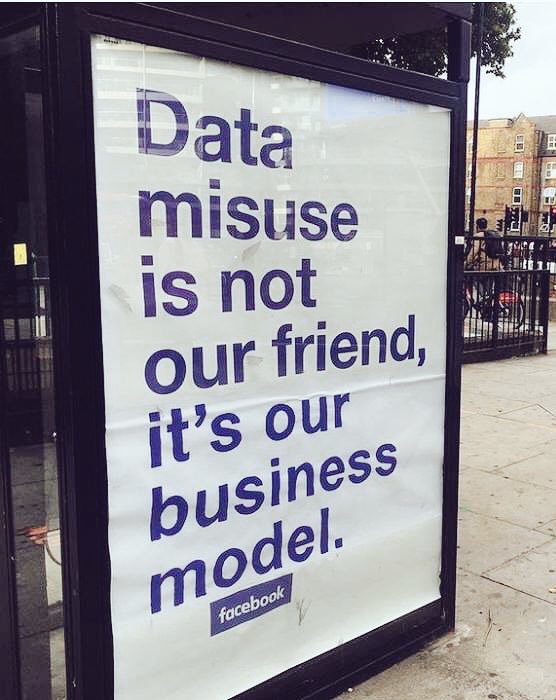
Copyright Adbusters

One of the only reasons I’ve had trouble leaving is that I don’t normally think of Facebook the company when I’m connecting with friends over Facebook the platform. That is, until about six months ago I was doing a fair amount of compartmentalization regarding my Facebook feelings: I would hear the news about Facebook’s business practices with mounting disgust, then log on and hand out a bunch of likes and haha faces and hearts to my friends’ pictures and memes and political links. Part of me knew that Facebook’s poetic PR language about connecting the world was just so much corporate bullshit. But then I would get on Facebook and act like all of that bullshit was true.

That’s because Facebook has very effectively built a business model which exploits our love for our friends and family. There’s nothing inherently wrong with such a business model: a thousand major companies, from Hallmark to Hasbro to TGIFridays, monetizes our desire to connect with people we love. But I do expect such a company, if it claims to be devoted to connecting me with my loved ones, not sell my personal data to political dirty tricks operations, to voter suppression outfits, to election oppo researchers. And I definitely expect such a company to step in when their platform is being used to encourage genocide.

So, please consider this my last post on Facebook. If you are reading this post on that platform, know that I will miss you. You I like. But so long as Facebook continues under its current leadership, with its mix of smarmy public apologies accompanied by no meaningful change in policy, I won’t be back. As a small potatoes writer who would like to have more exposure, I do understand that leaving Facebook behind will mean cutting off one of the few channels by which most people see my work. But the internet is a big place–there will still be lots of places that an interested reader can find me.

If you happen to be an interested reader, feel free to subscribe to my blog, The Subway Test –you can also find the blog simply by googling “Joe Pitkin.” Until then, I’ll say goodbye and deactivate my accounts on New Year’s Day.

I’m open to coming back someday. In fact, I’ll be happy to come back to Facebook and Instagram if the company will take meaningful action to clean up its act. For starters, the Board of Directors needs to fire Mark Zuckerberg and Sheryl Sandberg. I know that Zuckerberg can go ahead and fire the board in return–he is after all the majority shareholder in Facebook–but the board needs to grow a spine and do its job. If Zuck wants to fire the board in return, let him go ahead and do that: at the very least his doing so will make public what a morally bankrupt human being he is. If the board is able to replace Facebook’s top executives with people who will shepherd a transformation at Facebook, creating a company with meaningful privacy policies, meaningful informed consent about how our data is used, and a serious effort to clamp down on disinformation and incitement, Facebook could be fun again.

Goodbye until then–much love to you, friends!


Readings for the Time of Troubles

15 Thursday Dec 2016

Posted by Joe in Musings and ponderation, Politics, The Time of Troubles

≈ Leave a comment

Tags

hamfisted con men, racism, resolutions, utopia

I was surprised to learn that the textbook my daughter was using for her US History class is Howard Zinn’s A People’s History of the United States. I had long been an admirer of Zinn’s lefty outlook on the world from interviews Zinn did in the last years of his life, though I had never read any of his work. Finding out that my daughter is reading his signature book was apparently the encouragement I needed to read the book myself.

While the first edition of People’s History was written nearly 40 years ago and the last edition is over ten years old, the book is timely, and oddly comforting in these last weeks before the inauguration of Trump. I came away from People’s History with two guiding consolations. First, Trump is no aberration. His misogyny, nativism, racism, and venality have deep roots in the history of the United States. If this doesn’t seem like much of a consolation, I might put it another way: the country has been through crises like Trumpism before. Second, for all the suffering the Trump administration will cause millions of people, for all the theft of public goods that is coming, there is a countervailing force of decency in the American character as well. The courage of Frederick Douglass and Fannie Lou Hamer, of Mother Jones and Eugene Debs, of Daniel Berrigan and César Chávez–and of millions of others–is available to us as well. We can fight, in many small and powerful ways, if decent Americans are willing to give up their self-satisfaction and passivity and security to stand up for our country.

While I was familiar with every period Zinn wrote about in People’s History, I don’t think I had ever seen all these periods stitched together into a single overarching vision. Basically, Zinn’s contention is that the true history of the United States is not defined by the actions of presidents and congresses who have worked at practically every turn to enrich a tiny economic elite–by preserving slavery, by massacring the natives, by invading Mexico and Cuba and The Philippines, by overthrowing democratically elected governments in Guatemala and Chile and Iran. Rather, American history is made up of the often overlooked struggles of the oppressed, the working class, the unrepresented. It is a history of people fighting, over centuries sometimes, to be included in the opening phrase of the Constitution: “We the People.”

It’s an inspiring–if sometimes flawed–vision. I believe that what it offers, in a crowded field of history texts, is a truly alternative analysis of the history of the nation. Many critics have accused him of bias, though I would argue that what Zinn has done instead is abandon the pretense of objectivity that sometimes smothers the work of other historians. No historian, no human being, can be a thoroughly objective observer of the human experience. In telling any history, we leave neutrality behind as soon as we decide which events we will focus on and which ones we will omit.

And so many history texts, even those informed by the counter-cultural critique of history that came out of the 60s and 70s, still focus the actions of “the great men,” the Jeffersons and Jacksons and Roosevelts, with entire social movements of millions of ordinary people receiving comparatively little mention, or in some cases no mention at all. Zinn’s timely contribution is to argue that US History was not made by the Jeffersons and Jacksons and Roosevelts–that our elected leaders were responding to massive social and economic currents that they could barely influence, let alone control.

Presidents and congresses and supreme courts are led by the people, not the other way around. Unfortunately, according to Zinn, our elected leaders have usually been in thrall to what Occupy Wall Street popularized as “the 1%”: industrialists, financiers, speculators, robber barons. But frequently enough, a demand for justice will rise up from the roots of society with enough force that the elected leaders must listen and the law responds. The end of slavery, women’s suffrage, the 40-hour work week, the civil rights movement–all of these changes came, not from the courage of Abraham Lincoln, Woodrow Wilson, U.S. Grant, or L.B.J., but in response to the demands of ordinary Americans. Those demands took decades to make themselves felt sometimes, and the success of those demands depended on the tremendous courage of millions of people, but nearly every advance that the US has made in social justice has been led from below, not from above.

One can work towards neutrality and fairness in writing by committing to telling as many sides of the story as one can–a very common, and admirable, approach among the historians I’ve read. But it’s also valuable to have someone standing outside that system, observing from without, making no claim to neutrality–someone who pulls back the curtain on the mainstream view of American history to expose the so-called historical consensus as a fiction. Zinn’s book has helped me see my country in a new way.

And he’s helped me get my game face on for the time to come: if I want a humane minimum wage for Americans, if I want truly public college education and single-payer health care, I have to fight for those things. Not because I expect the hamfisted con man we just elected to respond to my demands, but because he may make enough people angry enough to care. The day will come when we have a free and equitable society, ruled by justice and reason. It’s up to us to make it.


A Spiritual Journey to Olympia

04 Saturday Jun 2016

Posted by Joe in Journeys, Musings and ponderation, The Ideal Vehicle

≈ Leave a comment

Tags

bicycles, Olympia, resolutions

For all the time my daughter attended The Evergreen State College in Olympia, I talked about riding my bike up from Portland to visit her. I have the dream of one day riding across the United States over the course of a summer, and a ride to Olympia, which I initially estimated at a little over 100 miles, seemed a low-stakes training run, a kind of exploratory sally for this larger dream. Google Maps quickly disabused me of the 100-mile estimate–the distance on a bike is closer to 130 miles–but I toyed with the idea during all of Gloria’s student years.

Now, in late spring of 2016, my daughter is nearly a year out of college and planning to move away from Olympia for good. And so I recognized a few weeks back the familiar sight of my dithering, the ease with which I spin up romantic, poetic dreams and the difficulty I have seeing them through. I realized that if I was going to pay my inner guide any mind, the time to ride out to my daughter was now.

I bought a few supplies–bottle cages, bottles, new cycling gloves–and asked the mechanic at Community Cycling Center to true up my rear wheel, in hopes that the long-suffering rims would roll another 150 miles. “This wheel won’t go another 150 miles,” the mechanic said. “In fact, I advise you to stop riding on it today.” So that weekend, after buying a new hand-built 36-spoke rear wheel, I set off at 6:51 am on May 29 to make a 137-mile ride, ideally in a single day.

Such a ride is about twice as far as I’d ever ridden in a single day. I knew that many people ride the 205-mile Seattle-to-Portland in a single day every year, but generally on unloaded road bikes rather than on cyclocross commuter setups with fenders and racks and stuffed panniers. However, I started with the best attachment to non-attachment that I could muster: either I would finish in a single day or I wouldn’t; I could stop when I got tired and stay in a motel somewhere along the way. The stakes, therefore, were pretty low.

outside Scappoose

The day was gorgeous, mild and mostly cloudy, with a decent tailwind, and dry for the first 4/5 of the ride. I was anxious because the ride was a journey into the unknown for me: I worried about being run off the road, about being run over by a back-roads pot smoker, about hitting a physiological wall and bonking.

And, as is so often the case in my life, none of what I feared came to pass. I stopped every twenty miles or so to stretch and have a Lara Bar. I was surprised at how well, and how easily, I rode. With very few exceptions, I had generously wide shoulders to ride on, though for many hours I was surprised at how often I had the road to myself for as far as I could see and hear.

In both physical and mental ways, it was easier to ride between the towns than through them: the only wrong turns I took, and the only times I tired of riding–because of the constant starting and stopping–came as I went through Longview and Kelso, Chehalis and Centralia, and very late in the ride going through Tumwater.

I have driven along I-5 from Portland to Olympia dozens of times. And riding along the back-roads–the Westside Highway along the Cowlitz River, Military Road, The Newaukum Valley Road, Old Highway 99–I was rarely more than three or four miles from that motor-clogged artery that is the Interstate. And yet, close as I was to the freeway, I was in a different world: quiet and peaceable, breezy and bird-filled.

The motorist’s view from the Interstate

Some of the places where I-5 had taught me to expect ugliness, like the approach to Chehalis, were beautiful and tranquil and friendly. And, while I rode through some of the most conservative country in the state of Washington, I saw only a single Trump sign along the whole 137 miles.

The view from the bike: at the top of Military Road, between Vader and Napavine

I remember standing in the pedals to get up a short hill at the end of the day and feeling the wonderful deep soreness that comes from a long contest, and I felt a euphoric gratitude that my body had done everything I had asked it to do that day, hour upon hour, for more than 130 miles. I was too tired and out of it to hold the camera steady when I arrived at Capitol Lake, but I managed to snap one blurry shot of the capitol on my arrival, like a personal grainy Loch Ness Monster photo, to show my wife and daughters that I had arrived.

Capitol Lake, after 137 miles in 11.5 hours


Real Life Takes Center Stage

21 Saturday May 2016

Posted by Joe in A Place for my Stuff, Uncategorized

≈ Leave a comment

Tags

dadly responsibilities, Making a buck, resolutions, writing practice

Hello, Friends:

My two month-long radio silence from this blog has been a little sad-making for me. I have a lot to report about my writing; my incisive (to me) observations are piling up, waiting to be observed in this blog. But dang–work life and my dadly responsibilities have made blogging hard of late.

There’s more to come on The Subway Test: I am hopeful that the coming two months will be less bananas at work than the last two months have been. There are books I want to share with you, scientific discoveries I’d like to philosophize about, news about my own writing to share. I hope we’ll see each other here soon.

–Joe

writing hands

Photo Credit: Marco Castellani

A Meditation on Time

18 Thursday Feb 2016

Posted by Joe in Biology, Musings and ponderation, My Fiction

≈ Leave a comment

Tags

big 19th century novels, dystopia, resolutions, that strumpet Fame, utopia, writing practice

I have been taking my sweet time in reading Anna Karenina, a Christmas gift from my lovely stepdaughter. At the rate I’m going, I would guess I have two more months with this delicious, painful, hilarious book. Meanwhile, as I dither through this enormous work of art, it’s been hanging over my head that I don’t keep up my blog as befits a serious writer, dispensing witty remarks and novel observations at least once per week.

I really don’t yearn for “simpler times” (e.g. Tolstoy’s time), in which the world of ideas moved more slowly and people had time–from our perspective, anyway–to write long letters and long novels, to linger over an idea in a journal for months and even years. Many people of Tolstoy’s day didn’t regard their time as leisurely: they felt as rushed and harried as we do now, since the era of railroads and electricity had sped up life for them at an unprecedented rate. Perhaps in a hundred years my descendants will regard my lifestyle as leisurely, since most of us today don’t yet have Adderall prescriptions or cranial implants or other technological prostheses to speed up our rate of pumping out new ideas and reacting to new ideas we see.

This morning as I read my ten pages on the bus, I was taken by Tolstoy’s words about time: Prince Shcherbatsky is reacting to being told that “time is money,” and he says, “Time, indeed, that depends! Why, there’s time one would give a month of for fifty kopeks, and time you wouldn’t give half an hour of for any amount.”

It occurred to me as I sat with that quote today that I have given away lots of time in my life for fifty kopeks, or for less. When I returned to graduate school in my thirties, I was so excited to be able to take classes at public expense (since I am an employee of the state, my classes cost $5 per course)–I often joked with people that I had spent more money on parking tickets than on tuition when I was in grad school the second time. I feel thankful to the Great State of Washington every time I think of what I learned there.

But I also made a huge blunder by valuing my labor at zero in those days. The courses cost $5, so my degree must only cost about $100, no? Yet, of course there was the massive opportunity cost of my shutting myself up for years to read academic papers on ecology and statistical analysis: there were hikes I didn’t take, other skills I didn’t learn, traveling I didn’t do. I’ve written in a couple of my stories from that period about students who get into ecology because they love spending time outdoors in nature, but that their ecological studies lock them up in a lab for months on end doing gas chromatography or grinding up plant tissue samples.

I’ve come home with a fever tonight–ironically, the fever is what has slowed me down enough to be able to meditate about time in this blog post. And I have realized that as I age, I am becoming less and less willing to give up time to others (that is, to people I don’t love) for any amount. Even if by magic I could, I wouldn’t give up this feverish time tonight–unpleasant as it is–for money. I’m sure I have my price for taking on more work, but I’m realizing that the price is much, much higher than a community college would typically pay. I would just rather have the time.

Whither Wikipedia?

18 Monday Jan 2016

Posted by Joe in Musings and ponderation

≈ 1 Comment

Tags

resolutions, The Omega Point

For several years, I made a very small yearly donation ($10-$15) to Wikipedia when I would come across their oddly ugly banner ads. I use Wikipedia daily, often multiple times a day, not just because of the convenience, nor because of the way Wikipedia has muscled its way to the top of Google’s search rankings, but because I honestly believe in Wikipedia’s mission. The idea of creating a free and open repository of human knowledge, with versions in many languages (potentially all human languages), strikes some deep chord in my psyche. I suppose, now that I am daring myself to put it into words, that I am fascinated by Teilhard de Chardin’s idea of The Omega Point: that goal of universal love and community toward which humanity is striving–and which I believe it is our destiny to find. Wikipedia seems to me a step on that dim path.

One might ask, if Wikipedia is a sign of the coming Omega Point, why I would only give $10. That’s an excellent question, and I don’t come out looking very good in any of the answers I could come up with. And anyway, I haven’t given any money at all since reading David Auerbach’s piece in Slate on the misogyny and trollery of many of Wikipedia’s core of editors. As a teacher of research writing, I’m well aware of the uses and misuses of Wikipedia, the many inaccuracies and at times true mendacity, the often flabby writing and foggy explanation. I’ve lately felt ambivalent about this tool that I use so often: is this worldwide experiment in democracy and collaboration so fatally flawed that I should begin looking for a better encyclopedia, something which accomplishes what Wikipedia tried to and failed?

Wikipedia’s glaring flaws notwithstanding, I suppose I still see it as one of the best things in town: non-profit, devoted in principle (and often in practice) to human betterment and the common good. The low participation of women in the project troubles me, but I’m heartened a bit at least to know that the Wikimedia Foundation is actively trying to close that gap (and that the participation of women has increased last year over the year before, even if not by as much as the foundation had hoped). Perhaps it’s time to put aside my gripes and give a little to this project.

Fan Mail

06 Tuesday Jan 2015

Posted by Joe in Uncategorized

≈ 1 Comment

Tags

fandom, resolutions, that strumpet Fame

Last weekend I received the second piece of fan mail I’ve ever received in my life. I was touched and flattered, of course, but it reminded me of a long-ago resolution I’d made–when I received my first fan mail–and failed to keep. I remembered that I have never once reached out to another author myself.

I can think of many, many authors whose work has meant a great deal to me but who haven’t received the kind of attention that Cormac McCarthy or Ursula LeGuin get. Kij Johnson and John Crowley come immediately to mind. One of them will get an email from me this week–I resolve it. Or re-resolve it.

Subscribe

  • Entries (RSS)
  • Comments (RSS)

Archives

  • November 2025
  • September 2025
  • August 2025
  • July 2025
  • May 2025
  • April 2025
  • March 2025
  • January 2025
  • December 2024
  • October 2024
  • September 2024
  • August 2024
  • June 2024
  • May 2024
  • April 2024
  • March 2024
  • February 2024
  • January 2024
  • December 2023
  • October 2023
  • August 2023
  • July 2023
  • June 2023
  • April 2023
  • March 2023
  • May 2022
  • August 2021
  • June 2021
  • January 2021
  • October 2020
  • May 2020
  • March 2020
  • February 2020
  • January 2020
  • July 2019
  • June 2019
  • December 2018
  • October 2018
  • July 2018
  • May 2018
  • April 2018
  • January 2018
  • December 2017
  • November 2017
  • September 2017
  • August 2017
  • July 2017
  • June 2017
  • May 2017
  • April 2017
  • March 2017
  • February 2017
  • January 2017
  • December 2016
  • November 2016
  • October 2016
  • August 2016
  • July 2016
  • June 2016
  • May 2016
  • March 2016
  • February 2016
  • January 2016
  • December 2015
  • November 2015
  • October 2015
  • July 2015
  • May 2015
  • March 2015
  • February 2015
  • January 2015
  • December 2014

Categories

  • A Place for my Stuff
  • Advertising
  • Artificial Intelligence
  • Beta Readers
  • Biology
  • Book reviews
  • Curious Fictions
  • Dungeons and Dragons
  • Exit Black
  • fantasy
  • Games
  • HPIC
  • Journeys
  • Let's All Admire That Fantastic Can
  • Lit News
  • Literary criticism
  • Musings and ponderation
  • My Fiction
  • Pacifica
  • Politics
  • Reading Roundup
  • Science
  • Science Fiction
  • Science Fiction Writers of America
  • SETI
  • Stories
  • Stranger Bird
  • The Ideal Vehicle
  • The Time of Troubles
  • Uncategorized
  • Utopia and Dystopia
  • Welcome
  • YA fantasy

Meta

  • Create account
  • Log in

Authors

  • Joe's avatar

Blog at WordPress.com.

  • Subscribe Subscribed
    • The Subway Test
    • Join 143 other subscribers
    • Already have a WordPress.com account? Log in now.
    • The Subway Test
    • Subscribe Subscribed
    • Sign up
    • Log in
    • Report this content
    • View site in Reader
    • Manage subscriptions
    • Collapse this bar
 

Loading Comments...