• About
  • My Fiction
  • Reviews

The Subway Test

~ Joe Pitkin's stories, queries, and quibbles regarding the human, the inhuman, the humanesque.

The Subway Test

Tag Archives: Stories

My First 2024 Writing Retreat

21 Sunday Jan 2024

Posted by Joe in Musings and ponderation, My Fiction, Stories

≈ 8 Comments

Tags

books, fathers and sons, libraries, library, reading, Stories, Western Oregon University, writing

Outside of the summertime, I rarely get decent stretches of time to write. During the school year, I feel lucky when I can squeeze in 20 minutes to write at the beginning of the day. For me, that kind of time is maybe enough to work on revisions, especially of short pieces, but I’ve had no luck writing novels in those tiny dribs and drabs.

A couple of years ago, after my bitching about that state of affairs for the 6,813th time, my wife wisely proposed that I take a few writing retreats throughout the year–little two-day stints where I can write for hours at a time.

Right after new year’s day, I had my first retreat of the year: over two days, I wrote in a swath across the central Willamette Valley–Corvallis, Monmouth, Salem. I knocked out about 4,000 words of a short story I have been working on and allowed myself to feel, briefly, like writing is the main thing I do.

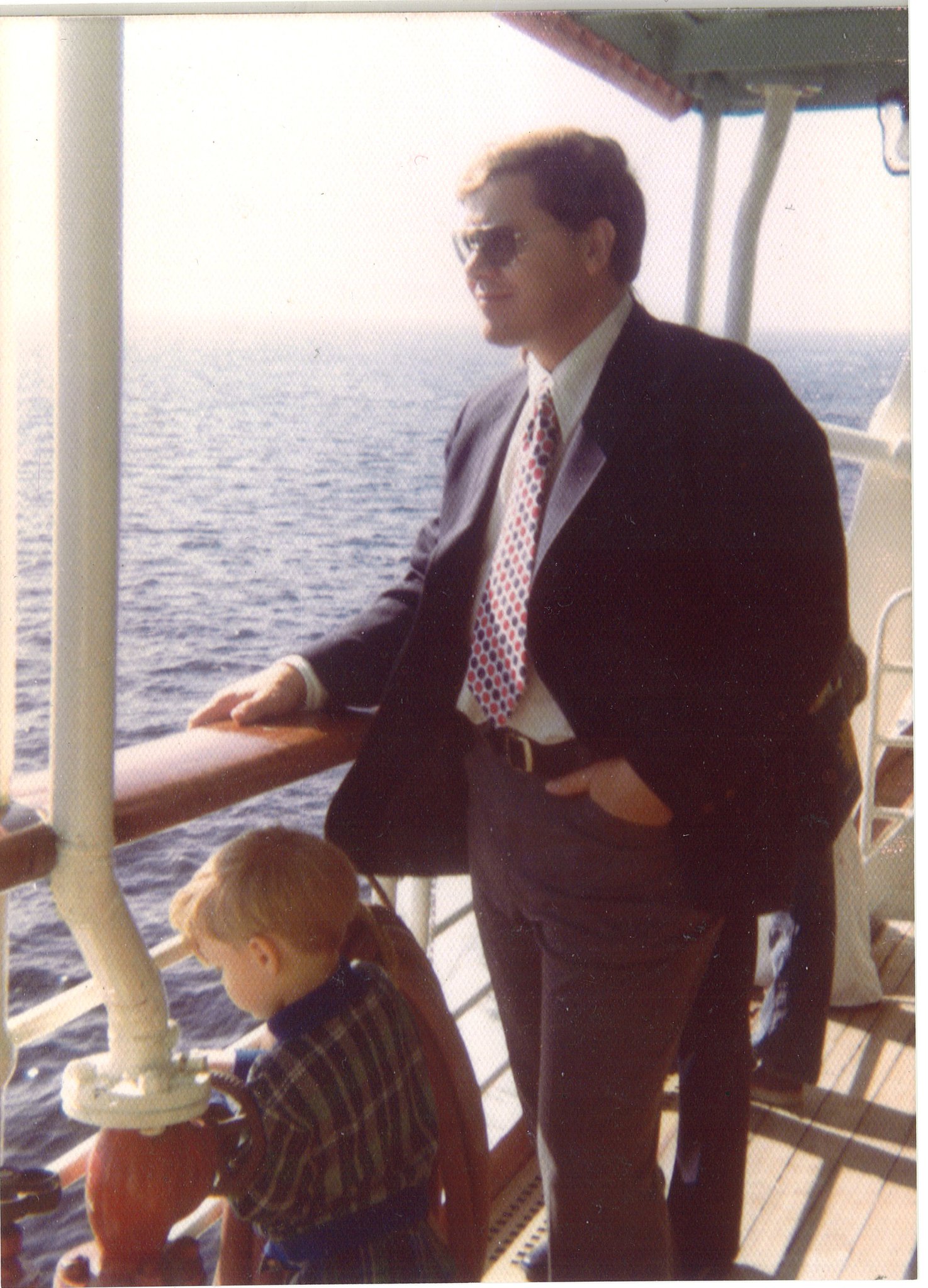
I spent a good part of the retreat in the Hamersly Library of Western Oregon University. I hadn’t been to Monmouth since I was a little fellow, when my dad taught English at Western Oregon (back when the place was still called the Oregon College of Education). Classes hadn’t started at WOU yet, so I was able to walk around this campus which I would have been too young to remember, listening for my dad’s ghost lingering around the older buildings.

Portrait of the author with his father, ca. 1972

No librarians challenged me when I walked in to the Hamersly (why would they? Librarians are the most welcoming bureaucrats on Earth), and I was able to find the perfect nook to write in. It’s worth giving thanks for libraries: like the DNA of our culture, libraries are both the metaphor for the entire human enterprise as well as the literal encoder of that enterprise. The Hamersly wasn’t built until 2000, long after my dad stopped teaching in Monmouth, but I may as well have seen my dad’s shade there, walking among the stacks. I was reminded of one of my favorite poems from Philip Larkin, my favorite librarian poet:

New eyes each year
Find old books here,
And new books, too,
Old eyes renew;
So youth and age
Like ink and page
In this house join,
Minting new coin.

My Newest Story:”Nomenclator of the Revolution”

25 Friday Aug 2023

Posted by Joe in fantasy, My Fiction, Science Fiction, Stories, The Time of Troubles, Utopia and Dystopia

≈ 4 Comments

Tags

Boston Review, fantasy, poem, sci-fi, Science Fiction, Stories

I’m pleased to announce that my story “Nomenclator of the Revolution” is now appearing in Boston Review. The folks at BR did a lovely job with the layout and the drop quotes, and I couldn’t be happier that the story is available to be read.

From the set of Guillermo del Toro’s Pinocchio, another tale about the relationship of language to authoritarianism. Photo Joe Pitkin.

And here’s a little secret about the story for you all, beloved blog readers: the short poem in the middle of “Nomenclator” is one of my favorite poems that I have ever written, and it’s a piece that I found impossible to place (in fact, I stopped trying to publish any of my poems after receiving about thirty rejections of that one). I remain convinced that it’s a good poem; hopefully it has a better fate as the work of a fictional character in this story.

I’ve spent the last few weeks drafting two new short stories and workshopping a third, so I hope that “Nomenclator” isn’t the last short story you will see from me. However, given the mystical journey of getting stories placed and published, “Nomenclator” may be my last published short fiction for a few months. I hope you enjoy it!

Here again is the link: https://www.bostonreview.net/articles/nomenclator-of-the-revolution/

Eight Months to Exit Black

07 Wednesday Jun 2023

Posted by Joe in Exit Black, Lit News, My Fiction, Science Fiction

≈ 8 Comments

Tags

Action, Blackstone, books, sci-fi, Science Fiction, Stories, Thriller

Hello, literarians and assorted (and beloved) fellow weirdos!

I received an email from my publisher, Blackstone, yesterday with a publication schedule for my second novel, Exit Black. I’m excited to announce that my little bundle of joy is due to come out in February of 2024 (or, to use Cesare Emiliani’s Holocene Calendar, February 12024). I promise not to pester you about it every day for the next eight months!

I also promise not to ever refer to Exit Black as “my little bundle of joy” again. But it sure is a little bundle of something–little bundle of action? Little bundle of thrills? Little bundle of artfully strung-together words? That last one feels a little too on-the-nose.

I call it “Bold and Brash”

30 Sunday Apr 2023

Posted by Joe in A Place for my Stuff, Advertising, Exit Black, Musings and ponderation, My Fiction, Pacifica

≈ 3 Comments

Tags

Bold and Brash, marketing, sci-fi, Science Fiction, Spongebob, Squidward, Stories, that strumpet Fame

I experienced a weird constellation of three events last week. First, my editor, my agent, and I hashed out the jacket copy for my upcoming novel, Exit Black. It was weird to realize that I was basically helping write ad copy for a book that I labored over for two years. Second, I sent out a query to a literary agent for the book I drafted after Exit Black, called Pacifica. (My current excellent and extant agent, Scott, works on film and TV projects, and Pacifica definitely isn’t movie material, so I am looking for a bookish agent as well).

And third, I was driving down Broadway in Portland when I saw this bumper sticker ahead of me:

Millennials and Zoomers–and their parents who might have watched Spongebob Squarepants with them twenty years ago–will recognize this as Squidward Tentacles’ self portrait, “Bold and Brash.” I was happily shocked to see it on a bumper sticker. And I realized when I saw it that this publication process I am experiencing with my books is drawing up all of my deeply Squidwardian impulses: my vanity, my hunger for approval, my inner conflict about how art intersects with commerce. Squidward, c’est moi.

If you need a blast from the past, or you somehow never saw the original, here is a clip of me Squidward from the episode “Artist Unknown:”

Back on the Subway

31 Friday Mar 2023

Posted by Joe in Journeys, My Fiction, Pacifica, Stories, Uncategorized, Welcome

≈ 7 Comments

Tags

fantasy, resolutions, sci-fi, Science Fiction, SFF, Stories

I’ve had a long spell away from this blog while I was drafting my third novel, Pacifica. But now that Pacifica is (finally, after a thousand sighs) drafted, and as I prepare for the publication of my second novel, Exit Black, by Blackstone this year, I’m able to give a little more attention to this space. I’ve missed being here, and I’ve missed interacting with you through The Subway Test. I hope to connect with you a little more frequently in the coming months!

“So-Sz”–10th Anniversary Edition

03 Wednesday Jul 2019

Posted by Joe in Curious Fictions, fantasy, My Fiction, Science, Science Fiction, Stories

≈ Leave a comment

Tags

Bigfoot, Curious Fictions, fantasy, Missing Link, Science Fiction, Stories

I was invited recently to join Curious Fictions, a platform for short fiction on the web. And, while I’m likely to keep writing for the magazine and podcast circuit, Curious Fictions does seem like a sweet place for me to drop my stories, especially those pieces that are hard to find elsewhere.

As I was thinking about an inaugural story for my Curious Fictions profile,
I immediately landed on one of my favorite first pieces: “So-Sz.”
I first sent the story out for publication ten years ago this month. The story
appeared in a wonderful little web magazine, 5923 Quarterly , which
folded not long after, perhaps coincidentally. “So-Sz” has been out
of print and unavailable since then.

I’ve always had a soft spot for this story. It’s one of my earliest efforts
at short fiction that struck me as mostly successful. And, while I am a better
writer today than I was ten years ago, there’s not a great deal I would change about the piece.

I was also reminded of “So-Sz” by the most recent Laika movie, Missing
Link
. Hopefully you’ll see some similarities (and differences) as well.

So, without further ado, I invite you to click over to Curious Fictions to
see the 10th Anniversary Edition of one of my favorite journeyman efforts: “So-Sz.”

Photo Credit: Steve Rotman; Art Credit: Some Awesome Graffitist

The Author Gratefully Acknowledges

06 Saturday Oct 2018

Posted by Joe in My Fiction, Politics, Science, Science Fiction, Stories, The Time of Troubles

≈ Leave a comment

Tags

Bill Gates, hard sci fi, Politics, sci-fi, Science Fiction, social justice, Stories

My story “Potosí” recently came out in Analog, and it’s gotten lots of the positive and negative attention that I had hoped it would. In the case of this story, I looked forward to some negative attention, as “Potosí” is a not-so-veiled indictment of the Trumpian worldview, and some readers of science fiction, unfortunately, are also white supremacists. (This is not to say, by the way, that everyone who hated the story is a white supremacist. People could have any number of reasons for disliking the story; however, a few people who hated it had objections which were rooted in a white supremacist worldview).

I’ve also been happy with how the story looks in Analog. Even though the magazine is print-only, it’s still nice in this internet age to see one’s name in print. However, I do have one regret about how the piece looks: my bio was omitted from the end of the story. That’s normally not a big deal at all for me–I suspect the editors left it off for space-saving reasons, and the folks at Analog have done more than just about anyone to promote my work. They were even kind enough to run a full page biosketch on me a couple of years ago. But there was a line in my bio for this story that I really wanted to appear in the magazine. Here is is:

“The author gratefully acknowledges the assistance of Phil Ekstrom in working out the physics of this story.”

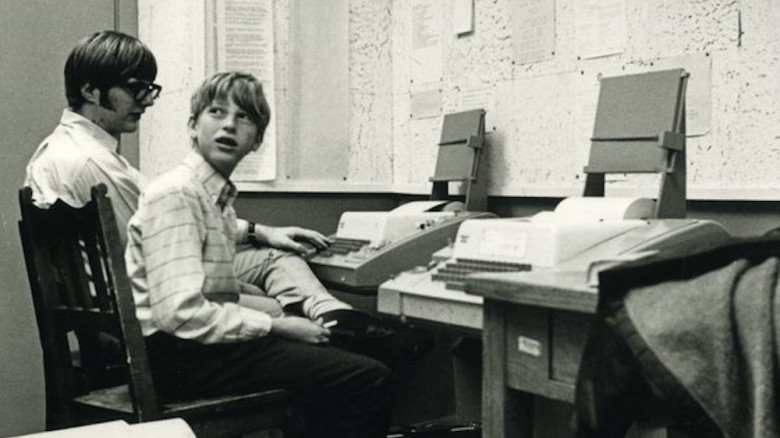
Phil is a friend of mine whose knowledge of physics not only exceeds my own (that’s an exceedingly easy accomplishment), but his knowledge of physics also exceeds my knowledge of any field at all, including writing. He’s a man of great accomplishment in a wide number of fields of physics and engineering; while it’s hardly his greatest achievement, some will recognize his work in the photo below: Phil was one of the people who wired up the young Bill Gates’ and Paul Allen’s first computer.

young gates and allen

A teenage Bill Gates looks to the top of an imagined stack of 100 billion dollar bills –Getty Images

“Potosí” involves a decent amount of classical mechanics–most of the story takes place in the microgravity of a small asteroid being pushed this way and that by space tugs, mass drivers, and the imaginary forces of human greed and anger. I’m reasonably good at describing  the greed and anger part, but I needed a lot of help with the physical forces. I can tell Phil has years of experience explaining things to undergraduates of varying talent; he certainly needed to call on those skills in order to explain my story to me.

The story has some (I hope small) violations of physical laws, where I did a little handwaving in order to accomplish an artistic goal. But to the extent that “Potosí” is any example of hard sci-fi–as opposed to the science fantasy of Star Wars or the kilomoles of handwavium in Star Trek–I have Phil Ekstrom to thank for giving the story some semblance of rigor. Thanks, Phil.

Loneliness

31 Wednesday Jan 2018

Posted by Joe in Biology, Musings and ponderation, Science, Stories, Utopia and Dystopia

≈ 2 Comments

Tags

loneliness, Scientific American, Stories

all alone.jpg

Sculpture Credit: “All Alone,” by a young Gloria Pitkin

To be a modern human is to contend with loneliness.

While this insight has been with us for decades or even centuries, it’s only recently that a body of research around the causes of loneliness, as well as its effects and its cures, has started to catch the public imagination.

Folks like Kafka and Camus seemed to assume, in the previous century, that loneliness was simply fundamental, part of the warp and weft of human existence. Today, though, researchers have begun to argue that loneliness is no more basic to human existence than tuberculosis–that, in fact, loneliness is a medical condition that can be prevented and cured.

The January issue of Scientific American has an article on loneliness that really spoke to me, perhaps because I was so lonely for so much of my youth. The author, Francine Russo, argues that in much the same way that the disease of consumption was medicalized and clinicalized into tuberculosis, we may be in the process of reconceiving loneliness as a treatable and preventable disease rather than a central reality of the human condition. For an artist like John Keats in the early 19th century, tuberculosis and loneliness were existential threats that he spent his life and work grappling with. Today, TB is (for many people in the developed world, anyway) something that one is vaccinated against.

But what vaccine is available for loneliness? Russo suggests cognitive behavioral therapy (CBT), a technique which has had deeply positive effects on my own life. And yet, in spite of my having experienced both chronic loneliness and CBT first-hand, I lacked the imagination to conceive of loneliness as a disease rather than a consequence of my very flawed character.

The other thing that dawned on me as I read the article was just how often I write about lonely characters in my stories. I just signed off on the galley prints for my latest story, “Potosí,” and realized that the main character spends a good deal of the story in utter solitude. Just like Miranda in “Full Fathom Five,” Epic in “Proteus,” and Sandra in “Lamp of the Body.” Stories with well-adjusted characters and lots of friends seem to be more rare with me.

As with all things Scientific American, the print article isn’t available online, but this closely related SciAm blog post is.
 

R.I.P., U.K.L.G.

23 Tuesday Jan 2018

Posted by Joe in fantasy, Journeys, Science Fiction, Science Fiction Writers of America, Utopia and Dystopia, YA fantasy

≈ Leave a comment

Tags

books, fantasy, literature, mythopoesis, sci-fi, Science Fiction, Stories, Ursula Le Guin

ursula_k_le_guin

By Gorthian (Own work) [CC BY-SA 3.0 (https://creativecommons.org/licenses/by-sa/3.0)%5D, via Wikimedia Commons

One of my literary heroes, Ursula K. Le Guin, died yesterday after a long illness. In her careful, forceful prose, and in her far-reaching moral vision, Le Guin expanded for me the concept of what a science fiction and fantasy writer could be. She was not the first great fantasy writer, but she was the first fantasy writer I encountered whose work had the feel of a high-literary novel. I’ll miss her.

Someday I’ll write a longer appreciation of her work in which I try to explain how meaningful her writing has been for me. For now, I’ll simply reprise the last essay I wrote about Le Guin, a post about her marvelous book The Lathe of Heaven.

Reading Roundup 2017

31 Sunday Dec 2017

Posted by Joe in Dungeons and Dragons, fantasy, Literary criticism, Reading Roundup, Science Fiction

≈ Leave a comment

Tags

books, D&D, fantasy, literature, Politics, Reading Roundup, sci-fi, Science Fiction, Stories

I guess I couldn’t get any later with my yearly reading roundup. And, since joining Goodreads last month, the thought of chronicling my reading habits for the last year feels a bit redundant. However, these posts have been fun to write for the last three years, and it helps me to consider in full the books I’ve read over the last year, if only to re-evaluate the stuff I’m reading.

I had a paltry reading harvest this year–13 books in all–though partly this number hides the many short stories, longform journalism pieces, and political blog posts I waded through this year. Having said that, I hope 2018 holds a little less covfefe coverage for me and a few more actual books by thoughtful people.

So, without further prologue, here is my crop of 2017 reads:

Chabon, Michael. The Yiddish Policemen’s Union.  This is one of the most inspiring high-wire acts I’ve read in all of fantasy fiction. Actually, I’m not sure exactly how the book is marketed—it’s an alternate history detective story—but here Chabon manages to weave a truly absorbing and moral tale set in a counter-historical Jewish homeland (which happens to be Sitka, Alaska). Also, Chabon’s writing is much like Eddie Van Halen’s guitar playing for me: while it’s often not exactly to my taste, every page or two I find myself asking “how did he do that?” as Chabon drops off another metaphorical description of the Alaska sky or a tough chess move.

Dick, Philip K. Do Androids Dream of Electric Sheep? There’s a rough-cut, coarse grained quality to PKD’s writing that gives this book the feel of a brilliantly inventive first draft. For all I know, perhaps it was: PKD was forced by poverty to churn out pulp books at a fantastic rate, under the influence of a good deal of amphetamine. The book is different in almost every way from Blade Runner, the film that was based on it and which provided my first exposure to PKD’s work. The book has a bit more of a Ray Bradbury-ish quality—sci-fi objects like ray guns and electric sheep are not portrayed as believable objects so much as mythical symbols, the kind of objects one would find in a dream. Blade Runner has a good deal more world-building in it. However, the book is the dream that the movie was made from.

Dick, Philip K. The Man in the High Castle This granddaddy of “what if Hitler had won?” novels is my favorite Philip K Dick book. The novel follows the loosely connected stories of several Americans living in a California that has become a protectorate of Imperial Japan. The story has the kind of trippy plot twists that Dick was famous for, but this story seemed tethered enough to a believable reality that it was much easier for me to inhabit this world than, say, Ubik or Do Androids Dream of Electric Sheep? The book is a creature of its time and some of the characterization of non-white peoples—especially the Japanese imperialists—hasn’t aged well; however, I would argue that those depictions are more ham-fisted than aggressively racist. While I’m not normally a fan of alternate histories, this one really got to me.

Dozois, Gardner, editor. The Year’s Best Science Fiction #33. It’s been years since I’ve read a “year’s best” anthology; however, I read this one cover to cover in hopes of learning more about the field I’m writing in. As with any book by a medley of writers, some of these stories spoke to me more than others. There were some good stories from writers I knew about—Kelly Link, James S.A. Corey, and Pablo Bacigalupi all had solid entries—but I was more blown away by several new (to me) writers: Ian McDonald, Gwyneth Jones, Carter Scholtz, Chaz Brenchley, Nick Harkaway, and Kelly Robson. The best of these stories do what I hope (and often fail) to do in my own work, bringing believable characters and well-turned dialogue to stories with the whiz-bang plots and settings of sci-fi. I have such a broad reading appetite, and I’m such a slow reader, that I probably won’t read another best-of anthology in the coming year. However, I have learned a lot about the short sci fi market here, and I do hope to come back to Gardner’s anthology again.

Dungeons and Dragons. Player’s Handbook, Dungeon Master’s Guide, and Monster Manual (three books). I’ve been a Dungeons & Dragons player since Christmas Day 1980. However, this is the first time that I’ve read the three core reference books for D&D from cover to cover. At the time, I had some hope of writing a set of longer and more involved posts about D&D (in addition to this one and this one), and so I told myself that I was doing research. It helped, too, that the books are generally quite well-written and that they provide an old player like me some insight into the evolving sociology of D&D.

Overall I loved most of the changes that these 5th edition books bring to the game. There is a long-running tension in the D&D community between those who like their games full of rules and statistics and those who favor the role-playing and interactive story-telling aspect of the game. (Of course, there are also many gamers, perhaps most, who play somewhere between these two extremes. As you can probably imagine, as a sci-fi and fantasy writer I play D&D for the story-telling). To my great joy, 5th Edition D&D is clearly an attempt to make role-playing and story-telling the center of the gaming experience. The focus on characters’ backgrounds and motivations and personal flaws, the reward of “inspiration points” to players who engage in particularly good role-playing, the inclusion of a more nuanced and morally complex alignment system—all of these innovations have turned 5th edition D&D into a game about inhabiting a character and playing a role. Yes, there are a few ways that the game has had its rules overly stripped down and simplified, but overall I’m much happier to see D&D moving towards a model of interactive storytelling.

I’m also pleased to see that the creators of this edition have worked hard to remedy the racist and sexist depictions of the first editions of D&D. So far as I remember, not a single illustration from 1st edition D&D depicted a non-white adventurer, and the descriptions of “savage” humanoids like hobgoblins and orcs were full of signifiers that associated these evil creatures with Asian hordes and African tribesmen (some of this racism was inherited directly from D&D’s source material. It’s no coincidence that the only African-American actors in The Lord of the Rings movies played orcs). Similarly, depictions of females in 1st edition D&D were almost always of the “chainmail bikini” variety—for example, on the cover of the original Dungeon Master’s Guide here:

dmg1e

5th edition has thankfully put real armor on the women, and the illustrators have broadened the color palette for illustrations, including (at last) for dwarves, elves, halflings, and all the other good-aligned creatures that might take up arms against a sea of goblins:

5thedfemale

Heath, Chip, and Dan Heath. Switch: How to Change Things When Change Is Hard. I’m generally skeptical of self-help books (especially those that are given to me at work), but I really loved the authors’ light tone here, as well as the well-researched underpinnings for what they were suggesting (hint: it’s in the title). I’m going to try these precepts in my own life and at work.

Kawasaki, Guy, and Shawn Welch. APE: How to Publish a Book. One of the best books on writing that I’ve ever encountered. Very different from the Brenda Ueland/John Gardner types of writing books, this one really focuses on the business end of publishing and promoting a book. I’ve built my publishing plan for Stranger Bird around these guys’ suggestions.

Hamilton, Alexander, John Jay, and Hames Madison: The Federalist Papers. Reading these fabulous essays was a bit of a slog, owing to the authors’ 18th century style. They were also at times hilarious: I wish I had counted the number of times Hamilton accuses the opponents of the constitution of wantonness, calumny, affectation, or speciousness (in the end he half-apologizes for his “intemperances of expression”). More importantly, though, I was struck by the genius of how the Constitution was framed, how an entire government could be brought about with so few moving parts in it. Of the three authors, Madison was my favorite: a gentle author, brilliant and deeply read, but also horribly compromised by his own slaveowning. Here (and elsewhere) we learn about Madison’s wish that slavery be abolished as inimical to a republican form of government; yet, like Jefferson and almost all the other founders, he did not free his own slaves in his lifetime or in his will. His Federalist 54, where he tries to explain the Three-Fifths Compromise, is one of the most fascinating and troubling things I’ve read from any of the founders. I have another take on these remarkable essays here.

Miéville, China. The City and the City.  I liked this book pretty well, though it suffered somewhat in comparison to Chabon’s The Yiddish Policemen’s Union, which I had read the month prior. Miéville turns in an interesting murder mystery in one of the most compelling imagined settings I’ve encountered recently, a double city in the Balkans somewhere where the inhabitants of each half are required by law not to see the inhabitants of the other half. Equal parts Kafka and Philip K Dick, this book offers a thought-provoking meditation on life in the Balkanized spaces of the world, the Jerusalems and Berlins and El Paso-Juárez double places.

Newton, Cam. Deep Work. I loved this book on first reading, though as Newton’s ideas have sat with me some of them haven’t aged well. I definitely agree with his overall thesis, though: that people who are able to focus for long periods of time on truly “deep work” (i.e. work that would be hard for others to do) can find themselves in great demand. This kind of focus is an increasingly rare skill. It is definitely having an effect on my work and home life.

Rulfo, Juan. Pedro Páramo. This slim story took me forever to finish, pokey as I am at reading in Spanish. I found the style much more accessible than Fuentes’ style in Artemio Cruz, and Rulfo’s story is both hilarious and frightening, like a gothic Poe tale retold by a Mexican John Kennedy Toole. The story was difficult, too, though—lots of unannounced time shifts, POV shifts, moments where it was unclear whether the speaker was living or dead. I may well teach this book sometime for my sci-fi and fantasy class. Anyone who liked the movie Coco should read this darker take on the subject.

Garamendi--de Pedro Paramo

Photo: “De Pedro Paramo 1/3,” Antonio Garamendi


← Older posts

Subscribe

  • Entries (RSS)
  • Comments (RSS)

Archives

  • November 2025
  • September 2025
  • August 2025
  • July 2025
  • May 2025
  • April 2025
  • March 2025
  • January 2025
  • December 2024
  • October 2024
  • September 2024
  • August 2024
  • June 2024
  • May 2024
  • April 2024
  • March 2024
  • February 2024
  • January 2024
  • December 2023
  • October 2023
  • August 2023
  • July 2023
  • June 2023
  • April 2023
  • March 2023
  • May 2022
  • August 2021
  • June 2021
  • January 2021
  • October 2020
  • May 2020
  • March 2020
  • February 2020
  • January 2020
  • July 2019
  • June 2019
  • December 2018
  • October 2018
  • July 2018
  • May 2018
  • April 2018
  • January 2018
  • December 2017
  • November 2017
  • September 2017
  • August 2017
  • July 2017
  • June 2017
  • May 2017
  • April 2017
  • March 2017
  • February 2017
  • January 2017
  • December 2016
  • November 2016
  • October 2016
  • August 2016
  • July 2016
  • June 2016
  • May 2016
  • March 2016
  • February 2016
  • January 2016
  • December 2015
  • November 2015
  • October 2015
  • July 2015
  • May 2015
  • March 2015
  • February 2015
  • January 2015
  • December 2014

Categories

  • A Place for my Stuff
  • Advertising
  • Artificial Intelligence
  • Beta Readers
  • Biology
  • Book reviews
  • Curious Fictions
  • Dungeons and Dragons
  • Exit Black
  • fantasy
  • Games
  • HPIC
  • Journeys
  • Let's All Admire That Fantastic Can
  • Lit News
  • Literary criticism
  • Musings and ponderation
  • My Fiction
  • Pacifica
  • Politics
  • Reading Roundup
  • Science
  • Science Fiction
  • Science Fiction Writers of America
  • SETI
  • Stories
  • Stranger Bird
  • The Ideal Vehicle
  • The Time of Troubles
  • Uncategorized
  • Utopia and Dystopia
  • Welcome
  • YA fantasy

Meta

  • Create account
  • Log in

Authors

  • Joe's avatar

Blog at WordPress.com.

  • Subscribe Subscribed
    • The Subway Test
    • Join 143 other subscribers
    • Already have a WordPress.com account? Log in now.
    • The Subway Test
    • Subscribe Subscribed
    • Sign up
    • Log in
    • Report this content
    • View site in Reader
    • Manage subscriptions
    • Collapse this bar
 

Loading Comments...