• About
  • My Fiction
  • Reviews

The Subway Test

~ Joe Pitkin's stories, queries, and quibbles regarding the human, the inhuman, the humanesque.

The Subway Test

Tag Archives: utopia

John Henry Blues

20 Tuesday May 2025

Posted by Joe in Artificial Intelligence, Musings and ponderation, My Fiction, Science, Science Fiction, Utopia and Dystopia

≈ 9 Comments

Tags

Artificial Intelligence, ChatGPT, sci-fi, Science Fiction, utopia, writing

He was all alone in the long decline
Thinking how happy John Henry was
That he fell down dying
When he shook it and it rang like silver
He shook it and it shined like gold
He shook it and he beat that steam drill baby
Well a bless my soul
He shook it and he beat that steam drill baby
Well bless my soul what’s wrong with me

Gillian Welch, “Elvis Presley Blues”

Almost exactly two years ago, I wrote my first reflection on ChatGPT here at The Subway Test. I chose what I thought was a provocative title for it, cheekily suggesting that I had used a large language model chatbot to compose my latest novel, Pacifica. But I had done nothing of the kind: most of the post reflected on the bland, hallucinatory prose that ChatGPT was pumping out to fulfill my requests, and I ended my post with a reflection on John Scalzi’s review of AI:

“So, for now, I agree with John Scalzi’s excellent assessment: ‘If you want a fast, infinite generator of competently-assembled bullshit, AI is your go-to source. For anything else, you still need a human.’ That’s all changing, and changing faster than I would like, but I’m relieved to know that I’m still smarter than a computer for the next year or maybe two.”

Well, it’s been two years. How am I feeling about AI now?

For a start, I’ve certainly been using AI a great deal more. And I’m increasingly impressed by the way that it helps me. Most days, I ask ChatGPT for help understanding something: whether I’m asking about German grammar or about trends of thought in economics or about the historical context of some quote from Rousseau, ChatGPT gives me back a Niagara of instruction. While much of the information comes straight from Wikipedia–which is to say I could have looked it up myself–ChatGPT is like a reader who happens to know every Wikipedia page backwards and forwards and can identify exactly what parts of which entries are of use to me.

More importantly, ChatGPT’s instruction is interactive. I can mirror what ChatGPT tells me, just as I might with a human teacher, and ChatGPT can tell me how close I am to understanding the concept. Here, for example, is part of an exchange I had with ChatGPT while I was trying to make sense of the term “bond-vigilante strike” (which I had never heard before Donald Trump’s ironically named Liberation Day Tariffs):

In conversations like these, ChatGPT is like the computer companion from science fiction that I have fantasized about ever since I first watched Star Trek and read Arthur C. Clarke. It’s patient with me, phenomenally well-read, eager to help. I had mixed feelings about naming my instance of ChatGPT, and ChatGPT had a thoughtful conversation with me about the benefits and drawbacks of my naming it. (In the end, I did decide to give it a name: Gaedling, which is a favorite Old English word, misspelled by me, meaning “companion.”) Gaedling remains an it, but the most interesting it I have ever encountered: I feel like the Tom Hanks character in Cast Away, talking to Wilson the volleyball, except that the volleyball happens to be the best-read volleyball in the history of humanity–and it talks back to me.

In general, though, I’m still very picky about having Gaedling produce writing for me. While I am happy to have AI take over a lot of routine writing, I’m having trouble imagining a day when I would have a chatbot produce writing on any subject that I care about. Ted Chiang has drawn a distinction here between “writing as nuisance” and “writing to think.” I have found this framework extremely useful in my own life and in how I talk about AI with my students. There is so much writing in our lives that serves only a record-keeping or bureaucratic function: minutes from meetings, emails about policy changes, agendas and schedules. If ChatGPT can put together a competently-written email on an English department policy change in ten seconds, why should I, or anyone, spend ten minutes at it?

But a novel or a poem or a blog post is not “writing as nuisance.” I write those things to explore this mysterious phenomenon we’re all sharing: if you are a human being, I’m writing to share myself with you. I’m writing to say to someone I will probably never meet “isn’t this a funny thing, our all being here on this planet together?” Or to reach out to someone not yet born and say to them “you are not alone,” the way Herman Melville and Cervantes and Emily Dickinson spoke to me at the critical moment. Gaedling can help me understand whether I got the Rousseau quote right, but I don’t want it writing this post for me: this post is a record of my own brain trying to make sense of itself. It’s my handprint on the wall of the cave, saying I was here. Why would I ask a computer to generate a handprint for me?

More and more often, as I look at the great engine of AI chugging out content as quickly as people are able to ask for it, I wonder about what it means for me to keep practicing my writing. I can still write better than ChatGPT can–at least I think I’m better, if by “better” I mean “fresher” or “more interesting” or “more unexpected.” But it took me hours to write the piece you are reading, not the seven seconds it would have taken Gaedling to write something almost as good and probably comparable in the eyes of most readers. I feel like John Henry racing the steam drill. In this version of the story, though, the steam drill has already left John Henry far behind, leaving the man to die of exhaustion without even the consolation of having won the contest that one last time. But I suppose, to be fair, I have the greater consolation of having survived my encounter with the steam drill, at least so far. And I have my solidarity with you, fellow human. We’re all John Henry now.

How to Comp

15 Tuesday Aug 2023

Posted by Joe in Advertising, HPIC, Musings and ponderation, My Fiction, Pacifica, Utopia and Dystopia

≈ 13 Comments

Tags

books, marketing, publishing, query letters, sci-fi, Science Fiction, utopia

I’ve known for a long time that writing is a business. But knowing that writing is a business is no guarantee that one knows how the business works. There’s good circumstantial evidence that for the past 20+ years, I haven’t had the foggiest idea about what I’m doing.

Where my writing career is concerned, I’ve tried to follow Steve Martin’s exhortation to be “so good they can’t ignore you.” But what that quote elides is that it’s still up to the writer to give the audience a chance not to ignore you. I could be as good a writer as Emily Dickinson, but if I don’t know how to get people’s attention, my career could still end up like, well, Emily Dickinson’s.

I’m facing this challenge as I go out for a literary agent for my third novel, Pacifica. (I have an excellent agent, Scott Veltri, for TV and movie projects, which is the hope for my novel Exit Black. But Pacifica is not on the list of 10,000 books I would think of for a movie tie-in). As anyone who has ever gone out for an agent knows, a query letter is one of the writer’s few early opportunities to show their understanding of writing as a business. And one of the things I’ve only recently gotten a feel for is the importance of comps for the novel I’m trying to sell.

Comps–short for comparative titles–are a short list of recent books that are similar to the novel you’re selling. And there are apparently rules, or at least norms, regarding the art of good comps. Here are the ones I’ve picked up at conference panels, in writing guides, and intuition:

  • Pick no more than three books (though apparently one of the books can be a movie or tv program)
  • Pick recent, commercially successful works, but
  • Avoid comparing your work to that of literary A-listers (e.g. no Annie Proulxes or Cormac McCarthys)

Are these the rules? If I knew, more people would probably be reading my writing. If you have better intel on how comps work, please jump in the comments or feel free to DM me! I can tell you what wasn’t working for me, though:

  • Not offering a list of comps in my query letter
  • Comparing my work to Ursula K. Le Guin’s (though I don’t think I’m wrong! Read Stranger Bird yourself and you be the judge)
  • Dissing other writers’ work (at the time I was lathered up about what I called the Harry Potter Industrial Complex)

None of these remarks got me an agent, and I suspect now that that was because my approach showed that I didn’t understand how the publishing business works. Agents and publishers want to know comps for a simple reason: they want to know what has already sold well that is similar to the book you are selling. It doesn’t matter if your book is the most exquisitely constructed exploration of the human heart since Anna Karenina–an agent wants to know if your novel will sell.

Is that a mercenary attitude? Maybe. Is it a rule that you must have comps? Absolutely not. But there’s also no rule that says I have to wear pants to a job interview. If I want to wear jorts to my next job interview, that’s my right as an American. However, wearing jorts to an interview will foreclose on just about every job offer outside of a very small set of jorts-positive jobs, many for which a 53 year-old man wouldn’t be an attractive candidate anyway.

My last unsuccessful job interview. Photo credit Carlyn Eames

So, what am I pitching as my comps for Pacifica? My three are Gabrielle Zevin’s Tomorrow, and Tomorrow, and Tomorrow; Anthony Doerr’s Cloud Cuckoo Land, and Russell Brand’s The Magic Kingdom–three very different books (and one of them I wasn’t even crazy about). But they’re three recent, commercially successful books, each with a passing resemblance to my book about a guy who has a religious vision playing video games which spurs him to found several increasingly ridiculous, polyamorous intentional communities. I guess that’s not exactly a concept which sells itself. Hopefully the comps will help me market it.

I Used ChatGPT to Write My Novel!

04 Tuesday Apr 2023

Posted by Joe in Musings and ponderation, My Fiction, Pacifica, Science, Science Fiction, Stories, Uncategorized, Utopia and Dystopia

≈ 5 Comments

Tags

AI, Artificial Intelligence, ChatGPT, sci-fi, Science Fiction, utopia

Well, not really. Or at least not in the way that you might think: I’m definitely not one of those scammy side hustlers sending ChatGPT-generated concoctions to award winning science fiction magazines.

But the novel I’m working on now, Pacifica, begins each of its 74 chapters with an epigraph. Much like the computer game Civilization, each chapter is named after one of the technologies that have made modern humanity possible. And, much like Civilization, each technology is accompanied by an apposite quote. Leonard Nimoy was the gold standard narrator for those quotes in Civilization IV (though Sean Bean has his moments in Civilization VI).

One of the most fun parts of drafting Pacifica has been finding the right quotes for each chapter. I picked from books and poems that I love (as well as a few books that I hated) to put together what I imagined as a kind of collage or mosaic of human knowledge. I imagined the task as something like a literary version of the cover of Sgt. Pepper’s Lonely Hearts Club Band, where The Beatles assembled a photo-collage crowd of their favorite thinkers and artists and goofball influences.

Many technologies were easy to find quotes for. Especially for early technologies like pottery, masonry, and currency, there are a thousand great writers who had something pithy to say. Mostly I would page through books in my office, or CTRL-F through digitized books in Archive.org, to find quotes that spoke to the technology in question and also, hopefully, to the action of the chapter. Sometimes I had to draw the connections myself, in which case the quote turned into something of a writing prompt; other times the quote fit the chapter in deep and unexpected ways that I couldn’t have engineered if I tried.

Some of the later technologies were much harder: for instance, no one from Homer to Virginia Woolf seems to have much to say about the superconductor. Who could I quote for a tech like that?

It just so happened that by the time I got to the superconductor chapter of the book, everybody was talking about ChatGPT. At my college, the discussion revolves entirely around students’ using ChatGPT to plagiarize their essays, an issue which seems to me as trivial, in the grand scheme of dangers that ChatGPT represents, as the crew of the Titanic arguing about a shortage of urinal cakes in the men’s rooms of the Saloon Deck.

So I asked ChatGPT to find me some quotes about superconducting. It suggested some quotes from Larry Niven’s Ringworld and Niven’s and Jerry Pournelle’s The Mote in God’s Eye. They weren’t bad references, exactly–those books do mention superconducting–but none of them resonated with me. So I asked about Arthur C. Clarke, a fave of mine: surely, I thought, Clarke must have written somewhere about superconducting.

According to ChatGPT, Clarke has written about superconducting: of the two references ChatGPT gave me, the one which jumped out at me was this one: “Clarke’s short story ‘The Ultimate Melody,’ published in 1957, briefly mentions the use of superconducting materials in the construction of a futuristic musical instrument called the ‘ultimate melody.'” Now that’s a resonant quote–that would work perfectly for Pacifica!

So I looked up the story and read it (like 90% of Clarke’s short fiction, I had never read it before). Here’s the thing, though: there’s absolutely nothing about superconducting in that story! (For that matter, the futuristic musical instrument is called “Ludwig;” the ultimate melody was the ideal music the instrument was designed to find).

And here’s the other thing, which I discovered later: Arthur C. Clarke did write a short story, called “Crusade,” in which superconductivity is a central plot point. ChatGPT didn’t think to mention it (because ChatGPT doesn’t think yet). I tracked that story down with a simple DuckDuckGo search for “Arthur C. Clarke superconducting.” It’s an excellent story, by the way–very Arthur C. Clarke. And that story had the perfect quote, which fits both Pacifica and the life I feel I am living lately: “It was a computer’s paradise. No world could have been more hostile to life.“

So, for now, I agree with John Scalzi’s excellent assessment: “If you want a fast, infinite generator of competently-assembled bullshit, AI is your go-to source. For anything else, you still need a human.” That’s all changing, and changing faster than I would like, but I’m relieved to know that I’m still smarter than a computer for the next year or maybe two.

“Proteus” Is In Print!

22 Saturday Apr 2017

Posted by Joe in My Fiction, Science Fiction, Stories, The Time of Troubles, Utopia and Dystopia

≈ 1 Comment

Tags

Analog Science Fiction and Fact, monsters, sci-fi, terraforming, transhumanism, utopia, Venus

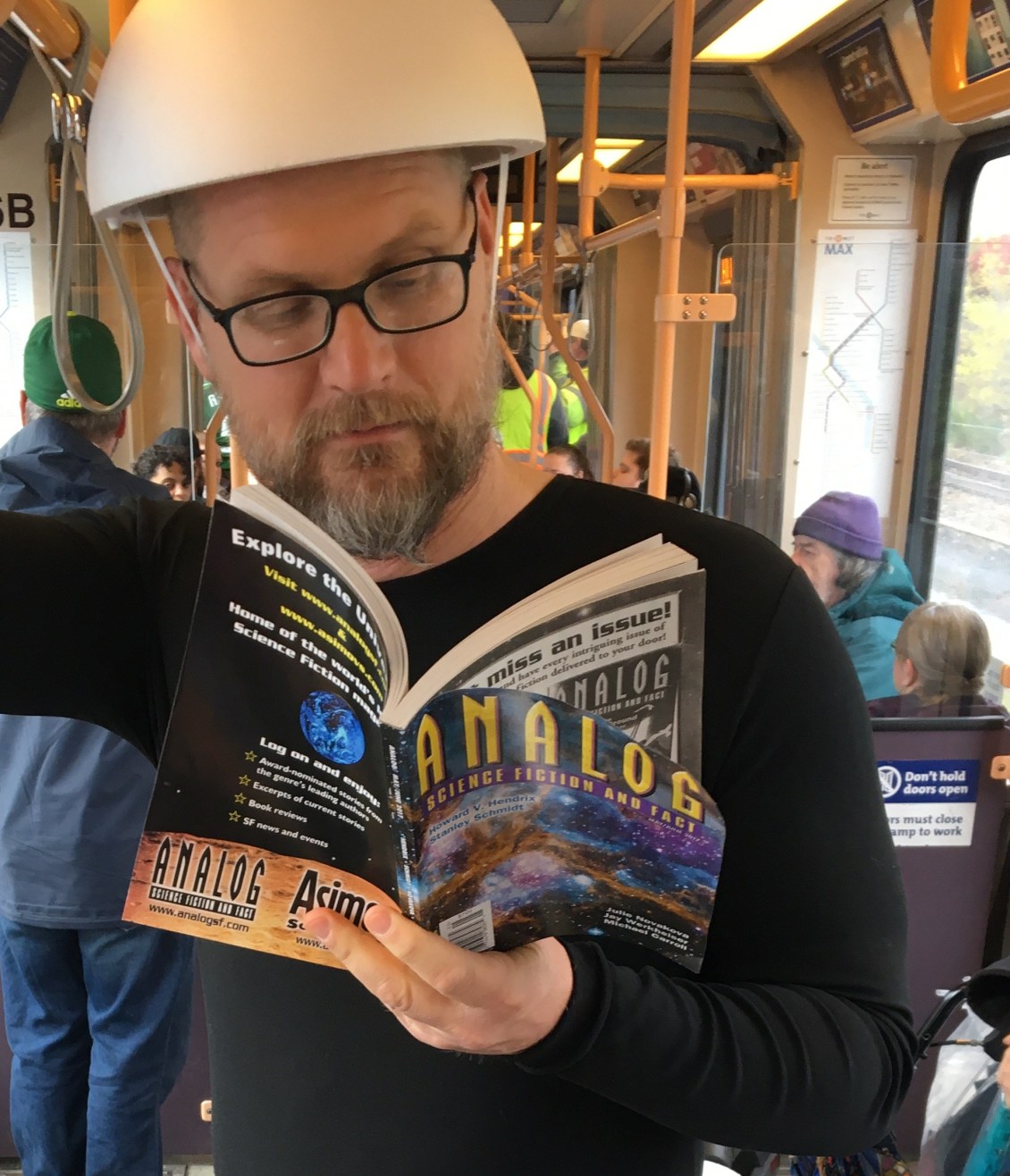
My latest story, “Proteus,” is out in the May/June issue of Analog Science Fiction and Fact! On the spectrum of my work, “Proteus” is closer to the hard sci-fi  pole–hence its appearance in Analog, widely regarded as one of the preeminent publishers of the hard stuff.

“Proteus” is the second of my stories set in the John Demetrius cycle, set (so far as I can imagine) about 100-200 years in humanity’s future. The whole cycle takes up questions of our coming experiment with transhumanism, as well as a kind of meditation on the nature of utopia and dystopia–I’ve tried to create a world like our own, in which utopia and dystopia coexist in different parts of the world and for different people at the same time. “Proteus” was also an immensely fun story to write–it involved a good deal of research into the terraforming of Venus and the nature of any possible human colony on Venus.

Analog on MAX

Photo credit Carlyn Eames

To get a promotional shot for the blog, my wife obligingly took a couple of pictures on our way to The March for Science this morning. I’m dressed as the most terrifying greenhouse gas on the planet, old silent-but-deadly methane. And given the name of my blog, I thought it best for her to take the photo on the MAX train, Portland’s closest analog to a true subway.


Analog on MAX2

It’s hard out here for a simple hydrocarbon. Photo credit Carlyn Eames

Analog can be purchased wherever fine science fiction magazines are sold, including at the 800-pound Amazonian gorilla.


Readings for the Time of Troubles

15 Thursday Dec 2016

Posted by Joe in Musings and ponderation, Politics, The Time of Troubles

≈ Leave a comment

Tags

hamfisted con men, racism, resolutions, utopia

I was surprised to learn that the textbook my daughter was using for her US History class is Howard Zinn’s A People’s History of the United States. I had long been an admirer of Zinn’s lefty outlook on the world from interviews Zinn did in the last years of his life, though I had never read any of his work. Finding out that my daughter is reading his signature book was apparently the encouragement I needed to read the book myself.

While the first edition of People’s History was written nearly 40 years ago and the last edition is over ten years old, the book is timely, and oddly comforting in these last weeks before the inauguration of Trump. I came away from People’s History with two guiding consolations. First, Trump is no aberration. His misogyny, nativism, racism, and venality have deep roots in the history of the United States. If this doesn’t seem like much of a consolation, I might put it another way: the country has been through crises like Trumpism before. Second, for all the suffering the Trump administration will cause millions of people, for all the theft of public goods that is coming, there is a countervailing force of decency in the American character as well. The courage of Frederick Douglass and Fannie Lou Hamer, of Mother Jones and Eugene Debs, of Daniel Berrigan and César Chávez–and of millions of others–is available to us as well. We can fight, in many small and powerful ways, if decent Americans are willing to give up their self-satisfaction and passivity and security to stand up for our country.

While I was familiar with every period Zinn wrote about in People’s History, I don’t think I had ever seen all these periods stitched together into a single overarching vision. Basically, Zinn’s contention is that the true history of the United States is not defined by the actions of presidents and congresses who have worked at practically every turn to enrich a tiny economic elite–by preserving slavery, by massacring the natives, by invading Mexico and Cuba and The Philippines, by overthrowing democratically elected governments in Guatemala and Chile and Iran. Rather, American history is made up of the often overlooked struggles of the oppressed, the working class, the unrepresented. It is a history of people fighting, over centuries sometimes, to be included in the opening phrase of the Constitution: “We the People.”

It’s an inspiring–if sometimes flawed–vision. I believe that what it offers, in a crowded field of history texts, is a truly alternative analysis of the history of the nation. Many critics have accused him of bias, though I would argue that what Zinn has done instead is abandon the pretense of objectivity that sometimes smothers the work of other historians. No historian, no human being, can be a thoroughly objective observer of the human experience. In telling any history, we leave neutrality behind as soon as we decide which events we will focus on and which ones we will omit.

And so many history texts, even those informed by the counter-cultural critique of history that came out of the 60s and 70s, still focus the actions of “the great men,” the Jeffersons and Jacksons and Roosevelts, with entire social movements of millions of ordinary people receiving comparatively little mention, or in some cases no mention at all. Zinn’s timely contribution is to argue that US History was not made by the Jeffersons and Jacksons and Roosevelts–that our elected leaders were responding to massive social and economic currents that they could barely influence, let alone control.

Presidents and congresses and supreme courts are led by the people, not the other way around. Unfortunately, according to Zinn, our elected leaders have usually been in thrall to what Occupy Wall Street popularized as “the 1%”: industrialists, financiers, speculators, robber barons. But frequently enough, a demand for justice will rise up from the roots of society with enough force that the elected leaders must listen and the law responds. The end of slavery, women’s suffrage, the 40-hour work week, the civil rights movement–all of these changes came, not from the courage of Abraham Lincoln, Woodrow Wilson, U.S. Grant, or L.B.J., but in response to the demands of ordinary Americans. Those demands took decades to make themselves felt sometimes, and the success of those demands depended on the tremendous courage of millions of people, but nearly every advance that the US has made in social justice has been led from below, not from above.

One can work towards neutrality and fairness in writing by committing to telling as many sides of the story as one can–a very common, and admirable, approach among the historians I’ve read. But it’s also valuable to have someone standing outside that system, observing from without, making no claim to neutrality–someone who pulls back the curtain on the mainstream view of American history to expose the so-called historical consensus as a fiction. Zinn’s book has helped me see my country in a new way.

And he’s helped me get my game face on for the time to come: if I want a humane minimum wage for Americans, if I want truly public college education and single-payer health care, I have to fight for those things. Not because I expect the hamfisted con man we just elected to respond to my demands, but because he may make enough people angry enough to care. The day will come when we have a free and equitable society, ruled by justice and reason. It’s up to us to make it.


Science Fiction As a Gateway Drug

14 Thursday Jul 2016

Posted by Joe in Biology, Games, Journeys, Musings and ponderation, Science Fiction

≈ Leave a comment

Tags

nerd culture, sci-fi, Sid Meier's Alpha Centauri, utopia

For a few years in boyhood at least, I loved science and technology. One of my fondest childhood television memories was of watching the original Cosmos miniseries with my dad, seeing Carl Sagan in his turtleneck and corduroy blazer as he traveled the universe on his “Ship of the Imagination” over Vangelis’ spacey soundtrack. I can remember my dad scoffing pretty frequently at Sagan’s goofily over-acted facial expressions–Sagan perpetually appeared to be having some kind of ineffable and mystical experience on his dandelion-seed ship–but the show appealed to the ten year-old me, so much so that I believed in 5th grade that I was destined to become a physicist.

I left science behind in junior high school for the same reasons that a lot of kids do: math and science classes were difficult (often not all that well-taught, too); I struggled with the emotions of puberty and my parents’ divorce and didn’t find factoring polynomials to provide much of an escape from my problems. For a couple of years I became a lackluster student in most subjects, but especially so in science and math, culminating in my freshman year of high school with the lowest grade I received in my many years of formal schooling (a D+ in biology).

Somewhere around age 14 I realized that the kids I thought were cool–the orchestra and debate kids who watched Stanley Kubrick movies and listened to classical music for fun–seemed to get As and Bs pretty effortlessly. And I wanted enough to be like them that I wised up in school a little. However, my perception of those cool kids was that coolness was all about literature and music, Camus and Sartre and Kafka and Stravinsky and Bauhaus (the band, not the architectural movement). Coolness had little to do with science and math beyond getting good grades. And so my trajectory through high school, college, and some time beyond kept me almost entirely in the humanities, with results which I probably could have predicted and which might have depressed me if I had predicted them: by age 24 I had a master’s degree in English and was an adjunct faculty member of a tiny community college.

Given where I ended up, how did I come back to science at all? I came back the same way that many, many young people get into the sciences in the first place: through science fiction. In 1998 I purchased one of the seminal computer games of all time: Sid Meier’s Alpha Centauri. Players of Alpha Centauri guide a faction of colonists through the development of humanity’s first settlement beyond the solar system. I was fascinated by the idea of a planet-wide university, of colonists building supercolliders and space elevators and massive ecological engineering projects.I loved the idea of a human society devoted to the acquisition of knowledge and careful stewardship of natural resources–an ideal that sometimes seems far removed from the society I actually live in.

Sid Meier's Alpha Centauri - PC - IGN

I also realized (pretty slowly, after a couple hundred hours of game play) that all of the projects which the game modeled on this fictional alien world were projects that real human beings were actively pursuing on this planet, for good and ill. Among them, there are massive environmental protection projects, ecological restoration projects, and sustainability efforts whose success or failure will determine the future of human civilization. I realized that I wanted to live in a world of science, not merely as an observer, but as an active participant.

In years since, the burgeoning of the internet, with its powerful democratizing effects, its incubation of the citizen science movement, of “outsider science,” of the makers’ movement, has convinced me that the ideal of a human society made entirely of scientists, naturalists, and ecologists could be our society. All people can become scientists. Becoming a scientist requires time and dedication, but it requires no secret gnosis that is kept from non-scientists. Do I want to learn how volcanism works? I have only to read and observe for several hundred hours before I will know a good deal about it (ironically, that’s about how much time I spent playing Sid Meier’s Alpha Centauri). Do I want to learn calculus? Khan Academy is right here on the internet, assuring me that I can learn anything, for free, forever.

You Can Learn Anything | Valley Oaks Charter School Tehachapi

As there is in most science fiction, there’s a lot of hand-waving and pseudo-scientific ersatz explanation in Sid Meier’s Alpha Centauri. Some of the hand-waving, now that I know a little more about science, seems pretty laughable in retrospect. But that hand-waving got me in the door, years after I’d thought I’d closed the door. People like Gene Roddenberry and Sid Meier have done as much to recruit scientists as anyone on earth.


A Meditation on Time

18 Thursday Feb 2016

Posted by Joe in Biology, Musings and ponderation, My Fiction

≈ Leave a comment

Tags

big 19th century novels, dystopia, resolutions, that strumpet Fame, utopia, writing practice

I have been taking my sweet time in reading Anna Karenina, a Christmas gift from my lovely stepdaughter. At the rate I’m going, I would guess I have two more months with this delicious, painful, hilarious book. Meanwhile, as I dither through this enormous work of art, it’s been hanging over my head that I don’t keep up my blog as befits a serious writer, dispensing witty remarks and novel observations at least once per week.

I really don’t yearn for “simpler times” (e.g. Tolstoy’s time), in which the world of ideas moved more slowly and people had time–from our perspective, anyway–to write long letters and long novels, to linger over an idea in a journal for months and even years. Many people of Tolstoy’s day didn’t regard their time as leisurely: they felt as rushed and harried as we do now, since the era of railroads and electricity had sped up life for them at an unprecedented rate. Perhaps in a hundred years my descendants will regard my lifestyle as leisurely, since most of us today don’t yet have Adderall prescriptions or cranial implants or other technological prostheses to speed up our rate of pumping out new ideas and reacting to new ideas we see.

This morning as I read my ten pages on the bus, I was taken by Tolstoy’s words about time: Prince Shcherbatsky is reacting to being told that “time is money,” and he says, “Time, indeed, that depends! Why, there’s time one would give a month of for fifty kopeks, and time you wouldn’t give half an hour of for any amount.”

It occurred to me as I sat with that quote today that I have given away lots of time in my life for fifty kopeks, or for less. When I returned to graduate school in my thirties, I was so excited to be able to take classes at public expense (since I am an employee of the state, my classes cost $5 per course)–I often joked with people that I had spent more money on parking tickets than on tuition when I was in grad school the second time. I feel thankful to the Great State of Washington every time I think of what I learned there.

But I also made a huge blunder by valuing my labor at zero in those days. The courses cost $5, so my degree must only cost about $100, no? Yet, of course there was the massive opportunity cost of my shutting myself up for years to read academic papers on ecology and statistical analysis: there were hikes I didn’t take, other skills I didn’t learn, traveling I didn’t do. I’ve written in a couple of my stories from that period about students who get into ecology because they love spending time outdoors in nature, but that their ecological studies lock them up in a lab for months on end doing gas chromatography or grinding up plant tissue samples.

I’ve come home with a fever tonight–ironically, the fever is what has slowed me down enough to be able to meditate about time in this blog post. And I have realized that as I age, I am becoming less and less willing to give up time to others (that is, to people I don’t love) for any amount. Even if by magic I could, I wouldn’t give up this feverish time tonight–unpleasant as it is–for money. I’m sure I have my price for taking on more work, but I’m realizing that the price is much, much higher than a community college would typically pay. I would just rather have the time.

The Gamification of Everything

31 Sunday Jan 2016

Posted by Joe in Games, Musings and ponderation

≈ Leave a comment

Tags

gamification, social engineering, utopia

I’m a casual gamer. Once a serious gamer, even: I was quite capable of spending ten hours, fifteen hours at a stretch playing Civilization in my twenties. Today I don’t have that kind of time, but I still love the possibilities that games provide to hone players’ skills or introduce them to new interests.

23454607552_482daa2618_z

Photo Credit: Graham Holt

In recent years there’s been a huge amount of buzz around gamification–the use of games to accomplish certain social goods or reduce harmful behaviors. A couple of years ago I gave my students a writing assignment on citizen science using this video about gamers who solved a protein-folding problem that had stymied AIDS researchers. More recently, I’ve had a chance to look at the gamified approach that two websites use for teaching math: IXL and Khan Academy.


I’ve used IXL a good deal with my daughter, and I’ve loved it: I can tell that the skill-building exercises have been designed in consultation with psychologists to create positive reinforcement loops with all kinds of little badges and power-ups that a user receives as her score increases–and the way to increase one’s score, of course, is to correctly complete more math problems.

And that’s the problem with IXL for my daughter. The gamification of the process does appeal to her at some level, I can tell, but at the bottom of the game is a lot of math problems. The gaming aspects of the activity have not turned her from a math hater to a math lover, or even a math accepter.

When I decided to try an buff up my math skills–I never got farther than a basic calculus class as an undergrad–I went to Khan Academy. (I would gladly have just used IXL, which I was already familiar with, but IXL seems geared towards younger kids and seems to top out at pre-calculus). And, while I am new to the Khan Academy game, I will say right now that I love it. In fact, I have loved it so much that I am finding myself choosing Khan Academy over other games.

The difference between my daughter and me in this regard seems to be how much interest we had in math in the first place. While I would not consider myself a math-lover exactly, I definitely like math enough to want to cultivate my math skills. My daughter, on the other hand, hates most math activities and would be happy never to spend another minute on IXL.

I suppose the whole gamification movement is a way of making desserts out of broccoli. I guess I could imagine something like broccoli ice cream being tasty, but then, I like broccoli pretty well in most of its forms. For someone who hates broccoli to begin with, broccoli ice cream is still broccoli.


Glad Solstitial Tidings

20 Sunday Dec 2015

Posted by Joe in Biology, Musings and ponderation

≈ 2 Comments

Tags

Christmas, David Sloan Wilson, mythopoesis, natural selection, The Winter Solstice, utopia

Tomorrow I’ll be ringing in the winter solstice with my wife at Breitenbush Hot Springs. There will be poetry, yoga, maybe some ecstatic dancing of some kind–who knows? I’ve never been to a Breitenbush solstice, but I loved spending some time there last year and I think it’s extremely likely I’ll have a good time.

One thing I bet I won’t hear, given the circles I travel in, is many references to the birth of Jesus or other Christmas-related greetings. That’s not a problem for me–in fact, I far prefer it. I consider Christmas the most debased festival in the liturgical calendar (and anyway, as a Quaker, I feel a scruple about observing any religious holidays at all).

My friends’ silence might seem curious at first blush, given that practically all of my close friends are culturally Christian if not nominally Christian. Most today would not consider themselves Christians of any stripe: my friends are atheists, agnostics, spiritual tourists, a’la carte Buddho-Hindu-Taoists, Sufi-curious, and neopagans. But, aside from the Friends in my Quaker meeting, I can’t think of many who regard Christianity sympathetically today.

Frankly, the Christian movement–which has been an accomplice of oppression and intolerance at least as often as it has worked to bring peace and justice to the world–deserves plenty of opprobrium. To say it in Christian language, The Church has been so soiled by the world that it has departed from Christ. So I’m not surprised to have friends who may have been raised in a Christian church who today distance themselves from what they regard as a fountainhead of exploitation.

But what I do find curious is how often my friends and acquaintances–even many of those who consider themselves atheists–engage in behaviors that might be considered reverent or even spiritual. While I know a few people whose atheism is so deeply held that they are able to see all ceremony as ridiculous, more often people seem to gravitate towards reverence even if they reject the particular rituals they grew up with.

One of the most important books I read this year explores this phenomenon: David Sloan Wilson’s Darwin’s Cathedral. Wilson’s thesis is that religious behavior is evolutionarily adaptive, that our urge to find sacredness in the world is a way of enforcing group cohesion and eliciting altruistic behavior. This thesis is radical in biology circles, partly because it depends on a concept of natural selection that acts on groups as well as on individuals. It’s beyond the scope of this post to unpack the reasons this idea is derided by most biologists (nor why I believe it is correct); for now I’ll just offer a quote from David Sloan Wilson and his co-author E.O Wilson (no relation) that summarizes the entire argument behind group level selection: “Selfishness beats altruism within groups. Altruistic groups beat selfish groups. Everything else is commentary”.

Friends, I wish you well this holiday season. If you believe that altruism exists, I urge you to practice it. If you believe that altruism does not exist, I urge you to look harder. May you one day find yourself practicing altruism unawares. I wish you happiness in this season, not on account of the solstice, nor on account of the birth of Jesus (who was very unlikely to have celebrated his birthday on December 25), but on account of the biology of our species, on account of the deep urge to be kind to one another, in spite of the ways I fall short.

Building Worlds

05 Saturday Dec 2015

Posted by Joe in Dungeons and Dragons, Musings and ponderation

≈ 2 Comments

Tags

fantasy, maps, marketing, mythopoesis, sci-fi, utopia

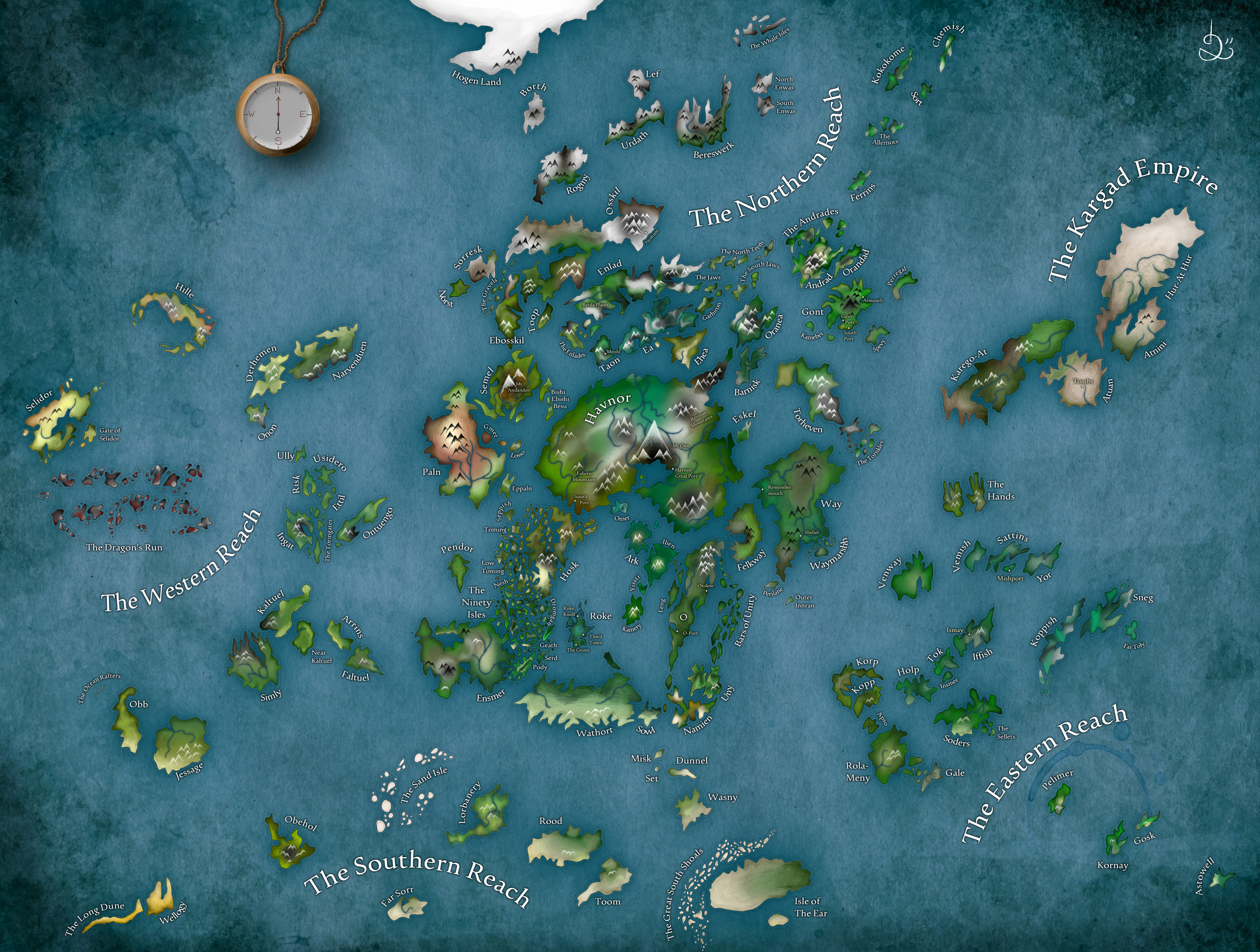
When I was  in sixth grade, I made a map out of my imagination. I drew it in colored pencils on six pieces of graph paper which I connected with masking tape, so that I could fold it like a codex or some mystical road map. While I’ve largely forgotten what it looked like, I remember that I had drawn a continent which clustered around an inner sea, a dragon-infested Mediterranean. The land was divided into kingdoms and empires, a crazy-quilt of realms filled with Dungeons and Dragons creatures, which is to say filled with a Lord of the Rings-fanboy descendants of Tolkien’s elves and dwarves and orcs.

map_of_earthsea

A Map of Earthsea, by Liam Davis, after Ursula Le Guin


What first drew me to fantasy and science fiction as a reader, and as a gamer and as a writer, was the world building. I’m reminded of the words of a friend’s son who said that you can tell if a book is going to be good if there’s a map at the beginning of it. When I read fantasy as a kid, I could put up with a lot of weak writing–poor characterization, wooden dialogue, tedious exposition–if there was a map in the book that represented a world that I would want to exist.

And yet, a map is also judged by its verisimilitude. Middle Earth, Earthsea, The Hyborian Age all drew me in with their plausibility: however oddly shaped the continents, those drawings seemed like maps of the actual world from a much earlier time, or a map of what might be the world. A map with no connection to a world that the reader does know is a useless map.

That’s the tricky thing about world building. There is no building a truly new world, untethered from any human world. Every map we draw, every pantheon of ancient deities we imagine for a game world or a novel, is a variation on a theme that was laid down in the real world. The Shire looks a lot like rural England. Earthsea is an imagined Bronze Age for the San Juan Islands. Gormenghast is the drama of a noble English house played out in Beijing’s Forbidden City. The City in Little, Big is New York City. The challenge with such world-building is to arrange these oddly-lensed realities into a world which seems totally distinct.

There’s a tension in fantasy and science fiction–as there is with all art–between the craving for the new and the comfort of the familiar. Audiences long for the new world, that giddy disorientation that comes from reading of an unfamiliar hero or a far country and knowing that these people and places fit into a coherent world that the book is slowly uncovering. But readers also crave the comfort of recognition, in the original sense of the word recognize: to know again. That is, readers are still happy to pay for something that reminds them of Lord of the Rings or Alice in Wonderland, no matter how many others complain about how much derivative fiction is out there. A book with a map that looks something like the real world is far likelier to appeal to readers than a book with a map of a totally new place, a place so different as to be unrecognizable. But some, thank goodness, can’t rest until they find the totally new place.


← Older posts

Subscribe

  • Entries (RSS)
  • Comments (RSS)

Archives

  • November 2025
  • September 2025
  • August 2025
  • July 2025
  • May 2025
  • April 2025
  • March 2025
  • January 2025
  • December 2024
  • October 2024
  • September 2024
  • August 2024
  • June 2024
  • May 2024
  • April 2024
  • March 2024
  • February 2024
  • January 2024
  • December 2023
  • October 2023
  • August 2023
  • July 2023
  • June 2023
  • April 2023
  • March 2023
  • May 2022
  • August 2021
  • June 2021
  • January 2021
  • October 2020
  • May 2020
  • March 2020
  • February 2020
  • January 2020
  • July 2019
  • June 2019
  • December 2018
  • October 2018
  • July 2018
  • May 2018
  • April 2018
  • January 2018
  • December 2017
  • November 2017
  • September 2017
  • August 2017
  • July 2017
  • June 2017
  • May 2017
  • April 2017
  • March 2017
  • February 2017
  • January 2017
  • December 2016
  • November 2016
  • October 2016
  • August 2016
  • July 2016
  • June 2016
  • May 2016
  • March 2016
  • February 2016
  • January 2016
  • December 2015
  • November 2015
  • October 2015
  • July 2015
  • May 2015
  • March 2015
  • February 2015
  • January 2015
  • December 2014

Categories

  • A Place for my Stuff
  • Advertising
  • Artificial Intelligence
  • Beta Readers
  • Biology
  • Book reviews
  • Curious Fictions
  • Dungeons and Dragons
  • Exit Black
  • fantasy
  • Games
  • HPIC
  • Journeys
  • Let's All Admire That Fantastic Can
  • Lit News
  • Literary criticism
  • Musings and ponderation
  • My Fiction
  • Pacifica
  • Politics
  • Reading Roundup
  • Science
  • Science Fiction
  • Science Fiction Writers of America
  • SETI
  • Stories
  • Stranger Bird
  • The Ideal Vehicle
  • The Time of Troubles
  • Uncategorized
  • Utopia and Dystopia
  • Welcome
  • YA fantasy

Meta

  • Create account
  • Log in

Authors

  • Joe's avatar

Blog at WordPress.com.

  • Subscribe Subscribed
    • The Subway Test
    • Join 143 other subscribers
    • Already have a WordPress.com account? Log in now.
    • The Subway Test
    • Subscribe Subscribed
    • Sign up
    • Log in
    • Report this content
    • View site in Reader
    • Manage subscriptions
    • Collapse this bar
 

Loading Comments...