Some of you know I’ve played in a lot of bands from the time I was 14 years old. More accurately, I guess, I played in a lot of bands from the age of 14 to 21, then took a nine year break, then played in basically one band since then. This one band that I’ve been in since 2001 has had a couple of name changes (from Los Profes to The Gravitropes to, now, threejays), and there was one major change in lineup when Dennis, one of the most skilled guitarists I’ve ever been allowed to play with, stepped away to tend to his tinnitus. But in most other ways it’s basically been the same band.
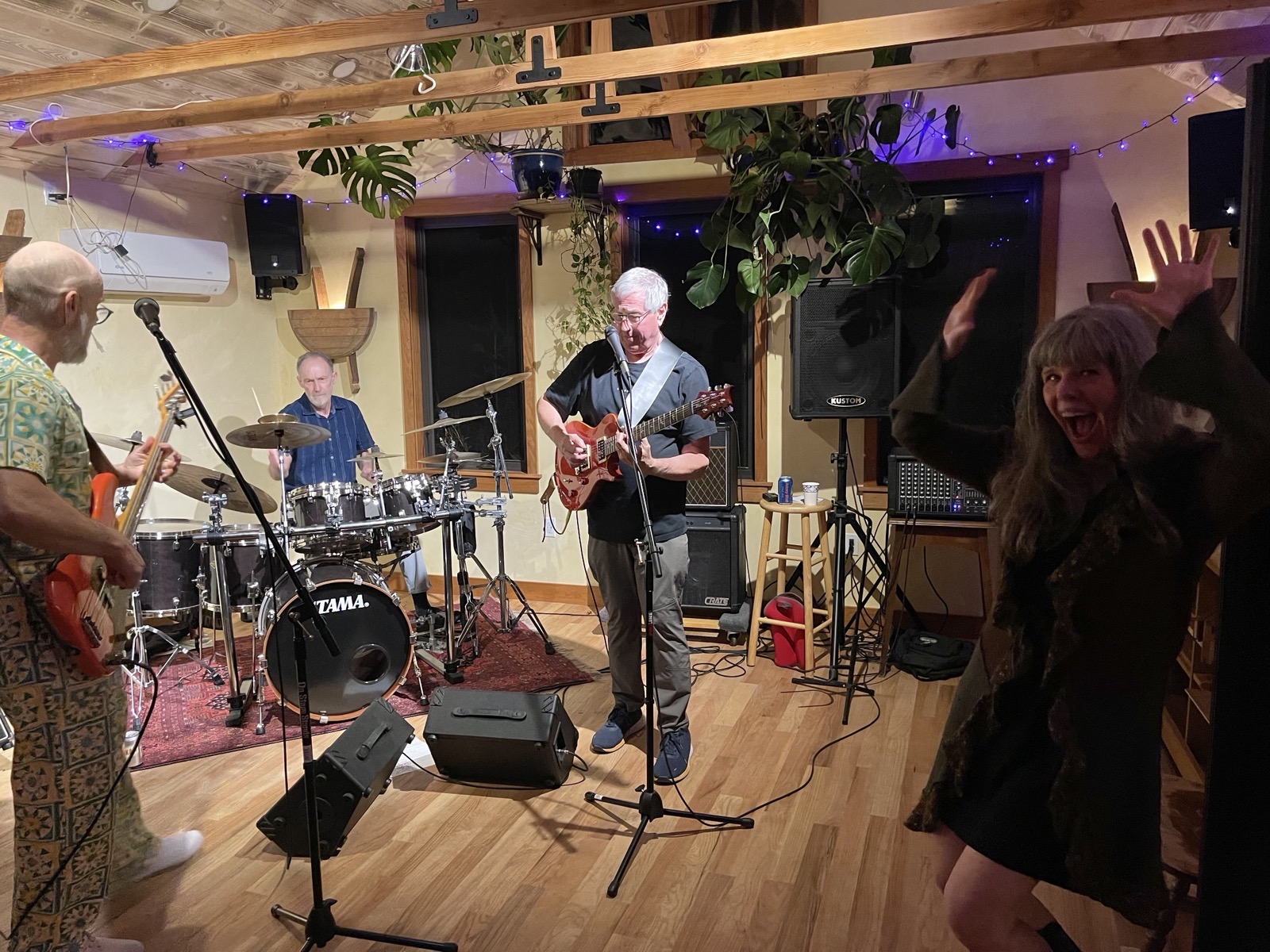
As the three remaining members of the band age–I’m 56 years old, and John and Jeff are in their early seventies–it feels like more and more of a mystical journey for us to play a gig. So I was touched and enthused when my friends Tanya, David, and Tyler hosted a threejays party at their house. They have an unforgettable, beautifully designed common space they converted from an old garage, and it had been a year since threejays had played out anywhere.
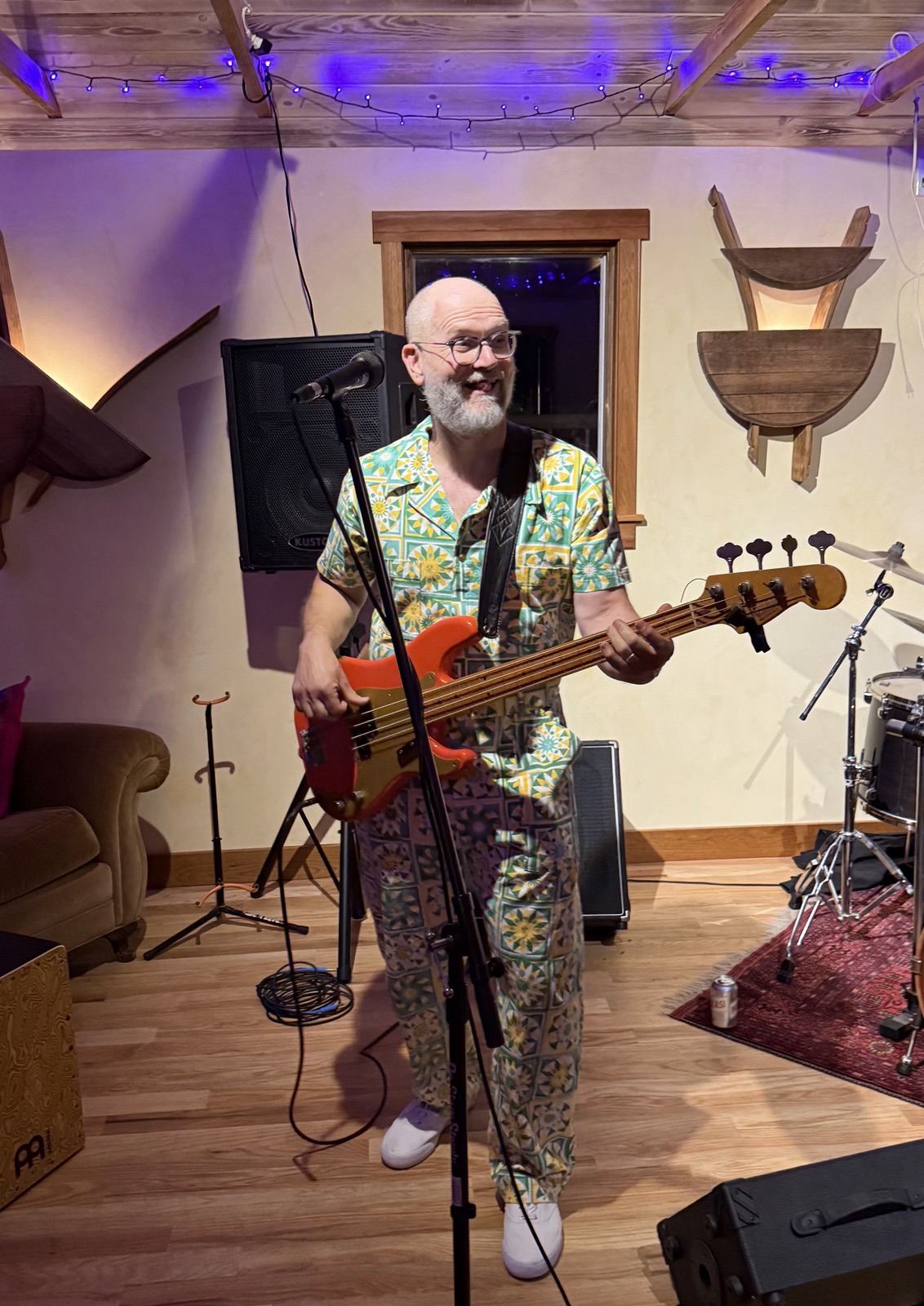
I did my best to celebrate the occasion by wearing the green jumpsuit I bought this summer. As my wife might say, there’s no being shy when you’re wearing a Big Bud Press jumpsuit.
Photo credit: Carlyn Eames
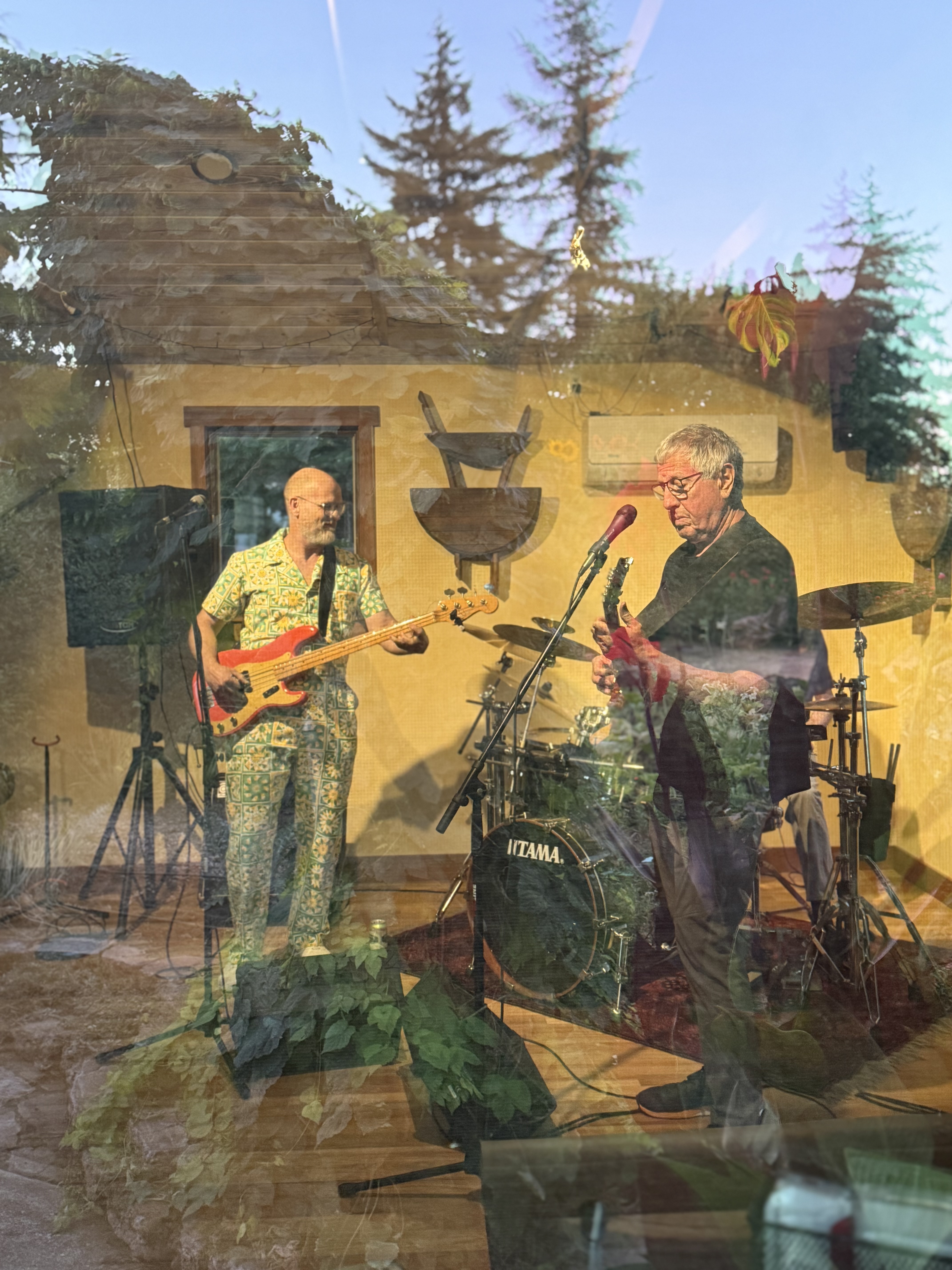
We were loud enough that practically all of the partygoers–and we had a sweet turnout–listened to us from the porch outside the Taj Garage. Nonetheless, I thought we sounded pretty good. Jeff and John are remarkable musicians, and I did some serious woodshedding over the last weeks to hold up my end of things. We sounded, at least, like we’d practiced these original songs every week since 2021, which was indeed the case.
threejays through the window–photo credit Robert Hughes
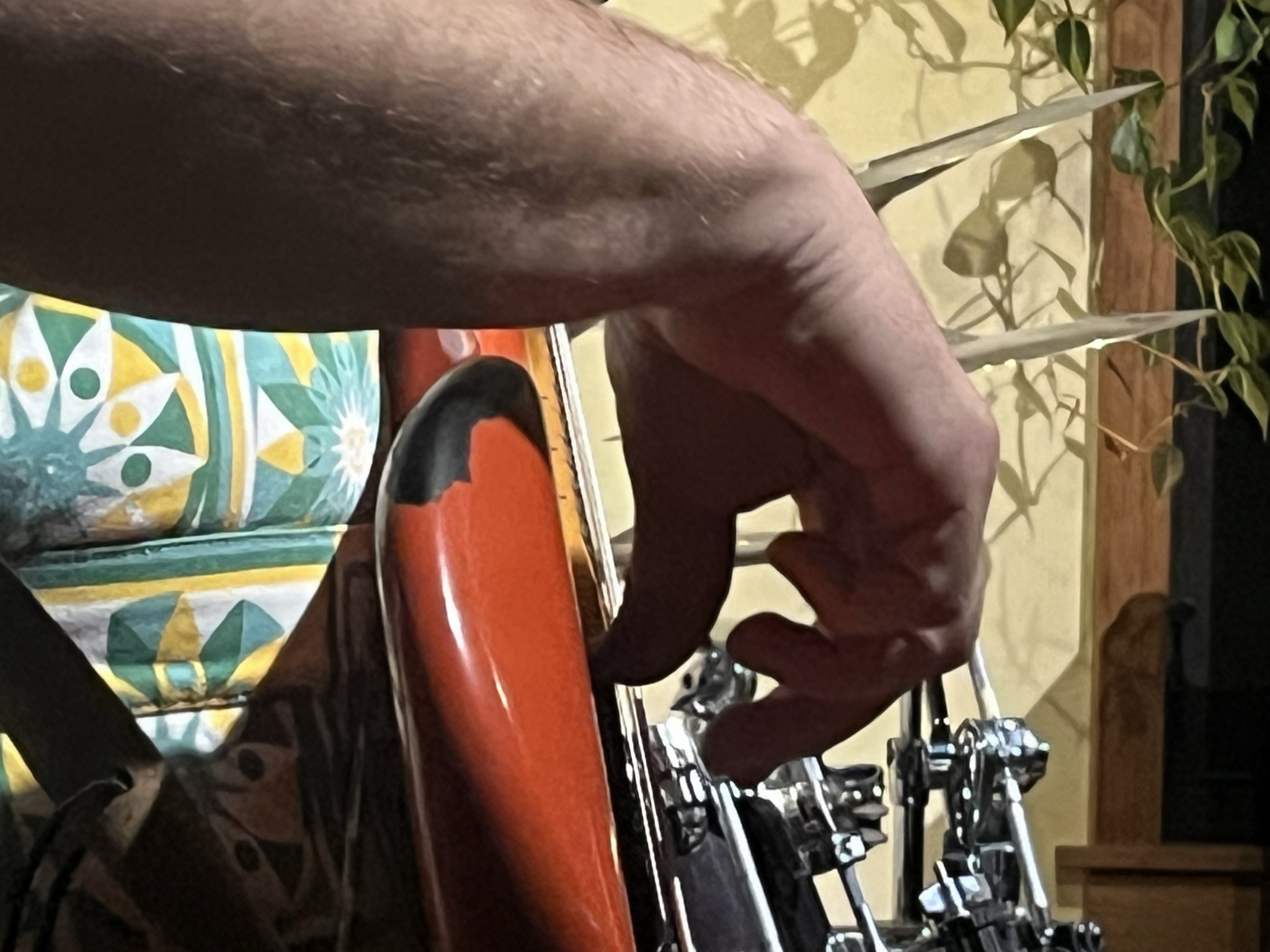
Probably my favorite photo of the night is the one below: my friend Damian (a wonderful fellow bassist, by the way) was obsessed by how much love this old Fender Precision has gotten, as evidenced by the wear patterns.
The bass is Jeff’s, but I’ve been playing on it for 25 years. Photo credit: Damian Lynch
I would have liked to record the whole show, but it was beyond me to get that set up. A number of friends took little videos, though–this was one of the best of them. The song is one I wrote many years ago, “The Girl With the Artichoke Heart.”
Video credit: David Tovey
As a teacher, I’ve been dismayed over recent years at how few of my students play any kind of musical instrument. I tell them the truth: it’s not that hard to learn to play a few chords on the guitar, and if you know a few chords, there are 10,000 different songs you can play. If you can get good at playing a few songs–maybe a half dozen, say–people will invite you to their parties and you can make music with your friends. There are very few things in life that have brought me more joy than that.
My lovely wife, Carlyn, in her awesome party dress. Photo credit: David Tovey
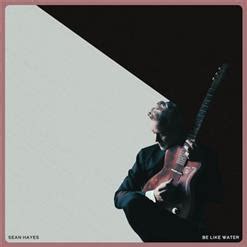
Carlyn and I went to see the great Sean Hayes (the Petaluma folkie, not the wonderful Will and Grace actor) at Polaris Hall in Portland a couple of weeks ago. It was probably my sixth time going to a Sean Hayes show, this time a fantastic duo concert with guitar master John Courage. It was also an opportunity for Carlyn and me to introduce our very special friends, Tanya and David, to Sean Hayes’s music. I am crazy for how Hayes builds a song out of practically nothing. I’m a decent songwriter myself (for a hobbyist, anyway) and I am in awe of how Hayes does his work: it seems sometimes like he builds his songs out of a three note lick and a refrain repeated 16 times.
There’s one kind of joy in finding a songwriter who writes songs more or less the way you do but does it better than you can. There’s an entirely different kind of joy in finding someone better than you who also happens to write songs in such a different way that you can’t even tell what he’s doing. Listening to Sean Hayes gives me this second kind of joy.
And yet, Sean Hayes has only 47,695 monthly listeners on Spotify. The word only is misleading here: I think 98% of Spotify performers have fewer than 1,000 monthly listeners, and 80% of performers have fewer than 50, if Claude is to be believed. And a figure of 47K monthly listeners is still amazing compared to my readership as a novelist–probably higher by two or even three orders of magnitude.
So when I say “Sean Hayes has only 47,695 monthly listeners on Spotify,” it’s because there are some far less talented songwriters who have more fans than Sean Hayes–again, two or three orders of magnitude more. As Ecclesiastes tells us, the race goes not to the swift.
I got to thinking about Hayes’s fandom partly in the context of Devon Halliday’s recent Substack essay, “Literary Fiction Has Lost the Plot.” This essay, which seems to have gone viral in my corner of Substack, offers a close reading of the first pages of two famous current novelists and takes them down a peg, basically arguing that the writing on page one of each novel is so bad that there’s no good reason to move on to page two.
There’s a lot Devon Halliday and I agree about here. The writers she takes down are both very famous–one of the writers has won the Pulitzer, and the other has been longlisted for the Booker Prize–and neither of the first pages of their novels is (in my opinion) anything breathtaking. In the case of the Pulitzer winner, I think you could make the case that his first page is actively bad.
Having said that, I think Halliday is wrong about the importance of first pages. As she says of the first novel, Emma Cline’s Switzy,
You probably think I’m being too harsh. Switzy is a long and complex novel that tracks the unraveling of a mind—maybe the later pages will justify this slow, vague, broody opening!
So what if they do? The first page of a novel must justify itself.
While I do think it’s true that “the first page of a novel must justify itself,” I also think it’s a shame for us to conclude that the first page of a novel must justify itself on the first page. To my mind, that is an extremely modern and mostly made-up problem, a result of millions of people self-publishing their novels and web comics and music and poetry–we’re all squawking for attention like the geese in Kundera’s The Book of Laughter and Forgetting, and you’d better hook your audience fast because they grew up on TikTok and will only spend a few seconds, if that, waiting for you to amuse them.
But I bet you can come up with counter-examples of novels, even relatively recent ones, that sneaked up slowly on you. My most recent read, Murakami’s The Wind-Up Bird Chronicle, is a classic example: if you judge by the first ten pages or so, it sounds like the book is going to be about a guy looking for his lost cat in the alley behind his house. But the story slowly, and with great creepiness, turns into a surreal, noir exploration of the soul of Japan.
That slow pacing is the fruit of a literary reputation. Literary reputation is a kind of emotional line of credit that can be drawn down very slowly before the reader is going to demand that the writer produce a justification for what they’re doing. I’m a decent writer, but I’m no Murakami–to return to a musical analogy, if Murakami is someone with the literary reputation of David Bowie, I’m more like a busker at the top of the subway stairs. If someone discovered a lost Bowie track today, millions of people would listen through it with the most generous ear imaginable, because hey—this is a previously undiscovered David Fucking Bowie track! The opening chords could seem anodyne, or poorly mixed, or even boring, and we would keep listening because Bowie was surely going somewhere when he wrote that intro.
But my situation, the busker’s situation, is the situation of most writers. In my case, I’ve got about 15 seconds, if that, to impress you with my busking before you start descending the stairs to the trains. (And even then, you might not notice even if the playing and the composition are the most brilliant thing to touch your ears all year. Remember that Washington Post experiment where Joshua Bell played Bach in a DC Metro station and practically everyone walked right by him. I think only one adult over several hours—a serious violinist himself—ultimately noticed that it was Joshua Bell. For what it’s worth, lots of little kids paused to listen before their parents dragged them away.)
Writerly jealousy is a non-trivial problem in the creative writing classes I teach. As befits an open door community college, every class I have ever taught contains a broad mix of student ability: there are many students who are more earnest than skilled, but there are promising and even scarily talented writers as well. So there’s a lot of jealously: some students care a lot about their work, and they are often good enough readers to see that their writing isn’t as strong as that of some others in the class. The challenge is compounded by the fact that some of the most talented writers are also the least interested in devoting themselves to writing long term–often enough they are engineering or biology majors taking an “ice cream class.”
So every term I tell my students about Jimi Hendrix and Neil Young at Woodstock. Hendrix and Young were friends; according to legend, they even arrived together at Woodstock in a hotwired pickup truck, some agent or promoter having sent them to the wrong regional airport. Both men played guitar at the festival. And, I tell my students, of the 500,000 people that were at Woodstock, I doubt that anyone in the audience thought that Neil Young was the better guitarist.
But Neil Young is awesome. And the world of guitar has plenty of space for Neil Young. More importantly, there are ways that Neil Young plays a solo that never would have occurred to Jimi Hendrix for all his talent, or to any other human being, for that matter.
(One might add that Neil Young is also still alive, and that some, like me, consider Neil Young a greater songwriter than Jimi Hendrix. But that’s all beside the point: even if Jimi Hendrix were a better human being in every way than Neil Young, Neil Young remains a priceless and indispensible musician.)
There are a million ways to write a story, to write a song, to play a song, to engage with the world. Work hard at what you’re doing, the way you’re doing it, then belt it out. People will give you the 15 seconds or they won’t. If they don’t, and your work is nevertheless wonderful, the point is that you made wonderful work. The race goes not to the swift.
Here’s one way of writing and singing a song that you should listen to, I’m telling you: Sean Hayes doing “When We Fall In” at Le Poisson Rouge a few years back. I first listened to it before Carlyn and I were even married, and I knew as soon as I heard the first eight bars of the song that I was, in fact, in deep with her.