• About
  • My Fiction
  • Reviews

The Subway Test

~ Joe Pitkin's stories, queries, and quibbles regarding the human, the inhuman, the humanesque.

The Subway Test

Author Archives: Joe

Drafting Update

03 Thursday Apr 2025

Posted by Joe in Lit News, My Fiction, Science Fiction, Stories

≈ 2 Comments

Tags

John Demetrius, mythopoesis, sci-fi, Science Fiction, SFF, short story

It feels good to have cooked up a reader’s draft of a short story during my spring writer’s retreat in Corvallis, Oregon earlier this week. Even better is that this new story, “Arden Is a New World,” takes place in the John Demetrius story cycle that I have been toying with for many years–I had worried for a while that I had run out of gas on the John Demetrius concept.

Knowing me, I’m a few months and a couple of peer critiques away from sending the story anywhere, but it feels wonderful to be building up a roster of publishable stories again. I worked so long and hard on novels–first Pacifica, then Exit Black, then Pacifica again–that I’m surprised by that short fiction feeling, the sense of being able to get one’s head around an entire narrative in a single sitting. I’ve missed short stories, and it’s good to be back.

Donald Trump is a Selective Event

25 Tuesday Mar 2025

Posted by Joe in Musings and ponderation, Politics, The Time of Troubles, Utopia and Dystopia

≈ 7 Comments

Tags

democracy, democratic republic, Donald Trump, Politics, primary succession

I don’t intend to dehumanize the man. At the bottom of all the chaos he’s catalyzed, Donald Trump is an ordinary mortal. He is a criminal and grifter and predator, but despite all that he remains a human being.

But Donald Trump is also an erupting supervolcano, defacing a continent. He is a plume of gigatons of methane released into the atmosphere by the melting of clathrate ices. He is a comet striking the earth.

In less poetic terms, the Donald Trump presidency is the civic equivalent of what evolutionary biologists call a selective event: a dramatic or even catastrophic change that exposes the organisms of a community to powerful natural selection. Some organisms may survive; many will not. There is a lot about America that I’ve taken for granted my whole life which will disappear, I suspect. I can lament the loss; I can make myself angry thinking about how as a country, we’ve brought the catastrophe down on ourselves. But there’s no sense hand-waving past the magnitude of the changes upon us.

Nor do I have anything to gain by despairing about the situation we face. It’s still important for me to read the news and to engage with the political process, if only because I believe that facing reality is an ethical stance towards the world.

Though it can be fun for science fiction authors to make predictions, I decline to speculate now about what the United States will be like in ten years or even five. Even without the metastasis of Donald Trump, the changes of the next few years would have been cataclysmic: not necessarily all bad, or even mostly bad, but nonetheless deeply altered. As artificial intelligence penetrates ever further into our lives, as the vise grip of anthropogenic climate change tightens the screw one more turn, our lives over the next ten years would have been profoundly different even if the United States had not elected a strongman more in the tradition of a 19th century Latin American country than of a republic with a free press and mature civil society.

Here’s what I will say, though: if America looks unrecognizable after the civic catastrophe of Trumpism, it’s worth establishing for myself–as well as for my students and descendants–what values I will hold to regardless of what’s left of the country when the dust has cleared.

I had the great fortune of doing ecological work on Mount St. Helens from 2009-2011, thirty years after the eruption of 1980. My field site was an area called the Pumice Plain, directly in the pyroclastic flow of the volcano, where 40 meters of 300º-730º C pumice had sterilized the mountainside. For a moment, the Pumice Plain was as barren as the surface of the moon.

And yet, the story of how life reestablished itself on Mount St. Helens was as interesting and impressive as the story of how the Pumice Plain destroyed the forest it replaced. Within a year of the eruption, researchers had found a single dwarf alpine lupine, Lupinus lepidus, had taken root on that barren moonscape:

A descendant of the tough little flower in question.

By the time I got to the Pumice Plain, there were a million of these unassuming, scrappy lupines growing there, as well as Sitka willow saplings and young cedars and Douglas firs and Western hemlocks. Darwin’s entire entangled bank of invertebrates and birds and mammals and amphibians trawled over the new plant life there, trying to work their ecological niches.

I believe that regardless of the forces arrayed against it, democracy is a similarly inexorable force. Whatever remains after the eruption of the years of Trumpism–whether they last from 2016-2028 or from 2016-2116–my allegiances are with the forces of democracy and pluralism. This bedrock commitment stems as much from my faith as a Quaker as it does from my having grown up in a democratic country, and it informs all other civic values that I’ll speak to in coming posts.

Goodbye, Kevin Drum

12 Wednesday Mar 2025

Posted by Joe in Journeys, Musings and ponderation, Politics

≈ Leave a comment

Tags

blogging, Kevin Drum, Politics

The best blogger in the world, Kevin Drum, died last Friday after a ten-year journey with multiple myeloma. Though I never met him, I miss him terribly.

Kevin became the voice of the Political Animal blog at Washington Monthly in 2004–that’s where I discovered him. And while I don’t remember the first time I took notice of his work, I’ve read him daily for at least 20 years, first at Political Animal, then at Mother Jones, and finally at his solo endeavor, Jabberwocking.

Kevin’s work was so thoughtful, so insightful, so wide-ranging and funny, that sometime around 2006 or 2007 I felt inspired to start a blog of my own. I learned almost immediately how hard it is to do what Kevin Drum did every day, multiple times a day. After a few weeks of putting up meandering, useless-to-anyone-but-me musings–maybe six or seven of them in total–I realized that I would never be able to do what Kevin did. In retrospect, the feeling was a little like that scene in the movie Trainwreck where Bill Hader is playing one-on-one basketball against LeBron James: the difference between what I was trying to do and what Kevin was doing was so great that it wasn’t even clear that we were playing the same game.

And now he’s gone. I can’t think of a political commentator in my lifetime that was more fair-minded, more intellectually rigorous, more even-keeled, more decent than Kevin. For 20 years, his mind has been indispensable to me. And, while I am reminded of the Charles de Gaulle quote “the cemeteries of the world are full of indispensable men”–a saying I first encountered in a Kevin Drum post–I regard with loneliness the prospect that we will all have to get along without Kevin’s incomparable gift from now on.

Rest in Peace, Man

Empires Die, But Euclid’s Theorems Keep Their Youth Forever

22 Wednesday Jan 2025

Posted by Joe in Exit Black, Musings and ponderation, The Time of Troubles

≈ 1 Comment

Tags

DJT, Donald Trump, Politics, Volterra

I’ve been slow to speak on the current political situation of the United States, partly because so many people smarter and quicker than I have flooded the zone. I’ve never been good at the hot take–for that matter, I’m too slow a processor to ever be very good at blogging, I think–but I have definitely been thinking and reading, and I remain a believer in the old English 101 maxim about writing to discover what you actually think about an issue. So, maybe these few paragraphs (and some of the posts that will follow) will help me get clear on a way forward: how do democracy-minded people move towards a civil society devoted to the rule of law?

(A second reason I want to write, I’m afraid, is that if America really is careening into full-blown authoritarianism or even dictatorship, I also don’t want to remain silent. Let this post, and any others I have categorized under “The Time of Troubles,” be a public record of my beliefs in the event of job dismissals or round-ups or worse. While that seems like an alarmist take today, on 22 January 2025, I have to admit that I’ve already witnessed insanities and inanities that I never imagined I would see in the United States. Who really knows what is coming?)

I’ve been mulling over Josh Marshall’s excellent advice to people on the political Left of late. In his TalkingPointsMemo post of 20 January titled “A Moment of Calm,” he suggests

What is the kind of American society we want to create? What are the problems we see and how do we think they should be addressed? These are elementary questions. But they are good ones to ask ourselves in a moment of uncertainty and chaos like this. Everyone is so spun up on themselves, hungry for the killer strategy or tactic to get back in the political driver’s seat. That’s natural. But desperation doesn’t lead to clear or good thinking. When you have time — and I would argue that at the moment, paradoxically, you do have time — the best place to start is to think clearly about what you’re actually trying to achieve in your own small role in politics. That’s not the end of the story of course. Thinking what your ideal society is doesn’t in itself dictate a political strategy. But you’ll never get where you’re trying to go if you haven’t figured out where that is. And clarity about goals is itself a strategy. Clarity creates coherence and consistency. Voters don’t like political movements that don’t know what they believe or want, that flip from one stratagem to the next with the weather.

Josh Marshall, “A Moment of Calm”

This is what I hope to be spending at least some of my precious blogging time on: what is the society I argue for? On what am I basing those recommendations? How do we move towards those goals? These questions may seem precious or even ridiculous in the current political moment. However, I maintain my faith that the American people will sooner or later repent the election of Donald Trump, and I continue to hope that we will repent early enough that we still have recourse to charting a different course for our republic.

For now, I am reminded of one of my intellectual heroes, the great Italian mathematician Vito Volterra. He was one of the authors of the Lotka-Volterra Equations that model predator-prey interactions–astute readers of my book Exit Black may notice that I named one of the book’s characters Viv Volterra to allude to the book’s meditation on the complicated relationship of predators and prey in human society. I suppose, now that I think about it, that this era is the most opportune moment since the days of Jim Crow, the Gilded Age, and the “Indian Wars” of the 19th century to talk about American predators and prey.

But my main reason for thinking about Vito Volterra lately comes from his reaction to Mussolini’s fascist Italy. In 1931, when professors in Italy were expected to sign loyalty oaths to the fascist regime, Volterra was one of only 12 professors who refused to do so. After being dismissed from his position at University of Rome La Sapienza, he began signing his postcards to friends with the words Empires die, but Euclid’s theorems keep their youth forever. And, while Mussolini and his regime outlived Volterra by about five years, Volterra was unquestionably right. His words today are a reminder to keep my eyes on the long game, on those ideas that keep their youth forever.

Portrait of Vito Volterra by Unknown author – http://www.phys.uniroma1.it/DipWeb/dottorato/SCUO_VOLTERRA/scuola_volterra.html, Public Domain, https://commons.wikimedia.org/w/index.php?curid=16117839

We’re #8! We’re #8!

13 Monday Jan 2025

Posted by Joe in Advertising, Book reviews, Exit Black, Lit News, My Fiction, Science Fiction

≈ 10 Comments

Tags

Blackstone, books, Carolina Hoyos, Discover Sci-Fi, Exit Black, fiction, sci-fi, Science Fiction, writing

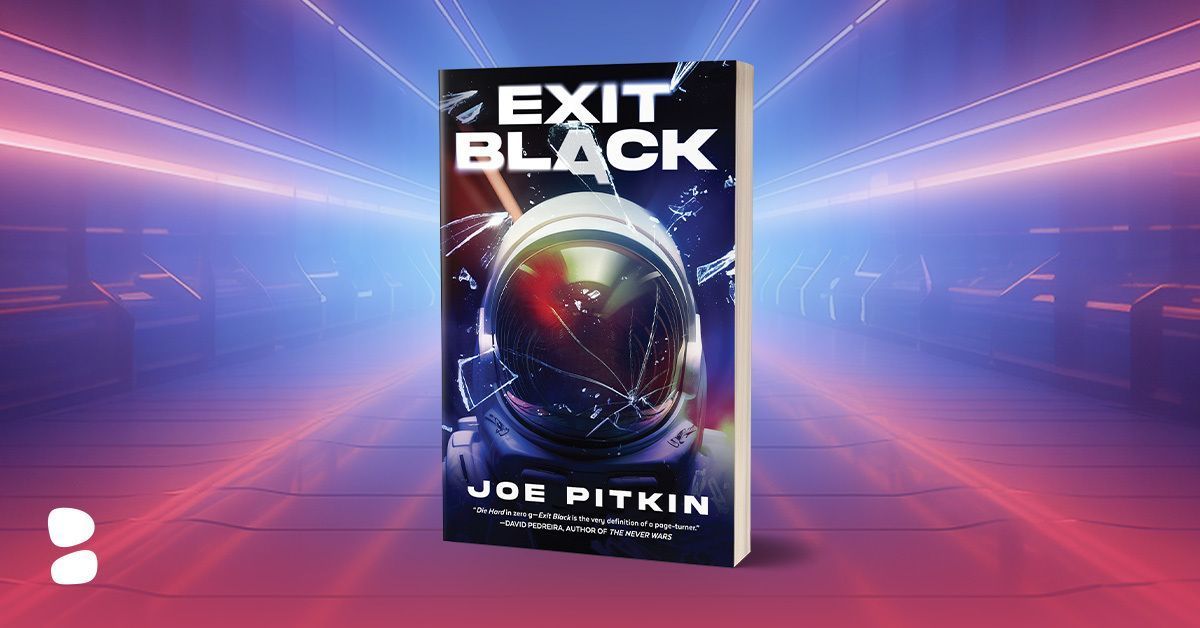
That was my publisher’s note to me when we learned that Exit Black cracked the top ten best sci fi audiobooks in 2024 at Discover Sci-Fi. I’m super stoked: while I would have loved for Exit Black to take the #1 spot, of course, there’s no shame losing out to the likes of Adrian Tchaikovsky narrating his own book and Jeff VanderMeer having his work read by Bronson Pinchot. Carolina Hoyos is a hell of a reader, and I was very lucky to have gotten to work with her.

I loved every step of this project with Blackstone Publishing, and to make my Captain Obvious Statement of the Day: Blackstone knows audiobooks. Thanks so much to all of you who voted and all of you who listened. And, if you haven’t listened yet, if you ever feel a hankering for a tale about a bunch of techbros getting their comeuppance, Exit Black couldn’t be more timely.

Freaking Out in Powell’s City of Books

30 Monday Dec 2024

Posted by Joe in Exit Black, Musings and ponderation, Science Fiction

≈ 3 Comments

Tags

book review, books, Exit Black, fiction, independent bookstores, marketing, Powell's City of Books, reading, sci-fi, Science Fiction, writing

As a Portlander, I have to contend with the reality of Powell’s City of Books. It’s the largest independent bookstore in the world, and as you might imagine it has a mighty footprint on the Portland literary scene. A friend who worked there told me about 20 years ago that 40% of Amazon’s book orders actually go through Powell’s. I doubt that that is still the case today, but it gives you some idea of the size of the place, as well as the indirect role Powell’s played in the rise of Amazon. One of Portland’s most popular tourist destinations, Powell’s City of Books is its own Portlandia sketch.

For many years, basically from the time I started writing fiction in my thirties, I had a lot of trouble going into Powell’s. Part of the dread I felt was simple cognitive overload. But I was also contending with two related kinds of self-loathing in the City of Books, one as a reader and one as a writer.

As a reader, I would feel depressed in City of Books to come into contact with all the great books that I hadn’t read and would likely never read. As a writer, I would despair that of the tens of thousands of titles that were on the shelves on any given day, nothing I had written had ever shown up there. In my foolishness, the place had become a visual metaphor for two ways I felt I had come up short as a human being.

Eventually the feeling passed, probably just because I got older. It doesn’t upset me so much anymore that I don’t have that many more books to read in my future. Even if I live a fantastically long life, it seems unlikely that I have more than 2000 books left to read, and the number could be far, far lower than that. The key, as my friend and bandmate John Governale has shown me, is not to try to read all the good books out there, but rather just to remember that there is always a great book out there for me–I don’t need to spend any time reading a bad one.

As for the fact that my stuff had never shown up on the shelves of Powell’s City of Books, I eventually got over myself there, too. I think that as I got better as a writer, I started to find more joy in just writing well (as distinct from winning awards or getting prestigious publications or big book contracts). I still love to get published, but even more than that I love the feeling of putting together a story that really works.

As I tell my students and my kids, there are lots of situations where you start getting good at something right around the time that you don’t have to do that thing anymore. And there was a similar feeling of irony for me when I went into Powell’s City of Books last week and found that my latest novel, Exit Black, is indeed on the shelves there. I still prefer the smaller independent bookstores in my life–Broadway Books, White Oak Books, Annie Bloom’s–but it is a nice feeling to know that a tourist in Portland who wanted to find my work for some reason could find Exit Black right in the Gold Room of Powell’s City of Books, section 722.

Vote for Carolina Hoyos’ Masterful Reading of Exit Black

21 Saturday Dec 2024

Posted by Joe in Exit Black, Lit News, My Fiction, Science Fiction

≈ 4 Comments

Tags

Best Sci-Fi of 2024, Discover Sci-Fi, Exit Black, sci-fi, Science Fiction

I am excited to learn that Exit Black has been nominated for Discover Sci-Fi’s Best Sci-Fi Books of 2024! Exit Black is a nominee in the Best Sci-Fi Audiobook category, a testament to Carolina Hoyos’ tense, too-cool-for-school reading of my work, as well as to Blackstone Publishing’s amazing audiobook chops. If you heard Carolina read my book, or if you are an Exit Black supporter, I’d be honored to have your vote.

Voting remains open until January 8–you can fill in the little bubble here: Discover Sci-Fi’s Best Sci-Fi Books of 2024.

My Best Reads of 2024

11 Wednesday Dec 2024

Posted by Joe in Book reviews, Exit Black, Literary criticism, Musings and ponderation, My Fiction, Reading Roundup, Science Fiction

≈ Leave a comment

Tags

books, sci-fi, sci-fi thriller, Science Fiction, Shepherd, Thriller

As you may remember from former posts, I’m a big fan of the book site Shepherd. And, like many of the writers on that site, I was invited by Shepherd founder Ben Fox to talk about my three favorite books of 2024. I was game, partly because I’m happy for any opportunity to link to my own book of this year, Exit Black–I believe it’s one of this year’s best thrillers on economic inequality that you’ll read this year.

I’m not sure what my choices say about me besides the fact that I do a lot of reading outside the genres I write in, but here were my three faves of this year: Edith Wharton’s The Age of Innocence, Toni Morrison’s Jazz, and Laurent Binet’s Civilizations. Why did I love them so? Check out my Shepherd page to find out!

Remembering Julian Nelson

07 Monday Oct 2024

Posted by Joe in Musings and ponderation

≈ 22 Comments

Tags

Julian Nelson, Rainer Maria Rilke, Rememberance

“Geburtstagskind” (Birthday Child). Photo Credit: Julian Nelson.

Two Saturdays ago, my colleague and friend Julian Nelson went into cardiac arrest and died. About the shock and sadness of losing him I have nothing more to say than that I am heartbroken. But besides the shock, and besides the gaping sadness of losing him, I was insulted by the surprise of his leaving: he was a young man, or at least not an old one, still gadding about Clark College like a boulevardier or a peripatetic philosopher in the week he died. While he had suffered daunting health challenges his whole life, he had an illusionist’s knack for conveying vitality to the world. I must have just been assuming that he would be around forever. As Ophelia would have said, I was the more deceived.

Julian came to work at the same college as me in 2005 as a German professor. I was on his screening committee, in fact, so I met him before almost anybody else at Clark College had. And even before he was hired, I knew that he was someone who, if circumstances permitted, I would be friends with. Thankfully, the circumstances did permit: Clark College hired him, and we became immediate fast friends. I was impressed and a little intimidated by his skill with languages and with his knowledge of writers and philosophers that I had barely heard of, much less read. Yet I think we also saw in one another a love of old books, a commitment to the ancient Stoic concept of kosmopolitês, a shared sense that the world and its follies were an elaborate joke with a hilarious and redemptive punchline just over the horizon.

Lots of people thought we looked alike. I didn’t see the resemblance, frankly, though I can understand that a couple of bald Teutonic men of a certain age will share certain likenesses. One upper administrator at the college–a supervisor to both of us–would call me Julian at least as often as they would call me Joe. After a few months of that public confusion, Julian started greeting me with “Hallo, mein Doppelgänger!” a term which he knew better than anyone conveyed the sense of the eerie, a spirit twin or evil double, as though the existence of one of us spelled trouble for the other. But I knew he was joking, and even if our resemblance had been deadly serious he would have joked about it because humor was his natural stance towards trouble of all kinds.

And trouble did find him. I had only the vaguest notion of many of the difficulties he faced: he approached so many of his misfortunes with such stoic and sardonic humor that I wasn’t always sure how heartbroken he was. But the misfortunes I did see–such as when the college shuttered his beloved German program, not because of his teaching (which was excellent) or student demand (which was strong), but because it seemed a convenient place for the administration to scoop up a little money in a lean time–he faced with aplomb. And, because he had a PhD in comparative literature and knew more about novels than most of the English department, he simply remade himself as an English teacher and kept going. It wasn’t long before he won a second Faculty Excellence Award, this time for teaching in a field he had never intended to work in.

I drank as much beer with him, and shared as many laughs with him, as I have ever done with anyone. And, since I am not a young man myself and I follow not so far behind him, there may be no one else in my life that I will share more beers and silly bookish jokes with. Though we had grown up up across the world from one another, we were both children of a homophobic age that is skeptical of close male friendship, as though the most natural and necessary thing in the world is to say “no homo” after any expression of affection between men. We spoke about this modern hesitancy about male friendship over beers once, bonding over a line from Montaigne that we both loved (ironically for me now, an essay Montaigne had written about the passing of his own close friend, Étienne de La Boétie): “If a man should importune me to give a reason why I loved him, I find it could no otherwise be expressed, than by making answer: because he was he, because I was I.”

I did love him, because he was he and because I was I. As I think about his being gone now, as I consider his wonderful writing that will remain in rough draft forever, the portraits he took with his ancient cameras whose film will never be developed now, my own regret is smaller and more personal. I regret my lack of courage about speaking German with him. He had such facility with English, French, German–I think Greek, even. But I was too reticent, too self-conscious, to say more than a handful of words to him in German. What is it like to speak a language that’s not yours, to know that there are a thousand things you could say if you were speaking your own language, but that in this language, the one you are trying to speak now, you are limited to the crudest approximations and flattest understatements? That the language you are trying to learn has a million deeps and narrows that, even if you practice every day for the rest of your life, you’ll never be able to express? I told him once that I had been studying German daily–I think I was up to a three year streak on Duolingo at that point–in hopes that we would one day talk about books and history in his native tongue like two refined and learned men of the world. (Being refined, being regarded as a man of the world, has been one of my most ridiculous and futile obsessions since I was 12 years old.) And Julian, always the language teacher even years after the college had scuttled the German program, praised my faltering efforts and then made a couple of quick steps in German that escaped me before he had said four or five words.

I’ve lost the chance now to look past my own embarrassment and fear of mistakes, to just speak with the man in whatever poor German I would have been able to cobble together. But in his honor, I want to recite one of the only German poems I know by heart: “Herbsttag,” by Rainer Maria Rilke. This poem, which translates as “Autumn Day” in English, captures the season in which Julian died. And more to the point now, it captures the feeling of the autumn season of life that comes for you, too, if you are lucky enough to live that long.

Tschüss, mein Doppelgänger: Ich vermisse dich.

Pacifica is Finished!

09 Monday Sep 2024

Posted by Joe in Musings and ponderation, My Fiction, Pacifica, Science Fiction

≈ 9 Comments

Tags

books, novels, sci-fi, Science Fiction

As one of the silly characters in the book says, consummatio est. After 15 years of experimenting, worrying, improvising, devising, revising, and catalyzing, I’ve finished a draft of Pacifica that I can walk away from. While any author will tell you that a novel is never really finished, I do feel good about what I’ve done here. If I get hit by a bus tomorrow, I will feel ok (if I feel anything at all) about people reading Pacifica.

It was a much more foolish version of me who set out in 2009 to write a comic novel in hopes that it would be fun. And I would be lying if I said that I never had any fun at all: there were many times that the writing filled me with joy. But more often it was a hard and frustrating slog, like a summer fling one enters into foolishly that somehow stretches out into a fractious 15-year marriage. Nonetheless, I came to love the book. As I wrote to a friend, while I may write another book in my life, and I bet I can write a better one than Pacifica, I doubt I will ever love a book as much as I have loved this one. Not just because it is a love letter to my religious upbringing and to the places of my youth, but because it was the most ambitious thing I have ever tried or am likely to try. I remember reading somewhere that Faulkner’s favorite of his own novels was The Sound and the Fury because he felt he could never get it quite right. And even though I am working way, way downhill from Faulkner, I believe I know exactly how he felt.

← Older posts
Newer posts →

Subscribe

  • Entries (RSS)
  • Comments (RSS)

Archives

  • January 2026
  • November 2025
  • September 2025
  • August 2025
  • July 2025
  • May 2025
  • April 2025
  • March 2025
  • January 2025
  • December 2024
  • October 2024
  • September 2024
  • August 2024
  • June 2024
  • May 2024
  • April 2024
  • March 2024
  • February 2024
  • January 2024
  • December 2023
  • October 2023
  • August 2023
  • July 2023
  • June 2023
  • April 2023
  • March 2023
  • May 2022
  • August 2021
  • June 2021
  • January 2021
  • October 2020
  • May 2020
  • March 2020
  • February 2020
  • January 2020
  • July 2019
  • June 2019
  • December 2018
  • October 2018
  • July 2018
  • May 2018
  • April 2018
  • January 2018
  • December 2017
  • November 2017
  • September 2017
  • August 2017
  • July 2017
  • June 2017
  • May 2017
  • April 2017
  • March 2017
  • February 2017
  • January 2017
  • December 2016
  • November 2016
  • October 2016
  • August 2016
  • July 2016
  • June 2016
  • May 2016
  • March 2016
  • February 2016
  • January 2016
  • December 2015
  • November 2015
  • October 2015
  • July 2015
  • May 2015
  • March 2015
  • February 2015
  • January 2015
  • December 2014

Categories

  • A Place for my Stuff
  • Advertising
  • Artificial Intelligence
  • Beta Readers
  • Biology
  • Book reviews
  • Curious Fictions
  • Dungeons and Dragons
  • Exit Black
  • fantasy
  • Games
  • HPIC
  • Journeys
  • Let's All Admire That Fantastic Can
  • Lit News
  • Literary criticism
  • Musings and ponderation
  • My Fiction
  • Pacifica
  • Politics
  • Reading Roundup
  • Science
  • Science Fiction
  • Science Fiction Writers of America
  • SETI
  • Stories
  • Stranger Bird
  • The Ideal Vehicle
  • The Time of Troubles
  • Uncategorized
  • Utopia and Dystopia
  • Welcome
  • YA fantasy

Meta

  • Create account
  • Log in

Authors

  • Joe's avatar

Blog at WordPress.com.

  • Subscribe Subscribed
    • The Subway Test
    • Join 145 other subscribers
    • Already have a WordPress.com account? Log in now.
    • The Subway Test
    • Subscribe Subscribed
    • Sign up
    • Log in
    • Report this content
    • View site in Reader
    • Manage subscriptions
    • Collapse this bar
 

Loading Comments...