• About
  • My Fiction
  • Reviews

The Subway Test

~ Joe Pitkin's stories, queries, and quibbles regarding the human, the inhuman, the humanesque.

The Subway Test

Author Archives: Joe

From Poetry to Science Fiction

27 Tuesday Jun 2017

Posted by Joe in Book reviews, fantasy, Literary criticism, Musings and ponderation, My Fiction, Science Fiction, Stories

≈ Leave a comment

Tags

B. J. Novak, books, fantasy, literature, poetry, readers, sci-fi, Science Fiction

While on a road trip yesterday, my wife and I listened to B.J. Novak’s hilarious and touching story “J. C. Audetat, Translator of Don Quixote.” J.C. is a skilled and thoughtful poet in an age that doesn’t value poetry (that is to say, our age). He finds fame instead by translating, first Don Quixote, and then other great works, each to greater acclaim, even as his translations grow ever more absurd. I won’t say much more about the story for fear of giving away the joke—it really is a marvelous story.

Part of why I was so touched by the story was how much I recognized myself in the character of J.C. Not that I’ve ever been famous—rather, J.C.’s inner struggle with writing poetry for small literary magazines that practically no one reads called up an old personal struggle of mine.

Not long after I started college I knew I wanted to be some kind of writer, and at that time I wrote short fiction, poetry, and creative non-fiction pretty much in equal measure. Towards the end of my time at college, though, during a tough and lonely time in my life I listened to a cassette tape recording of a Robert Bly reading called “Poetry East and West,” and I decided, precipitously, that I would devote myself to poetry for the rest of my life.

I was not at that time a good poet. I became one over time, but I wrote quite a few bad poems before I wrote a single good one, and I wrote many more bad ones after that first good one. It was some years before I any knack at all for writing good ones.

What attracted me to poetry in the first place was its almost total disdain for market forces. Nobody will pay you to write a poem, and so you are free to write whatever you like, to dig down to the bedrock of existence, beneath those composting strata of life’s trivialities that we spend so much time buying and selling.

That way of writing and living still appeals to me. But it was only after years of writing poems that it dawned on me why nobody will pay you to write a poem: because nobody reads poetry much. To be a poet today is to walk away from readers and towards an absolute experience, like a monk or yogi or hermit. I could shut myself up in my cabin, in the manner of Robert Francis or Bashō or Emily Dickinson, and pour myself into work that few people would see, living a full life in conversation with an indifferent world, like a man calling down into an empty canyon or a sparrow singing for a mate in a supermarket parking lot. That would be a painful way to live, but it would be a life defined by the coolness of an uncompromised vision.

I don’t think I’m cool enough to be an artist of that type. It’s hard to imagine throwing my voice down a canyon for years like that. I want people to read my work, to ask me questions about it, to tell me how they reacted to it. This desire is not the same as the desire for fame—the idea of being famous gives me the willies. Rather, what I want is a conversation, a person who reads something I’ve written and says that was meaningful to me or I’ve been nagged by this question about your main character and I have to ask you. And to have that conversation, I need a reader.

I chose to write science fiction and fantasy because I thought they were genres I could write in, and at the time I was exploring the idea I thought fantasy and science fiction could use a more serious literary treatment than they have usually gotten in recent decades. (The fact that the world is full of literary science fiction and fantasy writers shows how dated my understanding of those genres was, as well as how many writers have been working the same hustle I hoped to, only years before it had ever occurred to me).

Someday I may hole up in the cabin and write poetry for the rest of my life. But not right now. Right now, I’m grateful to have a handful of readers. Every once in a while someone will email me about how much they got out of a story of mine, or with a question about something that didn’t make sense to them, and it’s that feedback from a few readers that keeps me writing.


The New Yorkering of Science Fiction

14 Wednesday Jun 2017

Posted by Joe in Book reviews, HPIC, Literary criticism, Musings and ponderation, Science Fiction

≈ 2 Comments

Tags

fandom, fantasy, Laura Miller, literature, marketing, sci-fi

A couple of weeks ago one of my writing group comrades passed along to me this Laura Miller article from Slate on the incursion of “literary novelists” into the field of science fiction. I often find the premise of such articles cringeworthy–that there are good, serious writers out there who used to write good, serious fiction about failing marriages and suburban malaise but who now have decided, who knows why, to write crap about lasers and robots with big boobs.

Hajime Sorayama--Sexy Robot

Hajime Sorayama, Sexy Robot–photo credit Moody Man

Miller’s article is more nuanced than that–it acknowledges that the line between literary fiction and science fiction has always been blurry, and that calling a book “literary fiction” is no more a guarantee of its quality than calling a book “science fiction” guarantees that it is trash. Miller’s basic argument is that life is changing so quickly now that a contemporary story is dated almost before it is finished: if I am a literary novelist writing about a Tinder romance that goes sour, who knows what online romance trend will have replaced Tinder by the time I finish my book five years later? Wouldn’t it be better for me, then, to imagine a near-future dating app, so that when my book comes out I seem “buoyantly dystopic” and “a literary polymath” to reviewers?

I don’t dispute Miller’s reasoning: I hadn’t thought about it before, but surely some of the near-futuristic “serious fiction” out there is meant as a commentary on the pace of change in our lives and how maddening it is for us to try and keep up with it all.

But I’d like to suggest another hypothesis to explain the huge influx of Columbia MFA grads and New Yorker raconteurs into the slums of science fiction. Part of the shift, I’m sure, is that the last two generations of writers have grown up watching science fiction movies and TV with good production values and believable special effects. Science fiction was often regarded as shlocky in the pre-CGI era, and certainly before the breakthrough of Star Wars, partly because so many sci fi movies looked so clunky and fake. (Of course, there were excellent exceptions in the years before Star Wars, movies like 2001:A Space Odyssey, Forbidden Planet, and George Pal’s War of the Worlds, but these were rare glints of gold in a sea of Plan 9 From Outer Space dross).

Today, however, it’s possible for even a modestly-budgeted TV show–to say nothing of a big budget movie–to have the kind of truly believable special effects on which good sci fi viewing depends. And the existence of commercially successful, well-made science fiction movies catalyzes the creation of more such work, attracting writers and filmmakers with serious artistic chops–no one needs feel ashamed anymore that they like science fiction (at least the highbrow literary “speculative fiction” of Margaret Atwood or Michael Chabon).

One might argue that the crossover popularity of a writer like Vonnegut is what opened the floodgates to good science fiction. I disagree: Vonnegut was regarded for most of his career as a literary oddball, someone who would be a major writer if only he didn’t write science fiction. And Vonnegut’s popularity in the seventies did not facilitate the mainstream popularity of other science fiction greats like Ursula Le Guin and Stanislaw Lem (both of whom, thank goodness, have since received some of the attention they deserve).

The fact is that until recently, practically the only speculative writers who were unequivocally welcomed into the literary canon were authors from the non-English speaking world: people like Kafka and Borges, and later García Márquez and Calvino. And some would still argue that their inclusion in the canon is proof that what they were writing was something other than sci fi or fantasy–if you want to make a college English professor flip out, try calling “The Metamorphosis” or “The Library of Babel” a science fiction story.

Am I bitter about it? I suppose I must be–why else would I write 700 more words in defense of science fiction writers? In the long run, though, if David Foster Wallace and Jennifer Egan get the highbrow readers to crack a science fiction novel, if that brings them to look, eventually, at Octavia Butler or John Crowley, then who am I to complain?


A Story for the Time of Troubles

31 Wednesday May 2017

Posted by Joe in Musings and ponderation, My Fiction, Science Fiction, The Time of Troubles, Utopia and Dystopia

≈ 1 Comment

Tags

Asteroid Mining, racism, sci-fi, Stories

I’ve been intending to write a story about asteroid mining for some years now. Last week I put the finishing touches on my best attempt at the topic: what started last year as a first draft of about 3,000 words plumped up over the course of a year into a 10,000 word dreadnought of a story (actually a novelette, for those of you interested in the preposterous nomenclature of fiction) about terrorism, white supremacists, and a floating mountain of pure platinum.

There aren’t many science fiction magazines that will take a story of that length, so if it isn’t picked up it may not see print until I publish a collection of my own stories. But I do hope that it is printed before then, partly because so much of what the story became bubbled up out of my struggling with the political climate of the last year.

While the terrorist enemy of the day is ISIS, science fiction looks beyond today’s social structures, refracting the view of today’s enemies and power relations into a new image that arrests our attention with its logic. What I’ve attempted to do is not exactly a bravura leap of imagination: it’s pretty easy today to see parallels between the medievalist Islamic terrorists of ISIS and their reactionary Christian, white supremacist counterparts. The greatest parallel between them is that for all the hostility they seem to have for one another, their common enemy is liberalism: both groups hate the world of globalized commerce and its perceived moral relativism; both are willing to kill innocent people in order to restore what they believe to be the proper–and long-insulted–social order.

Robert Thivierge

Photo Credit: Robert Thivierge

In the last few weeks it’s been comforting to watch the total shambolic ineptitude of the Trump administration. I have some faith that Trump’s vision of a hyper-nationalist, authoritarian America will fall apart over the next two to three years, if only because Trump and his cronies seem so intent on committing impeachable offenses (and crimes) in plain view. However, Trump’s incompetence will not dismiss the anger and hatred of some of his hardest-core supporters, the white supremacists and neo-fascists who have been so emboldened by Trump’s behavior. In fact, I’ve wondered whether Trump’s inability to govern, his failure to encourage the passage of legislation even with a pliant Republican congress eager to pass tax cuts and repeal Obamacare, may lead to even greater violence and frustration among Trump’s hardest core.

When I sat down to start this latest story, called “Potosí,” over a year ago, the thought of a white supremacist terror group seemed far-fetched, a hearkening back to the worst days of the KKK. Today I wonder whether the story is a little too prescient.


“Nonesuch” is out in Black Static!

24 Wednesday May 2017

Posted by Joe in A Place for my Stuff, fantasy, My Fiction, Stories

≈ Leave a comment

Tags

Black Static, dark fantasy, fantasy, mythopoesis, Stories

I’ve been meaning to post this note for a couple of weeks, but weariness at day’s end has constantly gotten the better of me lately. I’m excited to share that my story “Nonesuch” has come out in Britain’s great dark fantasy magazine Black Static. I’m quite taken by the layout, and the illustration is the best I’ve seen of my work.

“Nonesuch” is a very meaningful story for me. I set out to write a Bernard Malamud-ian, Marc Chagall-esque collage about my grandparents’ farm in Dayton, Oregon, and what I ended up with was both darker and more frightening than I had anticipated. I realize in retrospect that the story is a meditation on the loss of my brother, my father, and my grandfather, as well as a look at the theft and violence that lies at the root of all land ownership if you dig deeply enough into a family’s history. It was a hard story to write, but I can’t think of anything I’ve written that I feel more proud of. You can pick up the issue at the 800-pound Amazonian gorilla. Hopefully I’ll get the chance to give a reading of the story sometime.

Tabby’s Star Update!

22 Monday May 2017

Posted by Joe in Musings and ponderation, Science, SETI

≈ Leave a comment

Tags

Tabby's Star

I learned over the weekend that Tabby’s Star, which I posted about recently, has just undergone (or is still undergoing) one of its unpredictable and so-far inexplicable light fluxes!

Someday the Tabby’s Star mystery will be known, and it almost certainly won’t be aliens. But it’s exciting to watch an entire scientific community train its eyes on one very distant star with bated breath.

Meditations on Tabby’s Star

08 Monday May 2017

Posted by Joe in Musings and ponderation, Science, Science Fiction, SETI

≈ 1 Comment

Tags

Dyson Spheres, Dyson Swarms, sci-fi, SETI, Stapledon Spheres, Tabby's Star

This month’s issue of Scientific American has a good article summarizing the mystery of Tabby’s Star. (it’s behind a paywall, but this SciAm blog post has a rundown of the discovery). I remember talking briefly about Tabby’s Star in fall of 2015 during a reading. I remember thinking at the time that the mystery of it all would be batted away soon enough, that the star’s mysterious dimming pattern would be explained mundanely–perhaps invoking some novel phenomenon which would excite astrophysicists, but which would not become the subject of any science fiction stories to come.

A year and a half later, no such invocation has yet appeared. Humanity has discovered a star whose light emissions defy every existing rational explanation. That’s big. For me as a science fiction writer, it’s exciting to hear serious astronomers considering the possibility of the star’s mysterious dimming as the result of orbiting alien megastructures. I have to remind myself that the extraterrestrial intelligence explanation is really no more plausible than any of the explanations that do not depend on aliens–swarms of comets, a circumstellar disc, an orbiting black hole.

Whatever the explanation turns out to be–and I will say here what I said in 2015: I don’t think it’s aliens–the mere fact that an alien megastructures explanation is being considered seriously fills me with glee. It is the nature of human intelligence to reach out in all directions, seeking fellowship with like minds. Whether we do this by putting up a profile on OkCupid or a handprint on the walls of Lascaux, we are seeking fellows. I wish that Tabby’s Star, over a thousand light years away, is flocked with gigantic solar panels, because such a project could only be undertaken by creatures who–however more powerful than we they may be–think in ways that we can recognize.

Stormy Signals--Andy Smith

Photo Credit: “Stormy Signals,” by Andy Smith

Much of my own fiction has revolved around this idea. Perhaps all of it has. But two stories of mine especially, “A Murmuration of Starlings” and “Full Fathom Five,” are devoted to the longing of intelligent creatures to connect with one another. And I know I have not exhausted the subject–perhaps there is another such story slouching towards the Bethlehem of my keyboard this year.


Poetry, Theater, Dungeons & Dragons

01 Monday May 2017

Posted by Joe in Dungeons and Dragons, fantasy, Games, Musings and ponderation

≈ 3 Comments

Tags

fantasy, mythopoesis, nerd culture, Stranger Things

I’ve written before about my childhood love of Dungeons & Dragons. When I was 11 years old, D&D transformed me from a kid who loved The Hobbit and the D’Aulaires’ books of Greek and Norse myths into someone who wanted to make his own mythic stories. D&D (and related role playing games like Call of Cthulhu and Paranoia and Traveller: 2300) were one of the few ways I interacted with other human beings during a challenging early adolescence: my friends and I would gather in my dad’s basement to roll dice and shout about spells and orcs for entire weekends, for long, oppressively hot summers.

I still feel a twinge of embarrassment when I tell people that I play D&D every Sunday evening. Anytime I mention my adult D&D habit to a casual acquaintance, I fight the urge to explain that it’s not what you think. Thanks to the Internet’s capacity to link the shy and geeky with one another, we celebrate nerd culture today in a way that I could never have imagined when I was 13; however, Dungeons & Dragons has remained a cultural signifier of beyond the pale nerdity. We’re all nerds for something, for Star Wars or Game of Thrones or Fallout, but the ones who play D&D, they’re, well, nerd nerds.

Popular culture has never been very kind to D&D players, holding us up for a special kind of ridicule:

Image result for art thou feeling it now

One might argue that the treatment of D&D in shows like Stranger Things is more sympathetic and sweetly nostalgic, and I suppose that’s correct as far as it goes. But even here the Duffer Brothers built their series opener around D&D as a canny quotation of the D&D scene in the movie E.T.–and in both E.T. and Stranger Things the D&D scenes serve to establish the main characters as misfits and somewhat ridiculous young nerds:

The party back together again [Netflix]

Stranger Things [Netflix]

(Viewers who rolled a successful spot check also noticed that the Stranger Things lads were playing an adventure in which the characters were facing the awful demon prince Demogorgon, a name-check which also dredges up the old 1980s terror of D&D as a plot to involve children in devil worship. D&D thankfully survived that literal witch hunt.)

Why do I continue to play a game that people typically regard as an obsession for socially awkward tweens? The short answer is that it’s great fun, and I suppose I need no more elaborate an answer than that. But as I reflect on why I still have fun playing D&D, it occurs to me that tabletop role playing games mean something more than nerdly entertainment. Role playing games represent a distinct art form, a mix of fiction and theater and puzzle that is hard to appreciate as a spectator.  But when it’s played well–and I acknowledge that D&D is often not played very well–the game can be transformational for participants.

D&D is a kind of collaborative storytelling in which each of the participants plays the role of one of the characters. Players choose to a large extent the characters they want to inhabit–their backgrounds, their motivations, their strengths and weaknesses. The Dungeon Master acts as a kind of stage director and omniscient narrator, describing for the characters what they can see and hear, acting out the reactions of the characters’ enemies and friends and environment.

It’s a historical accident that these stories generally take place in a Tolkien-esque (some would say highly derivative) fantasy world of elves and dwarves and dragons. Gary Gygax, the creator of Dungeons & Dragons, tried adding a Tolkien-influenced “fantasy supplement” to his tabletop medieval warfare game Chainmail, largely in an attempt to boost his game’s popularity. The first role playing game could just as easily have developed from a science fiction concept, or from Lovecraft’s Cthulhu mythos, or from film noir. It just so happened that Gygax was obsessed with medieval warfare and that his players were Lord of the Rings addicts (ironically, Gygax hated Lord of the Rings–he considered it bloated and lacking in action).

The key to Dungeons & Dragons is not the dungeons or the dragons. It’s the idea of a person creating a story whose outcome can only be determined by the others at the table, those people who in ordinary storytelling would be the listeners or the readers. If the Dungeon Master is a good storyteller, and if the players are decent actors–or at least willing to play along with a bit of enthusiasm, the experience is, well, magic.

I Marched for Science

26 Wednesday Apr 2017

Posted by Joe in Musings and ponderation, Politics, Science, The Time of Troubles

≈ 2 Comments

Tags

scientific literacy, sociology of science, The March for Science

March for Science2

Photo credit–Carlyn Eames

I’m not a professional scientist. I do have enough training to work as a lab tech if there’s ever some neo-Maoist Cultural Counter-Revolution where we’re all rounded up and forced to work in research facilities–it goes without saying that that won’t be happening during this administration. I’d be reluctant to call myself a scientist because I have published no peer reviewed papers, and my field work is competent at best (and often in graduate school I wasn’t at my best).  Having said that, I have actually worn a lab coat and safety goggles as a part of my job–for a week here and there, anyway–and I  have all the love for the scientific enterprise that an enthusiastic amateur science fiction author can have.

Across the republic, the streets were filled with people like me last Saturday at the March for Science. Well, based on the signs people were carrying, I’m sure that a lot of the marchers were bona fide scientists–at least bona fide lab techs and grad students. And, while there has been a healthy debate within the sciences about whether this kind of public advocacy is helpful or harmful to the cause of science, put me down as one who believes it’s valuable for scientists and science-lovers to stand up and be counted.

MArch for Science1

I appreciate a properly footnoted sign. Photo credit–the lovely Carlyn Eames

There has been push-back from some scientists–this article at Slate is a typical example–that the march was an orgy of uninformed and misinformed pro-science good-feelery from non-scientists. That is, according to Dr. Jeremy Samuel Faust, the folks marching mostly don’t understand science enough. If marchers did understand the state of science, with its almost guild-like patronage system, its rampant data mining and cherry picking, its Potemkin peer review, they wouldn’t be so eager to draw up witty signs and march in its defense.

Faust does have a point: I suspect few of the people on the march this weekend understand what statistical significance really refers to, and even fewer would be ready to talk about the many misuses of p<.05 that researchers engage in because they’re trying to score a publication (or, more likely, because most scientists are not statisticians and often use statistical tools in ways they were not intended).

And yes, that’s a problem. But that’s not what the march is about. One can support the scientific enterprise, be willing to march in the rain for it, without knowing everything about science. None of the marchers, even the scientists, have a full understanding of all of the sciences humans engage in. The geologists on the march don’t know any more than I do about high energy physics, and the high energy physicists know less about environmental biology than I do.

Many of the scientists out there, even the duffers like me, know that there are deep problems with the sociology of science, with the misuse of methods and publication and statistical analysis. But something the marchers all had in common, scientists and non-scientists alike, was a support for the idea underlying science: that the scientific method can be used to describe our environment and make useful predictions. Faust is right that the scientific method is a roundly abused idea even within the sciences, to say nothing of non-scientists. But one can love and support a good idea without understanding it fully.  Whether any individual marcher can be picked out of the crowd and made to follow the scientific method to Dr. Faust’s satisfaction is beside the point.

The scientific enterprise is flawed, just as representative democracy is flawed. I marched because I believe in the idea of science (and, for that matter, representative democracy). The way to reform the institution of science is the same as the way to reform the republic: it will be saved by people who care for and love those institutions. Science and civil society won’t be reformed if we roll over when the administration attempts to hobble the EPA or reverse even modest US actions to counter climate change.

“Proteus” Is In Print!

22 Saturday Apr 2017

Posted by Joe in My Fiction, Science Fiction, Stories, The Time of Troubles, Utopia and Dystopia

≈ 1 Comment

Tags

Analog Science Fiction and Fact, monsters, sci-fi, terraforming, transhumanism, utopia, Venus

My latest story, “Proteus,” is out in the May/June issue of Analog Science Fiction and Fact! On the spectrum of my work, “Proteus” is closer to the hard sci-fi  pole–hence its appearance in Analog, widely regarded as one of the preeminent publishers of the hard stuff.

“Proteus” is the second of my stories set in the John Demetrius cycle, set (so far as I can imagine) about 100-200 years in humanity’s future. The whole cycle takes up questions of our coming experiment with transhumanism, as well as a kind of meditation on the nature of utopia and dystopia–I’ve tried to create a world like our own, in which utopia and dystopia coexist in different parts of the world and for different people at the same time. “Proteus” was also an immensely fun story to write–it involved a good deal of research into the terraforming of Venus and the nature of any possible human colony on Venus.

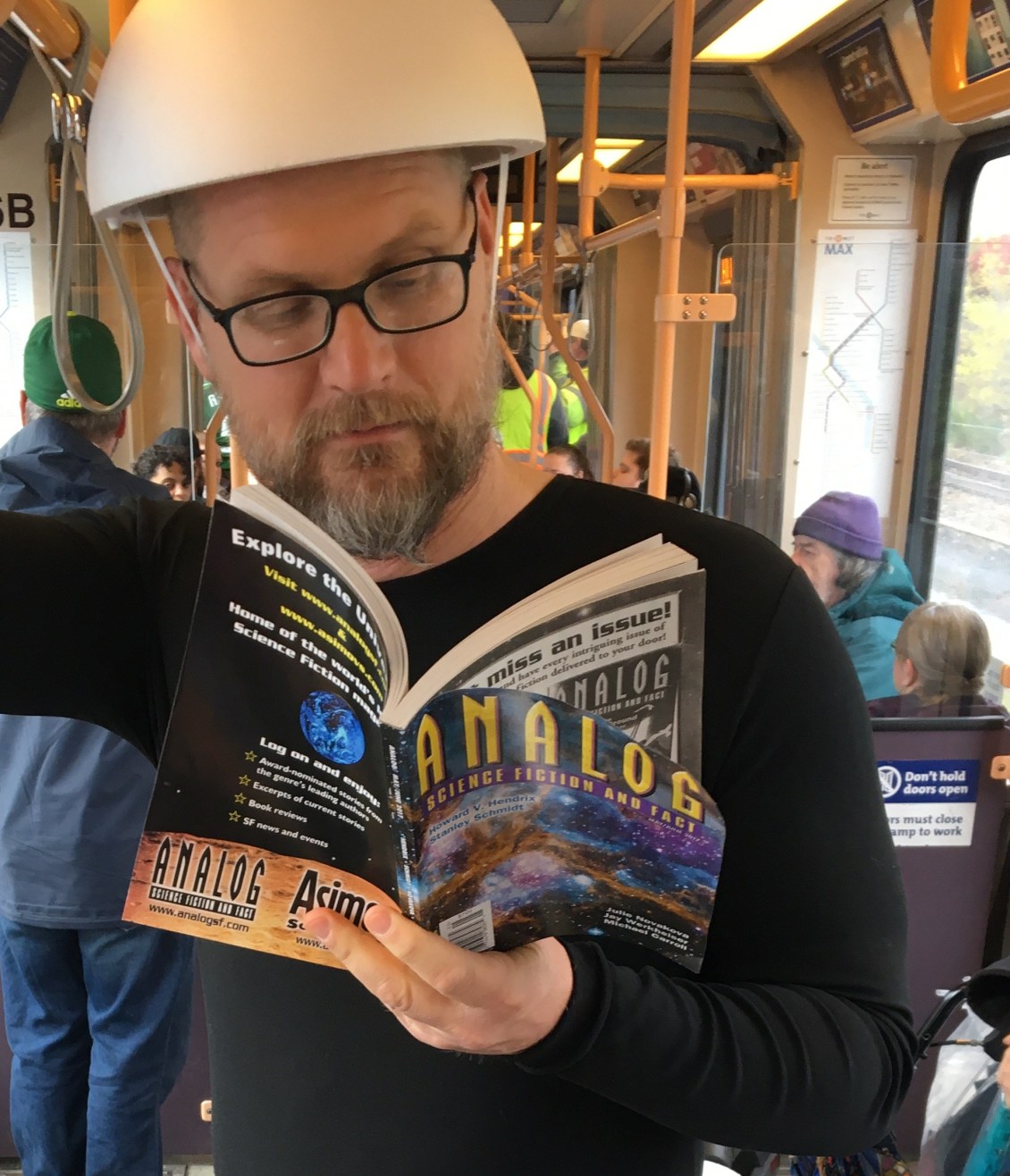
Analog on MAX

Photo credit Carlyn Eames

To get a promotional shot for the blog, my wife obligingly took a couple of pictures on our way to The March for Science this morning. I’m dressed as the most terrifying greenhouse gas on the planet, old silent-but-deadly methane. And given the name of my blog, I thought it best for her to take the photo on the MAX train, Portland’s closest analog to a true subway.


Analog on MAX2

It’s hard out here for a simple hydrocarbon. Photo credit Carlyn Eames

Analog can be purchased wherever fine science fiction magazines are sold, including at the 800-pound Amazonian gorilla.


Retiring Mr. Methane

17 Monday Apr 2017

Posted by Joe in Advertising, The Time of Troubles

≈ 2 Comments

Tags

marketing, profile photos, The March for Science

It is with mixed emotions that I retire my current profile photo for this blog: good old Mr. Methane:

methane

This is one of my favorite pictures of myself, taken by my wife on Halloween 2015. I thought I did a decent job making myself into a ball-and-stick model of the most frightening greenhouse gas on the planet. And the picture captures what I’ve always considered the essential ridiculousness of my writing enterprise.

But, I suppose if I want people to take my writing seriously, I might get more of the right kinds of attention if my profile pic doesn’t show a man in a black body suit and Styrofoam deedle balls.

And, I’ve been lucky to work with a truly talented photographer, Pat Rose, who took the most flattering photos of me I’ve ever encountered. The one I call “Smiley Joe” will go on the back cover of Stranger Bird when it comes out:

Joe Stranger Bird cover photo

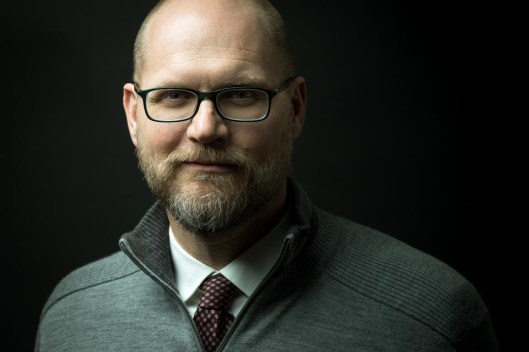
And for the blog itself, I’ll be using another of Pat’s fabulous shots, the one I don’t have a name for yet:

Joe web profile photo

I’m open to any names you want to suggest. “Oddly intense sci-fi man?” “Half-light Raconteur?” Really, he needs a name.

And old Mr. Methane? My wife had the genius idea that I should pull the old costume out for the March for Science. If I can wear a black bodysuit and stand up for civil society? What more could I want out of the weekend?

← Older posts
Newer posts →

Subscribe

  • Entries (RSS)
  • Comments (RSS)

Archives

  • February 2026
  • January 2026
  • November 2025
  • September 2025
  • August 2025
  • July 2025
  • May 2025
  • April 2025
  • March 2025
  • January 2025
  • December 2024
  • October 2024
  • September 2024
  • August 2024
  • June 2024
  • May 2024
  • April 2024
  • March 2024
  • February 2024
  • January 2024
  • December 2023
  • October 2023
  • August 2023
  • July 2023
  • June 2023
  • April 2023
  • March 2023
  • May 2022
  • August 2021
  • June 2021
  • January 2021
  • October 2020
  • May 2020
  • March 2020
  • February 2020
  • January 2020
  • July 2019
  • June 2019
  • December 2018
  • October 2018
  • July 2018
  • May 2018
  • April 2018
  • January 2018
  • December 2017
  • November 2017
  • September 2017
  • August 2017
  • July 2017
  • June 2017
  • May 2017
  • April 2017
  • March 2017
  • February 2017
  • January 2017
  • December 2016
  • November 2016
  • October 2016
  • August 2016
  • July 2016
  • June 2016
  • May 2016
  • March 2016
  • February 2016
  • January 2016
  • December 2015
  • November 2015
  • October 2015
  • July 2015
  • May 2015
  • March 2015
  • February 2015
  • January 2015
  • December 2014

Categories

  • A Place for my Stuff
  • Advertising
  • Artificial Intelligence
  • Beta Readers
  • Biology
  • Book reviews
  • Curious Fictions
  • Dungeons and Dragons
  • Exit Black
  • fantasy
  • Games
  • HPIC
  • Journeys
  • Let's All Admire That Fantastic Can
  • Lit News
  • Literary criticism
  • Musings and ponderation
  • My Fiction
  • Pacifica
  • Politics
  • Reading Roundup
  • Science
  • Science Fiction
  • Science Fiction Writers of America
  • SETI
  • Stories
  • Stranger Bird
  • The Ideal Vehicle
  • The Time of Troubles
  • Uncategorized
  • Utopia and Dystopia
  • Welcome
  • YA fantasy

Meta

  • Create account
  • Log in

Authors

  • Joe's avatar

Blog at WordPress.com.

  • Subscribe Subscribed
    • The Subway Test
    • Join 145 other subscribers
    • Already have a WordPress.com account? Log in now.
    • The Subway Test
    • Subscribe Subscribed
    • Sign up
    • Log in
    • Report this content
    • View site in Reader
    • Manage subscriptions
    • Collapse this bar
 

Loading Comments...