A long, long time ago, children, before everyone was self-publishing books on Amazon, before millions of people were writing fan fiction on their smart phones and publishing it to Wattpad, the bookstore chain Barnes & Noble represented (to certain lefty NPR-listening types, anyway) everything that was wrong with the publishing industry. Barnes & Noble stores were proliferating across the strip malls of America like massive commercial toadstools, and many people saw the local Barnes & Noble as a kind of Wal-Mart of books: a destroyer of independent bookstores and hometown loveliness. (If what I’m describing sounds like a plot point from the old 1998 rom-com You’ve Got Mail, that’s because the bookstore mega-chain in the movie was a not-so-subtle portrait of the real Barnes & Noble of the time.)
Fast forward 25 years, and Barnes & Noble seems more like the underdog now, trying to reinvent itself amidst the moribund shells of America’s hollowed-out malls, hustling to stay alive beneath the crushing shadow of Amazon. I was no lover of Barnes & Noble back in the You’ve Got Mail days, and I still try to buy all of my books at the many fine independent bookstores of Portland, but I have to admit that I have a soft spot for Barnes & Noble as it holds on for dear life.
I hope I’ll be seeing Exit Black at a whole lot of Portland spots–can I interest you, Broadway Books? How about you, Annie Bloom? But there is an unexpected thrill to seeing my name come up on the website of that once-maligned mall standby, good old Barnes & Noble. If I get a chance to do a reading or a signing at one, I’m going.
I’ve known for a long time that writing is a business. But knowing that writing is a business is no guarantee that one knows how the business works. There’s good circumstantial evidence that for the past 20+ years, I haven’t had the foggiest idea about what I’m doing.
Where my writing career is concerned, I’ve tried to follow Steve Martin’s exhortation to be “so good they can’t ignore you.” But what that quote elides is that it’s still up to the writer to give the audience a chance not to ignore you. I could be as good a writer as Emily Dickinson, but if I don’t know how to get people’s attention, my career could still end up like, well, Emily Dickinson’s.
I’m facing this challenge as I go out for a literary agent for my third novel, Pacifica. (I have an excellent agent, Scott Veltri, for TV and movie projects, which is the hope for my novel Exit Black. But Pacifica is not on the list of 10,000 books I would think of for a movie tie-in). As anyone who has ever gone out for an agent knows, a query letter is one of the writer’s few early opportunities to show their understanding of writing as a business. And one of the things I’ve only recently gotten a feel for is the importance of comps for the novel I’m trying to sell.
Comps–short for comparative titles–are a short list of recent books that are similar to the novel you’re selling. And there are apparently rules, or at least norms, regarding the art of good comps. Here are the ones I’ve picked up at conference panels, in writing guides, and intuition:
Pick no more than three books (though apparently one of the books can be a movie or tv program)
Pick recent, commercially successful works, but
Avoid comparing your work to that of literary A-listers (e.g. no Annie Proulxes or Cormac McCarthys)
Are these the rules? If I knew, more people would probably be reading my writing. If you have better intel on how comps work, please jump in the comments or feel free to DM me! I can tell you what wasn’t working for me, though:
Not offering a list of comps in my query letter
Comparing my work to Ursula K. Le Guin’s (though I don’t think I’m wrong! Read Stranger Bird yourself and you be the judge)
Dissing other writers’ work (at the time I was lathered up about what I called the Harry Potter Industrial Complex)
None of these remarks got me an agent, and I suspect now that that was because my approach showed that I didn’t understand how the publishing business works. Agents and publishers want to know comps for a simple reason: they want to know what has already sold well that is similar to the book you are selling. It doesn’t matter if your book is the most exquisitely constructed exploration of the human heart since Anna Karenina–an agent wants to know if your novel will sell.
Is that a mercenary attitude? Maybe. Is it a rule that you must have comps? Absolutely not. But there’s also no rule that says I have to wear pants to a job interview. If I want to wear jorts to my next job interview, that’s my right as an American. However, wearing jorts to an interview will foreclose on just about every job offer outside of a very small set of jorts-positive jobs, many for which a 53 year-old man wouldn’t be an attractive candidate anyway.
My last unsuccessful job interview. Photo credit Carlyn Eames
So, what am I pitching as my comps for Pacifica? My three are Gabrielle Zevin’s Tomorrow, and Tomorrow, and Tomorrow; Anthony Doerr’s Cloud Cuckoo Land, and Russell Brand’s The Magic Kingdom–three very different books (and one of them I wasn’t even crazy about). But they’re three recent, commercially successful books, each with a passing resemblance to my book about a guy who has a religious vision playing video games which spurs him to found several increasingly ridiculous, polyamorous intentional communities. I guess that’s not exactly a concept which sells itself. Hopefully the comps will help me market it.
I just got the news that my short story “Nomenclator of the Revolution” will be appearing in the excellent Boston Review‘s online magazine on Friday, August 18!
“Nomenclator” had a mystical journey getting to publication. I drafted it soon after the 2016 U.S. presidential election as a way of exorcising some of the troubles bedeviling me (no reason!) in those days. As is often the case when I’m having a tough time of things, I tried to write something funny–I will leave it to others to judge whether I succeeded. Generous readers might get a whiff of George Saunders’s work (or Donald Barthelme’s or Italo Calvino’s) in what I wrote.
I suppose it’s just as timely a story today, while the National Grifter is threatening the Republic yet again, even as he tries to outrun two three criminal indictments.
I’m also proud of this little story: it’s being published by one of the country’s most prestigious magazines after having been rejected by more than a few less highbrow publications. That’s one more reason for me to wonder whether I could improve the way I market my work. That’s a post for another time, though (the short answer being that I have been historically inept at marketing my work).
“Nomenclator” is the only short story I’m likely to publish this year, since I have been spending so much of my writing time on my novels Exit Black and Pacifica–so check out “Nomenclator of the Revolution” when it drops!
I decided to go in for a new head shot recently. It’s been over six years since my most recent head shots, and not only have I gotten more wizened over that time, but I also have a new book coming out in the next few months.
As with my last photos, my new head shot is he work of the incomparable Pat Rose. You can check out her amazing work here: she’s an institution of Portland portraiture. Having my photo taken by her feels a lot like I imagine sitting for a painted portrait would feel, and at the end of it all she produces an image that is wonderful and painterly as though Jan Van Eyck had painted me.
So, in honor of the coming Exit Black (and of my advancing age), I give you “Portrait of Joe Pitkin, aged 52”. . .
I experienced a weird constellation of three events last week. First, my editor, my agent, and I hashed out the jacket copy for my upcoming novel, Exit Black. It was weird to realize that I was basically helping write ad copy for a book that I labored over for two years. Second, I sent out a query to a literary agent for the book I drafted after Exit Black, called Pacifica. (My current excellent and extant agent, Scott, works on film and TV projects, and Pacifica definitely isn’t movie material, so I am looking for a bookish agent as well).
And third, I was driving down Broadway in Portland when I saw this bumper sticker ahead of me:
Millennials and Zoomers–and their parents who might have watched Spongebob Squarepants with them twenty years ago–will recognize this as Squidward Tentacles’ self portrait, “Bold and Brash.” I was happily shocked to see it on a bumper sticker. And I realized when I saw it that this publication process I am experiencing with my books is drawing up all of my deeply Squidwardian impulses: my vanity, my hunger for approval, my inner conflict about how art intersects with commerce. Squidward, c’est moi.
If you need a blast from the past, or you somehow never saw the original, here is a clip of me Squidward from the episode “Artist Unknown:”
I’m happy to announce that the great science fiction magazine Analog has picked up my story “Potosí” for publication. “Potosí” will be the fifth story I’ve had appear in Analog, and by far the longest story (nearly 10,000 words) I’ve ever placed in a professional market.
As I wrote elsewhere, “Potosí” is set in a near future where corporations and countries squabble over the solar system’s vast mineral rights. It’s also a meditation on white supremacy and terrorism, an attempt to explain today’s world in new and striking clothes–much the same way that Star Trek explains the Cold War and Forbidden Planet explores World War II survivors’ guilt.
It’s been a good (and busy) week for my writerly life. One of my recent stories (another Analog pick-up called “Proteus”) is getting some very nice attention, and my quest to publish my first young adult fantasy novel, Stranger Bird, continues apace. I’m hoping for a publication date of November 3–keep watching the transom for that.
There’s also much more that I want to share here on The Subway Test, and I’m sure I’ll have some longer musings and ponderations here soon, but for now I’m pretty busy just keeping on top of my sci fi and fantasy writing.
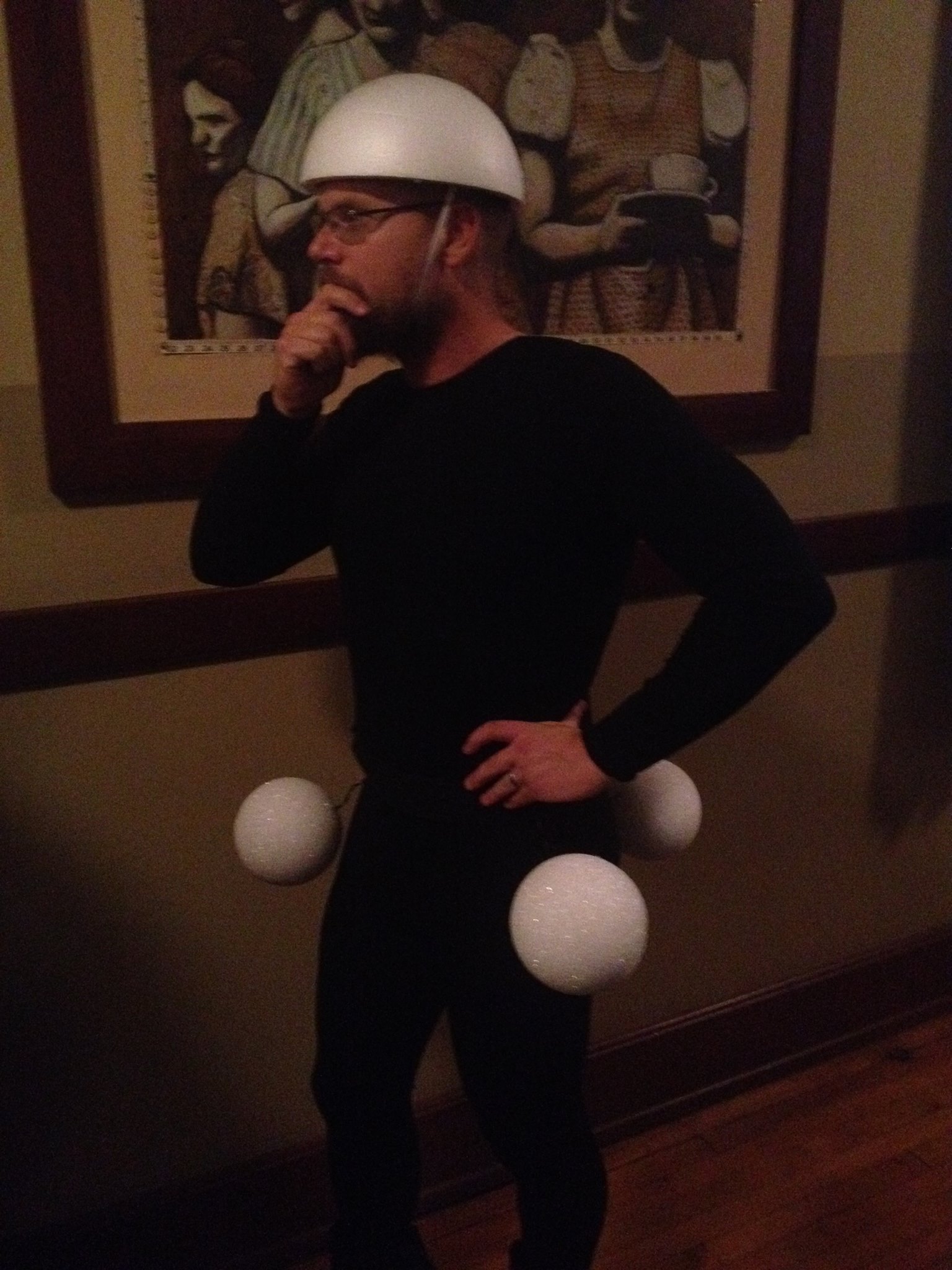
It is with mixed emotions that I retire my current profile photo for this blog: good old Mr. Methane:
This is one of my favorite pictures of myself, taken by my wife on Halloween 2015. I thought I did a decent job making myself into a ball-and-stick model of the most frightening greenhouse gas on the planet. And the picture captures what I’ve always considered the essential ridiculousness of my writing enterprise.
But, I suppose if I want people to take my writing seriously, I might get more of the right kinds of attention if my profile pic doesn’t show a man in a black body suit and Styrofoam deedle balls.
And, I’ve been lucky to work with a truly talented photographer, Pat Rose, who took the most flattering photos of me I’ve ever encountered. The one I call “Smiley Joe” will go on the back cover of Stranger Bird when it comes out:
And for the blog itself, I’ll be using another of Pat’s fabulous shots, the one I don’t have a name for yet:
I’m open to any names you want to suggest. “Oddly intense sci-fi man?” “Half-light Raconteur?” Really, he needs a name.
And old Mr. Methane? My wife had the genius idea that I should pull the old costume out for the March for Science. If I can wear a black bodysuit and stand up for civil society? What more could I want out of the weekend?
I’ve seen the Ford Company’s Super Bowl commercial a few times now–Google has determined that I’m part of Ford’s target demographic when I choose a Philip Glass or Gerald Finzi piece to listen to on YouTube. There’s a shout-out here to electric cars, to new car-sharing economic models, to bike sharing, and to self-driving vehicles–all trends that Ford seems to be trying to get out in front of. And it all plays out over Nina Simone’s “I Wish I Knew How It Would Feel to be Free,” one of the most beautiful and spiritual songs in American popular music. I have to say it’s a remarkable ad, even though Google doesn’t seem to know how much I dislike driving and how unlikely it is I’ll ever buy a new car as long as I live:
Or maybe that’s the point. Ford seems to be selling its brand here to people that don’t consider themselves drivers, or at least not typical drivers. It’s too early yet for me to say whether this particular piece of corporate propaganda is simple greenwashing–think British Petroleum’s laughable “Beyond Petroleum” campaign that aired in the months before the ecological crime they perpetrated with the Deepwater Horizon spill. Is it possible that Ford is really positioning itself as part of the solution to climate change, energy scarcity, air pollution, traffic gridlock–that is, all the problems that Ford hath wrought over the last 100 years?
It’s not impossible to imagine Ford remaking itself for a new transportational reality. Electric cars and self-driving cars are still cars, and Ford seems better-positioned to create them, if they want to, than many other companies trying to enter those markets. It’s a little harder for me to see how car-sharing and bike-sharing fit with the business model of Ford or any extant motor company: the whole idea behind vehicle sharing is that fewer people overall will buy cars. But I suppose there are smart people in Detroit trying to see how they could monetize car sharing in a way that beats out Uber and Lyft–perhaps the Ford of the future will be a massive car (and bike?) owner, a kind of Netflix of vehicles, renting out cars to drivers at a price that makes car ownership seem silly.
A corporation, whether Ford or BP, is an amoral kind of organism designed to do nothing more than maximize value for shareholders, in the same way that an amoeba is designed to eat rotting organic material until it’s big enough to split, amorally, into two amoebas. I wouldn’t call Ford’s move in these new greener directions a sign of Ford’s goodness, any more than BP’s greenwashing was a sign of corporate evil. Both corporations are just trying to make money for shareholders, and Ford is better positioned to handle the changes coming its way than British Petroleum has been. Solar power and wind power are entirely different industries than petroleum extraction; BP is no better positioned to enter the solar power market than Nike or Coca-Cola are.
And to be sure, Ford hasn’t transformed itself–the ad seems more aspiration than reportage. The ad slips in a decent amount of legerdemain, as when this supposedly green, forward looking new company cuts to a shot of the GT tearing along the freeway with all the subtlety of Chester Lampwick’s rocket car from The Simpsons.But the ad has beguiled my attention in spite of, or perhaps because of, my distaste for the driving experience. If a car company can do that, it’s a pretty neat trick.