It feels good to have cooked up a reader’s draft of a short story during my spring writer’s retreat in Corvallis, Oregon earlier this week. Even better is that this new story, “Arden Is a New World,” takes place in the John Demetrius story cycle that I have been toying with for many years–I had worried for a while that I had run out of gas on the John Demetrius concept.
Knowing me, I’m a few months and a couple of peer critiques away from sending the story anywhere, but it feels wonderful to be building up a roster of publishable stories again. I worked so long and hard on novels–first Pacifica, then Exit Black, then Pacifica again–that I’m surprised by that short fiction feeling, the sense of being able to get one’s head around an entire narrative in a single sitting. I’ve missed short stories, and it’s good to be back.
That was my publisher’s note to me when we learned that Exit Black cracked the top ten best sci fi audiobooks in 2024 at Discover Sci-Fi. I’m super stoked: while I would have loved for Exit Black to take the #1 spot, of course, there’s no shame losing out to the likes of Adrian Tchaikovsky narrating his own book and Jeff VanderMeer having his work read by Bronson Pinchot. Carolina Hoyos is a hell of a reader, and I was very lucky to have gotten to work with her.
I loved every step of this project with Blackstone Publishing, and to make my Captain Obvious Statement of the Day: Blackstone knows audiobooks. Thanks so much to all of you who voted and all of you who listened. And, if you haven’t listened yet, if you ever feel a hankering for a tale about a bunch of techbros getting their comeuppance, Exit Black couldn’t be more timely.
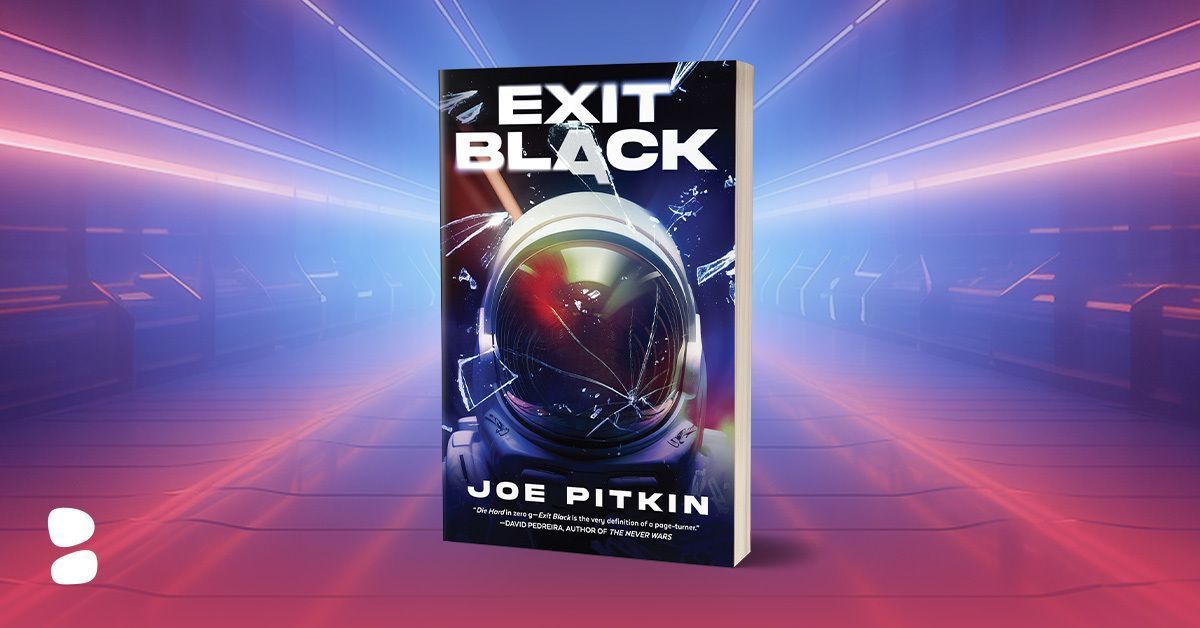
I am excited to learn that Exit Black has been nominated for Discover Sci-Fi’s Best Sci-Fi Books of 2024! Exit Black is a nominee in the Best Sci-Fi Audiobook category, a testament to Carolina Hoyos’ tense, too-cool-for-school reading of my work, as well as to Blackstone Publishing’s amazing audiobook chops. If you heard Carolina read my book, or if you are an Exit Black supporter, I’d be honored to have your vote.
I’ve had my head deep in a novel project this summer–my beloved white whale (or white elephant?) Pacifica–and so I’ve been away for a few weeks from this blog, as well as my garden, and hiking, and sometimes even meaningful human contact.
But! I love hearing from people about my latest novel, Exit Black, which came out in February. This screenshot, from my friend Bill in New York, is one of my favorites:
Yes, Exit Black is on the shelves in the New York Public Library!
For lots of reasons probably having to do with talent, I’m not the kind of writer who is ever going to win a Nebula or a Hugo, much less a PEN award or a Pulitzer. But someday I can tell my grandkids that their grandfather once had a book on the shelf of the New York Public Library. And, grandkids being grandkids, and the future being the future, there’s a good chance they will ask “what’s a library?” or, God forbid, “what’s a book?” Sic transit gloria mundi.
I was invited recently to present a workshop at one of Oregon’s wonderful creative writing conferences–the Compose Creative Writing Conference at Clackamas Community College (perhaps the hosts tried to come up with a seventh word starting with c- for the title, but six must have been all they could fit in). After the honor of being invited wore off, I realized that I would have to actually, you know, present something at the CCWC at CCC.
I decided to present a session on reducing infodump in speculative fiction. Did I choose this topic because I’ve been widely praised for my taut, sleek stories? I wish. Actually, if anything the opposite is true: during the early years of my fiction career, I got so many rejections along the lines of “this story is well-written, but it takes forever to get to its point. There’s so much infodump here that I was barely able to get to page 8.”
The best thing I can say about infodump in my writing is that editors don’t complain about it in my stories nearly as often now. So I figure that I’ve either learned to deal with it or editors are just tired of giving me notes on it.
As you probably know already, infodump refers to bogging down the flow of a story with tedious explanation. And, while writers of any genre can fall into the habit, it’s an especially common problem in speculative fiction. If you’ve ever read a bad fantasy novel (or watched a bad sci fi movie), you have surely seen some infodump along these lines:
Scientist: I sequenced the DNA sample you brought me. Whoever provided it has some snips that I’ve never seen in a human genome before.
Captain: Snips?
Scientist: ‘Single nucleotide polymorphisms.’ As you know, captain, all sexually reproducing creatures on Earth–including humans–inherit two copies of each gene, one from the mother, and one from the father. These genes determine everything from eye color to explainexplainexplain continue explaining for four pages explainexplainexplain I hope you did well in middle school biology…
For me, infodump is even worse in fantasy than in science fiction. In SF, there’s at least the possibility that what’s being infodumped actually will teach you something real about how planetary motion works or what the principle of competitive exclusion is. In fantasy, the infodump often amounts to nothing more than 20 pages of the author’s fever-dream journal entries about a fictional queen who lived 800 years before the story takes place and what she did to curse the elven sword that is the McGuffin for this whole heptalogy of novels…
What causes infodump? Why should you be wary of the phrase “as you know” in your writing? And how do you reduce infodump in your novel? Well, if you want the whole story, come see me at the CCWC on Saturday the 18th! Or, if you’re not a Portland person, drop me a line: I’m always happy to talk F/SF with book clubs, writing groups, bookish nerds, random drunks, and people on a secret mission.
For now, I’ll just say that two factors that contribute to infodump are 1. writers’ mistrust of the reader’s ability to follow along, and 2. writers who get lost for hours (or months, or decades) in worldbuilding before they ever get around to actually writing their story.
I may say more on the subject soon, but as you know, I have been working on reducing my infodump.
I’ve been hunting for years for a better book recommendation system than Goodreads (and its corporate owner, Amazon). One site that I think really shows promise is Shepherd: it’s better-curated, less compromised, more values-driven. And I’m honored to announce that I have been invited to make a Shepherd recommendation myself. Mine is called “The best fantasy-science fiction books that explore class and inequality,” and I’d love to have people take a look at it.
I’m grateful to have a website taking on the Goodreads/Amazon juggernaut. Goodreads is one of those ideas that struck me as having so much promise when it came out: it seemed (at first, anyway) a place where everyone could share ideas about the books they love. But, far from being a democracy of bibliophiles, Goodreads is a crass book marketing system that has proven easy to game and to abuse, from review bombing to pay-for-reviews to careless and anonymous one-star reviews just for the lulz.
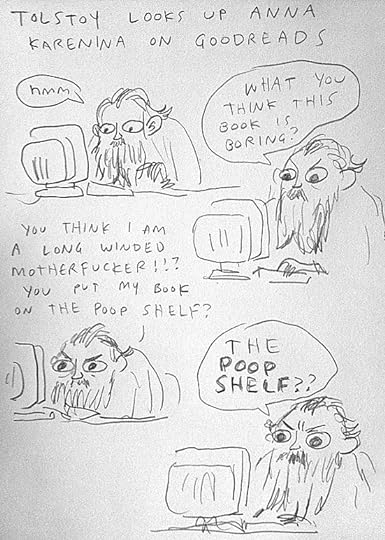
And, while my Goodreads reviews for Exit Black have been decent–more good reviews than bad, and a number of reviews from people who must have actually read the book–I am a little suspicious of a review site where The Martian has a higher rating than Madame Bovary and where only 42% of Anna Karenina reviewers gave that book 5 stars. Seriously?
Cartoon credit: Kate Beaton, Hark! A Vagrant
I accept that for better and worse, Goodreads and Amazon are the ways that authors have to market their books. I don’t have to like that state of affairs, but I do accept it. However, I’m always on the lookout for something better, something more humane, something not yet made grubby by millions of people on the make for a quick buck or trash-talking for the dopamine hit of a bunch of likes. Shepherd might not last. But for now, I really like the way they approach books and the people who write and read them. I hope you’ll go check it out!
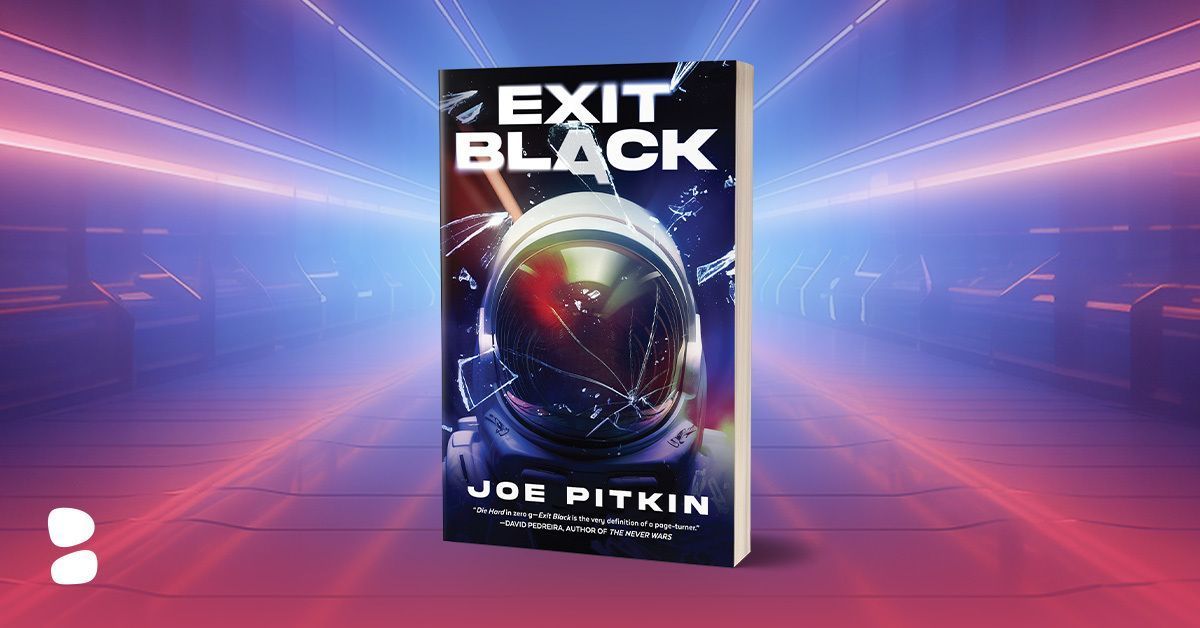
It’s publication day for my latest novel, Exit Black, and I was happy to see that the excellent and tireless arts and entertainment journalist Paul Semel chose today to publish our exclusive interview about the book. You can read the interview here: check it out to see why space tourism is the perfect metaphor for economic inequality, as well as who I would cast in an Exit Black movie! I’m still a little tickled that Paul calls it an “exclusive interview”–I mean, it is an exclusive interview, but he makes it sound like I’ve been playing hard to get all these years.
I self-published my first novel, Stranger Bird. That was an experience that I will always treasure: the feeling of putting a book together with a tiny group of friends and family, mostly newbies, doing our own copy editing and picking typefaces and buying ISBNs and learning how expensive it is to publish a book. I imagine the feeling is analogous to playing in an independent-label band, driving around the country in a van and playing a hundred bars and grange halls. And I know that even now, with a traditional publisher putting my book out, I am still a tiny fish in the big publishing ocean–I’m not the kind of writer who is ever going to win a Hugo (good thing, maybe, considering the latest scandal) or be on Reese’s book club list. But, even though I am most definitely small potatoes, I’m still a potato. And it is a sweet and oddly disorienting experience to have a team of people from a publishing house supporting your book. I couldn’t be happier with Blackstone, and I will have a good word for the folks there for as long as I live. Thanks to them, I am orbiting your reading list.
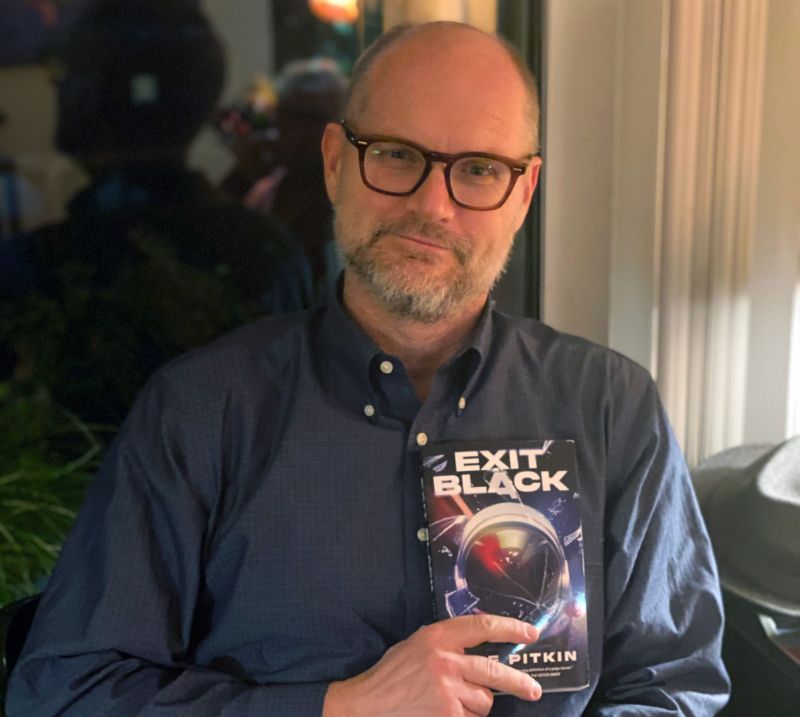
I’ll admit it: when I learned that my newest novel, Exit Black, was going to be published in trade paperback, rather than hardback, I was a little crestfallen. I grew up having inherited a whole raft of English major-y prejudices about what kinds of books are good and what kinds are trash. And, literally to judge a book by its cover, hardback books were the best kind of books.
I’ve written about this a little in Pacifica, which is in some ways a love letter to books, in my description of the semi-mythical Book Room:
Among good students at Sterne College, and even among lackluster ones, the Book Room was legendary. No acquaintance of Jude’s had ever reported having seen this inner sanctum of the library, where the leather-bound volumes of some donor’s bequest were shelved, not by Dewey Decimal or Library of Congress, but (according to college folklore) in the manner that had been used by Hypatia and Eratosthenes in Alexandria.
For better or worse, my real novels wouldn’t find shelf space in the Book Room. But, on getting the news from my publisher about Exit Black‘s being relegated to trade paperback status, I did at least feel like it was the right occasion to pull up an excellent old Beatles song, and one of my favorite Paul McCartney bass lines of all time:
So, dear Sir, Madam, or Mixter, will you read my book? It took me years to write; will you take a look?
Not long after I published my first novel, Stranger Bird, I mused on this blog about how many people might one day read my book. I realized quickly that it would always be tough for me to know, since the number of people who have Stranger Bird on their shelves will always be higher than the number who actually read it. Exhibit A for this argument is my own TBR pile, which has 34 books in it, most of them better than Stranger Bird, and many of which I will probably never get to, TBR piles being what they are in my life.
Here is the dream I had for Stranger Bird back then: I hoped that the book would one day have 100 readers.That excellent book has something like 16 reviews on Amazon right now, so my guess is that 100 readers is a decent ball park estimate for how many people have read, or will read, Stranger Bird.
Why am I bringing this up now, six years later? Because my new novel Exit Black, is traditionally published, with an actual marketing and promotion team working on it, with actual advanced reader copies and early reviews. I want to hope that a lot more people will read this new book. But what is a realistic hope? 10,000 readers? 100,000?
That seems like a lot of readers for an obscure science fiction writer who mostly works as a community college English instructor. For now, let me amplify my dreams by a single, ambitious order of magnitude: I hope that 1000 people will read, and love, Exit Black. I’ll never know how many will actually read it, but if Blackstone sells that many copies, or somewhat more than that, I will nurse the belief that a thousand people will read Exit Black.
I’d love for my number of readers to increase by an order of magnitude with each new book: 10,000 readers for Pacifica when it comes out, 100,000 for unnamed novel #4. At that rate, the entire population of Earth will be reading my ninth novel when I publish it, and then I can die knowing that I was the Colleen Hoover of my generation.
(I suppose that Colleen Hoover herself is the Colleen Hoover of my generation, but whatever).
Anyway, I’m sure that the Earth’s ecosystems have some carrying capacity for readers of Joe Pitkin books and that the population will level out at some limit long before I reach ten billion readers. I don’t have to worry about that right now. Right now, I’m hustling to get a thousand.







 The Subway Test