It’s publication day for my latest novel, Exit Black, and I was happy to see that the excellent and tireless arts and entertainment journalist Paul Semel chose today to publish our exclusive interview about the book. You can read the interview here: check it out to see why space tourism is the perfect metaphor for economic inequality, as well as who I would cast in an Exit Black movie! I’m still a little tickled that Paul calls it an “exclusive interview”–I mean, it is an exclusive interview, but he makes it sound like I’ve been playing hard to get all these years.
I’ll admit it: when I learned that my newest novel, Exit Black, was going to be published in trade paperback, rather than hardback, I was a little crestfallen. I grew up having inherited a whole raft of English major-y prejudices about what kinds of books are good and what kinds are trash. And, literally to judge a book by its cover, hardback books were the best kind of books.
I’ve written about this a little in Pacifica, which is in some ways a love letter to books, in my description of the semi-mythical Book Room:
Among good students at Sterne College, and even among lackluster ones, the Book Room was legendary. No acquaintance of Jude’s had ever reported having seen this inner sanctum of the library, where the leather-bound volumes of some donor’s bequest were shelved, not by Dewey Decimal or Library of Congress, but (according to college folklore) in the manner that had been used by Hypatia and Eratosthenes in Alexandria.
For better or worse, my real novels wouldn’t find shelf space in the Book Room. But, on getting the news from my publisher about Exit Black‘s being relegated to trade paperback status, I did at least feel like it was the right occasion to pull up an excellent old Beatles song, and one of my favorite Paul McCartney bass lines of all time:
So, dear Sir, Madam, or Mixter, will you read my book? It took me years to write; will you take a look?
Not long after I published my first novel, Stranger Bird, I mused on this blog about how many people might one day read my book. I realized quickly that it would always be tough for me to know, since the number of people who have Stranger Bird on their shelves will always be higher than the number who actually read it. Exhibit A for this argument is my own TBR pile, which has 34 books in it, most of them better than Stranger Bird, and many of which I will probably never get to, TBR piles being what they are in my life.
Here is the dream I had for Stranger Bird back then: I hoped that the book would one day have 100 readers.That excellent book has something like 16 reviews on Amazon right now, so my guess is that 100 readers is a decent ball park estimate for how many people have read, or will read, Stranger Bird.
Why am I bringing this up now, six years later? Because my new novel Exit Black, is traditionally published, with an actual marketing and promotion team working on it, with actual advanced reader copies and early reviews. I want to hope that a lot more people will read this new book. But what is a realistic hope? 10,000 readers? 100,000?
That seems like a lot of readers for an obscure science fiction writer who mostly works as a community college English instructor. For now, let me amplify my dreams by a single, ambitious order of magnitude: I hope that 1000 people will read, and love, Exit Black. I’ll never know how many will actually read it, but if Blackstone sells that many copies, or somewhat more than that, I will nurse the belief that a thousand people will read Exit Black.
I’d love for my number of readers to increase by an order of magnitude with each new book: 10,000 readers for Pacifica when it comes out, 100,000 for unnamed novel #4. At that rate, the entire population of Earth will be reading my ninth novel when I publish it, and then I can die knowing that I was the Colleen Hoover of my generation.
(I suppose that Colleen Hoover herself is the Colleen Hoover of my generation, but whatever).
Anyway, I’m sure that the Earth’s ecosystems have some carrying capacity for readers of Joe Pitkin books and that the population will level out at some limit long before I reach ten billion readers. I don’t have to worry about that right now. Right now, I’m hustling to get a thousand.
Outside of the summertime, I rarely get decent stretches of time to write. During the school year, I feel lucky when I can squeeze in 20 minutes to write at the beginning of the day. For me, that kind of time is maybe enough to work on revisions, especially of short pieces, but I’ve had no luck writing novels in those tiny dribs and drabs.
A couple of years ago, after my bitching about that state of affairs for the 6,813th time, my wife wisely proposed that I take a few writing retreats throughout the year–little two-day stints where I can write for hours at a time.
Right after new year’s day, I had my first retreat of the year: over two days, I wrote in a swath across the central Willamette Valley–Corvallis, Monmouth, Salem. I knocked out about 4,000 words of a short story I have been working on and allowed myself to feel, briefly, like writing is the main thing I do.
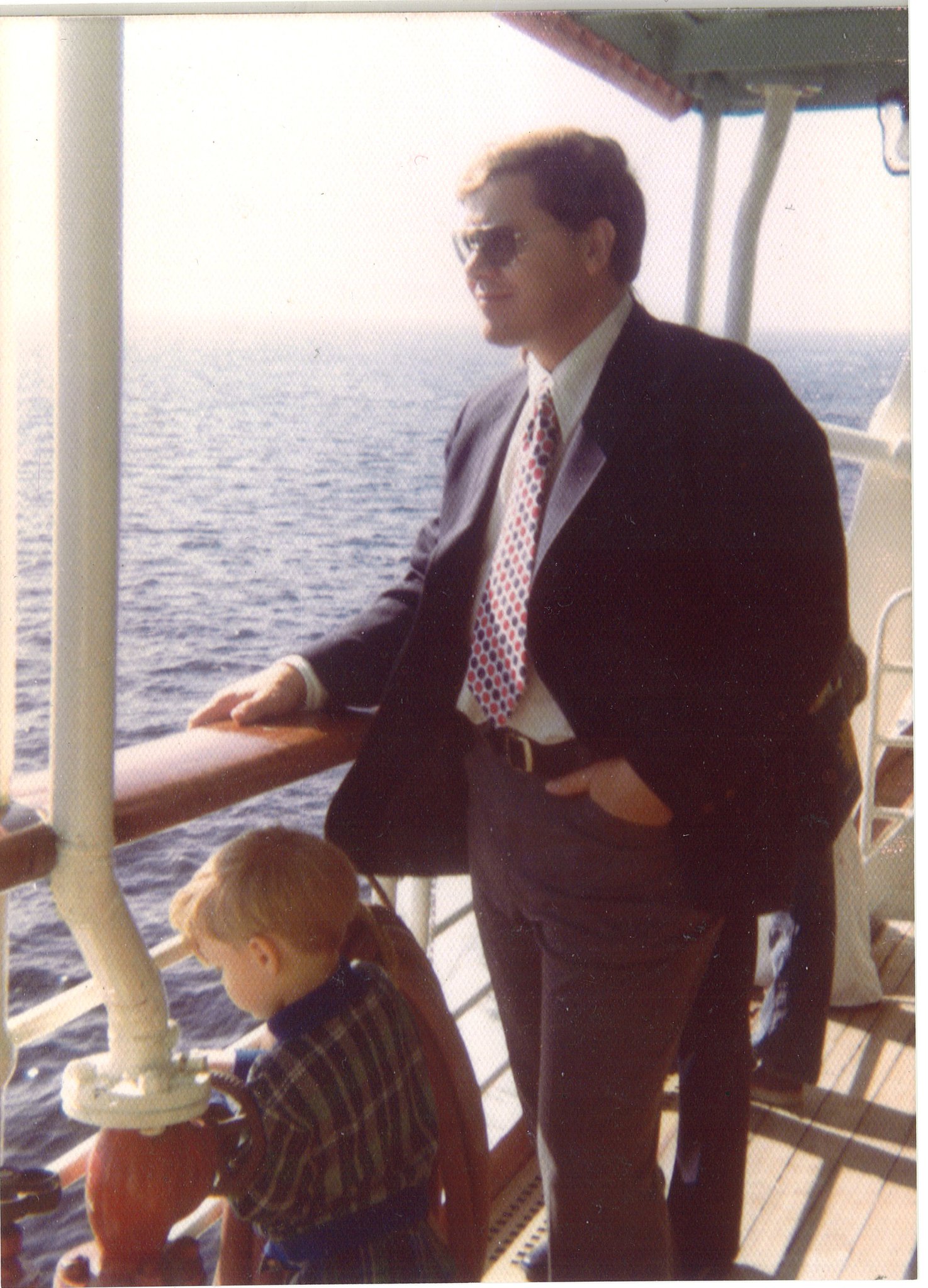
I spent a good part of the retreat in the Hamersly Library of Western Oregon University. I hadn’t been to Monmouth since I was a little fellow, when my dad taught English at Western Oregon (back when the place was still called the Oregon College of Education). Classes hadn’t started at WOU yet, so I was able to walk around this campus which I would have been too young to remember, listening for my dad’s ghost lingering around the older buildings.
Portrait of the author with his father, ca. 1972
No librarians challenged me when I walked in to the Hamersly (why would they? Librarians are the most welcoming bureaucrats on Earth), and I was able to find the perfect nook to write in. It’s worth giving thanks for libraries: like the DNA of our culture, libraries are both the metaphor for the entire human enterprise as well as the literal encoder of that enterprise. The Hamersly wasn’t built until 2000, long after my dad stopped teaching in Monmouth, but I may as well have seen my dad’s shade there, walking among the stacks. I was reminded of one of my favorite poems from Philip Larkin, my favorite librarian poet:
New eyes each year Find old books here, And new books, too, Old eyes renew; So youth and age Like ink and page In this house join, Minting new coin.
I write in coffee shops. It’s easier for me to stay focused, to keep to the writing plan, when I see other people tapping away on their laptops around me. The imagine the experience is not so different from that of medieval monks in a scriptorium, their pens all scratching away as they copy illuminated manuscripts. I’ll invite you to imagine the many, many other ways I would have made a terrible monk. In this one way, however–my need for the silent company of other writers–I would have thrived.
So it was a drag to learn a few days ago that my current writing haunt, Lolo Pass in Portland, is closing any day now, to be converted into a residential drug treatment center. I don’t want to be all NIMBY about it: Portland needs residential drug treatment centers right now way more than it needs another trendy bar/coffee shop/hostel. But Lolo Pass was my trendy bar/coffee shop/hostel–I wrote so many words in that place that it was the obvious choice for me to hold a launch party for Exit Black.
There will be other places to write, just as I’m sure I will figure out a place for the Exit Black launch party. But for now, I’m just sad to lose a place where I spent so many writerly hours. I hope a whole lot of Portlanders get clean in this space.
Goodbye, Lolo Pass. Note the author’s laptop behind the monstera leaves.
When I was writing it, one of the ideas that guided my upcoming novel Exit Black was that it was to be “Die Hard in space.” Those may have been the exact words that my publisher and my agent used when describing the project to me.
They couldn’t have known when they pitched the project to me that I was not a fan of Die Hard. Practically every one who was a young man in 1988 America loved Die Hard. How could I have hated the most iconic action movie of all time?
The answer to that is mysterious to me. One might think that because of my Quaker religious practice, I blanched at all of the violence in Die Hard. And maybe I did somewhat. However, there are a lot of violent movies that I love–some of them (like Fargo) are arguably more violent than Die Hard. And I loved most of the people in Die Hard--Bruce Willis was really doing something new in action movies with his portrayal of a sometimes panicked, self-doubting John McClane.
I think if I had to pin down my early dislike of Die Hard, it was the studio’s use of Beethoven’s 9th Symphony in the trailers for the movie. That piece of music was a touchstone for me even in my youth–I hated the studio’s use of a sacred cultural treasure (one whose main theme is of peace and universal brotherhood, no less) to sell an action movie about killing a bunch of common thieves (spoiler–sorry). I only watched A Clockwork Orange once in my life because of the same cognitive dissonance around Beethoven’s 9th.
But I was excited to work on a project with my agent and with this publisher, and when they proposed Die Hard in Space I thought I’d better give the movie another look. On watching it again, I was still turned off by the celebration of violence, and there were a number of other elements that I had forgotten but which haven’t aged very well over the last 35 years. But I also saw something there that I hadn’t noticed the first time.
I saw the antagonist, Hans Gruber, with new eyes. He was cool, self-possessed, brilliant but not a blowhard the way a James Bond villain would be. Of course, it was also impossible on this later viewing not to see the arc of Alan Rickman’s career stretching off before him as he glowered like a panther, snarling in Hans Gruber’s faux German.
While I didn’t come to like Die Hard on this second viewing, I was entranced by Hans Gruber. I wanted to write a cool villain like that. I wanted to make a character who readers would hate but who also they would find fascinating, perversely compelling. I wondered if I could build a novel around an antagonist like Gruber, perhaps even someone who would be more antihero than antagonist, like the character of Satan in Paradise Lost.
And that was how I decided to take on the Exit Black project. While even now the book is being marketed as a kind of Die Hard in space, I often tell people I tried to write something more like a Coen Brothers remake of Die Hard: a story with all the ironies and regrettable choices of a Greek tragedy, focusing on a noble, hubristic, ruthless, chillingly violent antihero at the center of the story. Exit Black is a space age remix of the old movie, a kind of Die Hard: The Hans Gruber Story.
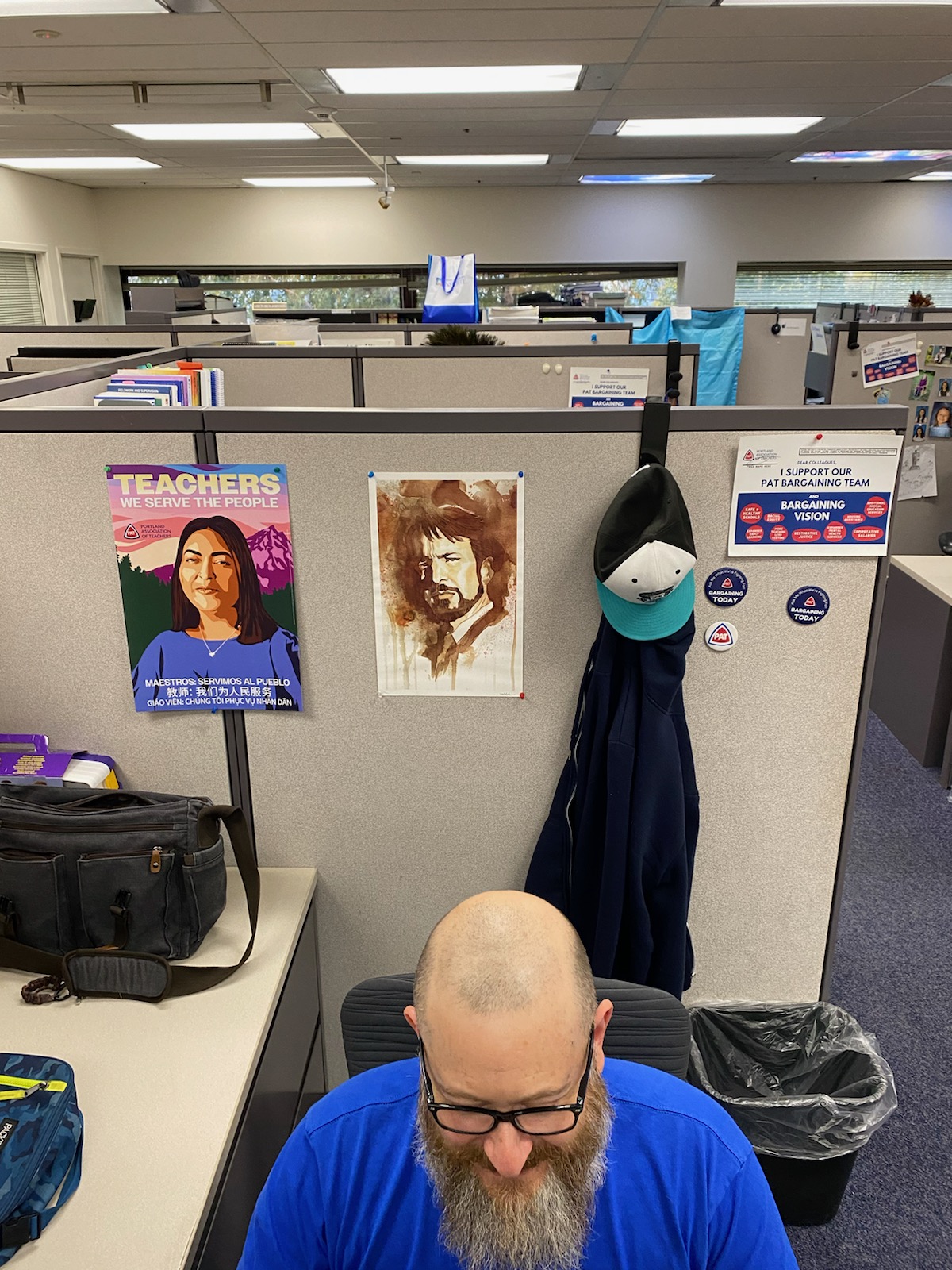
I hope the book will appeal to all of those perpetual teenagers typing away with a portrait of Hans Gruber stuck to their cubicle walls:
D&D friend, fellow unionist, and cubicleman Mike Carlip with portrait of Hans Gruber. Photo credit Carlyn Eames.
I once had dreams of writing witty, engaging content for this blog once per week. I guess I still nurse that fond hope. But obviously something about my strategy hasn’t been working so far: I believe this is only my fourteenth post this year.
The main reason for the slowdown is what it’s always been: my job. Teaching has been in many ways a wonderful career; in other ways, it has seemed like a wish I made on the monkey’s paw: I loved reading and writing, and so I thought that becoming an English major was a natural fit. And what better job for an English major than teaching community college English?
Little did I know when I was a 23 year-old teaching assistant that there would be weeks upon weeks of my job, year after year, where I would do nothing but read or write–and that none of that reading and writing would be for pleasure. I’ve probably read 20,000 student essays by this point in my career: many were thoughtfully written, and most were at least earnestly written, but not one of them was something I would have picked off of a newsstand shelf for fun. (Nor, to be fair, would my students have written any of them for fun). And every one of those essays, even the most slapped-together, carelessly constructed rush jobs, demanded that I write something real in response. By the time I get home most days, I barely have the mental energy to read the directions on a microwave burrito, much less read a novel, much less write one.
And yet, I can’t bring myself to quit teaching. I love community college students: I love their grit, their humor, their intellect, their disarming mix of cluelessness and commitment. I love seeing students ten or fifteen years later and hearing their excitement when they tell me that they still remember how to use commas around an appositive or that they never again started a conclusion with the words “in conclusion.” Often they remember things that I barely remember saying or things that aren’t really that important in the full analysis of what makes good writing. But some of what they remember is a kind of totem to them, and years later, they are better writers.
There are several weeks every term that I feel the fatal stroke or heart attack is just around the corner for me, that I’m just a day or two away from collapsing at the front of a classroom or dying with a stack of half-graded essays in my inbox. And then, every term (usually around finals week), the mental fog lifts again. I feel like I can go on for one more term, or maybe even for a whole year. I’m always reminded in those moments of the lines from the wonderful Jane Kenyon poem “Back,” which I believe she wrote about the lifting of a depression, but which I feel could apply to any teacher at the end of an academic term:
. . . I fall into my life again
like a vole picked up by a storm then dropped three valleys and two mountains away from home.
I can find my way back. I know I will recognize the store where I used to buy milk and gas . . .
Every day, I walk into class with the greeting “Hello, classmates!” or “Hello, knowledge seekers!” I try to present myself as though I were a wise, relentlessly optimistic trail guide leading them on their mystical journey through that ancient land of rhetoric. Some students surely must know that even thirty years into my career, I’m still faking it. But often enough, students take me up on what I’m offering: they follow along whether they realize or not what a sham all my optimism and confidence are. And some of them–many of them, most of them–finish up in a different place than where they started.
Portrait of the teacher by a beloved ENGL101 student in fall 2023.
WordPress helpfully informed me five days ago that I had just published my hundredth post. I suppose it’s worth commemorating: I’m up to three digits.
My first thought–negativity bias being what it is in my life–was “holy crap! I’ve been blogging here for nine years and all I could scrape together was 100 measly posts?” A little later, I realized that a more positive way to look at my blogging history is that I try to stick to the big topics. No one can accuse me of blogging about every tofu banh mi I’ve eaten or every development in Taylor Swift’s dating life (keeping in mind, of course, that Taylor Swift’s dating life is a properly big topic for Taylor Swift herself, and that a tofu banh mi is delicious).
Perhaps there’s no deeper significance than this: if you keep coming back to whatever you’re making, someday you’ll make a hundred of them. I’ve probably taught a hundred sections of English 101. I bet I’ve played a hundred characters in D&D. I may have written a hundred songs. I’m sure I’ve written a hundred poems. If I keep at it long enough–and if I live for 200+ years–I’ll write a hundred novels.
I’ve known for a long time that writing is a business. But knowing that writing is a business is no guarantee that one knows how the business works. There’s good circumstantial evidence that for the past 20+ years, I haven’t had the foggiest idea about what I’m doing.
Where my writing career is concerned, I’ve tried to follow Steve Martin’s exhortation to be “so good they can’t ignore you.” But what that quote elides is that it’s still up to the writer to give the audience a chance not to ignore you. I could be as good a writer as Emily Dickinson, but if I don’t know how to get people’s attention, my career could still end up like, well, Emily Dickinson’s.
I’m facing this challenge as I go out for a literary agent for my third novel, Pacifica. (I have an excellent agent, Scott Veltri, for TV and movie projects, which is the hope for my novel Exit Black. But Pacifica is not on the list of 10,000 books I would think of for a movie tie-in). As anyone who has ever gone out for an agent knows, a query letter is one of the writer’s few early opportunities to show their understanding of writing as a business. And one of the things I’ve only recently gotten a feel for is the importance of comps for the novel I’m trying to sell.
Comps–short for comparative titles–are a short list of recent books that are similar to the novel you’re selling. And there are apparently rules, or at least norms, regarding the art of good comps. Here are the ones I’ve picked up at conference panels, in writing guides, and intuition:
Pick no more than three books (though apparently one of the books can be a movie or tv program)
Pick recent, commercially successful works, but
Avoid comparing your work to that of literary A-listers (e.g. no Annie Proulxes or Cormac McCarthys)
Are these the rules? If I knew, more people would probably be reading my writing. If you have better intel on how comps work, please jump in the comments or feel free to DM me! I can tell you what wasn’t working for me, though:
Not offering a list of comps in my query letter
Comparing my work to Ursula K. Le Guin’s (though I don’t think I’m wrong! Read Stranger Bird yourself and you be the judge)
Dissing other writers’ work (at the time I was lathered up about what I called the Harry Potter Industrial Complex)
None of these remarks got me an agent, and I suspect now that that was because my approach showed that I didn’t understand how the publishing business works. Agents and publishers want to know comps for a simple reason: they want to know what has already sold well that is similar to the book you are selling. It doesn’t matter if your book is the most exquisitely constructed exploration of the human heart since Anna Karenina–an agent wants to know if your novel will sell.
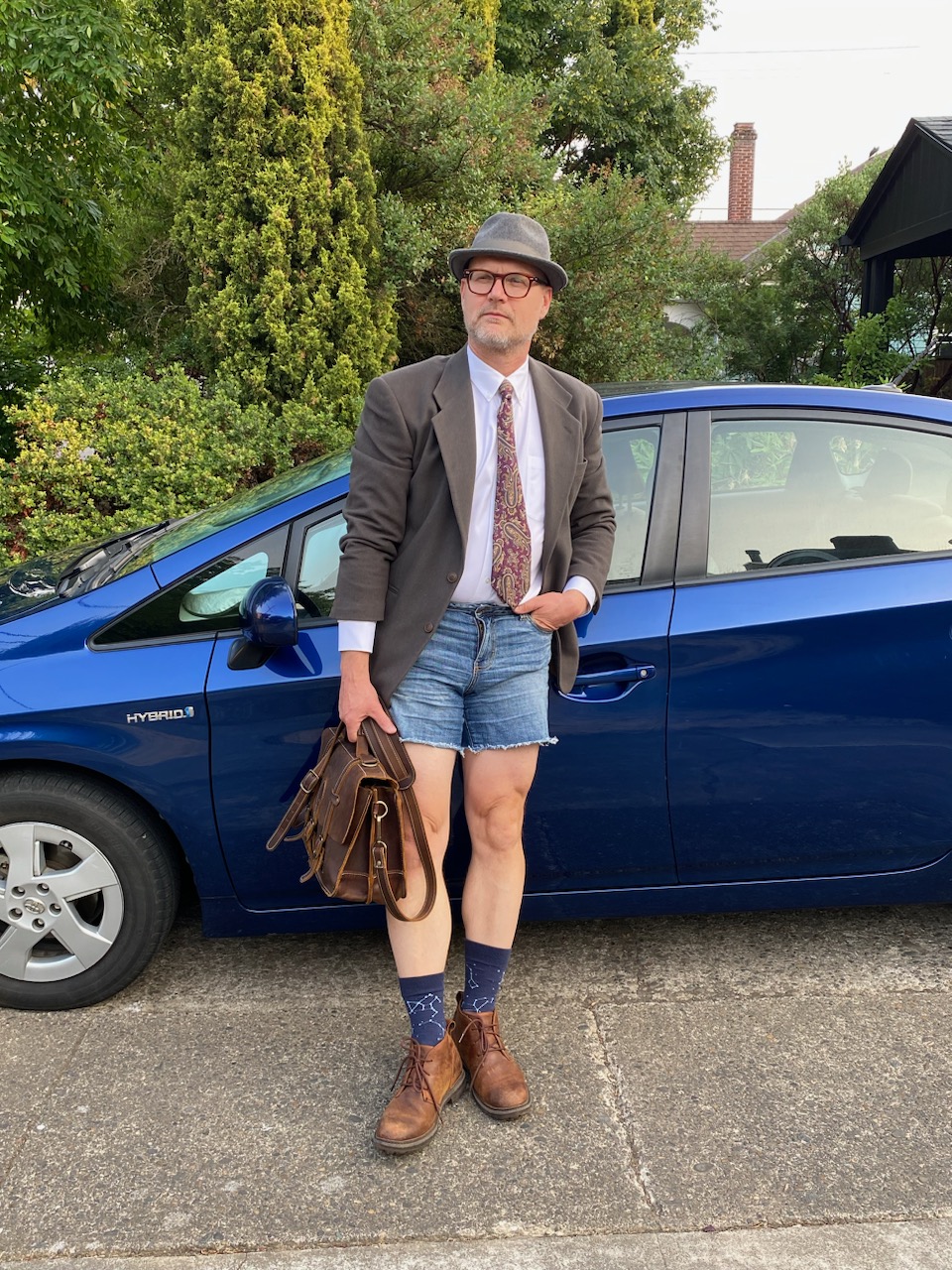
Is that a mercenary attitude? Maybe. Is it a rule that you must have comps? Absolutely not. But there’s also no rule that says I have to wear pants to a job interview. If I want to wear jorts to my next job interview, that’s my right as an American. However, wearing jorts to an interview will foreclose on just about every job offer outside of a very small set of jorts-positive jobs, many for which a 53 year-old man wouldn’t be an attractive candidate anyway.
My last unsuccessful job interview. Photo credit Carlyn Eames
So, what am I pitching as my comps for Pacifica? My three are Gabrielle Zevin’s Tomorrow, and Tomorrow, and Tomorrow; Anthony Doerr’s Cloud Cuckoo Land, and Russell Brand’s The Magic Kingdom–three very different books (and one of them I wasn’t even crazy about). But they’re three recent, commercially successful books, each with a passing resemblance to my book about a guy who has a religious vision playing video games which spurs him to found several increasingly ridiculous, polyamorous intentional communities. I guess that’s not exactly a concept which sells itself. Hopefully the comps will help me market it.
In a post of mine from a couple of weeks back, I mentioned as an aside my preference for the gritty, noir quality of sword & sorcery fantasy over the flash and bombast of high fantasy. As I’ve reflected on that offhand comment over the last days, I’ve wondered precisely what I meant by it. And I’ve wondered, both as a fantasy writer and a teacher of a fantasy and science fiction literature class, whether I even know what I mean by the terms high fantasy and sword & sorcery.
I’m not the only one to struggle with what seem like ill-defined terms. As the Wikipedia page on low fantasyargues, the distinction between high and low fantasy rests on where the action takes place: if the fantasy story takes place on another world (or a hidden world within this world), then it is high fantasy; if the action takes place in this world, then it is low fantasy. But this is hardly everyone’s definition: for many, the distinction between high fantasy and low fantasy involves the role of magic and morality in the story, not the question of where the story takes place. As the same Wikipedia page helpfully explains, “Thus, some works like Robert E. Howard‘s Conan the Barbarian series can be high fantasy according to the first definition but low fantasy according to the second.”
Fafhrd and the Gray Mouser have the same problem. . .but high fantasy or not, Dark Horse’s omnibus edition is coming soon!
So what did I mean when I said I preferred sword & sorcery to high fantasy? Well, here’s what I talk about when I talk about high fantasy: the world of the high fantasy novel or game is a cosmic battleground between the powers of good and evil. Magic is common, perhaps ubiquitous. The protagonists of the story or game–who are good–forge alliances and fellowships with other good creatures (often, and maybe usually, including elves, who often, maybe usually, represent an extreme incarnation of western beauty standards), who are locked in a mortal struggle with a host of evil creatures in the service of an even more evil master. If it sounds like I am describing The Lord of the Rings, I am: Tolkien’s work is usually held up as the type specimen of high fantasy. Many of the great high fantasy franchises you may be familiar with–like J.K. Rowling’s Harry Potter, The Inheritance Cycle of Christopher Paolini, Lloyd Alexander’s Chronicles of Prydain, and the Forgotten Realms setting of Dungeons & Dragons–are influenced by Tolkien’s cosmology. Some are downright derivative, little more than Tolkien reskins.
Behold, good folk, your hot ally has arrived. Legolas cosplay at Chicago Comic Con 2014, Photographer Gabbo T
Sword & Sorcery, by contrast, involves fewer world-spanning struggles between good and evil; instead, sword and sorcery focuses more on the trials and adventures of a single adventurer or a handful of them. Those adventurers are not “good” in the sense that high fantasy uses the term. Rather, “heroes” of sword & sorcery fantasy are typically a bundle of contradictions, a mix of noble and base impulses–often, much like the characters of hard-boiled detective fiction, they are just conflicted people trying to get a dirty job done. In short, sword & sorcery protagonists are a lot more like us, at least on the inside.
Magic, too, is less flashy, and far less common, in the typical sword & sorcery story. Unlike high fantasy, where in many franchises practically everybody can shoot lightning bolts and fly about like the superheroes of an MCU movie, magicians in sword & sorcery are rare, misunderstood, and mysterious figures. They are often sinister or at least morally compromised, as though magical power itself involves a deep and unsavory moral choice. They are far likelier to act as antagonists in the story, representatives of a shadowy corruption that it’s the protagonist’s job to resist.
Many of the classic heroes of sword & sorcery literature–Conan, Fafhrd and the Gray Mouser, Elric–had their heyday over forty years ago. And it’s probably been since the 1980s that I really read those books voraciously. There is no doubt that some of the writers’ underlying assumptions about gender and race have not aged well at all (of course, the same has certainly been said, fairly or not, about Tolkien’s work). In calling for a renaissance of sword & sorcery, I’m not arguing for a return of the passive, white-skinned, Frazetta-drawn “chainmail bikini” damsel in distress to fantasy literature. Sword & sorcery is cool for a totally different set of reasons, reasons which I believe are separable from the socially retrograde ideas of some of the original sword & sorcery creators.
Rather, what sword & sorcery offers, and what I wish Dungeons & Dragons would take more seriously, is moral complexity. Instead of simplistic good-vs.-evil alignments and the racial essentialism of “savage orcs” and “cultured elves,” I’d like to see more D&D that presents players with competing visions of the good, with life a series of tradeoffs to be made rather than a body of questions that one gets right or wrong. I’d like to see a magic system where the costs of devoting oneself to magic–or even wielding a magic item–are high enough that not every player will pursue magic power.
Dungeons & Dragons isn’t really built around those ideas. Too much about alignment and race and magic in D&D seem to assume a high fantasy worldview, and most D&D creators and players clearly seem more comfortable in a Tolkien-inflected high fantasy world. But one of the things I love about the current edition of D&D–and which I hope will continue in the coming version–is the game’s open environment for modifying, for mixing-and-matching. D&D today is more like a great set of cookbooks than a list of prescriptive instructions. And, just as it would be a lot of ridiculous work to prepare every recipe in a cookbook at the same time, most good dungeon masters know not to use every class and race and monster and option presented in the D&D books, at least not at the same time. One can make a sword & sorcery campaign in D&D; it’s just a matter of removing a few of the million options presented in the books.
There is a lot that I still love about high fantasy. I still attend Tolkien’s Birthday Bash every January at McMenamins Kennedy School in Portland to watch 6-13 straight hours of LOTR movies. But I prefer to think of the world we live in as something other than a cosmic battle between pure good and pure evil. And I like my storytelling and games, no matter how fantastic, to say something about the world as it is, not the world that black-and-white thinkers imagine that it is.