• About
  • My Fiction
  • Reviews

The Subway Test

~ Joe Pitkin's stories, queries, and quibbles regarding the human, the inhuman, the humanesque.

The Subway Test

Category Archives: Musings and ponderation

The Subway Is Running Again

30 Sunday Jun 2019

Posted by Joe in A Place for my Stuff, Musings and ponderation, My Fiction, Welcome

≈ 3 Comments

Tags

blogolalia, Science Fiction, the subway test

Six months after deleting my Facebook and Instagram accounts, I’ve come back to rehabilitate my blog, The Subway Test. I’ve missed writing it.

The author in the process of failing the subway test.

Without the gargantuan cave of Facebook to amplify my voice, I don’t know how many people will see my writing here. But it helps me to write here nonetheless.

Coming soon, I’ll reprint one of my favorite early stories in honor of its 10th anniversary. Keep watching the skies…

Facebook delenda est

27 Thursday Dec 2018

Posted by Joe in Musings and ponderation, Politics, The Time of Troubles, Uncategorized, Utopia and Dystopia

≈ 3 Comments

Tags

#deletefacebook, dystopia, Facebook, resolutions

I’ve spent months away from The Subway Test and from social media in general, deep in the burrows of a new writing project. And, as exciting as that new project has been (it’s so exciting that I can’t really tell you much about it), I have missed the writing practice that I had before, working on short stories, my novel Pacifica, and the odd blog post that most people read when I cross-post it to Facebook.

But regarding Facebook, I have had another reason for my radio silence: I just haven’t known how to respond to the mounting news about what a monstrous company Facebook is. On the face of it, I’m not sure it should be such a hard decision for me to leave Facebook (and its horrible little sister, Instagram): a company that seems devoted to permitting, even encouraging, the spread of political disinformation, up to and including disinformation that drives genocide, is a company I want nothing to do with.

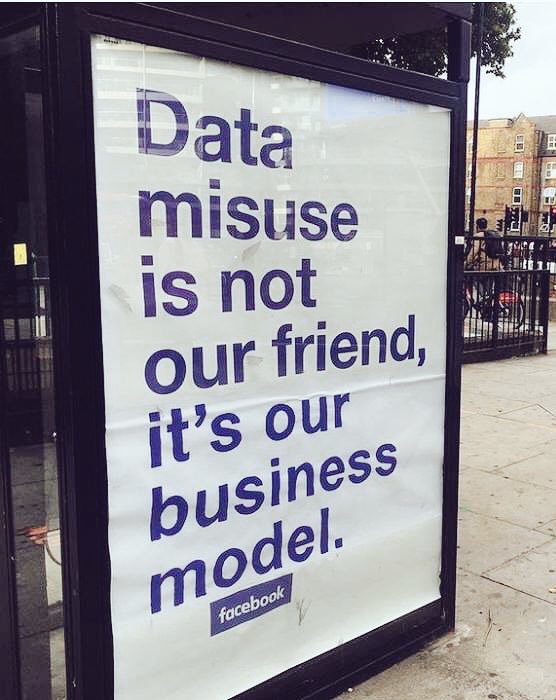
Copyright Adbusters

One of the only reasons I’ve had trouble leaving is that I don’t normally think of Facebook the company when I’m connecting with friends over Facebook the platform. That is, until about six months ago I was doing a fair amount of compartmentalization regarding my Facebook feelings: I would hear the news about Facebook’s business practices with mounting disgust, then log on and hand out a bunch of likes and haha faces and hearts to my friends’ pictures and memes and political links. Part of me knew that Facebook’s poetic PR language about connecting the world was just so much corporate bullshit. But then I would get on Facebook and act like all of that bullshit was true.

That’s because Facebook has very effectively built a business model which exploits our love for our friends and family. There’s nothing inherently wrong with such a business model: a thousand major companies, from Hallmark to Hasbro to TGIFridays, monetizes our desire to connect with people we love. But I do expect such a company, if it claims to be devoted to connecting me with my loved ones, not sell my personal data to political dirty tricks operations, to voter suppression outfits, to election oppo researchers. And I definitely expect such a company to step in when their platform is being used to encourage genocide.

So, please consider this my last post on Facebook. If you are reading this post on that platform, know that I will miss you. You I like. But so long as Facebook continues under its current leadership, with its mix of smarmy public apologies accompanied by no meaningful change in policy, I won’t be back. As a small potatoes writer who would like to have more exposure, I do understand that leaving Facebook behind will mean cutting off one of the few channels by which most people see my work. But the internet is a big place–there will still be lots of places that an interested reader can find me.

If you happen to be an interested reader, feel free to subscribe to my blog, The Subway Test –you can also find the blog simply by googling “Joe Pitkin.” Until then, I’ll say goodbye and deactivate my accounts on New Year’s Day.

I’m open to coming back someday. In fact, I’ll be happy to come back to Facebook and Instagram if the company will take meaningful action to clean up its act. For starters, the Board of Directors needs to fire Mark Zuckerberg and Sheryl Sandberg. I know that Zuckerberg can go ahead and fire the board in return–he is after all the majority shareholder in Facebook–but the board needs to grow a spine and do its job. If Zuck wants to fire the board in return, let him go ahead and do that: at the very least his doing so will make public what a morally bankrupt human being he is. If the board is able to replace Facebook’s top executives with people who will shepherd a transformation at Facebook, creating a company with meaningful privacy policies, meaningful informed consent about how our data is used, and a serious effort to clamp down on disinformation and incitement, Facebook could be fun again.

Goodbye until then–much love to you, friends!


My Autumnal Love Affair with Math

20 Sunday May 2018

Posted by Joe in Journeys, Musings and ponderation, Science

≈ 5 Comments

Tags

education, Khan Academy, math

I was an indifferent student of math growing up. I wasn’t bad at math exactly, but I didn’t much like the subject (except for geometry, which I took in high school from a brilliant and generous teacher who had left off being a rocket scientist–literally–so that he could teach young people). I pretty much stopped taking math as soon as I was allowed to  in high school–I stopped out at algebra III.

A couple of years later, in a spasm of optimism, I signed up to take a 7:00 am calculus class to meet my math requirement in my freshman year of college. I was influenced in this fool’s errand by one of my heroes, my writing professor Tom Lyon, whose hypoglycemia obliged him to teach at 7:00 and 8:00 am exclusively. I believed that something would blossom in me, and I would develop into the scholar and writer I was destined to be, a scholar and writer like Tom Lyon, if I got up every morning for calculus in the early hours.

Alas, my 7:00 am calculus teacher was no Tom Lyon: I remember her as earnest and competent, but not particularly skilled or experienced as a teacher. Probably, given that I was a freshman at a land grant university in a 7:00 am calculus class, she was a relatively new graduate teaching assistant. More importantly, what seeds of knowledge she sowed my way fell on rocky ground, or weedy ground–I remember not a lick of calculus from that class. Practically my only memory of that whole term was one morning watching the sun stream into the room late in the quarter and feeling the joy of being an 18 year-old in springtime.

Somehow I managed to pass that class despite all the time I spent gazing out the window. And 25 years later, somehow I managed to get a master of science degree in environmental science without much knowledge of calculus. I knew enough to be able to recognize that something was a calculus problem–the same way I might recognize that the people next to me are speaking Portuguese–but as for using calculus to model a problem or make a useful prediction about the world, the little glyphs and grammars of differential equations were utterly alien to me.

The gaps in my math knowledge were worse than this, actually: I remember as I was gathering the last data for my thesis that my classmate Alison Jacobs had to explain to me the formula for the slope of a line (y=mx+b) for about 30 seconds before I realized that she was talking about something that I had studied for months and months in junior high school. It comforted me a bit to learn later that the great E. O. Wilson had gotten his PhD in biology at Harvard without calculus–in Letters to a Young Scientist he talks about sitting in calculus class as a 32 year-old assistant professor, trying to atone for his crime of omission. But for me, it has been hard to shake the sense that however well I might use words to describe the thicket of the world,  I’ll never know the trails by which I might, using math, penetrate to the heart of things.

I had to climb over my own emotional palisades, then, to set out on a journey to teach myself calculus at age 45.  For me, coming back to differential calculus via Khan Academy has felt less like atonement and more like the discovery that someone I had regarded as homely in high school showed up at the 30 year reunion looking like a knockout. Somehow over the thirty years since I first sat in that 7:00 am calculus class, I have discovered that I’m in love with mathematics.

So far as I can tell, there’s no direct benefit to me in learning calculus or any other kind of math. No matter how good I may get at it in middle age, there will always be others around me who know math better and who use it more naturally than I. And what would I use calculus for anyway? I’m no better an English teacher or outcomes assessment specialist because of it. One could argue that I’m a worse English teacher because of it, opportunity costs being what they are–every hour I spend learning about limits and differentiation is an hour I don’t spend honing my knowledge of composition theory or something else I might actually use in the classroom.

But I don’t want to stop myself: I study math because math has become beautiful to me. Perhaps it seems more beautiful to me because it has no obvious use to me. I’m long past the spring term of my life now. Perhaps I can love math now because “the heyday of the blood is tame”–though in so many areas of life I feel I am entering a second youth, or even a long-delayed first youth. I never became, never will become, the scholar that Tom Lyon was in my life. But I’ve come back to scribbling out derivatives at 7:00 in the morning as I did when I was 18. The morning sun in springtime fills me with a different kind of joy.

10 000 Year Clock Badges Khan Academy

Screenshot credit: Khan Academy

What’s Your Science Fiction Pen Name?

26 Thursday Apr 2018

Posted by Joe in fantasy, Musings and ponderation, My Fiction, Politics, Science Fiction

≈ Leave a comment

Tags

editors, equity, fantasy, nom de plume, pen names, publishing, Science Fiction, social justice

I’ve really been getting into ambient music lately, and I’m noticing that many ambient artists–maybe most of them–have stage names. Loscil, Biosphere, Oöphoi–many of these folks name themselves as though they were themselves science fiction characters.

I’ve also been wondering a lot about identity in my writing, whether the fact that I’ve been published many times before makes it likelier for new editors to accept a story of mine for publication (it doesn’t seem to–I’m definitely an opening act as far as magazines and podcasts are concerned). But I do like the idea of my writing having an existence which is separate from my gender and ethnic and religious and sexual identity.

If fantasy and science fiction writing were more like ambient music (or if I thought it would accomplish something for me to take on a mysterious, Banksy-esque persona), I would choose the name Gravitrope or Pánfilo for my nom de plume. Both of these names resonate with me for personal reasons: for much of my thirties I was in a band called The Gravitropes, and I feel a kind of spiritual affinity for gravitropism, which is the ability of sprouting seeds to send their first shoots away from the pull of gravity and their first roots towards it. Pánfilo is a wonderful old Mexican name pulled from ancient Greek; the name means “lover of all.” I picked the name for one of my alter egos in my next novel, Pacifica.

One might wonder whether my taking on a writing name like Gravitrope or Pánfilo would be an attempt to game the publication system of speculative fiction. To their great credit, fantasy and science fiction editors are actively working to publish voices from a full diversity of genders, ethnicities, and sexualities. Would a writer with a pen name that seemed less white and male get a little more attention from editors today? Inasmuch as I hold the most privileged identities on the planet–I definitely present as white, male, straight, cis-, Christian, and it’s not worth quibbling over ways that not all of  those labels are perfectly, scrupulously accurate when the labels are definitely more true than not and when they are really markers of social privilege that I’ve held my whole life–it’s fair to say that if I took on a name that suggested a different gender, or genderlessness, or a different ethnicity, I would be dismissed as a poseur. I also don’t want to do anything that will make it harder for people from the full spectrum of humanity to get greater attention for their work. And, if there’s something I can do to help others from that fuller spectrum get published (short of refraining from writing myself), I’ll do it.

Having said that, there is something liberating in sending a story to a magazine under a different name, or to a magazine that uses a blind submissions process (i.e. you send the story in anonymously and the editors only learn who you are if they decide to publish your work). I don’t know whether I’ve had any better luck–or worse luck–getting published in blind-submission venues than in others. But I do like the prospect of my writing being read on its own terms, irrespective of who I am or who editors think that I am. I’d like to imagine my work reaching across boundaries of ethnicity and gender and history to tap at the bedrock of the human condition–in other words, I hope that my stories might function as works of art rather than simply as statements about what it means to be white and male in America.

That’s a fantasy, I know. But hey, I’m a fantasy writer.

And you? If you were to write sci fi under a pen name, what would you choose?


hierher

Photo credit: Hierher


Review of The Origins of Creativity

14 Saturday Apr 2018

Posted by Joe in Biology, Book reviews, Musings and ponderation, Science Fiction

≈ Leave a comment

Tags

biology, E.O.Wilson, Edward O. Wilson, Lascaux, Literary criticism, Science Fiction, STEM, The Origins of Creativity, Willendorf Venus

Edward O. Wilson’s latest book, The Origins of Creativity, is a return to the trails Wilson explored almost 20 years ago in Consilience: The Unity of Knowledge. In both books, Wilson attempts to bridge the gulf between the sciences and the humanities which has opened over the last century or more. Wilson makes a heroic effort in The Origins of Creativity (touchingly so, given that the great scientist is nearly ninety years old and has given the book some of  the touches of a final work). In the end I was unpersuaded by his exertions, but I am grateful for his return to a theme which is so meaningful for me personally. And, if Wilson’s proclamation of a coming Third Renaissance doesn’t quite convince me, I believe that Wilson still does us yeoman’s service in making an attempt to unify the humanities and the sciences.

Wilson’s starting point is uncomfortable, though obvious, for English teachers everywhere: the science, technology, engineering, and mathematics (STEM) fields have far outstripped the humanities in the public funds they receive, and STEM fields have been vastly more successful at producing lucrative jobs for college graduates. Elected officials regard the arts & humanities as luxuries whose comparatively tiny public budgets are often hard to justify.

Wilson’s diagnosis of the problem is that the humanities are stuck in the cultural cul-de-sac of present day. As Wilson puts it: “The main shortcoming of humanistic scholarship is its extreme anthropocentrism. Nothing, it seems, matters in the creative arts and critical humanistic analyses except as it can be expressed as a perspective of present-day literate cultures.”

While I do think that much of what goes on in the humanities is culturally blinkered, I’m not exactly sure how one would go about making the humanities less anthropocentric. The purpose of art is to explore what it means to be a human being–the humanities are anthropocentric by definition.

It is true that, with the exception of some artists working in the genre of science fiction, most artists and humanities scholars are not deeply educated around science. To put it another way, I think most scientists know way more about the humanities than most humanities scholars do about science. However, I’m not sure how our becoming more literate about evolutionary psychology and paleontology will make artists less anthropocentric. Art is one of the most anthropocentric activities on earth.

Would it help bridge the gulf between the arts and the humanities if the arts expressed something other than “a perspective of present-day literate cultures?” Maybe, but I don’t see it.  True, we would probably gain something by being better educated about the deep, biologically-driven ways that the lives of “present-day literate cultures” are related to the lives of the Lascaux Cave painters and the sculptor of the Venus of Willendorf. It does help us to recognize (and I think most present-day literate people do recognize) that those paleolithic artists were just like us in their humanity–their emotional lives were just as rich and subtle as Margaret Atwood’s. And, I do suppose that realization helps us in humanity’s most pressing moral challenge, that of seeing all humans across time and space as part of a single family, our common fate tied to the health of the ecosystem in which we live.  

Lascaux II

But this realization will not by itself bridge the gulf between the humanities and the sciences. That gulf is there because there is simply too much information to keep tabs on in the sciences for any human being to become an expert in more than a very small number of fields. It may be that our species is gathering scientific insights so quickly now that it’s impossible for a single human to become a true expert even in a single field as broad as chemistry or biology.

I’ll be the first to argue that artists could afford to learn a lot more about STEM fields. After all, science and technology are some of the most important organizing principles of human existence today. But whatever art we produce will still be to a certain extent time-bound: we make the art we do to give our lives a some kind of shape that makes sense to us. Our art remains bound in time and place because the human condition binds us to the time and place we live in.


Loneliness

31 Wednesday Jan 2018

Posted by Joe in Biology, Musings and ponderation, Science, Stories, Utopia and Dystopia

≈ 2 Comments

Tags

loneliness, Scientific American, Stories

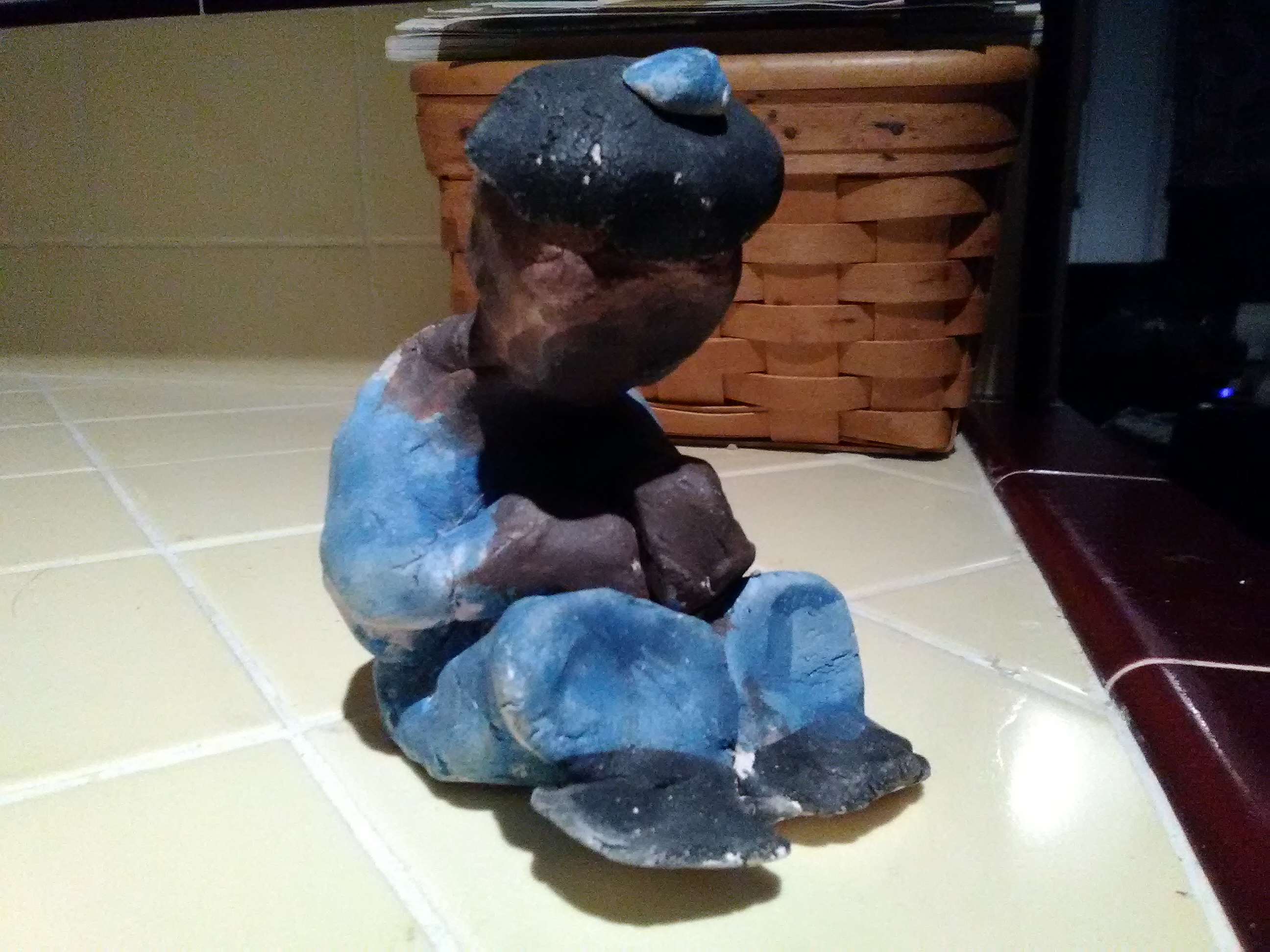
all alone.jpg

Sculpture Credit: “All Alone,” by a young Gloria Pitkin

To be a modern human is to contend with loneliness.

While this insight has been with us for decades or even centuries, it’s only recently that a body of research around the causes of loneliness, as well as its effects and its cures, has started to catch the public imagination.

Folks like Kafka and Camus seemed to assume, in the previous century, that loneliness was simply fundamental, part of the warp and weft of human existence. Today, though, researchers have begun to argue that loneliness is no more basic to human existence than tuberculosis–that, in fact, loneliness is a medical condition that can be prevented and cured.

The January issue of Scientific American has an article on loneliness that really spoke to me, perhaps because I was so lonely for so much of my youth. The author, Francine Russo, argues that in much the same way that the disease of consumption was medicalized and clinicalized into tuberculosis, we may be in the process of reconceiving loneliness as a treatable and preventable disease rather than a central reality of the human condition. For an artist like John Keats in the early 19th century, tuberculosis and loneliness were existential threats that he spent his life and work grappling with. Today, TB is (for many people in the developed world, anyway) something that one is vaccinated against.

But what vaccine is available for loneliness? Russo suggests cognitive behavioral therapy (CBT), a technique which has had deeply positive effects on my own life. And yet, in spite of my having experienced both chronic loneliness and CBT first-hand, I lacked the imagination to conceive of loneliness as a disease rather than a consequence of my very flawed character.

The other thing that dawned on me as I read the article was just how often I write about lonely characters in my stories. I just signed off on the galley prints for my latest story, “Potosí,” and realized that the main character spends a good deal of the story in utter solitude. Just like Miranda in “Full Fathom Five,” Epic in “Proteus,” and Sandra in “Lamp of the Body.” Stories with well-adjusted characters and lots of friends seem to be more rare with me.

As with all things Scientific American, the print article isn’t available online, but this closely related SciAm blog post is.


What Would You Call a Martian Highball?

30 Thursday Nov 2017

Posted by Joe in Musings and ponderation, My Fiction, Science, Science Fiction, Stories

≈ Leave a comment

Tags

cocktails, hard sci fi, Mars, Science Fiction, world building

I’m working on another hard sci fi story again. It’s a genre that I often make a conscious effort to branch out from–part of me feels much more drawn to writing absurdist Borgesian stories, or “The New Weird,” or whatever it’s being called these days. Yet something else draws me back, again and again, to writing hard science fiction, the stuff of space elevators and pressure domes and transhumanism.

One thing about hard sci fi that makes me feel out of my depth is the sheer volume of research that a serious hard sci fi reader expects from a story. And the research is wide ranging: it doesn’t matter whether I happen to know a little about genetic engineering; a good hard sci fi story also demands that I know something about AI and cryptography and planetary physics and orbital insertions.

That’s part of the fun, being able to research Martian concrete one day and asteroid mining the next. It’s also a little daunting to read the hard sci fi work of some of the current masters, folks like Linda Nagata and Ian McDonald and Gwyneth Jones, and see just how deeply researched their futures are, to see how offhandedly they predict something transformational about humanity 200 years in the future and make me wish I had thought of that.

Here’s a simple, dumb example. I’m writing a story set on a Mars colony between 100-200 years in the future. What do people drink there? I have a scene set in a bar, a kind of hangout that might remind people of an underground dive full of beer and curly fries. But it’s occurred to me in the last day or so that beer is a highly unlikely drink for colonists living under pressure domes on Mars: any staple crops like wheat or barley or oats would very likely be used for solid food, not beer. I’m fairly confident people will still want to drink alcohol 200 years in the future on Mars, but if it’s Martian hooch I would guess they’ll want something that yields a lot of alcohol from a relatively small biomass. What would that be? Fruit brandy? Potato vodka? Mezcal?

I still like the idea of a bunch of Martian undergrads downing beers and curly fries, so I may just leave those details in even though they make little sense. One of the characters in the scene is happy to see a Kentucky Bourbon on the menu–I suppose any society that can send 60,000 emigrants to Mars can also export Kentucky Bourbon, which makes more sense than exporting kegs of Earth beer over months and months and at fantastic weight. I’m not sure what to call the cocktail the character orders. Right now I just call the drink an offworlder, which seems a decent enough name, but I’m hoping to find a name with a little more zazz.

Hazel Nicholson

Photo Credit: Hazel Nicholson

What do you think? What would you call a Martian cocktail made with Kentucky Bourbon, perhaps distantly related to an old-fashioned?

Potosi Picked Up!

18 Monday Sep 2017

Posted by Joe in Advertising, Beta Readers, Musings and ponderation, My Fiction, Science Fiction, Stories, Stranger Bird, The Time of Troubles, YA fantasy

≈ 3 Comments

Tags

Analog Science Fiction and Fact, books, fantasy, literature, mythopoesis, racism, sci-fi, Science Fiction, self-publication, Stories

I’m happy to announce that the great science fiction magazine Analog has picked up my story “Potosí” for publication. “Potosí” will be the fifth story I’ve had appear in Analog, and by far the longest story (nearly 10,000 words) I’ve ever placed in a professional market.

As I wrote elsewhere, “Potosí” is set in a near future where corporations and countries squabble over the solar system’s vast mineral rights. It’s also a meditation on white supremacy and terrorism, an attempt to explain today’s world in new and striking clothes–much the same way that Star Trek explains the Cold War and Forbidden Planet explores World War II survivors’ guilt.

It’s been a good (and busy) week for my writerly life. One of my recent stories (another Analog pick-up called “Proteus”) is getting some very nice attention, and my quest to publish my first young adult fantasy novel, Stranger Bird, continues apace. I’m hoping for a publication date of November 3–keep watching the transom for that.

There’s also much more that I want to share here on The Subway Test, and I’m sure I’ll have some longer musings and ponderations here soon, but for now I’m pretty busy just keeping on top of my sci fi and fantasy writing.

The Founding Bloggers

23 Wednesday Aug 2017

Posted by Joe in Book reviews, Literary criticism, Musings and ponderation, Politics, Reading Roundup, The Time of Troubles

≈ 1 Comment

Tags

Alexander Hamilton, books, Hamilton, James Madison, John Jay, Lin-Manuel Miranda, Politics, The Federalist Papers, Trump

When a musical like Hamilton comes along, a rational response to the buzz is for folks to, you know, want to see Hamilton. Others might be overwhelmed enough by the positive press to look to Hamilton‘s source material, the gargantuan Ron Chernow biography of the man on the ten dollar bill.

Others, the cheapskates and musical theater philistines, might turn instead to The Federalist Papers.

Yes, I started reading The Federalist Papers because I heard Hamilton rapping on NPR for a minute and I realized that I hadn’t really read anything Hamilton had written.

I suppose if I’m really honest with myself, I do have to admit that fear for the future of America, at least as much as Lin-Manuel Miranda, is really what sent me to The Federalist Papers. As I watch the current president’s bumbling yet earnest assault on the Constitution–his flouting of the emoluments clause, his apparent ignorance of the establishment clause, his barrelling through each conversation as though the separation of powers didn’t exist–I realize that I don’t know enough about the document that the president is trying to subvert.  I have read the Constitution, and I’ve sure been going back to my pocket copy a lot lately, but like a powerless fanboy, I want to know more, to know it better. And The Federalist Papers, I’ve been told, are the inspired commentary on the US Constitution, the brilliant liner notes to that Sergeant Pepper’s Lonely Hearts Club Band of legislation.

I’m about a third of the way through so far, and it’s very slow going. All three of the authors–Alexander Hamilton, James Madison, and John Jay–learned to write in an age when a man showed his genius by teasing each sentence into a froth. Each sentence has a multi-layered, architectural quality, like the 18th century wigs that Hogarth lampoons in Five Orders of Perriwigs.

William_Hogarth_-_The_Five_Orders_of_Perriwigs

By William Hogarth – Scanned from The genius of William Hogarth or Hogarth’s Graphical Works, Public Domain, https://commons.wikimedia.org/w/index.php?curid=2714934

Of the three, John Jay is the most straightforward of the writers, the one least inclined to pile on the relative clauses. Imagine my dismay, then, to learn that John Jay wrote by far the fewest of the papers–only five of the 85–before illness forced him to give up the project. Hamilton, who wrote by far the most of the papers, is also the hardest to read. Every sentence of Hamilton’s is like listening to a Yngwie Malmsteen guitar solo: his paragraphs are spattered with commas, packed with dependent clauses that double back on themselves and seem to eat their own tails. And they are also filled with some of the most brilliant and vigorous writing I’ve ever seen.

This sentence, from Federalist #29, is typical Hamilton:

There is something so far-fetched and so extravagant in the idea of danger to liberty from the militia, that one is at a loss whether to treat it with gravity or with raillery; whether to consider it as a mere trial of skill, like the paradoxes of rhetoricians; as a disingenuous artifice to instil prejudices at any price; or as the serious offspring of political fanaticism.

Wow–I had to crawl through this sentence few times before I could tell what Hamilton was actually arguing: that militias are no danger to public liberty. However, one look at the rigging of this sentence is enough to warn me not to treat his ideas with raillery. A sentence like this demands to be treated with gravity.

I was also fascinated to see, in this sentence and elsewhere, how current Hamilton’s ideas are. Dust off the perriwig of his prose, and you can see that we are still  debating “the idea of danger to liberty from the militia” in this era of Cliven Bundy.

But what has impressed me the most so far about these letters is the high-wire act their authors pulled off. The three men, all writing under a single pseudonym–“Publius”–managed to pump out 85 of these essays over just ten months. That’s one letter every three or four days, each one a Niagara of commentary intended, I imagine, to bury the Constitution’s opponents under a flood of historical references, musings on American geography, and speculations on human behavior.

The newspapers these essays appeared in, The New York Packet and the Independent Journal, were two of that enormous flock of early American newspapers. I remember reading somewhere that most such papers had a circulation of about 1000. Publius was, in other words, much like an early blogger: a pseudonymous team of writers with a tiny audience, writing their asses off to produce brilliant content several times a week.

Dilettante that I am, I have nothing comparable to offer the country here at The Subway Test. I post a couple of times per month, sometimes about politics but usually not. Usually my topic is, in Homer Simpson’s words, “what some nerd thinks about Star Trek.” Yet I can reach back those 230 years to the brilliance of Publius and see that I am pushing my little cart up the great track they laid. If you want to resist the depredations of the current presidency, you have to educate yourself. Read The Federalist Papers. It is one of those books that will comfort you with the underlying genius of the republic. More importantly, it will help you understand what the hell you are defending when you stand up to the current president.
Time Is Money

05 Saturday Aug 2017

Posted by Joe in Musings and ponderation, My Fiction, Pacifica

≈ Leave a comment

Tags

life hacks, money, time, time is money

I’m back after a month away from The Subway Test, the longest hiatus I’ve given this blog in a year or more. As I wrote a month ago, I needed time to focus on getting the manuscript of my novel Stranger Bird ready for publication. It’s been a long few weeks, but the manuscript is finally in the hands of my layout editor, Erica, and I’m glad to be back working on other kinds of creative projects.

More than practically any other issue or idea in my life, I’ve struggled with time. I certainly contended over the last four weeks with a sense of time scarcity, even time starvation. Some of that feeling of lack comes from my own prodigious talents at wasting time. I’ve felt often enough that my time slips away from me like water out of a cracked bucket, lost to internet surfing and daydreaming, to chatting with colleagues and wandering about campus like a dilatory schoolboy.

Yet I don’t waste time every day–some days, some weeks even, I can approach my work with a grim and joyless puritanism, with the motto that if it’s fun, I can’t do it. I rarely feel much jealousy for the wealthy and powerful, but one thought that bedevils me with some frequency is the sense that, in spite of the fact that wealthy and powerful people have the same 24 hours a day that I do, those people have accomplished so much more than I in my 47 years on the planet. If I want to start feeling bad about myself, that’s the expressway to Self Loathington. Sometimes while I am on that expressway I can approach my work with a withering focus for a while, before my natural curiosity about whatever I’m not working on at the moment takes over once again.

One of the main characters in my novel Pacifica is a kind of spiritual self-portrait: a middle-aged librarian named Pánfilo (one of those wonderfully antique Mexican names that I love, from the Greek meaning “lover of all”). As I wrote in my first description of him,

Over the course of his forty-nine years of life, Pánfilo Gonzalez had completed seven hundred and twenty two college credits at nine universities, colleges, conservatories, institutes, and graduate optometry schools. Yet for all that, he had never taken a single college degree. He had come close several times—he would have received his Bachelor of Arts in History at Utah State University if he had just finished his physical education requirement and paid off his university parking tickets—but instead he had hired on to the Sterne College library as a janitor with nothing more than a high school diploma from the Escuela Nacional Preparatoria “José Vasconcelos.”

While in real life I have (barely) managed to take college degrees, as I approach Pánfilo’s real age I feel more and more like him.

taxcredits.net

Photo credit: TaxCredits.net

It is only now that I am halfway or so through my life that I feel some understanding of that phrase “time is money.” As a kid I always regarded it as one of those cartoonish shorthands TV writers would use to establish that a character was a successful businessman. I was not particularly interested in money, and so the phrase only served to make such characters as Mr. Slate from The Flintstones and Mr. Cogswell from The Jetsons unattractive to me. But it has dawned on me slowly over the last few years that if time is money, money is also time. Independently wealthy people may have the same 24 hours per day that I do, but they are much more able to spend their 24 hours doing only what they feel like doing. That so many of them spend their time working phenomenally hard, as though they are driven to it, suggests to me that there is something more to the “time is money” equation that I am not getting, or that perhaps they are not getting.

One of the internet wanderings I’ve made in the last few years that has had the most value for me attempts to quantify just how much money an hour is worth. The page is here at the excellent site clearerthinking.org–answer a few questions about how much you make, how busy you are, and how much you’d charge to do certain kinds of work, and the site will estimate for you just how much you should value your time. I learned a lot about myself after a few minutes at this site: it helped me realize that I’ve been way too willing to take on extra work in my job, and way too reticent about hiring out jobs like housecleaning and yard work. I have a long way to go to adjust my life so that I’m optimizing the number of hours I spend on preferred activities (primarily unpaid work like writing), but the site has really helped me understand just how much an hour is really worth to me.

← Older posts
Newer posts →

Subscribe

  • Entries (RSS)
  • Comments (RSS)

Archives

  • March 2026
  • February 2026
  • January 2026
  • November 2025
  • September 2025
  • August 2025
  • July 2025
  • May 2025
  • April 2025
  • March 2025
  • January 2025
  • December 2024
  • October 2024
  • September 2024
  • August 2024
  • June 2024
  • May 2024
  • April 2024
  • March 2024
  • February 2024
  • January 2024
  • December 2023
  • October 2023
  • August 2023
  • July 2023
  • June 2023
  • April 2023
  • March 2023
  • May 2022
  • August 2021
  • June 2021
  • January 2021
  • October 2020
  • May 2020
  • March 2020
  • February 2020
  • January 2020
  • July 2019
  • June 2019
  • December 2018
  • October 2018
  • July 2018
  • May 2018
  • April 2018
  • January 2018
  • December 2017
  • November 2017
  • September 2017
  • August 2017
  • July 2017
  • June 2017
  • May 2017
  • April 2017
  • March 2017
  • February 2017
  • January 2017
  • December 2016
  • November 2016
  • October 2016
  • August 2016
  • July 2016
  • June 2016
  • May 2016
  • March 2016
  • February 2016
  • January 2016
  • December 2015
  • November 2015
  • October 2015
  • July 2015
  • May 2015
  • March 2015
  • February 2015
  • January 2015
  • December 2014

Categories

  • A Place for my Stuff
  • Advertising
  • Artificial Intelligence
  • Beta Readers
  • Biology
  • Book reviews
  • Curious Fictions
  • Dungeons and Dragons
  • Exit Black
  • fantasy
  • Games
  • HPIC
  • Journeys
  • Let's All Admire That Fantastic Can
  • Lit News
  • Literary criticism
  • Musings and ponderation
  • My Fiction
  • Pacifica
  • Politics
  • Reading Roundup
  • Science
  • Science Fiction
  • Science Fiction Writers of America
  • SETI
  • Stories
  • Stranger Bird
  • The Ideal Vehicle
  • The Time of Troubles
  • Uncategorized
  • Utopia and Dystopia
  • Welcome
  • YA fantasy

Meta

  • Create account
  • Log in

Authors

  • Joe's avatar

Blog at WordPress.com.

  • Subscribe Subscribed
    • The Subway Test
    • Join 145 other subscribers
    • Already have a WordPress.com account? Log in now.
    • The Subway Test
    • Subscribe Subscribed
    • Sign up
    • Log in
    • Report this content
    • View site in Reader
    • Manage subscriptions
    • Collapse this bar
 

Loading Comments...