• About
  • My Fiction
  • Reviews

The Subway Test

~ Joe Pitkin's stories, queries, and quibbles regarding the human, the inhuman, the humanesque.

The Subway Test

Category Archives: Politics

What’s Your Science Fiction Pen Name?

26 Thursday Apr 2018

Posted by Joe in fantasy, Musings and ponderation, My Fiction, Politics, Science Fiction

≈ Leave a comment

Tags

editors, equity, fantasy, nom de plume, pen names, publishing, Science Fiction, social justice

I’ve really been getting into ambient music lately, and I’m noticing that many ambient artists–maybe most of them–have stage names. Loscil, Biosphere, Oöphoi–many of these folks name themselves as though they were themselves science fiction characters.

I’ve also been wondering a lot about identity in my writing, whether the fact that I’ve been published many times before makes it likelier for new editors to accept a story of mine for publication (it doesn’t seem to–I’m definitely an opening act as far as magazines and podcasts are concerned). But I do like the idea of my writing having an existence which is separate from my gender and ethnic and religious and sexual identity.

If fantasy and science fiction writing were more like ambient music (or if I thought it would accomplish something for me to take on a mysterious, Banksy-esque persona), I would choose the name Gravitrope or Pánfilo for my nom de plume. Both of these names resonate with me for personal reasons: for much of my thirties I was in a band called The Gravitropes, and I feel a kind of spiritual affinity for gravitropism, which is the ability of sprouting seeds to send their first shoots away from the pull of gravity and their first roots towards it. Pánfilo is a wonderful old Mexican name pulled from ancient Greek; the name means “lover of all.” I picked the name for one of my alter egos in my next novel, Pacifica.

One might wonder whether my taking on a writing name like Gravitrope or Pánfilo would be an attempt to game the publication system of speculative fiction. To their great credit, fantasy and science fiction editors are actively working to publish voices from a full diversity of genders, ethnicities, and sexualities. Would a writer with a pen name that seemed less white and male get a little more attention from editors today? Inasmuch as I hold the most privileged identities on the planet–I definitely present as white, male, straight, cis-, Christian, and it’s not worth quibbling over ways that not all of  those labels are perfectly, scrupulously accurate when the labels are definitely more true than not and when they are really markers of social privilege that I’ve held my whole life–it’s fair to say that if I took on a name that suggested a different gender, or genderlessness, or a different ethnicity, I would be dismissed as a poseur. I also don’t want to do anything that will make it harder for people from the full spectrum of humanity to get greater attention for their work. And, if there’s something I can do to help others from that fuller spectrum get published (short of refraining from writing myself), I’ll do it.

Having said that, there is something liberating in sending a story to a magazine under a different name, or to a magazine that uses a blind submissions process (i.e. you send the story in anonymously and the editors only learn who you are if they decide to publish your work). I don’t know whether I’ve had any better luck–or worse luck–getting published in blind-submission venues than in others. But I do like the prospect of my writing being read on its own terms, irrespective of who I am or who editors think that I am. I’d like to imagine my work reaching across boundaries of ethnicity and gender and history to tap at the bedrock of the human condition–in other words, I hope that my stories might function as works of art rather than simply as statements about what it means to be white and male in America.

That’s a fantasy, I know. But hey, I’m a fantasy writer.

And you? If you were to write sci fi under a pen name, what would you choose?


hierher

Photo credit: Hierher


The Big Red Carpet

14 Tuesday Nov 2017

Posted by Joe in Politics, The Time of Troubles

≈ Leave a comment

Tags

2018 Elections, Checks and Balances, Impeachment, Politics, The Federalist Papers

Lots of people smarter than me have written about how Trump is a pushover in international negotiations: Trump’s two week sojourn in Asia brought out a round of such analyses here, here, and here. But for me our current president’s addiction to flattery and fawning appeared in his remarks about the red carpet treatment Trump (and, well, America) was given:

“It was red carpet like nobody, I think, has probably ever received. And that really is a sign of respect, perhaps for me a little bit, but really for our county. And I’m really proud of that.”

red carpet

photo courtesy of The White House

It’s hard to watch our country get played for a bunch of suckers by the government of China, of Russia, of really any nation with leadership savvy enough to understand Trump’s fragility and neediness. I just happened to have stumbled across James Madison’s sentiments on the matter, written back in 1788:

Every nation, consequently, whose affairs betray a want of wisdom and stability, may calculate on every loss which can be sustained from the more systematic policy of their wiser neighbors. But the best instruction on this subject is unhappily conveyed to America by the example of her own situation. She finds that she is held in no respect by her friends; that she is the derision of her enemies; and that she is a prey to every nation which has an interest in speculating on her fluctuating councils and embarrassed affairs.

–Madison, Federalist #62

Madison’s remedy for our “fluctuating councils and embarrassed affairs” was a brand new constitution. What’s our remedy today?

Hint: the remedy is in the Constitution!

The Founding Bloggers

23 Wednesday Aug 2017

Posted by Joe in Book reviews, Literary criticism, Musings and ponderation, Politics, Reading Roundup, The Time of Troubles

≈ 1 Comment

Tags

Alexander Hamilton, books, Hamilton, James Madison, John Jay, Lin-Manuel Miranda, Politics, The Federalist Papers, Trump

When a musical like Hamilton comes along, a rational response to the buzz is for folks to, you know, want to see Hamilton. Others might be overwhelmed enough by the positive press to look to Hamilton‘s source material, the gargantuan Ron Chernow biography of the man on the ten dollar bill.

Others, the cheapskates and musical theater philistines, might turn instead to The Federalist Papers.

Yes, I started reading The Federalist Papers because I heard Hamilton rapping on NPR for a minute and I realized that I hadn’t really read anything Hamilton had written.

I suppose if I’m really honest with myself, I do have to admit that fear for the future of America, at least as much as Lin-Manuel Miranda, is really what sent me to The Federalist Papers. As I watch the current president’s bumbling yet earnest assault on the Constitution–his flouting of the emoluments clause, his apparent ignorance of the establishment clause, his barrelling through each conversation as though the separation of powers didn’t exist–I realize that I don’t know enough about the document that the president is trying to subvert.  I have read the Constitution, and I’ve sure been going back to my pocket copy a lot lately, but like a powerless fanboy, I want to know more, to know it better. And The Federalist Papers, I’ve been told, are the inspired commentary on the US Constitution, the brilliant liner notes to that Sergeant Pepper’s Lonely Hearts Club Band of legislation.

I’m about a third of the way through so far, and it’s very slow going. All three of the authors–Alexander Hamilton, James Madison, and John Jay–learned to write in an age when a man showed his genius by teasing each sentence into a froth. Each sentence has a multi-layered, architectural quality, like the 18th century wigs that Hogarth lampoons in Five Orders of Perriwigs.

William_Hogarth_-_The_Five_Orders_of_Perriwigs

By William Hogarth – Scanned from The genius of William Hogarth or Hogarth’s Graphical Works, Public Domain, https://commons.wikimedia.org/w/index.php?curid=2714934

Of the three, John Jay is the most straightforward of the writers, the one least inclined to pile on the relative clauses. Imagine my dismay, then, to learn that John Jay wrote by far the fewest of the papers–only five of the 85–before illness forced him to give up the project. Hamilton, who wrote by far the most of the papers, is also the hardest to read. Every sentence of Hamilton’s is like listening to a Yngwie Malmsteen guitar solo: his paragraphs are spattered with commas, packed with dependent clauses that double back on themselves and seem to eat their own tails. And they are also filled with some of the most brilliant and vigorous writing I’ve ever seen.

This sentence, from Federalist #29, is typical Hamilton:

There is something so far-fetched and so extravagant in the idea of danger to liberty from the militia, that one is at a loss whether to treat it with gravity or with raillery; whether to consider it as a mere trial of skill, like the paradoxes of rhetoricians; as a disingenuous artifice to instil prejudices at any price; or as the serious offspring of political fanaticism.

Wow–I had to crawl through this sentence few times before I could tell what Hamilton was actually arguing: that militias are no danger to public liberty. However, one look at the rigging of this sentence is enough to warn me not to treat his ideas with raillery. A sentence like this demands to be treated with gravity.

I was also fascinated to see, in this sentence and elsewhere, how current Hamilton’s ideas are. Dust off the perriwig of his prose, and you can see that we are still  debating “the idea of danger to liberty from the militia” in this era of Cliven Bundy.

But what has impressed me the most so far about these letters is the high-wire act their authors pulled off. The three men, all writing under a single pseudonym–“Publius”–managed to pump out 85 of these essays over just ten months. That’s one letter every three or four days, each one a Niagara of commentary intended, I imagine, to bury the Constitution’s opponents under a flood of historical references, musings on American geography, and speculations on human behavior.

The newspapers these essays appeared in, The New York Packet and the Independent Journal, were two of that enormous flock of early American newspapers. I remember reading somewhere that most such papers had a circulation of about 1000. Publius was, in other words, much like an early blogger: a pseudonymous team of writers with a tiny audience, writing their asses off to produce brilliant content several times a week.

Dilettante that I am, I have nothing comparable to offer the country here at The Subway Test. I post a couple of times per month, sometimes about politics but usually not. Usually my topic is, in Homer Simpson’s words, “what some nerd thinks about Star Trek.” Yet I can reach back those 230 years to the brilliance of Publius and see that I am pushing my little cart up the great track they laid. If you want to resist the depredations of the current presidency, you have to educate yourself. Read The Federalist Papers. It is one of those books that will comfort you with the underlying genius of the republic. More importantly, it will help you understand what the hell you are defending when you stand up to the current president.

I Marched for Science

26 Wednesday Apr 2017

Posted by Joe in Musings and ponderation, Politics, Science, The Time of Troubles

≈ 2 Comments

Tags

scientific literacy, sociology of science, The March for Science

March for Science2

Photo credit–Carlyn Eames

I’m not a professional scientist. I do have enough training to work as a lab tech if there’s ever some neo-Maoist Cultural Counter-Revolution where we’re all rounded up and forced to work in research facilities–it goes without saying that that won’t be happening during this administration. I’d be reluctant to call myself a scientist because I have published no peer reviewed papers, and my field work is competent at best (and often in graduate school I wasn’t at my best).  Having said that, I have actually worn a lab coat and safety goggles as a part of my job–for a week here and there, anyway–and I  have all the love for the scientific enterprise that an enthusiastic amateur science fiction author can have.

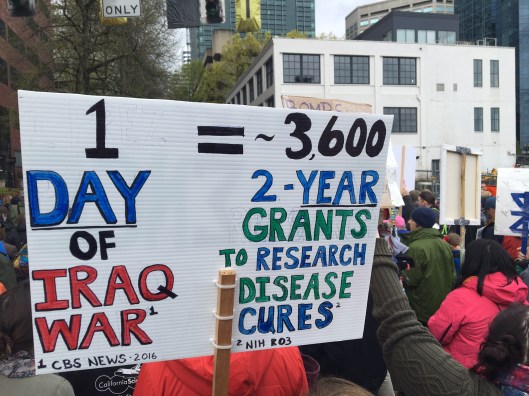
Across the republic, the streets were filled with people like me last Saturday at the March for Science. Well, based on the signs people were carrying, I’m sure that a lot of the marchers were bona fide scientists–at least bona fide lab techs and grad students. And, while there has been a healthy debate within the sciences about whether this kind of public advocacy is helpful or harmful to the cause of science, put me down as one who believes it’s valuable for scientists and science-lovers to stand up and be counted.

MArch for Science1

I appreciate a properly footnoted sign. Photo credit–the lovely Carlyn Eames

There has been push-back from some scientists–this article at Slate is a typical example–that the march was an orgy of uninformed and misinformed pro-science good-feelery from non-scientists. That is, according to Dr. Jeremy Samuel Faust, the folks marching mostly don’t understand science enough. If marchers did understand the state of science, with its almost guild-like patronage system, its rampant data mining and cherry picking, its Potemkin peer review, they wouldn’t be so eager to draw up witty signs and march in its defense.

Faust does have a point: I suspect few of the people on the march this weekend understand what statistical significance really refers to, and even fewer would be ready to talk about the many misuses of p<.05 that researchers engage in because they’re trying to score a publication (or, more likely, because most scientists are not statisticians and often use statistical tools in ways they were not intended).

And yes, that’s a problem. But that’s not what the march is about. One can support the scientific enterprise, be willing to march in the rain for it, without knowing everything about science. None of the marchers, even the scientists, have a full understanding of all of the sciences humans engage in. The geologists on the march don’t know any more than I do about high energy physics, and the high energy physicists know less about environmental biology than I do.

Many of the scientists out there, even the duffers like me, know that there are deep problems with the sociology of science, with the misuse of methods and publication and statistical analysis. But something the marchers all had in common, scientists and non-scientists alike, was a support for the idea underlying science: that the scientific method can be used to describe our environment and make useful predictions. Faust is right that the scientific method is a roundly abused idea even within the sciences, to say nothing of non-scientists. But one can love and support a good idea without understanding it fully.  Whether any individual marcher can be picked out of the crowd and made to follow the scientific method to Dr. Faust’s satisfaction is beside the point.

The scientific enterprise is flawed, just as representative democracy is flawed. I marched because I believe in the idea of science (and, for that matter, representative democracy). The way to reform the institution of science is the same as the way to reform the republic: it will be saved by people who care for and love those institutions. Science and civil society won’t be reformed if we roll over when the administration attempts to hobble the EPA or reverse even modest US actions to counter climate change.

Remake the Electoral College, Part II

19 Sunday Mar 2017

Posted by Joe in Musings and ponderation, Politics

≈ Leave a comment

Tags

good government

It’s exciting  to see people’s increasing enthusiasm about replacing America’s 18th-century sop to the slave states, the Electoral College. Oregon is currently considering a bill–HB2927–that would join the state to The National Popular Vote Interstate Compact. New Mexico and Connecticut are considering similar measures. Oregon friends, now is the time to contact your state representative in support of the bill!

To explain the beauty of The National Popular Vote Interstate Compact, below is the repost of my original message on the subject, written last November before the Time of Troubles had actually begun:

Friends all over the place are talking about how and where to support civic engagement with their time and money. The ACLU tops the list for many of my friends–as well as for a whole lot a friends I didn’t know I had.  There’s good reason today to support The Southern Poverty Law Center, Planned Parenthood, The Sierra Club, The Council on American-Islamic Relations–all places to devote your efforts if you are interested in preserving civil society during the Time of Troubles. I’ll be giving loved ones memberships to these for Christmas.

And there’s at least one more that deserves your support, even though the issue it covers–electoral reform–may seem like small potatoes compared to the threats we are facing. FairVote.org has been doing the quiet, patient work of improving the way elections work in the United States since 1992. And, among the many forward-thinking reforms that they have advocated, one of the most timely is the reform of the Electoral College.

Democrats have ample incentive to support Electoral College reform: Democrats have won the most votes in four of the last five presidential elections, yet we’ve had a Democratic president for only two of those electoral cycles. One can be forgiven for believing that, along with persistent gerrymandering and voter suppression tactics, the Republicans have used the Electoral College to hold on to power despite being a minority party in the United States.

Yet, the Republicans have just as many reasons to support the reform of the Electoral College. Yes, over two recent cycles (2000 and 2016) the Electoral College has favored the Republicans, but there’s no structural reason that this should be so. Indeed, some of you remember the scenario (and personal fantasy of mine) that in 2004 John Kerry would win the Electoral College in spite of losing the national popular vote. If I remember correctly, he came within 70,000 votes of winning Ohio (and hence the election) that way.

I had hoped in part that the election would swing that way in 2004 because I believed (and still believe) that if the Republicans had suffered the same kind of defeat that the Democrats had in 2000, there would be a bipartisan consensus to do away with the Electoral College.

But for better and worse (mostly for better), it will be extremely difficult to do away with the Electoral College entirely. Doing so would require an amendment to the Constitution, and that’s a pretty high bar to clear: the last amendment to the Constitution(the 27th) occurred nearly 25 years ago, 202 years after if had been proposed in 1789.

Wouldn’t it be wonderful if there was some way to reform the Electoral College without having to amend the Constitution? It turns out that there is such a way. The National Popular Vote Interstate Compact has just the kind of wonky name that puts people to sleep. However, it’s one of the most fundamental advances we could make to our presidential election system today. And we can make it law without having to amend the Constitution.

Here’s how it works. The Constitution is helpfully vague about how states choose who their electors will be:

Each State shall appoint, in such Manner as the Legislature thereof may direct, a Number of Electors, equal to the whole Number of Senators and Representatives to which the State may be entitled in the Congress…

In other words, individual state legislatures have wide latitude to decide how electors are appointed. And, if a state legislature decides that electors should be appointed on the basis of whoever wins the national popular vote, there’s nothing in the Constitution to forbid it.

Yet, what would be the incentive for a state to give up its influence over the electoral process by choosing its electors that way? That’s a good question, and certainly swing states like Ohio and Florida have little incentive (beyond an interest in democracy) to do so. Those states receive millions of dollars in ad revenue from the presidential campaigns every four years–they have a much greater stake in the status quo. However, the so-called “safe states” like California, New York, and Oklahoma–states which are reliably red or blue in every election–have less influence over presidential elections today than they would have if they simply banded together and agreed to choose electors on the basis of the national popular vote.

And that’s what the compact aims to do. As soon as enough states agree to appoint their electors that way–that is, as soon as states representing 270 electoral votes agree to it–the compact would go into force.

I’ll write more later about the benefits of such a plan, as well as about its constitutionality. But for now, check out the map of states which have already voted to implement the compact. Check out the states where the compact has almost passed–that is, where the compact has a reasonable chance of passing in the future. Check out how many times it took some of the states to pass the compact into law.

One of the beauties of this kind of work is that it is a concrete step for the public good that can be accomplished in state houses, where individual voters can bring more pressure to bear. Friends in Oregon, friends in Colorado, friends in Oklahoma and Tennessee: find out what your state legislator is doing to support this compact–which is to say, find out what your legislator is doing to support democracy in the United States. FairVote.org can help hook you up with this project.

The Seeds of Trump’s Undoing

14 Tuesday Feb 2017

Posted by Joe in Musings and ponderation, Politics, The Time of Troubles

≈ Leave a comment

Tags

Electoral Fraud, Putin, Russia, Trump, Watergate

I’ve been working on a couple of long blog posts that I have wanted to finish for a while. However, I back-burnered them all today as I digested the news of Michael Flynn’s resignation as Trump’s national security advisor. I was reminded of something I told my wife on the night of the election, and which I have repeated many times since: the seeds of Trump’s undoing are right in front of us.

I was not making a prophecy. I had simply been reading the news which was available to us since before the election, such as this groundbreaking piece by Mother Jones veteran David Corn. Many have suspected for months that Donald Trump was receiving aid from a hostile foreign power, a power determined to manipulate the outcome of the presidential election.

There are many Republicans in Congress who have circled their wagons around Trump because he is one of their team, because presumably they see some advantage to themselves in protecting the president. But even within the famously disciplined Republican Party there are increasing calls for investigations, not four weeks into Trump’s presidency, into “what did the president know, and when did he know it?”

The echoes of Watergate are obvious, but facile. Our current national nightmare is a great deal worse than Watergate: we are talking about an enemy state, ruled by an anti-democratic strongman, subverting our electoral process in order to bring a favored candidate to power. And Trump, Putin’s favored candidate, has been artlessly, bafflingly open about his desire to reward Putin for the help.

Today on CNN, Democratic congressman Seth Moulton called out the elephant in the room: the support of an enemy state’s agenda at the expense of the interests of your own country is, by definition, treason.

There is chaos and trouble ahead. In the same way that I wonder about my parents’ and grandparents’ stances in 1974, our kids and grandkids will ask about how we acted, and what we did, during the time we’re living through.

Readings for the Time of Troubles

15 Thursday Dec 2016

Posted by Joe in Musings and ponderation, Politics, The Time of Troubles

≈ Leave a comment

Tags

hamfisted con men, racism, resolutions, utopia

I was surprised to learn that the textbook my daughter was using for her US History class is Howard Zinn’s A People’s History of the United States. I had long been an admirer of Zinn’s lefty outlook on the world from interviews Zinn did in the last years of his life, though I had never read any of his work. Finding out that my daughter is reading his signature book was apparently the encouragement I needed to read the book myself.

While the first edition of People’s History was written nearly 40 years ago and the last edition is over ten years old, the book is timely, and oddly comforting in these last weeks before the inauguration of Trump. I came away from People’s History with two guiding consolations. First, Trump is no aberration. His misogyny, nativism, racism, and venality have deep roots in the history of the United States. If this doesn’t seem like much of a consolation, I might put it another way: the country has been through crises like Trumpism before. Second, for all the suffering the Trump administration will cause millions of people, for all the theft of public goods that is coming, there is a countervailing force of decency in the American character as well. The courage of Frederick Douglass and Fannie Lou Hamer, of Mother Jones and Eugene Debs, of Daniel Berrigan and César Chávez–and of millions of others–is available to us as well. We can fight, in many small and powerful ways, if decent Americans are willing to give up their self-satisfaction and passivity and security to stand up for our country.

While I was familiar with every period Zinn wrote about in People’s History, I don’t think I had ever seen all these periods stitched together into a single overarching vision. Basically, Zinn’s contention is that the true history of the United States is not defined by the actions of presidents and congresses who have worked at practically every turn to enrich a tiny economic elite–by preserving slavery, by massacring the natives, by invading Mexico and Cuba and The Philippines, by overthrowing democratically elected governments in Guatemala and Chile and Iran. Rather, American history is made up of the often overlooked struggles of the oppressed, the working class, the unrepresented. It is a history of people fighting, over centuries sometimes, to be included in the opening phrase of the Constitution: “We the People.”

It’s an inspiring–if sometimes flawed–vision. I believe that what it offers, in a crowded field of history texts, is a truly alternative analysis of the history of the nation. Many critics have accused him of bias, though I would argue that what Zinn has done instead is abandon the pretense of objectivity that sometimes smothers the work of other historians. No historian, no human being, can be a thoroughly objective observer of the human experience. In telling any history, we leave neutrality behind as soon as we decide which events we will focus on and which ones we will omit.

And so many history texts, even those informed by the counter-cultural critique of history that came out of the 60s and 70s, still focus the actions of “the great men,” the Jeffersons and Jacksons and Roosevelts, with entire social movements of millions of ordinary people receiving comparatively little mention, or in some cases no mention at all. Zinn’s timely contribution is to argue that US History was not made by the Jeffersons and Jacksons and Roosevelts–that our elected leaders were responding to massive social and economic currents that they could barely influence, let alone control.

Presidents and congresses and supreme courts are led by the people, not the other way around. Unfortunately, according to Zinn, our elected leaders have usually been in thrall to what Occupy Wall Street popularized as “the 1%”: industrialists, financiers, speculators, robber barons. But frequently enough, a demand for justice will rise up from the roots of society with enough force that the elected leaders must listen and the law responds. The end of slavery, women’s suffrage, the 40-hour work week, the civil rights movement–all of these changes came, not from the courage of Abraham Lincoln, Woodrow Wilson, U.S. Grant, or L.B.J., but in response to the demands of ordinary Americans. Those demands took decades to make themselves felt sometimes, and the success of those demands depended on the tremendous courage of millions of people, but nearly every advance that the US has made in social justice has been led from below, not from above.

One can work towards neutrality and fairness in writing by committing to telling as many sides of the story as one can–a very common, and admirable, approach among the historians I’ve read. But it’s also valuable to have someone standing outside that system, observing from without, making no claim to neutrality–someone who pulls back the curtain on the mainstream view of American history to expose the so-called historical consensus as a fiction. Zinn’s book has helped me see my country in a new way.

And he’s helped me get my game face on for the time to come: if I want a humane minimum wage for Americans, if I want truly public college education and single-payer health care, I have to fight for those things. Not because I expect the hamfisted con man we just elected to respond to my demands, but because he may make enough people angry enough to care. The day will come when we have a free and equitable society, ruled by justice and reason. It’s up to us to make it.


We Can Remake the Electoral College

26 Saturday Nov 2016

Posted by Joe in Musings and ponderation, Politics

≈ Leave a comment

Tags

good government

Friends all over the place are talking about how and where to support civic engagement with their time and money. The ACLU tops the list for many of my friends–as well as for a whole lot a friends I didn’t know I had.  There’s good reason today to support The Southern Poverty Law Center, Planned Parenthood, The Sierra Club, The Council on American-Islamic Relations–all places to devote your efforts if you are interested in preserving civil society during the Time of Troubles. I’ll be giving loved ones memberships to these for Christmas.

And there’s at least one more that deserves your support, even though the issue it covers–electoral reform–may seem like small potatoes compared to the threats we are facing. FairVote.org has been doing the quiet, patient work of improving the way elections work in the United States since 1992. And, among the many forward-thinking reforms that they have advocated, one of the most timely is the reform of the Electoral College.

Democrats have ample incentive to support Electoral College reform: Democrats have won the most votes in four of the last five presidential elections, yet we’ve had a Democratic president for only two of those electoral cycles. One can be forgiven for believing that, along with persistent gerrymandering and voter suppression tactics, the Republicans have used the Electoral College to hold on to power despite being a minority party in the United States.

Yet, the Republicans have just as many reasons to support the reform of the Electoral College. Yes, over two recent cycles (2000 and 2016) the Electoral College has favored the Republicans, but there’s no structural reason that this should be so. Indeed, some of you remember the scenario (and personal fantasy of mine) that in 2004 John Kerry would win the Electoral College in spite of losing the national popular vote. If I remember correctly, he came within 70,000 votes of winning Ohio (and hence the election) that way.

I had hoped in part that the election would swing that way in 2004 because I believed (and still believe) that if the Republicans had suffered the same kind of defeat that the Democrats had in 2000, there would be a bipartisan consensus to do away with the Electoral College.

But for better and worse (mostly for better), it will be extremely difficult to do away with the Electoral College entirely. Doing so would require an amendment to the Constitution, and that’s a pretty high bar to clear: the last amendment to the Constitution(the 27th) occurred nearly 25 years ago, 202 years after if had been proposed in 1789.

Wouldn’t it be wonderful if there was some way to reform the Electoral College without having to amend the Constitution? It turns out that there is such a way. The National Popular Vote Interstate Compact has just the kind of wonky name that puts people to sleep. However, it’s one of the most fundamental advances we could make to our presidential election system today. And we can make it law without having to amend the Constitution.

Here’s how it works. The Constitution is helpfully vague about how states choose who their electors will be:

Each State shall appoint, in such Manner as the Legislature thereof may direct, a Number of Electors, equal to the whole Number of Senators and Representatives to which the State may be entitled in the Congress…

In other words, individual state legislatures have wide latitude to decide how electors are appointed. And, if a state legislature decides that electors should be appointed on the basis of whoever wins the national popular vote, there’s nothing in the Constitution to forbid it.

Yet, what would be the incentive for a state to give up its influence over the electoral process by choosing its electors that way? That’s a good question, and certainly swing states like Ohio and Florida have little incentive (beyond an interest in democracy) to do so. Those states receive millions of dollars in ad revenue from the presidential campaigns every four years–they have a much greater stake in the status quo. However, the so-called “safe states” like California, New York, and Oklahoma–states which are reliably red or blue in every election–have less influence over presidential elections today than they would have if they simply banded together and agreed to choose electors on the basis of the national popular vote.

And that’s what the compact aims to do. As soon as enough states agree to appoint their electors that way–that is, as soon as states representing 270 electoral votes agree to it–the compact would go into force.

I’ll write more later about the benefits of such a plan, as well as about its constitutionality. But for now, check out the map of states which have already voted to implement the compact. Check out the states where the compact has almost passed–that is, where the compact has a reasonable chance of passing in the future. Check out how many times it took some of the states to pass the compact into law.

One of the beauties of this kind of work is that it is a concrete step for the public good that can be accomplished in state houses, where individual voters can bring more pressure to bear. Friends in Oregon, friends in Colorado, friends in Oklahoma and Tennessee: find out what your state legislator is doing to support this compact–which is to say, find out what your legislator is doing to support democracy in the United States. FairVote.org can help hook you up with this project.

On the Election of Donald J. Trump

14 Monday Nov 2016

Posted by Joe in Musings and ponderation, Politics

≈ 4 Comments

Tags

demagoguery, marketing, racism

Like so many folks, I have felt dazed and heartbroken about the election of Donald Trump to the presidency. I’ll speak plainly: while I believe the United States will survive this demagogue, no president has been a greater threat to the republic than Trump will be. Ever since Plato, political scientists have recognized that the greatest danger to democratic forms of government was demagoguery: and, in his cynical and phony populism, in his breezy dishonesty, in his breathtaking appeals to xenophobia and racism, Donald Trump is the most demagogic person ever to have been elected president of the United States.

SelfAwarePatterns, a WordPress comrade I admire, has posted a very thoughtful reflection on Trump’s win. He notes that while racists and nativists have helped to elect Trump, it does not follow that all—or even most—of Trump’s supporters are racists and nativists. Indeed, at least some of the people who voted for Obama in 2008 and 2012 came to support Trump in 2016. To ridicule these voters, to call them racists and haters or dupes, is to mistake the nature of Clinton’s loss and to further alienate those voters whom Clinton failed to reach.

While I don’t think that analysis tells the whole story, there is much to agree with here. I’ll start by saying that nothing good will come of trying to ridicule Trump voters. A huge part of Trump’s appeal came from his understanding that millions of Americans feel ridiculed already, feel looked down-on by liberal coastal elites. Trump’s harping on “the rigged system,” his invitation to rally-goers to heap abuse on the button-down liberals sitting in “the press pen,” were ways of blaming working class people’s losses on the kind of people that stereotypically vote for Hillary: those smug, expensively educated NPR listeners whose life is a kind of running Portlandia sketch.

Of course, Trump doesn’t just blame rich liberals for the problems with middle America; he blames Mexicans, “welfare takers,” Muslims. His racism and nativism are far more troubling because he can hurt and bully those target populations so much more easily. It’s the racism of these positions that has convinced many on the left that Trump’s voters must also be racists.

Doubtless some of them are.  Other Trump supporters, I’m sure, are troubled to some degree by Trump’s attitudes and statements, but not enough to consider his racism a disqualifying factor for his candidacy. Still others have been convinced that Trump’s xenophobic positions are the correct ones, even though they could have been convinced otherwise, and perhaps were convinced otherwise by Barack Obama. Are all of these stances equally blameworthy?

Perhaps approaching the problem from a different angle would yield better results. Years of teaching at a community college have taught me that ridiculing a person for their choices marks the end of all dialog. If I believe my choice for president is a better, saner, more moral choice than Donald Trump, I can’t hope to convince anyone of that by shaming them and telling them how stupid they are, as though I have some special insight into stupidity.

However, we can and must critique the system of racism: we can work to help working class whites see that their economic interests align with working class people of color, that modern racism is not some natural human state but rather a conscious political strategy. Racism is in fact a relatively recent political program, designed during the colonial American period by economic elites to divide and conquer the dispossessed that lived here: black slaves, white indentured servants, landless white tenant farmers, Native Americans. A white indentured servant in colonial America may be landless, may be exploited, may be helpless to resist the depredations of creditors and masters and landlords, but he could believe at least that he was better off than a slave or an Indian.

Of course people of color are the primary victims of this control strategy, just as they will suffer disproportionately in this Time of Troubles. All of us who consider ourselves allies have to work together to provide safe havens where we can and to bear witness.

But working class whites do not escape the system of racism without injury. To the extent that working class whites have been bamboozled by elites to believe that their problems are caused by the marginalized, powerless other, rather than by the elites themselves, they too have been made victims. They may escape the brutality and savagery that has been visited on immigrants and people of color—indeed, working class whites will often be the perpetrators of that brutality—but working class whites are lashing out at their own victimization: the hollowing out of their towns, the loss of the dignity of work, the replacement of main streets with pill mills and payday loan shops.

Muslims and Mexicans are not to blame for that victimization. Hillary Clinton is not to blame either, though Trump actually made a fair critique that Clinton represents an investor class which does bear some responsibility for the offshoring of jobs and the decimation of main street. That may be the only fair critique Donald Trump has made in his life.

Those who were convinced that Donald Trump is a regular guy, that he is somehow not part of that controlling elite himself, will perhaps fare better than immigrants and Muslims. But the voters of Wisconsin and Michigan and Pennsylvania that elected him won’t fare well: Donald Trump and his gang of goons are predators. Someday, perhaps in two years or four years or 24, there will be an opportunity to drive them out again. I hope when the opportunity comes we take it, and we have an honest conversation about racism. Not racists, but racism.

Newer posts →

Subscribe

  • Entries (RSS)
  • Comments (RSS)

Archives

  • November 2025
  • September 2025
  • August 2025
  • July 2025
  • May 2025
  • April 2025
  • March 2025
  • January 2025
  • December 2024
  • October 2024
  • September 2024
  • August 2024
  • June 2024
  • May 2024
  • April 2024
  • March 2024
  • February 2024
  • January 2024
  • December 2023
  • October 2023
  • August 2023
  • July 2023
  • June 2023
  • April 2023
  • March 2023
  • May 2022
  • August 2021
  • June 2021
  • January 2021
  • October 2020
  • May 2020
  • March 2020
  • February 2020
  • January 2020
  • July 2019
  • June 2019
  • December 2018
  • October 2018
  • July 2018
  • May 2018
  • April 2018
  • January 2018
  • December 2017
  • November 2017
  • September 2017
  • August 2017
  • July 2017
  • June 2017
  • May 2017
  • April 2017
  • March 2017
  • February 2017
  • January 2017
  • December 2016
  • November 2016
  • October 2016
  • August 2016
  • July 2016
  • June 2016
  • May 2016
  • March 2016
  • February 2016
  • January 2016
  • December 2015
  • November 2015
  • October 2015
  • July 2015
  • May 2015
  • March 2015
  • February 2015
  • January 2015
  • December 2014

Categories

  • A Place for my Stuff
  • Advertising
  • Artificial Intelligence
  • Beta Readers
  • Biology
  • Book reviews
  • Curious Fictions
  • Dungeons and Dragons
  • Exit Black
  • fantasy
  • Games
  • HPIC
  • Journeys
  • Let's All Admire That Fantastic Can
  • Lit News
  • Literary criticism
  • Musings and ponderation
  • My Fiction
  • Pacifica
  • Politics
  • Reading Roundup
  • Science
  • Science Fiction
  • Science Fiction Writers of America
  • SETI
  • Stories
  • Stranger Bird
  • The Ideal Vehicle
  • The Time of Troubles
  • Uncategorized
  • Utopia and Dystopia
  • Welcome
  • YA fantasy

Meta

  • Create account
  • Log in

Authors

  • Joe's avatar

Blog at WordPress.com.

  • Subscribe Subscribed
    • The Subway Test
    • Join 143 other subscribers
    • Already have a WordPress.com account? Log in now.
    • The Subway Test
    • Subscribe Subscribed
    • Sign up
    • Log in
    • Report this content
    • View site in Reader
    • Manage subscriptions
    • Collapse this bar
 

Loading Comments...