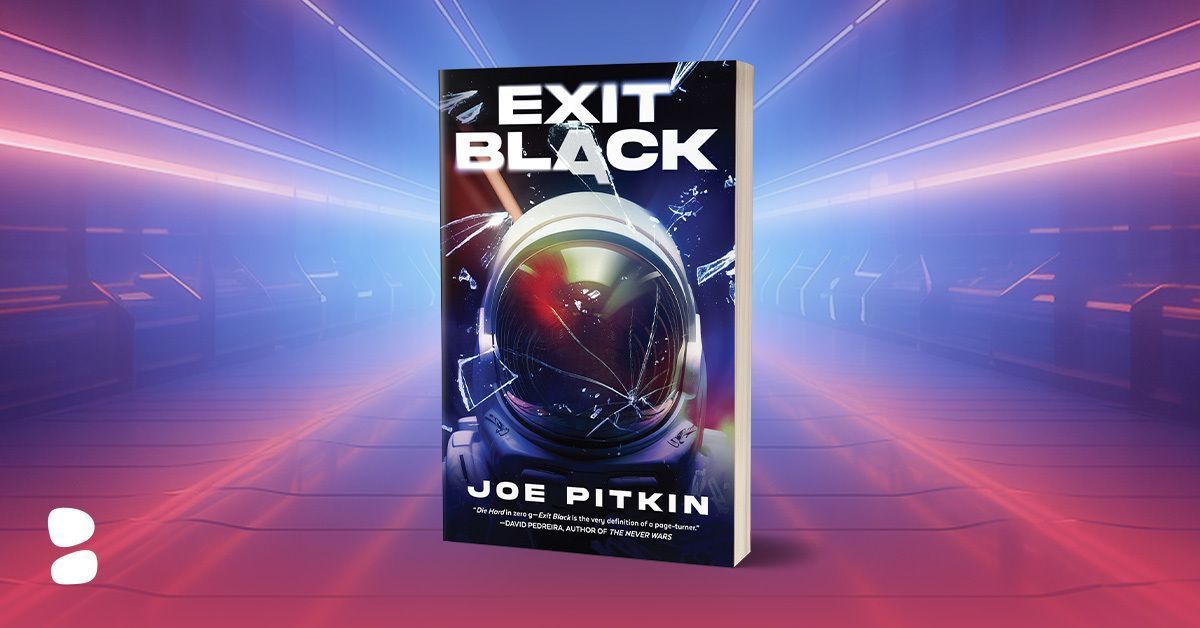
It’s publication day for my latest novel, Exit Black, and I was happy to see that the excellent and tireless arts and entertainment journalist Paul Semel chose today to publish our exclusive interview about the book. You can read the interview here: check it out to see why space tourism is the perfect metaphor for economic inequality, as well as who I would cast in an Exit Black movie! I’m still a little tickled that Paul calls it an “exclusive interview”–I mean, it is an exclusive interview, but he makes it sound like I’ve been playing hard to get all these years.
I self-published my first novel, Stranger Bird. That was an experience that I will always treasure: the feeling of putting a book together with a tiny group of friends and family, mostly newbies, doing our own copy editing and picking typefaces and buying ISBNs and learning how expensive it is to publish a book. I imagine the feeling is analogous to playing in an independent-label band, driving around the country in a van and playing a hundred bars and grange halls. And I know that even now, with a traditional publisher putting my book out, I am still a tiny fish in the big publishing ocean–I’m not the kind of writer who is ever going to win a Hugo (good thing, maybe, considering the latest scandal) or be on Reese’s book club list. But, even though I am most definitely small potatoes, I’m still a potato. And it is a sweet and oddly disorienting experience to have a team of people from a publishing house supporting your book. I couldn’t be happier with Blackstone, and I will have a good word for the folks there for as long as I live. Thanks to them, I am orbiting your reading list.
Not long after I published my first novel, Stranger Bird, I mused on this blog about how many people might one day read my book. I realized quickly that it would always be tough for me to know, since the number of people who have Stranger Bird on their shelves will always be higher than the number who actually read it. Exhibit A for this argument is my own TBR pile, which has 34 books in it, most of them better than Stranger Bird, and many of which I will probably never get to, TBR piles being what they are in my life.
Here is the dream I had for Stranger Bird back then: I hoped that the book would one day have 100 readers.That excellent book has something like 16 reviews on Amazon right now, so my guess is that 100 readers is a decent ball park estimate for how many people have read, or will read, Stranger Bird.
Why am I bringing this up now, six years later? Because my new novel Exit Black, is traditionally published, with an actual marketing and promotion team working on it, with actual advanced reader copies and early reviews. I want to hope that a lot more people will read this new book. But what is a realistic hope? 10,000 readers? 100,000?
That seems like a lot of readers for an obscure science fiction writer who mostly works as a community college English instructor. For now, let me amplify my dreams by a single, ambitious order of magnitude: I hope that 1000 people will read, and love, Exit Black. I’ll never know how many will actually read it, but if Blackstone sells that many copies, or somewhat more than that, I will nurse the belief that a thousand people will read Exit Black.
I’d love for my number of readers to increase by an order of magnitude with each new book: 10,000 readers for Pacifica when it comes out, 100,000 for unnamed novel #4. At that rate, the entire population of Earth will be reading my ninth novel when I publish it, and then I can die knowing that I was the Colleen Hoover of my generation.
(I suppose that Colleen Hoover herself is the Colleen Hoover of my generation, but whatever).
Anyway, I’m sure that the Earth’s ecosystems have some carrying capacity for readers of Joe Pitkin books and that the population will level out at some limit long before I reach ten billion readers. I don’t have to worry about that right now. Right now, I’m hustling to get a thousand.
When I was writing it, one of the ideas that guided my upcoming novel Exit Black was that it was to be “Die Hard in space.” Those may have been the exact words that my publisher and my agent used when describing the project to me.
They couldn’t have known when they pitched the project to me that I was not a fan of Die Hard. Practically every one who was a young man in 1988 America loved Die Hard. How could I have hated the most iconic action movie of all time?
The answer to that is mysterious to me. One might think that because of my Quaker religious practice, I blanched at all of the violence in Die Hard. And maybe I did somewhat. However, there are a lot of violent movies that I love–some of them (like Fargo) are arguably more violent than Die Hard. And I loved most of the people in Die Hard--Bruce Willis was really doing something new in action movies with his portrayal of a sometimes panicked, self-doubting John McClane.
I think if I had to pin down my early dislike of Die Hard, it was the studio’s use of Beethoven’s 9th Symphony in the trailers for the movie. That piece of music was a touchstone for me even in my youth–I hated the studio’s use of a sacred cultural treasure (one whose main theme is of peace and universal brotherhood, no less) to sell an action movie about killing a bunch of common thieves (spoiler–sorry). I only watched A Clockwork Orange once in my life because of the same cognitive dissonance around Beethoven’s 9th.
But I was excited to work on a project with my agent and with this publisher, and when they proposed Die Hard in Space I thought I’d better give the movie another look. On watching it again, I was still turned off by the celebration of violence, and there were a number of other elements that I had forgotten but which haven’t aged very well over the last 35 years. But I also saw something there that I hadn’t noticed the first time.
I saw the antagonist, Hans Gruber, with new eyes. He was cool, self-possessed, brilliant but not a blowhard the way a James Bond villain would be. Of course, it was also impossible on this later viewing not to see the arc of Alan Rickman’s career stretching off before him as he glowered like a panther, snarling in Hans Gruber’s faux German.
While I didn’t come to like Die Hard on this second viewing, I was entranced by Hans Gruber. I wanted to write a cool villain like that. I wanted to make a character who readers would hate but who also they would find fascinating, perversely compelling. I wondered if I could build a novel around an antagonist like Gruber, perhaps even someone who would be more antihero than antagonist, like the character of Satan in Paradise Lost.
And that was how I decided to take on the Exit Black project. While even now the book is being marketed as a kind of Die Hard in space, I often tell people I tried to write something more like a Coen Brothers remake of Die Hard: a story with all the ironies and regrettable choices of a Greek tragedy, focusing on a noble, hubristic, ruthless, chillingly violent antihero at the center of the story. Exit Black is a space age remix of the old movie, a kind of Die Hard: The Hans Gruber Story.
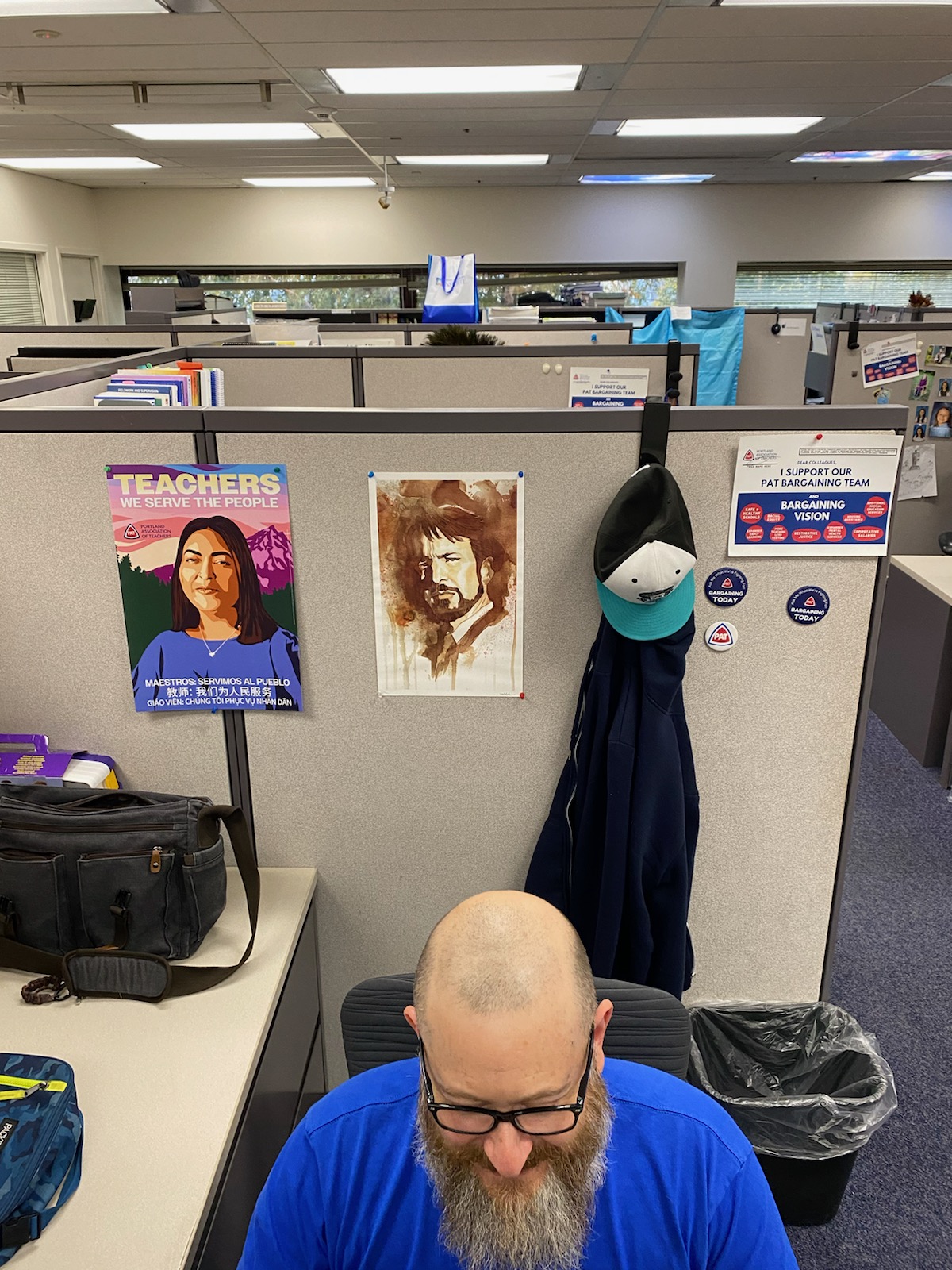
I hope the book will appeal to all of those perpetual teenagers typing away with a portrait of Hans Gruber stuck to their cubicle walls:
D&D friend, fellow unionist, and cubicleman Mike Carlip with portrait of Hans Gruber. Photo credit Carlyn Eames.
A long, long time ago, children, before everyone was self-publishing books on Amazon, before millions of people were writing fan fiction on their smart phones and publishing it to Wattpad, the bookstore chain Barnes & Noble represented (to certain lefty NPR-listening types, anyway) everything that was wrong with the publishing industry. Barnes & Noble stores were proliferating across the strip malls of America like massive commercial toadstools, and many people saw the local Barnes & Noble as a kind of Wal-Mart of books: a destroyer of independent bookstores and hometown loveliness. (If what I’m describing sounds like a plot point from the old 1998 rom-com You’ve Got Mail, that’s because the bookstore mega-chain in the movie was a not-so-subtle portrait of the real Barnes & Noble of the time.)
Fast forward 25 years, and Barnes & Noble seems more like the underdog now, trying to reinvent itself amidst the moribund shells of America’s hollowed-out malls, hustling to stay alive beneath the crushing shadow of Amazon. I was no lover of Barnes & Noble back in the You’ve Got Mail days, and I still try to buy all of my books at the many fine independent bookstores of Portland, but I have to admit that I have a soft spot for Barnes & Noble as it holds on for dear life.
I hope I’ll be seeing Exit Black at a whole lot of Portland spots–can I interest you, Broadway Books? How about you, Annie Bloom? But there is an unexpected thrill to seeing my name come up on the website of that once-maligned mall standby, good old Barnes & Noble. If I get a chance to do a reading or a signing at one, I’m going.
I’m pleased to announce that my story “Nomenclator of the Revolution” is now appearing in Boston Review. The folks at BR did a lovely job with the layout and the drop quotes, and I couldn’t be happier that the story is available to be read.
From the set of Guillermo del Toro’s Pinocchio, another tale about the relationship of language to authoritarianism. Photo Joe Pitkin.
And here’s a little secret about the story for you all, beloved blog readers: the short poem in the middle of “Nomenclator” is one of my favorite poems that I have ever written, and it’s a piece that I found impossible to place (in fact, I stopped trying to publish any of my poems after receiving about thirty rejections of that one). I remain convinced that it’s a good poem; hopefully it has a better fate as the work of a fictional character in this story.
I’ve spent the last few weeks drafting two new short stories and workshopping a third, so I hope that “Nomenclator” isn’t the last short story you will see from me. However, given the mystical journey of getting stories placed and published, “Nomenclator” may be my last published short fiction for a few months. I hope you enjoy it!
Hello, literarians and assorted (and beloved) fellow weirdos!
I received an email from my publisher, Blackstone, yesterday with a publication schedule for my second novel, Exit Black. I’m excited to announce that my little bundle of joy is due to come out in February of 2024 (or, to use Cesare Emiliani’s Holocene Calendar, February 12024). I promise not to pester you about it every day for the next eight months!
I also promise not to ever refer to Exit Black as “my little bundle of joy” again. But it sure is a little bundle of something–little bundle of action? Little bundle of thrills? Little bundle of artfully strung-together words? That last one feels a little too on-the-nose.
But the novel I’m working on now, Pacifica, begins each of its 74 chapters with an epigraph. Much like the computer game Civilization, each chapter is named after one of the technologies that have made modern humanity possible. And, much like Civilization, each technology is accompanied by an apposite quote. Leonard Nimoy was the gold standard narrator for those quotes in Civilization IV (though Sean Bean has his moments in Civilization VI).
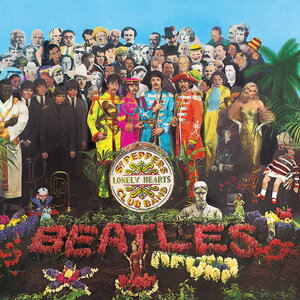
One of the most fun parts of drafting Pacifica has been finding the right quotes for each chapter. I picked from books and poems that I love (as well as a few books that I hated) to put together what I imagined as a kind of collage or mosaic of human knowledge. I imagined the task as something like a literary version of the cover of Sgt. Pepper’s Lonely Hearts Club Band, where The Beatles assembled a photo-collage crowd of their favorite thinkers and artists and goofball influences.
Many technologies were easy to find quotes for. Especially for early technologies like pottery, masonry, and currency, there are a thousand great writers who had something pithy to say. Mostly I would page through books in my office, or CTRL-F through digitized books in Archive.org, to find quotes that spoke to the technology in question and also, hopefully, to the action of the chapter. Sometimes I had to draw the connections myself, in which case the quote turned into something of a writing prompt; other times the quote fit the chapter in deep and unexpected ways that I couldn’t have engineered if I tried.
Some of the later technologies were much harder: for instance, no one from Homer to Virginia Woolf seems to have much to say about the superconductor. Who could I quote for a tech like that?
It just so happened that by the time I got to the superconductor chapter of the book, everybody was talking about ChatGPT. At my college, the discussion revolves entirely around students’ using ChatGPT to plagiarize their essays, an issue which seems to me as trivial, in the grand scheme of dangers that ChatGPT represents, as the crew of the Titanic arguing about a shortage of urinal cakes in the men’s rooms of the Saloon Deck.
So I asked ChatGPT to find me some quotes about superconducting. It suggested some quotes from Larry Niven’s Ringworld and Niven’s and Jerry Pournelle’s The Mote in God’s Eye. They weren’t bad references, exactly–those books do mention superconducting–but none of them resonated with me. So I asked about Arthur C. Clarke, a fave of mine: surely, I thought, Clarke must have written somewhere about superconducting.
According to ChatGPT, Clarke has written about superconducting: of the two references ChatGPT gave me, the one which jumped out at me was this one: “Clarke’s short story ‘The Ultimate Melody,’ published in 1957, briefly mentions the use of superconducting materials in the construction of a futuristic musical instrument called the ‘ultimate melody.'” Now that’s a resonant quote–that would work perfectly for Pacifica!
So I looked up the story and read it (like 90% of Clarke’s short fiction, I had never read it before). Here’s the thing, though: there’s absolutely nothing about superconducting in that story! (For that matter, the futuristic musical instrument is called “Ludwig;” the ultimate melody was the ideal music the instrument was designed to find).
And here’s the other thing, which I discovered later: Arthur C. Clarke did write a short story, called “Crusade,” in which superconductivity is a central plot point. ChatGPT didn’t think to mention it (because ChatGPT doesn’t think yet). I tracked that story down with a simple DuckDuckGo search for “Arthur C. Clarke superconducting.” It’s an excellent story, by the way–very Arthur C. Clarke. And that story had the perfect quote, which fits both Pacifica and the life I feel I am living lately: “It was a computer’s paradise. No world could have been more hostile to life.“
So, for now, I agree with John Scalzi’s excellent assessment: “If you want a fast, infinite generator of competently-assembled bullshit, AI is your go-to source. For anything else, you still need a human.” That’s all changing, and changing faster than I would like, but I’m relieved to know that I’m still smarter than a computer for the next year or maybe two.
So, feel free to call me Mr. Gravity for the rest of 2022. Or Professor Gravity if that appeals to you more. On second thought, don’t call me that: a name like Professor Gravity suggests that I might actually understand gravity, and as my physics teacher said long ago, gravity is harder to understand than you think. Just keep calling me Joe.
Many thanks to Brad and Rob for their fine publication, Center Field of Gravity, which I hope you will check out.
I’m pleased to announce that my story “Before Concord” has been chosen as a finalist for the 2022 Gravity Award by the fine folks at Center Field of Gravity. As they say on the Oscars, it’s an honor just to be nominated.
“Before Concord” is a favorite of mine: it’s my first satisfactory attempt at a hard-boiled detective story (though, because I’m me, it’s set on the University Republic of Mars at the end of the 22nd century). With all the novel work I have been doing lately, I’m very happy to see one of my shorter pieces get picked up.
The winner will be announced this Tuesday the 17th of May, and you can read the story in all its nominated glory here.




 The Subway Test