I mean this in both the “free speech” and “free beer” senses of the term: I use The Subway Test to say what I want, and I have no intention of charging you for my words of wisdom.
I have nothing against the Heather Cox Richardsons and Matt Yglesiases and Paul Krugmans of the Substack world– on the contrary, I love what they are doing, and I’m glad they get financial support for it. And I have a soft spot, or at least an “oh, buddy, bless your heart” compassion, for the thousands of people on Substack with a tiny following who are trying to tease those singles or tens of readers into some stream of income for themselves.
But I have a decent job that I like doing, at least most days, and I get paid enough teaching first year composition at a community college to keep body and soul together. I write slowly, and I know that a paid readership wouldn’t improve me on that score. If I had, say, 14 paid subscribers to please with a regular feuilleton of my own wit and incisive commentary, the pressure to please them would not improve my writing, increase my happiness, or add anything of value to your lives.
But for all that, if you read something here that makes you think, “I like that Pitkin–that slowpoke speaks my mind,” there are other ways you can support me.
A like on one of my posts is nice. A comment is even better.
And if you really want to give me some money, feel free to buy my novel Stranger Bird. It’s a charming YA fantasy written during the height of the Harry Potter Industrial Complex–in reaction to those heady times, I looked back to the older style of YA fantasy that Ursula Le Guin, Lloyd Alexander, and Richard Adams were practicing back in the 1960s and 70s. The result is literally magical.
Or, if you’re not so sure about YA fantasy, you could spring for Exit Black, my 2024 meditation on space tourism which is really a meditation on violence, techbros, and American predators and prey. There’s also a great audiobook version of this one, read by the incomparable Catalina Hoyos.
Or, if you really want to support me, start an independent publishing house of impeccable good taste and artistic daring, and pick up Pacifica to be published in your catalog. That’s my top support tier: if you spend thousands of dollars on me, you’ll have a publishing house with at least one title. That one is a reach goal.
In a post of mine from a couple of weeks back, I mentioned as an aside my preference for the gritty, noir quality of sword & sorcery fantasy over the flash and bombast of high fantasy. As I’ve reflected on that offhand comment over the last days, I’ve wondered precisely what I meant by it. And I’ve wondered, both as a fantasy writer and a teacher of a fantasy and science fiction literature class, whether I even know what I mean by the terms high fantasy and sword & sorcery.
I’m not the only one to struggle with what seem like ill-defined terms. As the Wikipedia page on low fantasyargues, the distinction between high and low fantasy rests on where the action takes place: if the fantasy story takes place on another world (or a hidden world within this world), then it is high fantasy; if the action takes place in this world, then it is low fantasy. But this is hardly everyone’s definition: for many, the distinction between high fantasy and low fantasy involves the role of magic and morality in the story, not the question of where the story takes place. As the same Wikipedia page helpfully explains, “Thus, some works like Robert E. Howard‘s Conan the Barbarian series can be high fantasy according to the first definition but low fantasy according to the second.”
Fafhrd and the Gray Mouser have the same problem. . .but high fantasy or not, Dark Horse’s omnibus edition is coming soon!
So what did I mean when I said I preferred sword & sorcery to high fantasy? Well, here’s what I talk about when I talk about high fantasy: the world of the high fantasy novel or game is a cosmic battleground between the powers of good and evil. Magic is common, perhaps ubiquitous. The protagonists of the story or game–who are good–forge alliances and fellowships with other good creatures (often, and maybe usually, including elves, who often, maybe usually, represent an extreme incarnation of western beauty standards), who are locked in a mortal struggle with a host of evil creatures in the service of an even more evil master. If it sounds like I am describing The Lord of the Rings, I am: Tolkien’s work is usually held up as the type specimen of high fantasy. Many of the great high fantasy franchises you may be familiar with–like J.K. Rowling’s Harry Potter, The Inheritance Cycle of Christopher Paolini, Lloyd Alexander’s Chronicles of Prydain, and the Forgotten Realms setting of Dungeons & Dragons–are influenced by Tolkien’s cosmology. Some are downright derivative, little more than Tolkien reskins.
Behold, good folk, your hot ally has arrived. Legolas cosplay at Chicago Comic Con 2014, Photographer Gabbo T
Sword & Sorcery, by contrast, involves fewer world-spanning struggles between good and evil; instead, sword and sorcery focuses more on the trials and adventures of a single adventurer or a handful of them. Those adventurers are not “good” in the sense that high fantasy uses the term. Rather, “heroes” of sword & sorcery fantasy are typically a bundle of contradictions, a mix of noble and base impulses–often, much like the characters of hard-boiled detective fiction, they are just conflicted people trying to get a dirty job done. In short, sword & sorcery protagonists are a lot more like us, at least on the inside.
Magic, too, is less flashy, and far less common, in the typical sword & sorcery story. Unlike high fantasy, where in many franchises practically everybody can shoot lightning bolts and fly about like the superheroes of an MCU movie, magicians in sword & sorcery are rare, misunderstood, and mysterious figures. They are often sinister or at least morally compromised, as though magical power itself involves a deep and unsavory moral choice. They are far likelier to act as antagonists in the story, representatives of a shadowy corruption that it’s the protagonist’s job to resist.
Many of the classic heroes of sword & sorcery literature–Conan, Fafhrd and the Gray Mouser, Elric–had their heyday over forty years ago. And it’s probably been since the 1980s that I really read those books voraciously. There is no doubt that some of the writers’ underlying assumptions about gender and race have not aged well at all (of course, the same has certainly been said, fairly or not, about Tolkien’s work). In calling for a renaissance of sword & sorcery, I’m not arguing for a return of the passive, white-skinned, Frazetta-drawn “chainmail bikini” damsel in distress to fantasy literature. Sword & sorcery is cool for a totally different set of reasons, reasons which I believe are separable from the socially retrograde ideas of some of the original sword & sorcery creators.
Rather, what sword & sorcery offers, and what I wish Dungeons & Dragons would take more seriously, is moral complexity. Instead of simplistic good-vs.-evil alignments and the racial essentialism of “savage orcs” and “cultured elves,” I’d like to see more D&D that presents players with competing visions of the good, with life a series of tradeoffs to be made rather than a body of questions that one gets right or wrong. I’d like to see a magic system where the costs of devoting oneself to magic–or even wielding a magic item–are high enough that not every player will pursue magic power.
Dungeons & Dragons isn’t really built around those ideas. Too much about alignment and race and magic in D&D seem to assume a high fantasy worldview, and most D&D creators and players clearly seem more comfortable in a Tolkien-inflected high fantasy world. But one of the things I love about the current edition of D&D–and which I hope will continue in the coming version–is the game’s open environment for modifying, for mixing-and-matching. D&D today is more like a great set of cookbooks than a list of prescriptive instructions. And, just as it would be a lot of ridiculous work to prepare every recipe in a cookbook at the same time, most good dungeon masters know not to use every class and race and monster and option presented in the D&D books, at least not at the same time. One can make a sword & sorcery campaign in D&D; it’s just a matter of removing a few of the million options presented in the books.
There is a lot that I still love about high fantasy. I still attend Tolkien’s Birthday Bash every January at McMenamins Kennedy School in Portland to watch 6-13 straight hours of LOTR movies. But I prefer to think of the world we live in as something other than a cosmic battle between pure good and pure evil. And I like my storytelling and games, no matter how fantastic, to say something about the world as it is, not the world that black-and-white thinkers imagine that it is.
But the novel I’m working on now, Pacifica, begins each of its 74 chapters with an epigraph. Much like the computer game Civilization, each chapter is named after one of the technologies that have made modern humanity possible. And, much like Civilization, each technology is accompanied by an apposite quote. Leonard Nimoy was the gold standard narrator for those quotes in Civilization IV (though Sean Bean has his moments in Civilization VI).
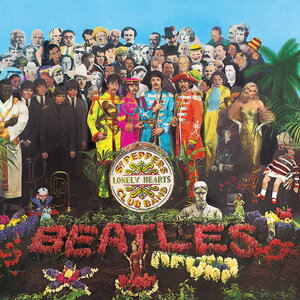
One of the most fun parts of drafting Pacifica has been finding the right quotes for each chapter. I picked from books and poems that I love (as well as a few books that I hated) to put together what I imagined as a kind of collage or mosaic of human knowledge. I imagined the task as something like a literary version of the cover of Sgt. Pepper’s Lonely Hearts Club Band, where The Beatles assembled a photo-collage crowd of their favorite thinkers and artists and goofball influences.
Many technologies were easy to find quotes for. Especially for early technologies like pottery, masonry, and currency, there are a thousand great writers who had something pithy to say. Mostly I would page through books in my office, or CTRL-F through digitized books in Archive.org, to find quotes that spoke to the technology in question and also, hopefully, to the action of the chapter. Sometimes I had to draw the connections myself, in which case the quote turned into something of a writing prompt; other times the quote fit the chapter in deep and unexpected ways that I couldn’t have engineered if I tried.
Some of the later technologies were much harder: for instance, no one from Homer to Virginia Woolf seems to have much to say about the superconductor. Who could I quote for a tech like that?
It just so happened that by the time I got to the superconductor chapter of the book, everybody was talking about ChatGPT. At my college, the discussion revolves entirely around students’ using ChatGPT to plagiarize their essays, an issue which seems to me as trivial, in the grand scheme of dangers that ChatGPT represents, as the crew of the Titanic arguing about a shortage of urinal cakes in the men’s rooms of the Saloon Deck.
So I asked ChatGPT to find me some quotes about superconducting. It suggested some quotes from Larry Niven’s Ringworld and Niven’s and Jerry Pournelle’s The Mote in God’s Eye. They weren’t bad references, exactly–those books do mention superconducting–but none of them resonated with me. So I asked about Arthur C. Clarke, a fave of mine: surely, I thought, Clarke must have written somewhere about superconducting.
According to ChatGPT, Clarke has written about superconducting: of the two references ChatGPT gave me, the one which jumped out at me was this one: “Clarke’s short story ‘The Ultimate Melody,’ published in 1957, briefly mentions the use of superconducting materials in the construction of a futuristic musical instrument called the ‘ultimate melody.'” Now that’s a resonant quote–that would work perfectly for Pacifica!
So I looked up the story and read it (like 90% of Clarke’s short fiction, I had never read it before). Here’s the thing, though: there’s absolutely nothing about superconducting in that story! (For that matter, the futuristic musical instrument is called “Ludwig;” the ultimate melody was the ideal music the instrument was designed to find).
And here’s the other thing, which I discovered later: Arthur C. Clarke did write a short story, called “Crusade,” in which superconductivity is a central plot point. ChatGPT didn’t think to mention it (because ChatGPT doesn’t think yet). I tracked that story down with a simple DuckDuckGo search for “Arthur C. Clarke superconducting.” It’s an excellent story, by the way–very Arthur C. Clarke. And that story had the perfect quote, which fits both Pacifica and the life I feel I am living lately: “It was a computer’s paradise. No world could have been more hostile to life.“
So, for now, I agree with John Scalzi’s excellent assessment: “If you want a fast, infinite generator of competently-assembled bullshit, AI is your go-to source. For anything else, you still need a human.” That’s all changing, and changing faster than I would like, but I’m relieved to know that I’m still smarter than a computer for the next year or maybe two.
I’ve had a long spell away from this blog while I was drafting my third novel, Pacifica. But now that Pacifica is (finally, after a thousand sighs) drafted, and as I prepare for the publication of my second novel, Exit Black, by Blackstone this year, I’m able to give a little more attention to this space. I’ve missed being here, and I’ve missed interacting with you through The Subway Test. I hope to connect with you a little more frequently in the coming months!
Today the temperature on our backyard weather station topped out at 112 degrees Fahrenheit. Apparently the reading at the Portland International Airport was 116 degrees. It was the hottest day ever recorded in the history of Portland. Indeed, it was very likely the hottest day that has ever occurred in this valley in the entire history of human habitation at this site. The second hottest day in Portland’s history was yesterday; the third hottest was the day before that.
For years, ever since I knew what climate change was–ever since we used the term global warming instead of climate change–experts have cautioned the public not to point at any specific weather event and say “See? That’s climate change at work.” With my own students, I’ve taken pains to differentiate weather from climate and to help them understand that extreme weather events have always been with us, that extreme weather is a natural consequence of living on a planet with an atmosphere and oceans and an axial tilt. However, extreme weather events do not happen by magic. And I am thankful that more and more Americans seem to have awakened to the reality that these shocking extremes in the weather are being driven by human-caused climate change.
A few years ago, I decided to devote the rest of my career to fighting anthropogenic climate change. Like a lot of people, I feel overwhelmed by how puny my influence is in relation to the scope of the problem. But I can work to address climate inaction at my college, and I can help shepherd into being academic programs devoted to restoration ecology and climate remediation and environmental policy change. And I know that I can work with students in ways both formal and informal to help them see the political and economic transformation ahead of us.
You can see the transformation ahead of us as well. It will cost you and me a good deal of money to address the catastrophe that is upon us. However, you and I will pay it: either we will pay the cost to save human civilization or we will pay for our civilization’s collapse.
I hope that a few locals who have been snookered by Fox News and its ilk into climate change skepticism (some of them students of mine) will be jostled into cognitive dissonance by the heat of the last three days. I have less hope for the cynics and nihilists that broadcast to them or who pretend to represent them politically. But it was ever so: those who today claim that climate science is unsettled are close cousins of those who used to argue that cigarettes don’t cause cancer or that black people were happier as slaves than as free people. For whatever social evil one cares to name, there is a powerful constituency that benefits from its existence and that will fight to keep it. For the last several decades, that force has been concentrated in the Republican Party and its various media outlets. The names may change at some point–just as the Republicans used to be a far more progressive party than today and the Democrats far more socially regressive–but there will always be a group of powerful people ready to defend an exploitative or oppressive status quo.
But here’s the good news, to the extent that any news about what is happening to us can be good: climate change is not going away. The problem will continue to knock at our doors more and more insistently. And in the words attributed to my favorite Republican, “you may fool people for a time; you can fool a part of the people all the time; but you can’t fool all the people all the time.”
I’ve spent months away from The Subway Test and from social media in general, deep in the burrows of a new writing project. And, as exciting as that new project has been (it’s so exciting that I can’t really tell you much about it), I have missed the writing practice that I had before, working on short stories, my novel Pacifica, and the odd blog post that most people read when I cross-post it to Facebook.
But regarding Facebook, I have had another reason for my radio silence: I just haven’t known how to respond to the mounting news about what a monstrous company Facebook is. On the face of it, I’m not sure it should be such a hard decision for me to leave Facebook (and its horrible little sister, Instagram): a company that seems devoted to permitting, even encouraging, the spread of political disinformation, up to and including disinformation that drives genocide, is a company I want nothing to do with.
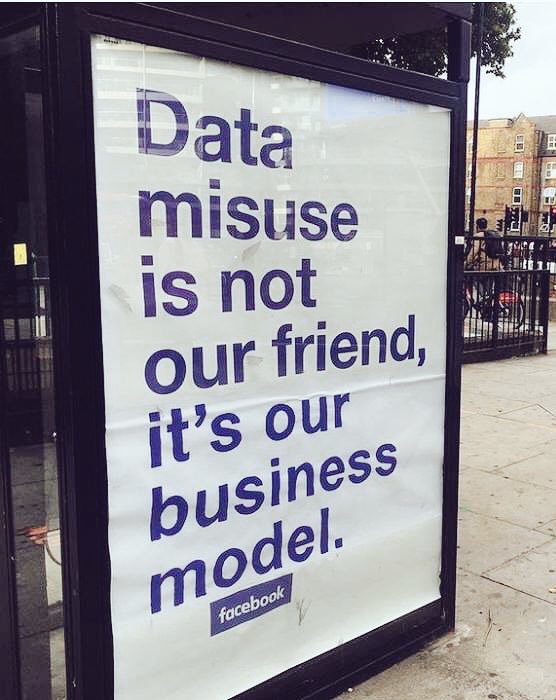
Copyright Adbusters
One of the only reasons I’ve had trouble leaving is that I don’t normally think of Facebook the company when I’m connecting with friends over Facebook the platform. That is, until about six months ago I was doing a fair amount of compartmentalization regarding my Facebook feelings: I would hear the news about Facebook’s business practices with mounting disgust, then log on and hand out a bunch of likes and haha faces and hearts to my friends’ pictures and memes and political links. Part of me knew that Facebook’s poetic PR language about connecting the world was just so much corporate bullshit. But then I would get on Facebook and act like all of that bullshit was true.
That’s because Facebook has very effectively built a business model which exploits our love for our friends and family. There’s nothing inherently wrong with such a business model: a thousand major companies, from Hallmark to Hasbro to TGIFridays, monetizes our desire to connect with people we love. But I do expect such a company, if it claims to be devoted to connecting me with my loved ones, not sell my personal data to political dirty tricks operations, to voter suppression outfits, to election oppo researchers. And I definitely expect such a company to step in when their platform is being used to encourage genocide.
So, please consider this my last post on Facebook. If you are reading this post on that platform, know that I will miss you. You I like. But so long as Facebook continues under its current leadership, with its mix of smarmy public apologies accompanied by no meaningful change in policy, I won’t be back. As a small potatoes writer who would like to have more exposure, I do understand that leaving Facebook behind will mean cutting off one of the few channels by which most people see my work. But the internet is a big place–there will still be lots of places that an interested reader can find me.
If you happen to be an interested reader, feel free to subscribe to my blog, The Subway Test –you can also find the blog simply by googling “Joe Pitkin.” Until then, I’ll say goodbye and deactivate my accounts on New Year’s Day.
I’m open to coming back someday. In fact, I’ll be happy to come back to Facebook and Instagram if the company will take meaningful action to clean up its act. For starters, the Board of Directors needs to fire Mark Zuckerberg and Sheryl Sandberg. I know that Zuckerberg can go ahead and fire the board in return–he is after all the majority shareholder in Facebook–but the board needs to grow a spine and do its job. If Zuck wants to fire the board in return, let him go ahead and do that: at the very least his doing so will make public what a morally bankrupt human being he is. If the board is able to replace Facebook’s top executives with people who will shepherd a transformation at Facebook, creating a company with meaningful privacy policies, meaningful informed consent about how our data is used, and a serious effort to clamp down on disinformation and incitement, Facebook could be fun again.
It’s been a while since I’ve posted here, but I haven’t been idle. My story “Potosi” has come out in Analog, and the story editor for the magazine, the indefatigable Emily Hockaday, asked me if I would write a companion piece for the Analog blog. I’m reposting it here. Thanks for the invite, Emily!
Science fiction writers love aliens. We believe in their existence; we dream of hearing from them. As a boy, I remember seeing Carl Sagan’s explanation of the Drake Equation—a string of variables that estimates the number of extraterrestrial civilizations in the galaxy—and being struck both by the possibilities of interstellar neighbors and by the tremendous uncertainty in the variables.
Those of you who have spent time meditating on the Drake Equation know that its variables fp and ne, representing the number of planets in the galaxy and the fraction of those planets harboring environments suitable for life, have been pinned down with greater and greater confidence in the last two decades. You know, too, that the value of these variables is very, very high. But many of the other variables in the Drake Equation remain highly uncertain, even suspect in a couple of…
My two month-long radio silence from this blog has been a little sad-making for me. I have a lot to report about my writing; my incisive (to me) observations are piling up, waiting to be observed in this blog. But dang–work life and my dadly responsibilities have made blogging hard of late.
There’s more to come on The Subway Test: I am hopeful that the coming two months will be less bananas at work than the last two months have been. There are books I want to share with you, scientific discoveries I’d like to philosophize about, news about my own writing to share. I hope we’ll see each other here soon.
I’ve written flash fiction (i.e. a story of less than 1000 words) only a couple of times in my life. It’s not a genre I’m comfortable with. But I liked this attempt at flash fiction–I hope you will too. Readers who have seen my story “Lamp of the Body” will recognize the name of the bar. I am no lover of astrology (more accurately, I’m an astrology loather), but I always thought “Mercury Retrograde” would be a cool name for a bar. Anyway, I hope you like it: “I Fall to Pieces.”
Photo credit: Rob Swatski
I Fall to Pieces
Wil has just enough room at the end of the text to address the girl by the pet name he used with her: Soph. He would have liked to write out the full Sophia. But apparently even breakups, like relationships, are about compromise.
Wil feels a jolt of energy move through him when he finishes pecking out the message on his phone. It feels like a flash of purpose; he is old enough to know that such a jolt often spells trouble. But it is hard to walk away from such a flush of energy. He presses the Send button.
He downs the rest of the pint in front of him and wonders whether his tone had been appropriately dignified. 150 characters is not a lot to work with when establishing a tone. Probably that is one reason not to break up with someone via text messaging.
He imagines her out with someone else, someone who looks like Ethan Hawke. Or maybe a huge black swan. What does it matter? She is in the Rose Garden where Wil had walked with her on their first date. Only now, instead of walking beside her, taken in by her, Wil inhabits each rose bush like a troll as she walks by.
Which leads him to wonder whether he was in fact breaking up with her. Or had his message simply shown her, at last, that he understood that she was ignoring him? You send a text. Ok, maybe she didn’t receive it. You leave a voice mail, you leave a Facebook message. She doesn’t answer them. You send up smoke signals and a poem tied to the leg of a homing pigeon. You blink to her in Morse Code. She ignores every overture, explicit and implied, written and spoken and telepathic. Who is breaking up with whom, really?
The waitress comes back and he orders without looking up. Instead he gazes around the bar at the couples and singles. Half of them—half of the couples, even—are pecking away at smart phones, taking pictures of their beers, announcing to Facebook acquaintances that they are sitting @ Mercury Retrograde, perhaps summoning a real friend from his house in the glorious sunset. Would it have been better to have sent her a Facebook message instead of a text? In addition to a text? Wil dismisses the latter possibility as soon as it occurs to him: have some dignity, you sorry bastard, he tells himself.
He is tired of dissecting the last word she said to him (before she said goodbye):yes.Do you want to see Obscure Object of Desire at the Laurelhurst, he had asked her. What she said was yes. Had it been a yes of unalloyed, infatuated enthusiasm, as he had assumed when he first heard her say it? Or was there a subtext, an undercurrent of sarcasm or cruelty or carelessness or lack of resolve? He is exhausted from running over the contours of that yes in his mind, but he cannot help himself from worrying over it the way one picks at a festering sliver in the palm of the hand.
The bar stereo is playing Patsy Cline’s greatest hits. “I Fall to Pieces,” Wil’s favorite. You walk by, and I, fall to pieces, she sings. That’s a song that only makes sense in a small town in the fifties. When and where would Wil just see her walking by? You ignore my texts and I fall to pieces, he thinks.
Wil realizes that he should not have ordered another pint as soon as the waitress brings it. He contemplates the full glass morosely, watches the foam spread over the top of the nut-brown ale as though it is a map of lost continents spread over a dark ocean. Perhaps an entire civilization of yeast had burgeoned and died in this glass, unmourned by all except Wil in his drunkenness.
A cheer goes up throughout the bar. On the muted bar televisions a news program is reporting the first holographic marriages to be ceremonialized in New York. Wil looks up from his beer at the pair of slender, aged holographs in tuxedos exchanging vows on the screen, and at the dozens of patrons rejoicing that everyone is free now to love whoever they want.
I’ve always regarded NaNoWriMo participants with a mixture of admiration and skepticism: I love the can-do spirit of the movement, but I’m also curious about what kinds of novels come out of the experience. I remember when I was first considering NaNoWriMo for myself, I read an article by founder Chris Baty that “Slow writers find they can write about 800 words of novel per hour; a speedy writer (and good typist) can easily do twice that.” I knew then that I was not the droid Chris Baty was looking for.
Whatever the merits of NaNoWriMo, someone writing 800 words per hour is not a slow writer in my book. When I was writing Stranger Bird, I rarely wrote faster than 250 words per hour, I would guess–and that was on days that I was focused and serious. And that worked for me–Stranger Bird turned out well, I think, and while it may never get picked up for publication, it’s not a badly written novel at all.
So why do I even care how fast Chris Baty thinks a slow writer can write? Well, for a number of reasons, I don’t have the luxury of writing time that I had when I was working on Stranger Bird: long empty summer months when writing a novel was really the only thing I was doing. One of the main reasons I turned to writing short fiction since then has been that a slowpoke like me can cobble a good story together with the dribs and drabs of time that are available to me: a half hour here, a few minutes before bed there, maybe a couple of uninterrupted hours on the weekend.
Pacifica is the working title of my second novel. Often I’ve felt foolish for taking a run at it: I feel so starved for time on most days that I’ve no idea how the whole draft will come together. As I work on it, I have to calm myself down daily, get clear with myself that this draft will be sloppy, come to accept that it will be full of dead ends and plot holes. All first drafts are loose, but I am consciously giving myself permission to write something truly horrible in the rough draft, in the hopes that somewhere in the slop of it there will be a story I can draw out. Otherwise the book will never come together; I just don’t have the time to write a tighter rough draft. This isn’t a NaNoWriMo project–I’ve been working on this draft since July and have at least another month or two to go–but I feel as though I’ve absorbed something of the NaNoWriMo ethic.
It’s been an uncomfortable process, almost painful some days. And it may turn out to be a flaming disaster of an experiment. But if anything good comes of it, it will be because I got over my control freakery long enough to allow 50,000 words to erupt on to the page.




 The Subway Test