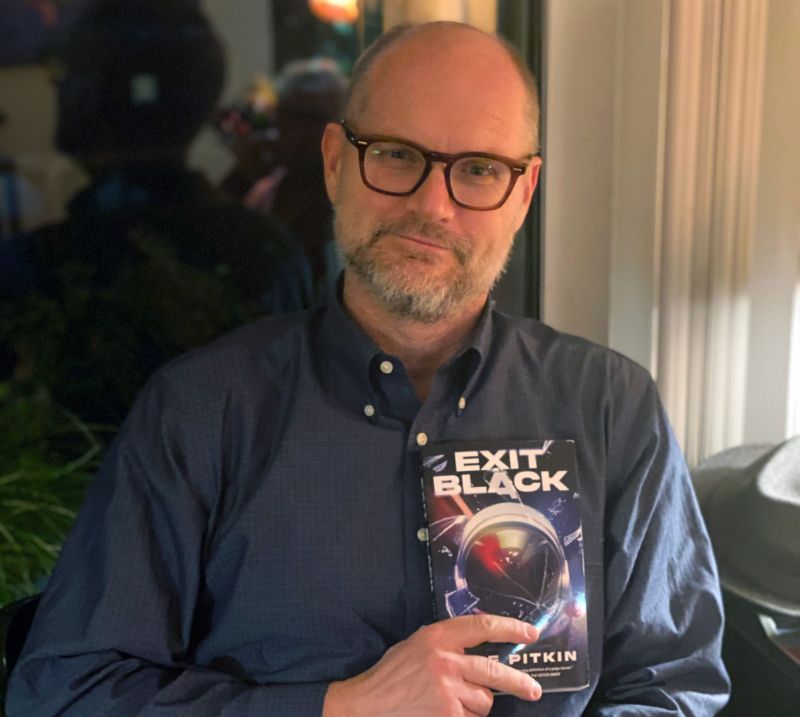
As you may remember from former posts, I’m a big fan of the book site Shepherd. And, like many of the writers on that site, I was invited by Shepherd founder Ben Fox to talk about my three favorite books of 2024. I was game, partly because I’m happy for any opportunity to link to my own book of this year, Exit Black–I believe it’s one of this year’s best thrillers on economic inequality that you’ll read this year.
I’m not sure what my choices say about me besides the fact that I do a lot of reading outside the genres I write in, but here were my three faves of this year: Edith Wharton’s The Age of Innocence, Toni Morrison’s Jazz, and Laurent Binet’s Civilizations. Why did I love them so? Check out my Shepherd page to find out!
Two Saturdays ago, my colleague and friend Julian Nelson went into cardiac arrest and died. About the shock and sadness of losing him I have nothing more to say than that I am heartbroken. But besides the shock, and besides the gaping sadness of losing him, I was insulted by the surprise of his leaving: he was a young man, or at least not an old one, still gadding about Clark College like a boulevardier or a peripatetic philosopher in the week he died. While he had suffered daunting health challenges his whole life, he had an illusionist’s knack for conveying vitality to the world. I must have just been assuming that he would be around forever. As Ophelia would have said, I was the more deceived.
Julian came to work at the same college as me in 2005 as a German professor. I was on his screening committee, in fact, so I met him before almost anybody else at Clark College had. And even before he was hired, I knew that he was someone who, if circumstances permitted, I would be friends with. Thankfully, the circumstances did permit: Clark College hired him, and we became immediate fast friends. I was impressed and a little intimidated by his skill with languages and with his knowledge of writers and philosophers that I had barely heard of, much less read. Yet I think we also saw in one another a love of old books, a commitment to the ancient Stoic concept of kosmopolitês, a shared sense that the world and its follies were an elaborate joke with a hilarious and redemptive punchline just over the horizon.
Lots of people thought we looked alike. I didn’t see the resemblance, frankly, though I can understand that a couple of bald Teutonic men of a certain age will share certain likenesses. One upper administrator at the college–a supervisor to both of us–would call me Julian at least as often as they would call me Joe. After a few months of that public confusion, Julian started greeting me with “Hallo, mein Doppelgänger!” a term which he knew better than anyone conveyed the sense of the eerie, a spirit twin or evil double, as though the existence of one of us spelled trouble for the other. But I knew he was joking, and even if our resemblance had been deadly serious he would have joked about it because humor was his natural stance towards trouble of all kinds.
And trouble did find him. I had only the vaguest notion of many of the difficulties he faced: he approached so many of his misfortunes with such stoic and sardonic humor that I wasn’t always sure how heartbroken he was. But the misfortunes I did see–such as when the college shuttered his beloved German program, not because of his teaching (which was excellent) or student demand (which was strong), but because it seemed a convenient place for the administration to scoop up a little money in a lean time–he faced with aplomb. And, because he had a PhD in comparative literature and knew more about novels than most of the English department, he simply remade himself as an English teacher and kept going. It wasn’t long before he won a second Faculty Excellence Award, this time for teaching in a field he had never intended to work in.
I drank as much beer with him, and shared as many laughs with him, as I have ever done with anyone. And, since I am not a young man myself and I follow not so far behind him, there may be no one else in my life that I will share more beers and silly bookish jokes with. Though we had grown up up across the world from one another, we were both children of a homophobic age that is skeptical of close male friendship, as though the most natural and necessary thing in the world is to say “no homo” after any expression of affection between men. We spoke about this modern hesitancy about male friendship over beers once, bonding over a line from Montaigne that we both loved (ironically for me now, an essay Montaigne had written about the passing of his own close friend, Étienne de La Boétie): “If a man should importune me to give a reason why I loved him, I find it could no otherwise be expressed, than by making answer: because he was he, because I was I.”
I did love him, because he was he and because I was I. As I think about his being gone now, as I consider his wonderful writing that will remain in rough draft forever, the portraits he took with his ancient cameras whose film will never be developed now, my own regret is smaller and more personal. I regret my lack of courage about speaking German with him. He had such facility with English, French, German–I think Greek, even. But I was too reticent, too self-conscious, to say more than a handful of words to him in German. What is it like to speak a language that’s not yours, to know that there are a thousand things you could say if you were speaking your own language, but that in this language, the one you are trying to speak now, you are limited to the crudest approximations and flattest understatements? That the language you are trying to learn has a million deeps and narrows that, even if you practice every day for the rest of your life, you’ll never be able to express? I told him once that I had been studying German daily–I think I was up to a three year streak on Duolingo at that point–in hopes that we would one day talk about books and history in his native tongue like two refined and learned men of the world. (Being refined, being regarded as a man of the world, has been one of my most ridiculous and futile obsessions since I was 12 years old.) And Julian, always the language teacher even years after the college had scuttled the German program, praised my faltering efforts and then made a couple of quick steps in German that escaped me before he had said four or five words.
I’ve lost the chance now to look past my own embarrassment and fear of mistakes, to just speak with the man in whatever poor German I would have been able to cobble together. But in his honor, I want to recite one of the only German poems I know by heart: “Herbsttag,” by Rainer Maria Rilke. This poem, which translates as “Autumn Day” in English, captures the season in which Julian died. And more to the point now, it captures the feeling of the autumn season of life that comes for you, too, if you are lucky enough to live that long.
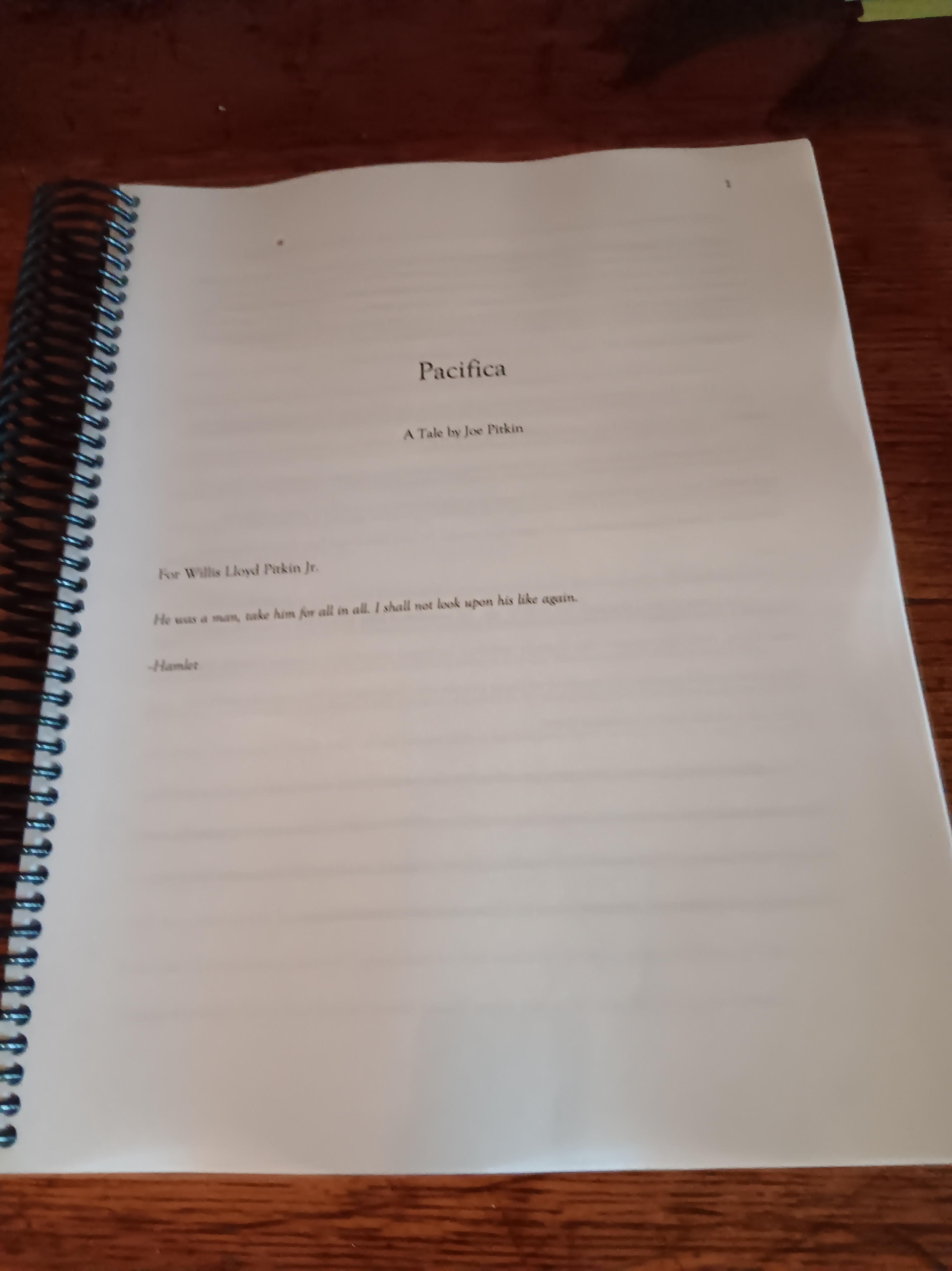
As one of the silly characters in the book says, consummatio est. After 15 years of experimenting, worrying, improvising, devising, revising, and catalyzing, I’ve finished a draft of Pacifica that I can walk away from. While any author will tell you that a novel is never really finished, I do feel good about what I’ve done here. If I get hit by a bus tomorrow, I will feel ok (if I feel anything at all) about people reading Pacifica.
It was a much more foolish version of me who set out in 2009 to write a comic novel in hopes that it would be fun. And I would be lying if I said that I never had any fun at all: there were many times that the writing filled me with joy. But more often it was a hard and frustrating slog, like a summer fling one enters into foolishly that somehow stretches out into a fractious 15-year marriage. Nonetheless, I came to love the book. As I wrote to a friend, while I may write another book in my life, and I bet I can write a better one than Pacifica, I doubt I will ever love a book as much as I have loved this one. Not just because it is a love letter to my religious upbringing and to the places of my youth, but because it was the most ambitious thing I have ever tried or am likely to try. I remember reading somewhere that Faulkner’s favorite of his own novels was The Sound and the Fury because he felt he could never get it quite right. And even though I am working way, way downhill from Faulkner, I believe I know exactly how he felt.
The title says it all, really. White Oak Books is one of my favorite new additions to the Uptown Village neighborhood of Vancouver, Washington. I spent a long time living just up the street from their spot when I moved to the Northwest, and there were some years that I would have given my eye teeth to have such a cool bookstore in the neighborhood. I’m happy to support them, and I’m honored that they want to help me publicize my work.
Vancouver friends–and Portland friends willing to have your minds blown by crossing the Columbia River–come hear me read from Exit Black, my new SF thriller from Blackstone Publishing, on Thursday, August 29, at 6:30.
White Oak Books 1700 Main Street Ste D Vancouver, WA 98660-2660
I’ve had my head deep in a novel project this summer–my beloved white whale (or white elephant?) Pacifica–and so I’ve been away for a few weeks from this blog, as well as my garden, and hiking, and sometimes even meaningful human contact.
But! I love hearing from people about my latest novel, Exit Black, which came out in February. This screenshot, from my friend Bill in New York, is one of my favorites:
Yes, Exit Black is on the shelves in the New York Public Library!
For lots of reasons probably having to do with talent, I’m not the kind of writer who is ever going to win a Nebula or a Hugo, much less a PEN award or a Pulitzer. But someday I can tell my grandkids that their grandfather once had a book on the shelf of the New York Public Library. And, grandkids being grandkids, and the future being the future, there’s a good chance they will ask “what’s a library?” or, God forbid, “what’s a book?” Sic transit gloria mundi.
I used to write songs all the time. In fact, songwriting was the first literary genre I took seriously as writing for writing’s sake (as opposed to strings of words on paper that I would turn in for a grade at school like a monkey doing a trick for a banana with a big “A+” drawn on the peel. Or a banana with a “B-” on it–those bananas worked fine for me, too).
Back when I was a skinny, shaggy young slacker, I wrote songs for the first band I was in, The Missionaries. Then I wrote a lot more songs for the bands that followed (Leatherbound Shakespeares, The Ben Was, Hop on Pop). None of those songs were any good–seriously, the best thing about those bands (besides how amazing our hair was back then) were the band names. But the songs themselves? In retrospect, I can see that they were very early artistic efforts, much more earnest than skillful.
The artist earnestly trying on some kind of Roger Daltrey vibe, 1986 (?)
Come to think of it, though, I do believe a couple of songs I wrote for that last youthful band, Hop on Pop, were actually pretty good. I remember feeling proud of them when I was 20 years old because they were so far beyond anything I had written previously. In fact, I’d give a lot to hear those songs again, not the way I would play them today, but as we played them over thirty years ago, feeling brash and flip and like we were going to be whisked off at any minute to an as-yet-undetermined big city to become rock stars.
I’ve been playing music on and off (mostly off) since then, mostly for a band where I am the youngest and least technically adept player. This band has gone by a few names as well: Los Profes, then the Gravitropes, and now we’re trying on the name threejays (what do you think, dear reader? Should it be capitalized? All lower case? ALL UPPER CASE?!) In any case, the one thing I brought to the group historically–besides relative youth–is half-decent songwriting ability.
So it was with a little leap of inner joy when I found myself writing a song a couple of weeks ago–the first one I have written in at least 12 years or so. Will it be any good? Hard to say. As I tell my creative writing students all the time, you’ll write a lot of crappy poems (or stories, or songs) before you write a single good one. And then you’ll write a lot more crap before you start writing good stuff with any regularity. And no one I know writes good stuff all the time. So the odds are stacked against this song (with the working title “Necktie Rhetoric”) being a good one. But it feels great to come back to a genre I haven’t tried in a long time. Whoever you are out there, and whatever you do, I wish for you to feel the freedom to make something useless exactly the way you want to make it.
The artist declaiming…something…over a pleasant drone of guitars, 1991
I was invited recently to present a workshop at one of Oregon’s wonderful creative writing conferences–the Compose Creative Writing Conference at Clackamas Community College (perhaps the hosts tried to come up with a seventh word starting with c- for the title, but six must have been all they could fit in). After the honor of being invited wore off, I realized that I would have to actually, you know, present something at the CCWC at CCC.
I decided to present a session on reducing infodump in speculative fiction. Did I choose this topic because I’ve been widely praised for my taut, sleek stories? I wish. Actually, if anything the opposite is true: during the early years of my fiction career, I got so many rejections along the lines of “this story is well-written, but it takes forever to get to its point. There’s so much infodump here that I was barely able to get to page 8.”
The best thing I can say about infodump in my writing is that editors don’t complain about it in my stories nearly as often now. So I figure that I’ve either learned to deal with it or editors are just tired of giving me notes on it.
As you probably know already, infodump refers to bogging down the flow of a story with tedious explanation. And, while writers of any genre can fall into the habit, it’s an especially common problem in speculative fiction. If you’ve ever read a bad fantasy novel (or watched a bad sci fi movie), you have surely seen some infodump along these lines:
Scientist: I sequenced the DNA sample you brought me. Whoever provided it has some snips that I’ve never seen in a human genome before.
Captain: Snips?
Scientist: ‘Single nucleotide polymorphisms.’ As you know, captain, all sexually reproducing creatures on Earth–including humans–inherit two copies of each gene, one from the mother, and one from the father. These genes determine everything from eye color to explainexplainexplain continue explaining for four pages explainexplainexplain I hope you did well in middle school biology…
For me, infodump is even worse in fantasy than in science fiction. In SF, there’s at least the possibility that what’s being infodumped actually will teach you something real about how planetary motion works or what the principle of competitive exclusion is. In fantasy, the infodump often amounts to nothing more than 20 pages of the author’s fever-dream journal entries about a fictional queen who lived 800 years before the story takes place and what she did to curse the elven sword that is the McGuffin for this whole heptalogy of novels…
What causes infodump? Why should you be wary of the phrase “as you know” in your writing? And how do you reduce infodump in your novel? Well, if you want the whole story, come see me at the CCWC on Saturday the 18th! Or, if you’re not a Portland person, drop me a line: I’m always happy to talk F/SF with book clubs, writing groups, bookish nerds, random drunks, and people on a secret mission.
For now, I’ll just say that two factors that contribute to infodump are 1. writers’ mistrust of the reader’s ability to follow along, and 2. writers who get lost for hours (or months, or decades) in worldbuilding before they ever get around to actually writing their story.
I may say more on the subject soon, but as you know, I have been working on reducing my infodump.
During our first-ever trip to Spain last year, my wife and stepdaughter and I immediately noticed the variety and beauty of Spanish door knockers. Neither Rick Steves’ Spain nor any of our friends who had been to Spain nor Carlyn’s hundreds of hours studying Spanish on Duolingo prepared us sufficiently for them. And after taking a few dozen shots of them, my wife began planning a book of these pictures, which she plans to title Carlyn’s Knockers.
Imitation being the sincerest form of flattery, etc. etc., I began thinking that I should do something similar. Novels, short stories, trenchant cultural and political analysis–who cares about all of that? I should be applying my very novice photography skills to something interesting in the found environment.
Luckily, this thought occurred to me while I was looking at a curious garbage can in the restroom at Two Stroke Coffee in the St. Johns neighborhood of Portland. My newest occasional blog series was born!
So without further ado, I give you the first installment of what I am calling Let’s All Admire That Fantastic Can:
Garbage Can, Two Stroke Coffee Restroom
What first struck me about this can was that it appears to be signed by skateboarding legend Tony Hawk, or at least someone who has really practiced Tony Hawk’s autograph.
I was further intrigued by the much insulted (and perhaps stained) label at the top of the can stating “THIS IS NOT A URINAL.” If you have to remind patrons that something is not a urinal, your coffee shop occupies a certain ecological niche. Maybe you are thinking “that can’t possibly be the coffee shop for me.” However, I am here to tell you that Two Stroke Coffee is awesome. And they have an awesome restroom garbage can.
I’ve been hunting for years for a better book recommendation system than Goodreads (and its corporate owner, Amazon). One site that I think really shows promise is Shepherd: it’s better-curated, less compromised, more values-driven. And I’m honored to announce that I have been invited to make a Shepherd recommendation myself. Mine is called “The best fantasy-science fiction books that explore class and inequality,” and I’d love to have people take a look at it.
I’m grateful to have a website taking on the Goodreads/Amazon juggernaut. Goodreads is one of those ideas that struck me as having so much promise when it came out: it seemed (at first, anyway) a place where everyone could share ideas about the books they love. But, far from being a democracy of bibliophiles, Goodreads is a crass book marketing system that has proven easy to game and to abuse, from review bombing to pay-for-reviews to careless and anonymous one-star reviews just for the lulz.
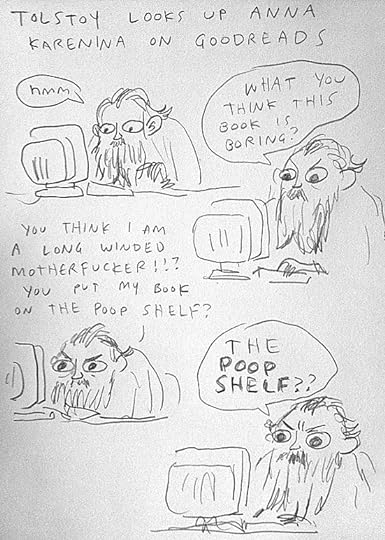
And, while my Goodreads reviews for Exit Black have been decent–more good reviews than bad, and a number of reviews from people who must have actually read the book–I am a little suspicious of a review site where The Martian has a higher rating than Madame Bovary and where only 42% of Anna Karenina reviewers gave that book 5 stars. Seriously?
Cartoon credit: Kate Beaton, Hark! A Vagrant
I accept that for better and worse, Goodreads and Amazon are the ways that authors have to market their books. I don’t have to like that state of affairs, but I do accept it. However, I’m always on the lookout for something better, something more humane, something not yet made grubby by millions of people on the make for a quick buck or trash-talking for the dopamine hit of a bunch of likes. Shepherd might not last. But for now, I really like the way they approach books and the people who write and read them. I hope you’ll go check it out!
I had every intention of publishing my interview with fellow Willamette Writer (and fellow community college teacher) Avis Adams when she published it almost two weeks ago. Then the end of winter term descended over me like a weighted blanket made of student essays and departmental emails. Now that I have finally wriggled out from under its sweaty embrace, I can give a little more attention to this blog, to promoting Exit Black, and to all things literary.
So, many thanks to Avis for cooking up some delightful interview questions and for offering such a warm reading of my book. Check out her review and my interview at her wonderful blog, Your Next Favorite Author.








 The Subway Test