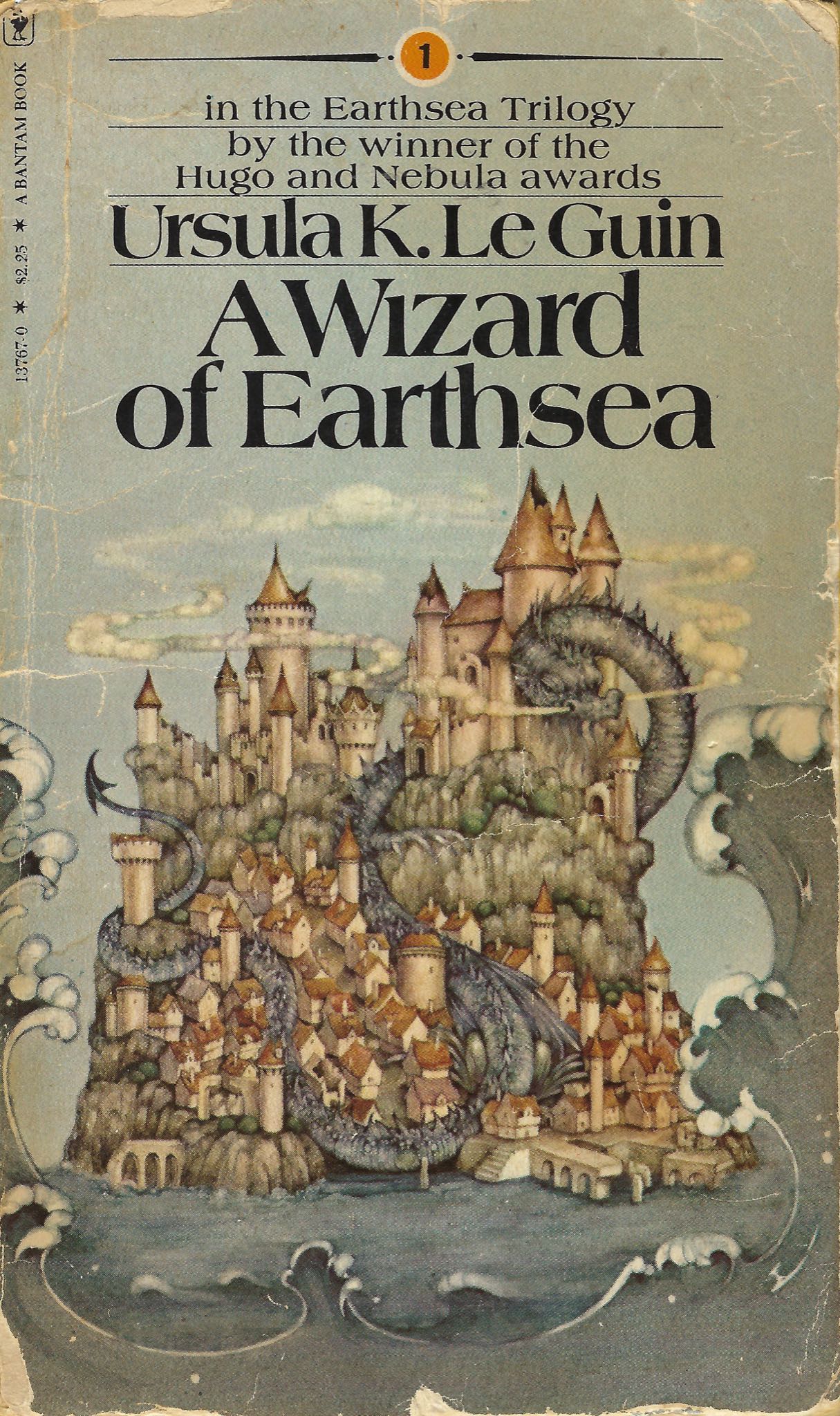
Today, after a peer critique of the fifth or sixth fantasy story we’ve seen this quarter, I asked my fiction writing students how many of them were into fantasy. All but three of them raised their hands.
Then I asked how many of them had read A Wizard of Earthsea. Not one of them had.
Every once in a while, I’ll wonder what I’m doing, what inner problem I’m attempting to solve by working at a community college. Then I’ll have a moment like this, and I’ll realize that if my only contribution to my students’ lives is that I turned a few of them on to Usrula Le Guin–a woman who wrote practically all her books just a couple miles away on Thurman Street in Portland–I will have done something good with my life.
And you, dear reader, do you like fantasy? Have you read A Wizard of Earthsea? If you haven’t, go pick up that little book and check it out: you’ll see something that isn’t a hundredth as famous as Lord of the Rings, and which didn’t make a thousandth as much money for the author as Harry Potter did for J. K. Rowling, but Earthsea is better than both of them. Read it, and then contend with your desire to sue J.K. Rowling for plagiarism.
And as a bonus, if you aspire to be a fantasy or science fiction writer yourself, read just the first paragraph of A Wizard of Earthsea and see how much Le Guin accomplishes without a scintilla of infodump. What’s a dragonlord? you may ask as you read that first paragraph, What’s an archmage? The answer is who knows? It won’t matter, because you’ll already be hooked.
I was trawling through some of my old posts on The Subway Test, and I noticed that I had published this one, “A Meditation on Time,” exactly ten years ago. As I reread it, I realized that a lot of what I was struggling with back then has gotten even more visible, more acute, with the advent of LLMs. It feels like a message in a time capsule to my future self. And maybe to you: I hope that time is not your enemy.
Here is what I wrote on that long-ago February day:
I have been taking my sweet time in reading Anna Karenina, a Christmas gift from my lovely stepdaughter. At the rate I’m going, I would guess I have two more months with this delicious, painful, hilarious book. Meanwhile, as I dither through this enormous work of art, it’s been hanging over my head that I don’t keep up my blog as befits a serious writer, dispensing witty remarks and novel observations at least once per week.
I really don’t yearn for “simpler times” (e.g. Tolstoy’s time), in which the world of ideas moved more slowly and people had time–from our perspective, anyway–to write long letters and long novels, to linger over an idea in a journal for months and even years. Many people of Tolstoy’s day didn’t regard their time as leisurely: they felt as rushed and harried as we do now, since the era of railroads and electricity had sped up life for them at an unprecedented rate. Perhaps in a hundred years my descendants will regard my lifestyle as leisurely, since most of us today don’t yet have Adderall prescriptions or cranial implants or other technological prostheses to speed up our rate of pumping out new ideas and reacting to new ideas we see.
This morning as I read my ten pages on the bus, I was taken by Tolstoy’s words about time: Prince Shcherbatsky is reacting to being told that “time is money,” and he says, “Time, indeed, that depends! Why, there’s time one would give a month of for fifty kopeks, and time you wouldn’t give half an hour of for any amount.”
It occurred to me as I sat with that quote today that I have given away lots of time in my life for fifty kopeks, or for less. When I returned to graduate school in my thirties, I was so excited to be able to take classes at public expense (since I am an employee of the state, my classes cost $5 per course)–I often joked with people that I had spent more money on parking tickets than on tuition when I was in grad school the second time. I feel thankful to the Great State of Washington every time I think of what I learned there.
But I also made a huge blunder by valuing my labor at zero in those days. The courses cost $5, so my degree must only cost about $100, no? Yet, of course there was the massive opportunity cost of my shutting myself up for years to read academic papers on ecology and statistical analysis: there were hikes I didn’t take, other skills I didn’t learn, traveling I didn’t do. I’ve written in a couple of my stories from that period about students who get into ecology because they love spending time outdoors in nature, but that their ecological studies lock them up in a lab for months on end doing gas chromatography or grinding up plant tissue samples.
I’ve come home with a fever tonight–ironically, the fever is what has slowed me down enough to be able to meditate about time in this blog post. And I have realized that as I age, I am becoming less and less willing to give up time to others (that is, to people I don’t love) for any amount. Even if by magic I could, I wouldn’t give up this feverish time tonight–unpleasant as it is–for money. I’m sure I have my price for taking on more work, but I’m realizing that the price is much, much higher than a community college would typically pay. I would just rather have the time.
One of the most celebrated poets in America right now, Danez Smith, came to my college to read last week. My job, as a utility infielder on Clark College’s creative writing committee who happens to live near the airport, was to pick up Danez and drive them to their hotel downtown.
The pick-up was a breeze–Danez has clearly done this kind of thing many times–and I was pleased when they got in the car at how easygoing they seemed, as well as how I was not coming off (in my own mind, anyway) as too star-struck.
As I drove, we chatted about America’s two main Portlands–Danez is living in Portland, ME right now–and they pressed me on my mixed feelings about my own Portland (i.e. a great American city driven to a terminally twee nonconformity by, among other things, the show Portlandia). We talked about the amazing restaurant town that Portland, OR, has become, and I was overjoyed to hear that Danez would be eating at Gado Gado, a brilliant Indonesian place in my neighborhood.
And then, while describing to Danez what the gado gado dish consists of, I took the wrong exit on to I-84–instead of the westbound, towards downtown, I took the eastbound, towards Utah. I’ve driven from the airport to I-84 hundreds of times, so I am not sure what made me take the wrong exit just then: maybe my poor memory for foods was taxing my brain as I tried to remember what was in gado gado, or maybe I was more star-struck than I realized.
In any event, the wrong exit I took was one of the worst wrong exits I could take in the whole benighted Portland metro freeway system. Exits do exist on I-84 eastbound between Portland and Utah, but really there are a lot fewer than you would think. I got off the freeway at 122nd street and started making a loop down to the butt end of Sandy Boulevard, where I knew I could get back on to I-205 and thence to westbound I-84. We talked about family, about the trouble that comes for our loved ones at the end of their lives (and, by extension, for us one day). I navigated expertly after my breathtaking blunder back to the freeway, got us back on, and we were back on the track. Danez looked up at one of the exit signs and said “Wait, wasn’t that where we got off the freeway last time?”
Indeed it was, Danez Smith, indeed it was. I’ve just taken 15 minutes of your life force at the end of a very long travel day for you. Forgive me.
The next day, Danez read like a dream. They came up in the slam tradition, and they have a theater background to boot, and it shows: each poem was like some incantation, a crazy pile-up of language that blew us all away. Part of me wished that I was one of the shell-shocked 19 year-olds from Intro to Literature sitting in the audience, encountering their first poetry reading the way I took in mine from William Stafford in 1989. You poor suckers, I wanted to say to them, it’s never going to get better than this. If you go to a thousand more readings, you’ll always be thinking about this one.
Danez is a better and younger poet than me. I had to remind myself of something I tell my creative writing students every term to help them get past the anxiety and professional jealously that comes from reading the work of someone better than you: that both Jimi Hendrix and Neil Young were at Woodstock–in fact, they arrived together in the same hot-wired truck–and that not one of the 500,000 people at Woodstock would have said that Neil Young was the more talented guitarist of the two. But Jimi Hendrix’s greatness does not make Neil Young less great, and Neil Young is no less singular a talent just because he had to share the stage with someone as incandescent as Jimi Hendrix. (Of course, in this extended analogy, I am neither Jimi Hendrix nor Neil Young, but rather an accomplished and nearly unknown player like Dave Schramm or, even more aptly, like a member of the fictional band the Late Greats from the Wilco song).
Here’s Danez’s most famous poem, one they didn’t read last week, but one that will give you a taste of what we heard. Good Jimi Hendrix energy–we were lucky to catch it at Clark College, “The Harvard of Two-Year Colleges,” in scenic Vancouver, Washington:
I mean this in both the “free speech” and “free beer” senses of the term: I use The Subway Test to say what I want, and I have no intention of charging you for my words of wisdom.
I have nothing against the Heather Cox Richardsons and Matt Yglesiases and Paul Krugmans of the Substack world– on the contrary, I love what they are doing, and I’m glad they get financial support for it. And I have a soft spot, or at least an “oh, buddy, bless your heart” compassion, for the thousands of people on Substack with a tiny following who are trying to tease those singles or tens of readers into some stream of income for themselves.
But I have a decent job that I like doing, at least most days, and I get paid enough teaching first year composition at a community college to keep body and soul together. I write slowly, and I know that a paid readership wouldn’t improve me on that score. If I had, say, 14 paid subscribers to please with a regular feuilleton of my own wit and incisive commentary, the pressure to please them would not improve my writing, increase my happiness, or add anything of value to your lives.
But for all that, if you read something here that makes you think, “I like that Pitkin–that slowpoke speaks my mind,” there are other ways you can support me.
A like on one of my posts is nice. A comment is even better.
And if you really want to give me some money, feel free to buy my novel Stranger Bird. It’s a charming YA fantasy written during the height of the Harry Potter Industrial Complex–in reaction to those heady times, I looked back to the older style of YA fantasy that Ursula Le Guin, Lloyd Alexander, and Richard Adams were practicing back in the 1960s and 70s. The result is literally magical.
Or, if you’re not so sure about YA fantasy, you could spring for Exit Black, my 2024 meditation on space tourism which is really a meditation on violence, techbros, and American predators and prey. There’s also a great audiobook version of this one, read by the incomparable Catalina Hoyos.
Or, if you really want to support me, start an independent publishing house of impeccable good taste and artistic daring, and pick up Pacifica to be published in your catalog. That’s my top support tier: if you spend thousands of dollars on me, you’ll have a publishing house with at least one title. That one is a reach goal.
I’ll begin with the obvious: we can’t defend the republic simply by reading books. Reclaiming and repairing American democracy will require mass protest, creative civil disobedience, and serious political organization.
But let’s not minimize the importance of a shared text for the cohesion of a political movement: from The Bible to Common Sense to Uncle Tom’s Cabin, defenders of American democracy in the past found solidarity and a shared language through a text held in common. And beyond that, a book often serves as an extended argument for or against a cause, an intellectual defense of an idea that needs defenders. Most Americans haven’t read The Federalist, but anyone who has read it has access to the first and most brilliant exegesis for the Constitution itself.
I don’t expect any of the books below to have the impact of Common Sense. But I got a great deal out of reading each of them, and I think our movement would be better off if more defenders of constitutional democracy were aware of the ideas here. My reasons for choosing to read them were idiosyncratic, but I want to evangelize for each of these books to you. While they aren’t the only good books I’ve read this year, they each in their own way offer an argument for meeting the current authoritarian moment in the United States.
Autocracy, Inc.: The Dictators Who Want to Run the World, by Anne Applebaum: I get the impression that this book is a compilation of pieces that Applebaum has written in The Atlantic, some of which were extended in this book. Nevertheless, I really recommend taking in her argument all at once here. According to Applebaum, the anti-democratic regimes of the world—from Putin’s Russia and Xi’s China all the way to Maduro’s Venezuela and Mnangagwa’s Zimbabwe—have banded together into a kind of mutual aid society. That is, regimes that see democracy as a threat to their survival are helping one another to evade sanctions, to foment an anti-democratic disinformation network, and to sabotage the democracies of the world. This network of autocrats and strongmen has accomplished a great deal to undermine democracy already, and I came away from this little book believing that the struggle against Vladimir Putin and Xi Jinping is inextricable from the struggle to resist Donald Trump. It’s not totally clear yet how the forces of democracy will succeed at restoring civil society’s fortunes; however, success begins with understanding the nature of the forces attacking us. In a dark time, I take heart in Applebaum’s dedication of the book “for the optimists.” To paraphrase John Lennon, she’s not the only one.
Abundance, by Ezra Klein and Derek Thompson. I picked this up after it seemed like every lefty blogger–and a lot of non-lefties–couldn’t stop talking about it. I find the book’s thesis straightforward and compelling: according to Klein and Thompson, America has lost its initiative to build housing, transportation projects, and energy infrastructure, and progressives bear at least some responsibility for that state of affairs. In the name of environmental protection, labor unionism, and racial justice (a trifecta the authors refer to as “everything bagel liberalism”), we on the left have deployed environmental impact statements, restrictive zoning ordinances, and other restrictions on property use, often with the self-serving secondary purpose of boosting property values in blue cities.
As a progressive, labor unionist, and committed environmentalist, I find this thesis challenging. However, it’s hard to deny that NIMBY attitudes have slowed the construction of affordable housing in many putatively progressive West Coast cities, and these same attitudes have slowed or stalled many energy generation projects, even some solar and wind installations, to say nothing of nuclear energy capacity. On the right, Tyler Cowen has argued that organized labor and environmental groups are the two primary culprits in this slowdown. I would like to hold out the possibility that opposition to more environmentally friendly infrastructure, energy generation, and housing is not baked into the recipe of the labor and environmental movements, but this book issues a challenge to us on the left to support, rather than oppose, a society which builds more for its members. One of the personal goals I’ve set myself over the coming year is to investigate ways that the abundance agenda–which I believe I endorse–can be reconciled with the values of organized labor, social equity, environmental protection, and ecological restoration that I also support. Of course, all life is a series of trade-offs, and not every virtuous goal can be maximized simultaneously. I want to seek out practical compromises for the coming restoration of democracy that will move society forward, and this book is a great call for that.
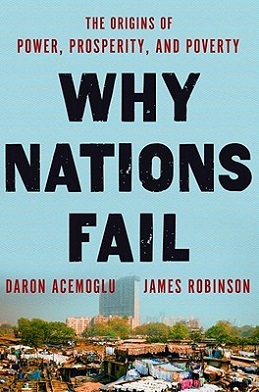
Why Nations Fail: the Origins of Power, Prosperity, and Poverty, by Daron Acemoglu and James Robinson. I spoke of the explanatory power of this remarkable book in an earlier post on democracy. The timing of its coming into my life was a bit random: I saw it sitting on the bookshelf of the drummer in my band about a week after Donald Trump’s 2024 victory, and I guess I was sensitized to the title. And, knowing John to be a well read guy–one of the two best-read drummers I’ve ever played with–I figured I would give the book a spin. Acemoglu and Robinson are two-thirds of a Nobel prize-winning team of economists for their work studying “the importance of societal institutions for a country’s prosperity,” to quote the The Royal Swedish Academy of Sciences. And this book, which struck me as both readable and magisterial in its scope, has helped me more than anything I have read before to articulate why democracy delivers peace, happiness, prosperity, and well-being better than any other form of government yet tried.
In a time when many Americans on the political right are growing fascism-curious (when they are not out-and-proud tiki torch-carrying fascists); and in a political moment when some on the left are so committed to ideological purity around questions of race, gender, Israel, and capitalism that they would rather lose elections than work with centrists, I found this book wise, humane, and ultimately hopeful. I hope more of my fellow Americans will read it.
I’ve been gathering ideas for a fourth novel, and almost the only thing I know about it is that I want to write a noir detective story. Everything else is sketched out in the faintest outlines: I know the protagonist will be a woman because I try to switch between male and female protagonists with each new novel. Also, the woman’s adult son will figure prominently in the plot. So will a guitar.
Beyond that, I don’t know a lot. I don’t think the protagonist will be a professional detective–in this, the story will be more like Graham Greene’s Our Man in Havana or Eric Ambler’s A Coffin for Dimitrios than like Raymond Chandler or Dashiell Hammett. Oh, and the story will be set in Portland.
Portland’s White Stag sign in September 2016. Photo by Steve Morgan.
Why Portland? Well, besides the fact that I’ve lived here for 25 years and know the city pretty well, I’m struck by many of Portland’s noir qualities. The city grew fast over the last 30 years. There’s a lot of money here. One doesn’t need to look very far to find public corruption. Add to that the city’s darkness and drizzle and fog for six months of the year (or seven or nine months), and the atmospherics are great for noir.
But my decision to set the book in Portland got me thinking: what are the great noir cities? Los Angeles is the type specimen because of Raymond Chandler and his spiritual progeny, from Chinatown and LA Confidential to The Big Lebowski. Apparently, then, one doesn’t need a foggy, rainy city as a noir setting (though I was surprised at how often chandler has it raining in The Big Sleep–I’ve never seen so many rainy days in the real LA). Los Angeles in Chandler’s 1930s was still a boomtown: my paternal grandfather’s family had migrated to LA sometime around 1920, I think, on a strength of an advertisement for the city that claimed that in California “the only man who isn’t thriving is the undertaker.” A lot of people from all over the country came in those years, and the mixing of a native Latine population with Blacks of the Great Migration and White Okies and immigrants from all over Asia made for a welter of changing social mores, violence, and resentment. Add to that a land rush of mostly White speculators and the artistic gold rush of Hollywood, and all the ingredients for noir were there: cynicism, corruption, a sense that with enough money all outrages and abominations were permissible.
But many of these boomtown dynamics seem to have smoothed out in LA somewhat over the last 100 years. I don’t think of LA so much as a noir city now–by the time you get to The Big Lebowski, set in the early 1990s, the vibe is more farce than noir.
I don’t know–maybe I haven’t spent enough time in Southern California lately. I’d be happy to hear from Angelinos about the noir qualities of contemporary LA. But what does make a city ripe for the noir? As I think of cities that I have some familiarity with, it’s not hard to put them in noir and not-noir buckets: Seattle and San Francisco, definitely noir. Salt Lake City and Phoenix, not noir. Las Vegas, not noir (at least not today, I feel–1950s Las Vegas is a different thing). Reno, by contrast, strikes me as totally noir. Mexico City is very noir (Grim Fandango, anyone?) while London is not. Budapest, noir. Vienna, not noir–at least not since the days of The Third Man.
What do you think? Where are the under-appreciated noir cities today? How big does a noir city have to be? It’s hard for me to imagine a noir set in the country–that’s the realm of the gothic–but can you have suburban noir? College town noir? I feel great about setting this new novel in Portland, since it’s the first and maybe only time in my life I’ll be doing that. But I’m curious what great noir cities I’m leaving out.
That was my publisher’s note to me when we learned that Exit Black cracked the top ten best sci fi audiobooks in 2024 at Discover Sci-Fi. I’m super stoked: while I would have loved for Exit Black to take the #1 spot, of course, there’s no shame losing out to the likes of Adrian Tchaikovsky narrating his own book and Jeff VanderMeer having his work read by Bronson Pinchot. Carolina Hoyos is a hell of a reader, and I was very lucky to have gotten to work with her.
I loved every step of this project with Blackstone Publishing, and to make my Captain Obvious Statement of the Day: Blackstone knows audiobooks. Thanks so much to all of you who voted and all of you who listened. And, if you haven’t listened yet, if you ever feel a hankering for a tale about a bunch of techbros getting their comeuppance, Exit Black couldn’t be more timely.
As a Portlander, I have to contend with the reality of Powell’s City of Books. It’s the largest independent bookstore in the world, and as you might imagine it has a mighty footprint on the Portland literary scene. A friend who worked there told me about 20 years ago that 40% of Amazon’s book orders actually go through Powell’s. I doubt that that is still the case today, but it gives you some idea of the size of the place, as well as the indirect role Powell’s played in the rise of Amazon. One of Portland’s most popular tourist destinations, Powell’s City of Books is its own Portlandia sketch.
For many years, basically from the time I started writing fiction in my thirties, I had a lot of trouble going into Powell’s. Part of the dread I felt was simple cognitive overload. But I was also contending with two related kinds of self-loathing in the City of Books, one as a reader and one as a writer.
As a reader, I would feel depressed in City of Books to come into contact with all the great books that I hadn’t read and would likely never read. As a writer, I would despair that of the tens of thousands of titles that were on the shelves on any given day, nothing I had written had ever shown up there. In my foolishness, the place had become a visual metaphor for two ways I felt I had come up short as a human being.
Eventually the feeling passed, probably just because I got older. It doesn’t upset me so much anymore that I don’t have that many more books to read in my future. Even if I live a fantastically long life, it seems unlikely that I have more than 2000 books left to read, and the number could be far, far lower than that. The key, as my friend and bandmate John Governale has shown me, is not to try to read all the good books out there, but rather just to remember that there is always a great book out there for me–I don’t need to spend any time reading a bad one.
As for the fact that my stuff had never shown up on the shelves of Powell’s City of Books, I eventually got over myself there, too. I think that as I got better as a writer, I started to find more joy in just writing well (as distinct from winning awards or getting prestigious publications or big book contracts). I still love to get published, but even more than that I love the feeling of putting together a story that really works.
As I tell my students and my kids, there are lots of situations where you start getting good at something right around the time that you don’t have to do that thing anymore. And there was a similar feeling of irony for me when I went into Powell’s City of Books last week and found that my latest novel, Exit Black, is indeed on the shelves there. I still prefer the smaller independent bookstores in my life–Broadway Books, White Oak Books, Annie Bloom’s–but it is a nice feeling to know that a tourist in Portland who wanted to find my work for some reason could find Exit Black right in the Gold Room of Powell’s City of Books, section 722.
As you may remember from former posts, I’m a big fan of the book site Shepherd. And, like many of the writers on that site, I was invited by Shepherd founder Ben Fox to talk about my three favorite books of 2024. I was game, partly because I’m happy for any opportunity to link to my own book of this year, Exit Black–I believe it’s one of this year’s best thrillers on economic inequality that you’ll read this year.
I’m not sure what my choices say about me besides the fact that I do a lot of reading outside the genres I write in, but here were my three faves of this year: Edith Wharton’s The Age of Innocence, Toni Morrison’s Jazz, and Laurent Binet’s Civilizations. Why did I love them so? Check out my Shepherd page to find out!
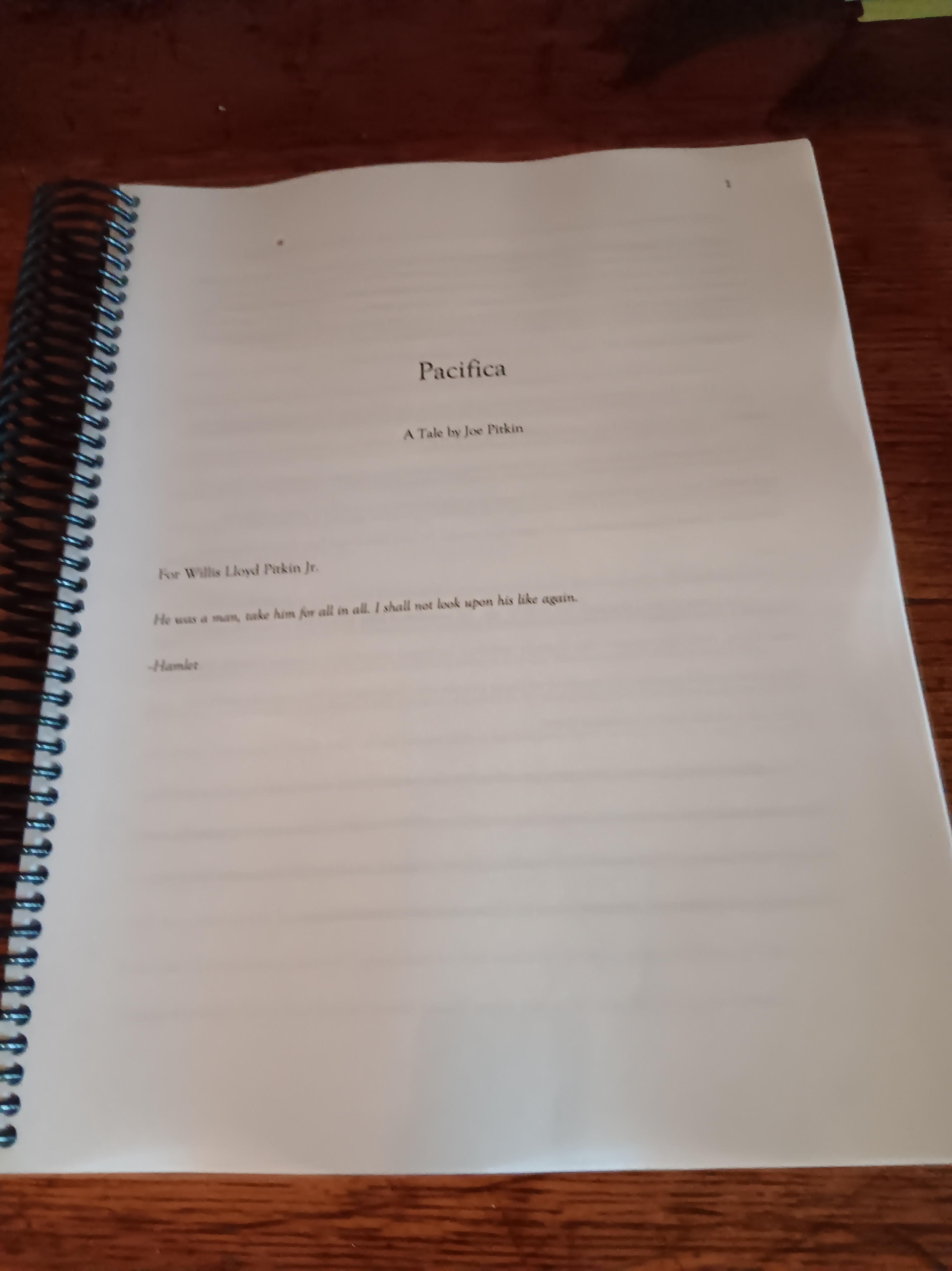
As one of the silly characters in the book says, consummatio est. After 15 years of experimenting, worrying, improvising, devising, revising, and catalyzing, I’ve finished a draft of Pacifica that I can walk away from. While any author will tell you that a novel is never really finished, I do feel good about what I’ve done here. If I get hit by a bus tomorrow, I will feel ok (if I feel anything at all) about people reading Pacifica.
It was a much more foolish version of me who set out in 2009 to write a comic novel in hopes that it would be fun. And I would be lying if I said that I never had any fun at all: there were many times that the writing filled me with joy. But more often it was a hard and frustrating slog, like a summer fling one enters into foolishly that somehow stretches out into a fractious 15-year marriage. Nonetheless, I came to love the book. As I wrote to a friend, while I may write another book in my life, and I bet I can write a better one than Pacifica, I doubt I will ever love a book as much as I have loved this one. Not just because it is a love letter to my religious upbringing and to the places of my youth, but because it was the most ambitious thing I have ever tried or am likely to try. I remember reading somewhere that Faulkner’s favorite of his own novels was The Sound and the Fury because he felt he could never get it quite right. And even though I am working way, way downhill from Faulkner, I believe I know exactly how he felt.





 The Subway Test