I’ll admit it: when I learned that my newest novel, Exit Black, was going to be published in trade paperback, rather than hardback, I was a little crestfallen. I grew up having inherited a whole raft of English major-y prejudices about what kinds of books are good and what kinds are trash. And, literally to judge a book by its cover, hardback books were the best kind of books.
I’ve written about this a little in Pacifica, which is in some ways a love letter to books, in my description of the semi-mythical Book Room:
Among good students at Sterne College, and even among lackluster ones, the Book Room was legendary. No acquaintance of Jude’s had ever reported having seen this inner sanctum of the library, where the leather-bound volumes of some donor’s bequest were shelved, not by Dewey Decimal or Library of Congress, but (according to college folklore) in the manner that had been used by Hypatia and Eratosthenes in Alexandria.
For better or worse, my real novels wouldn’t find shelf space in the Book Room. But, on getting the news from my publisher about Exit Black‘s being relegated to trade paperback status, I did at least feel like it was the right occasion to pull up an excellent old Beatles song, and one of my favorite Paul McCartney bass lines of all time:
So, dear Sir, Madam, or Mixter, will you read my book? It took me years to write; will you take a look?
Not long after I published my first novel, Stranger Bird, I mused on this blog about how many people might one day read my book. I realized quickly that it would always be tough for me to know, since the number of people who have Stranger Bird on their shelves will always be higher than the number who actually read it. Exhibit A for this argument is my own TBR pile, which has 34 books in it, most of them better than Stranger Bird, and many of which I will probably never get to, TBR piles being what they are in my life.
Here is the dream I had for Stranger Bird back then: I hoped that the book would one day have 100 readers.That excellent book has something like 16 reviews on Amazon right now, so my guess is that 100 readers is a decent ball park estimate for how many people have read, or will read, Stranger Bird.
Why am I bringing this up now, six years later? Because my new novel Exit Black, is traditionally published, with an actual marketing and promotion team working on it, with actual advanced reader copies and early reviews. I want to hope that a lot more people will read this new book. But what is a realistic hope? 10,000 readers? 100,000?
That seems like a lot of readers for an obscure science fiction writer who mostly works as a community college English instructor. For now, let me amplify my dreams by a single, ambitious order of magnitude: I hope that 1000 people will read, and love, Exit Black. I’ll never know how many will actually read it, but if Blackstone sells that many copies, or somewhat more than that, I will nurse the belief that a thousand people will read Exit Black.
I’d love for my number of readers to increase by an order of magnitude with each new book: 10,000 readers for Pacifica when it comes out, 100,000 for unnamed novel #4. At that rate, the entire population of Earth will be reading my ninth novel when I publish it, and then I can die knowing that I was the Colleen Hoover of my generation.
(I suppose that Colleen Hoover herself is the Colleen Hoover of my generation, but whatever).
Anyway, I’m sure that the Earth’s ecosystems have some carrying capacity for readers of Joe Pitkin books and that the population will level out at some limit long before I reach ten billion readers. I don’t have to worry about that right now. Right now, I’m hustling to get a thousand.
When I was writing it, one of the ideas that guided my upcoming novel Exit Black was that it was to be “Die Hard in space.” Those may have been the exact words that my publisher and my agent used when describing the project to me.
They couldn’t have known when they pitched the project to me that I was not a fan of Die Hard. Practically every one who was a young man in 1988 America loved Die Hard. How could I have hated the most iconic action movie of all time?
The answer to that is mysterious to me. One might think that because of my Quaker religious practice, I blanched at all of the violence in Die Hard. And maybe I did somewhat. However, there are a lot of violent movies that I love–some of them (like Fargo) are arguably more violent than Die Hard. And I loved most of the people in Die Hard--Bruce Willis was really doing something new in action movies with his portrayal of a sometimes panicked, self-doubting John McClane.
I think if I had to pin down my early dislike of Die Hard, it was the studio’s use of Beethoven’s 9th Symphony in the trailers for the movie. That piece of music was a touchstone for me even in my youth–I hated the studio’s use of a sacred cultural treasure (one whose main theme is of peace and universal brotherhood, no less) to sell an action movie about killing a bunch of common thieves (spoiler–sorry). I only watched A Clockwork Orange once in my life because of the same cognitive dissonance around Beethoven’s 9th.
But I was excited to work on a project with my agent and with this publisher, and when they proposed Die Hard in Space I thought I’d better give the movie another look. On watching it again, I was still turned off by the celebration of violence, and there were a number of other elements that I had forgotten but which haven’t aged very well over the last 35 years. But I also saw something there that I hadn’t noticed the first time.
I saw the antagonist, Hans Gruber, with new eyes. He was cool, self-possessed, brilliant but not a blowhard the way a James Bond villain would be. Of course, it was also impossible on this later viewing not to see the arc of Alan Rickman’s career stretching off before him as he glowered like a panther, snarling in Hans Gruber’s faux German.
While I didn’t come to like Die Hard on this second viewing, I was entranced by Hans Gruber. I wanted to write a cool villain like that. I wanted to make a character who readers would hate but who also they would find fascinating, perversely compelling. I wondered if I could build a novel around an antagonist like Gruber, perhaps even someone who would be more antihero than antagonist, like the character of Satan in Paradise Lost.
And that was how I decided to take on the Exit Black project. While even now the book is being marketed as a kind of Die Hard in space, I often tell people I tried to write something more like a Coen Brothers remake of Die Hard: a story with all the ironies and regrettable choices of a Greek tragedy, focusing on a noble, hubristic, ruthless, chillingly violent antihero at the center of the story. Exit Black is a space age remix of the old movie, a kind of Die Hard: The Hans Gruber Story.
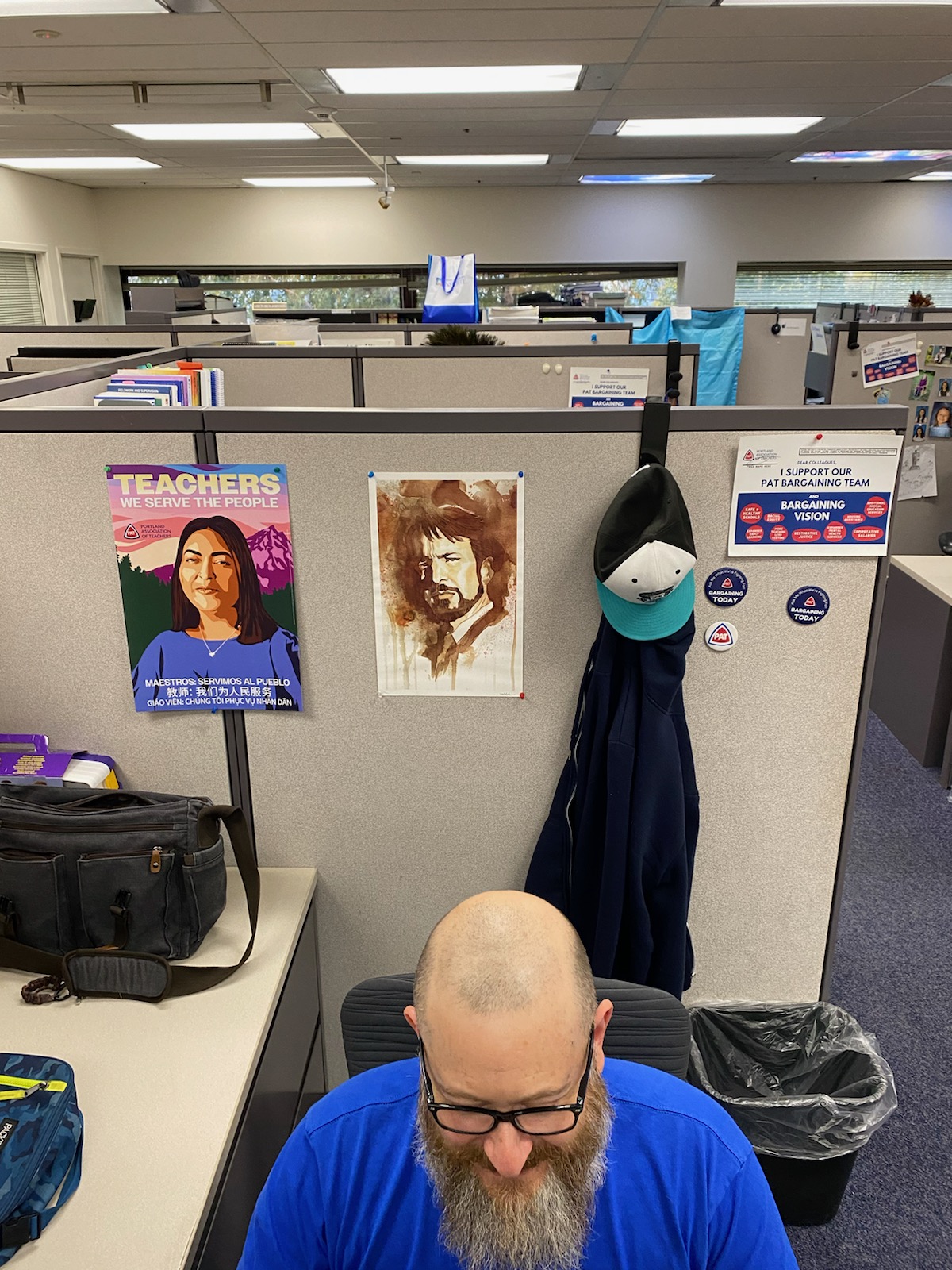
I hope the book will appeal to all of those perpetual teenagers typing away with a portrait of Hans Gruber stuck to their cubicle walls:
D&D friend, fellow unionist, and cubicleman Mike Carlip with portrait of Hans Gruber. Photo credit Carlyn Eames.
A long, long time ago, children, before everyone was self-publishing books on Amazon, before millions of people were writing fan fiction on their smart phones and publishing it to Wattpad, the bookstore chain Barnes & Noble represented (to certain lefty NPR-listening types, anyway) everything that was wrong with the publishing industry. Barnes & Noble stores were proliferating across the strip malls of America like massive commercial toadstools, and many people saw the local Barnes & Noble as a kind of Wal-Mart of books: a destroyer of independent bookstores and hometown loveliness. (If what I’m describing sounds like a plot point from the old 1998 rom-com You’ve Got Mail, that’s because the bookstore mega-chain in the movie was a not-so-subtle portrait of the real Barnes & Noble of the time.)
Fast forward 25 years, and Barnes & Noble seems more like the underdog now, trying to reinvent itself amidst the moribund shells of America’s hollowed-out malls, hustling to stay alive beneath the crushing shadow of Amazon. I was no lover of Barnes & Noble back in the You’ve Got Mail days, and I still try to buy all of my books at the many fine independent bookstores of Portland, but I have to admit that I have a soft spot for Barnes & Noble as it holds on for dear life.
I hope I’ll be seeing Exit Black at a whole lot of Portland spots–can I interest you, Broadway Books? How about you, Annie Bloom? But there is an unexpected thrill to seeing my name come up on the website of that once-maligned mall standby, good old Barnes & Noble. If I get a chance to do a reading or a signing at one, I’m going.
I decided to go in for a new head shot recently. It’s been over six years since my most recent head shots, and not only have I gotten more wizened over that time, but I also have a new book coming out in the next few months.
As with my last photos, my new head shot is he work of the incomparable Pat Rose. You can check out her amazing work here: she’s an institution of Portland portraiture. Having my photo taken by her feels a lot like I imagine sitting for a painted portrait would feel, and at the end of it all she produces an image that is wonderful and painterly as though Jan Van Eyck had painted me.
So, in honor of the coming Exit Black (and of my advancing age), I give you “Portrait of Joe Pitkin, aged 52”. . .