I’ve been hunting for years for a better book recommendation system than Goodreads (and its corporate owner, Amazon). One site that I think really shows promise is Shepherd: it’s better-curated, less compromised, more values-driven. And I’m honored to announce that I have been invited to make a Shepherd recommendation myself. Mine is called “The best fantasy-science fiction books that explore class and inequality,” and I’d love to have people take a look at it.
I’m grateful to have a website taking on the Goodreads/Amazon juggernaut. Goodreads is one of those ideas that struck me as having so much promise when it came out: it seemed (at first, anyway) a place where everyone could share ideas about the books they love. But, far from being a democracy of bibliophiles, Goodreads is a crass book marketing system that has proven easy to game and to abuse, from review bombing to pay-for-reviews to careless and anonymous one-star reviews just for the lulz.
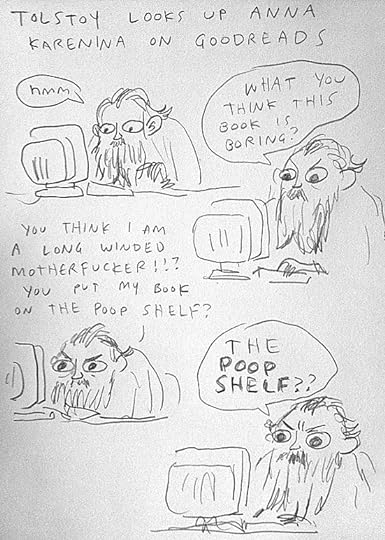
And, while my Goodreads reviews for Exit Black have been decent–more good reviews than bad, and a number of reviews from people who must have actually read the book–I am a little suspicious of a review site where The Martian has a higher rating than Madame Bovary and where only 42% of Anna Karenina reviewers gave that book 5 stars. Seriously?
Cartoon credit: Kate Beaton, Hark! A Vagrant
I accept that for better and worse, Goodreads and Amazon are the ways that authors have to market their books. I don’t have to like that state of affairs, but I do accept it. However, I’m always on the lookout for something better, something more humane, something not yet made grubby by millions of people on the make for a quick buck or trash-talking for the dopamine hit of a bunch of likes. Shepherd might not last. But for now, I really like the way they approach books and the people who write and read them. I hope you’ll go check it out!
I had every intention of publishing my interview with fellow Willamette Writer (and fellow community college teacher) Avis Adams when she published it almost two weeks ago. Then the end of winter term descended over me like a weighted blanket made of student essays and departmental emails. Now that I have finally wriggled out from under its sweaty embrace, I can give a little more attention to this blog, to promoting Exit Black, and to all things literary.
So, many thanks to Avis for cooking up some delightful interview questions and for offering such a warm reading of my book. Check out her review and my interview at her wonderful blog, Your Next Favorite Author.
One of the things I love most about a small bookstore is its point of view. There’s not enough shelf space to try and be all things to all readers: instead, a small bookstore announces its allegiances, however idiosyncratic, and it stocks the shelves with them.
I had my launch reading for Exit Black at my neighborhood bookstore: Broadway Books in Portland. Much like my publisher, Blackstone, Broadway Books is small, independent, a place of fierce good taste. And, while Broadway has a small FSF section, Exit Black fits there.
It’s like Where’s Waldo? but for my book. . .
It may be that my book barely fits there, that it’s on the shelf only because I am a local boy from just up the street. But they did make space for me on that shelf. And if someday, late in the game, I have the kind of readership that the FSF heavyweights have–the Ursula Le Guins and Octavia Butlers and Terry Pratchetts–I’d like to believe that Broadway Books will keep me on their shelves because my work is congruent with their values.
You can order Exit Black anywhere, of course, but you Portland readers, Portland visitors, and Portland passers-through can find a signed copy of my book at Broadway Books. Let me know if you’re in town; I’ll be happy to grab a tea and talk SF with you.
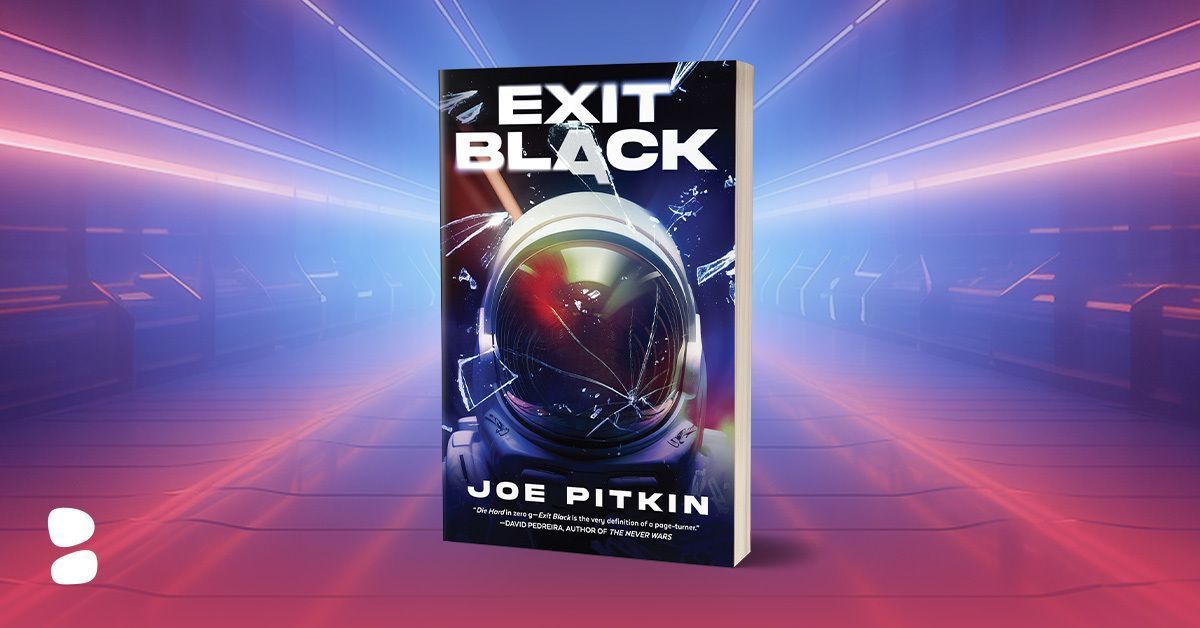
It’s publication day for my latest novel, Exit Black, and I was happy to see that the excellent and tireless arts and entertainment journalist Paul Semel chose today to publish our exclusive interview about the book. You can read the interview here: check it out to see why space tourism is the perfect metaphor for economic inequality, as well as who I would cast in an Exit Black movie! I’m still a little tickled that Paul calls it an “exclusive interview”–I mean, it is an exclusive interview, but he makes it sound like I’ve been playing hard to get all these years.
I self-published my first novel, Stranger Bird. That was an experience that I will always treasure: the feeling of putting a book together with a tiny group of friends and family, mostly newbies, doing our own copy editing and picking typefaces and buying ISBNs and learning how expensive it is to publish a book. I imagine the feeling is analogous to playing in an independent-label band, driving around the country in a van and playing a hundred bars and grange halls. And I know that even now, with a traditional publisher putting my book out, I am still a tiny fish in the big publishing ocean–I’m not the kind of writer who is ever going to win a Hugo (good thing, maybe, considering the latest scandal) or be on Reese’s book club list. But, even though I am most definitely small potatoes, I’m still a potato. And it is a sweet and oddly disorienting experience to have a team of people from a publishing house supporting your book. I couldn’t be happier with Blackstone, and I will have a good word for the folks there for as long as I live. Thanks to them, I am orbiting your reading list.
Not long after I published my first novel, Stranger Bird, I mused on this blog about how many people might one day read my book. I realized quickly that it would always be tough for me to know, since the number of people who have Stranger Bird on their shelves will always be higher than the number who actually read it. Exhibit A for this argument is my own TBR pile, which has 34 books in it, most of them better than Stranger Bird, and many of which I will probably never get to, TBR piles being what they are in my life.
Here is the dream I had for Stranger Bird back then: I hoped that the book would one day have 100 readers.That excellent book has something like 16 reviews on Amazon right now, so my guess is that 100 readers is a decent ball park estimate for how many people have read, or will read, Stranger Bird.
Why am I bringing this up now, six years later? Because my new novel Exit Black, is traditionally published, with an actual marketing and promotion team working on it, with actual advanced reader copies and early reviews. I want to hope that a lot more people will read this new book. But what is a realistic hope? 10,000 readers? 100,000?
That seems like a lot of readers for an obscure science fiction writer who mostly works as a community college English instructor. For now, let me amplify my dreams by a single, ambitious order of magnitude: I hope that 1000 people will read, and love, Exit Black. I’ll never know how many will actually read it, but if Blackstone sells that many copies, or somewhat more than that, I will nurse the belief that a thousand people will read Exit Black.
I’d love for my number of readers to increase by an order of magnitude with each new book: 10,000 readers for Pacifica when it comes out, 100,000 for unnamed novel #4. At that rate, the entire population of Earth will be reading my ninth novel when I publish it, and then I can die knowing that I was the Colleen Hoover of my generation.
(I suppose that Colleen Hoover herself is the Colleen Hoover of my generation, but whatever).
Anyway, I’m sure that the Earth’s ecosystems have some carrying capacity for readers of Joe Pitkin books and that the population will level out at some limit long before I reach ten billion readers. I don’t have to worry about that right now. Right now, I’m hustling to get a thousand.
A long, long time ago, children, before everyone was self-publishing books on Amazon, before millions of people were writing fan fiction on their smart phones and publishing it to Wattpad, the bookstore chain Barnes & Noble represented (to certain lefty NPR-listening types, anyway) everything that was wrong with the publishing industry. Barnes & Noble stores were proliferating across the strip malls of America like massive commercial toadstools, and many people saw the local Barnes & Noble as a kind of Wal-Mart of books: a destroyer of independent bookstores and hometown loveliness. (If what I’m describing sounds like a plot point from the old 1998 rom-com You’ve Got Mail, that’s because the bookstore mega-chain in the movie was a not-so-subtle portrait of the real Barnes & Noble of the time.)
Fast forward 25 years, and Barnes & Noble seems more like the underdog now, trying to reinvent itself amidst the moribund shells of America’s hollowed-out malls, hustling to stay alive beneath the crushing shadow of Amazon. I was no lover of Barnes & Noble back in the You’ve Got Mail days, and I still try to buy all of my books at the many fine independent bookstores of Portland, but I have to admit that I have a soft spot for Barnes & Noble as it holds on for dear life.
I hope I’ll be seeing Exit Black at a whole lot of Portland spots–can I interest you, Broadway Books? How about you, Annie Bloom? But there is an unexpected thrill to seeing my name come up on the website of that once-maligned mall standby, good old Barnes & Noble. If I get a chance to do a reading or a signing at one, I’m going.
I’m pleased to announce that my story “Nomenclator of the Revolution” is now appearing in Boston Review. The folks at BR did a lovely job with the layout and the drop quotes, and I couldn’t be happier that the story is available to be read.
From the set of Guillermo del Toro’s Pinocchio, another tale about the relationship of language to authoritarianism. Photo Joe Pitkin.
And here’s a little secret about the story for you all, beloved blog readers: the short poem in the middle of “Nomenclator” is one of my favorite poems that I have ever written, and it’s a piece that I found impossible to place (in fact, I stopped trying to publish any of my poems after receiving about thirty rejections of that one). I remain convinced that it’s a good poem; hopefully it has a better fate as the work of a fictional character in this story.
I’ve spent the last few weeks drafting two new short stories and workshopping a third, so I hope that “Nomenclator” isn’t the last short story you will see from me. However, given the mystical journey of getting stories placed and published, “Nomenclator” may be my last published short fiction for a few months. I hope you enjoy it!
I’ve known for a long time that writing is a business. But knowing that writing is a business is no guarantee that one knows how the business works. There’s good circumstantial evidence that for the past 20+ years, I haven’t had the foggiest idea about what I’m doing.
Where my writing career is concerned, I’ve tried to follow Steve Martin’s exhortation to be “so good they can’t ignore you.” But what that quote elides is that it’s still up to the writer to give the audience a chance not to ignore you. I could be as good a writer as Emily Dickinson, but if I don’t know how to get people’s attention, my career could still end up like, well, Emily Dickinson’s.
I’m facing this challenge as I go out for a literary agent for my third novel, Pacifica. (I have an excellent agent, Scott Veltri, for TV and movie projects, which is the hope for my novel Exit Black. But Pacifica is not on the list of 10,000 books I would think of for a movie tie-in). As anyone who has ever gone out for an agent knows, a query letter is one of the writer’s few early opportunities to show their understanding of writing as a business. And one of the things I’ve only recently gotten a feel for is the importance of comps for the novel I’m trying to sell.
Comps–short for comparative titles–are a short list of recent books that are similar to the novel you’re selling. And there are apparently rules, or at least norms, regarding the art of good comps. Here are the ones I’ve picked up at conference panels, in writing guides, and intuition:
Pick no more than three books (though apparently one of the books can be a movie or tv program)
Pick recent, commercially successful works, but
Avoid comparing your work to that of literary A-listers (e.g. no Annie Proulxes or Cormac McCarthys)
Are these the rules? If I knew, more people would probably be reading my writing. If you have better intel on how comps work, please jump in the comments or feel free to DM me! I can tell you what wasn’t working for me, though:
Not offering a list of comps in my query letter
Comparing my work to Ursula K. Le Guin’s (though I don’t think I’m wrong! Read Stranger Bird yourself and you be the judge)
Dissing other writers’ work (at the time I was lathered up about what I called the Harry Potter Industrial Complex)
None of these remarks got me an agent, and I suspect now that that was because my approach showed that I didn’t understand how the publishing business works. Agents and publishers want to know comps for a simple reason: they want to know what has already sold well that is similar to the book you are selling. It doesn’t matter if your book is the most exquisitely constructed exploration of the human heart since Anna Karenina–an agent wants to know if your novel will sell.
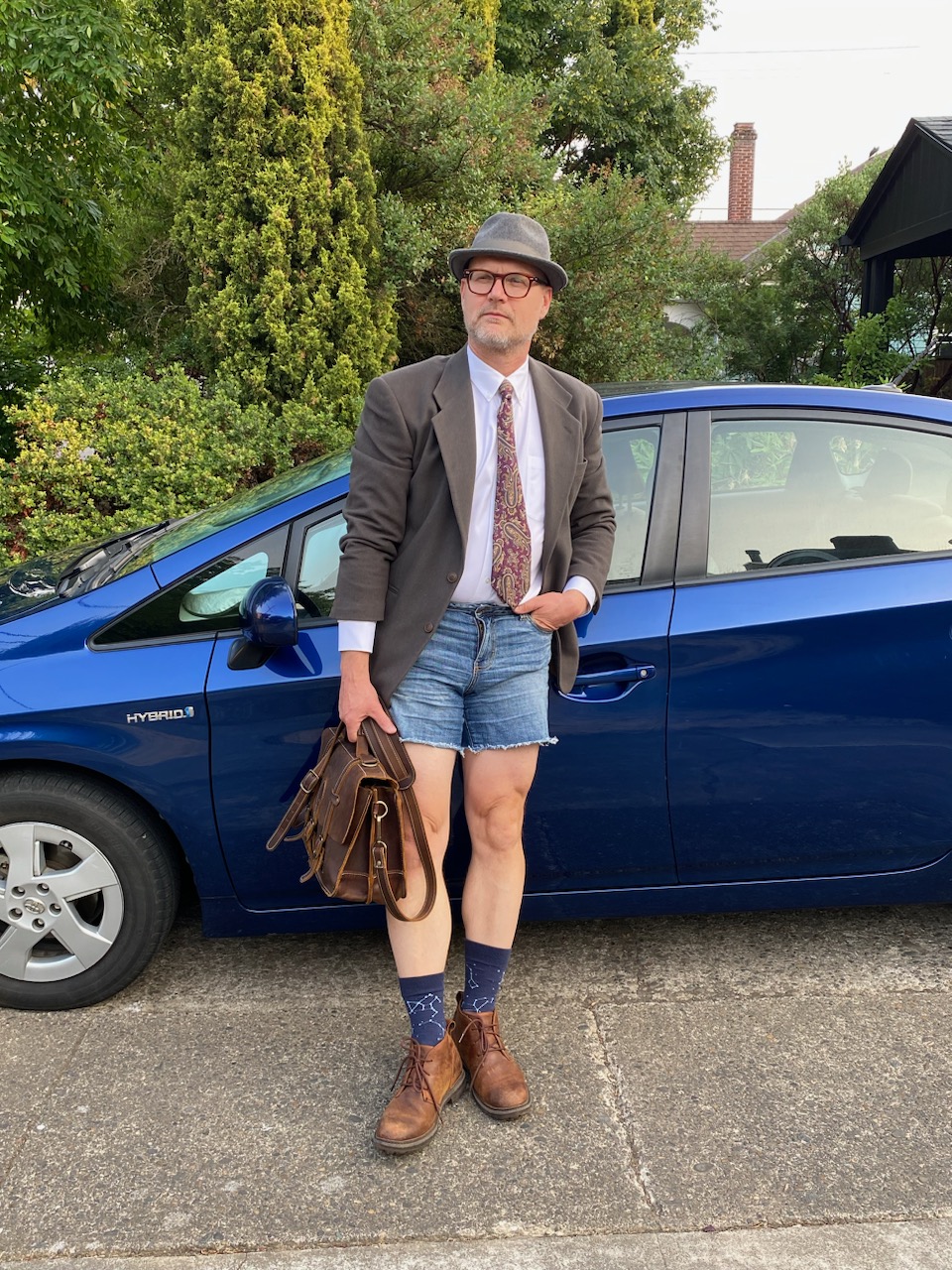
Is that a mercenary attitude? Maybe. Is it a rule that you must have comps? Absolutely not. But there’s also no rule that says I have to wear pants to a job interview. If I want to wear jorts to my next job interview, that’s my right as an American. However, wearing jorts to an interview will foreclose on just about every job offer outside of a very small set of jorts-positive jobs, many for which a 53 year-old man wouldn’t be an attractive candidate anyway.
My last unsuccessful job interview. Photo credit Carlyn Eames
So, what am I pitching as my comps for Pacifica? My three are Gabrielle Zevin’s Tomorrow, and Tomorrow, and Tomorrow; Anthony Doerr’s Cloud Cuckoo Land, and Russell Brand’s The Magic Kingdom–three very different books (and one of them I wasn’t even crazy about). But they’re three recent, commercially successful books, each with a passing resemblance to my book about a guy who has a religious vision playing video games which spurs him to found several increasingly ridiculous, polyamorous intentional communities. I guess that’s not exactly a concept which sells itself. Hopefully the comps will help me market it.
I just got the news that my short story “Nomenclator of the Revolution” will be appearing in the excellent Boston Review‘s online magazine on Friday, August 18!
“Nomenclator” had a mystical journey getting to publication. I drafted it soon after the 2016 U.S. presidential election as a way of exorcising some of the troubles bedeviling me (no reason!) in those days. As is often the case when I’m having a tough time of things, I tried to write something funny–I will leave it to others to judge whether I succeeded. Generous readers might get a whiff of George Saunders’s work (or Donald Barthelme’s or Italo Calvino’s) in what I wrote.
I suppose it’s just as timely a story today, while the National Grifter is threatening the Republic yet again, even as he tries to outrun two three criminal indictments.
I’m also proud of this little story: it’s being published by one of the country’s most prestigious magazines after having been rejected by more than a few less highbrow publications. That’s one more reason for me to wonder whether I could improve the way I market my work. That’s a post for another time, though (the short answer being that I have been historically inept at marketing my work).
“Nomenclator” is the only short story I’m likely to publish this year, since I have been spending so much of my writing time on my novels Exit Black and Pacifica–so check out “Nomenclator of the Revolution” when it drops!




 The Subway Test