• About
  • My Fiction
  • Reviews

The Subway Test

~ Joe Pitkin's stories, queries, and quibbles regarding the human, the inhuman, the humanesque.

The Subway Test

Tag Archives: sci-fi

Reading Roundup 2017

31 Sunday Dec 2017

Posted by Joe in Dungeons and Dragons, fantasy, Literary criticism, Reading Roundup, Science Fiction

≈ Leave a comment

Tags

books, D&D, fantasy, literature, Politics, Reading Roundup, sci-fi, Science Fiction, Stories

I guess I couldn’t get any later with my yearly reading roundup. And, since joining Goodreads last month, the thought of chronicling my reading habits for the last year feels a bit redundant. However, these posts have been fun to write for the last three years, and it helps me to consider in full the books I’ve read over the last year, if only to re-evaluate the stuff I’m reading.

I had a paltry reading harvest this year–13 books in all–though partly this number hides the many short stories, longform journalism pieces, and political blog posts I waded through this year. Having said that, I hope 2018 holds a little less covfefe coverage for me and a few more actual books by thoughtful people.

So, without further prologue, here is my crop of 2017 reads:

Chabon, Michael. The Yiddish Policemen’s Union.  This is one of the most inspiring high-wire acts I’ve read in all of fantasy fiction. Actually, I’m not sure exactly how the book is marketed—it’s an alternate history detective story—but here Chabon manages to weave a truly absorbing and moral tale set in a counter-historical Jewish homeland (which happens to be Sitka, Alaska). Also, Chabon’s writing is much like Eddie Van Halen’s guitar playing for me: while it’s often not exactly to my taste, every page or two I find myself asking “how did he do that?” as Chabon drops off another metaphorical description of the Alaska sky or a tough chess move.

Dick, Philip K. Do Androids Dream of Electric Sheep? There’s a rough-cut, coarse grained quality to PKD’s writing that gives this book the feel of a brilliantly inventive first draft. For all I know, perhaps it was: PKD was forced by poverty to churn out pulp books at a fantastic rate, under the influence of a good deal of amphetamine. The book is different in almost every way from Blade Runner, the film that was based on it and which provided my first exposure to PKD’s work. The book has a bit more of a Ray Bradbury-ish quality—sci-fi objects like ray guns and electric sheep are not portrayed as believable objects so much as mythical symbols, the kind of objects one would find in a dream. Blade Runner has a good deal more world-building in it. However, the book is the dream that the movie was made from.

Dick, Philip K. The Man in the High Castle This granddaddy of “what if Hitler had won?” novels is my favorite Philip K Dick book. The novel follows the loosely connected stories of several Americans living in a California that has become a protectorate of Imperial Japan. The story has the kind of trippy plot twists that Dick was famous for, but this story seemed tethered enough to a believable reality that it was much easier for me to inhabit this world than, say, Ubik or Do Androids Dream of Electric Sheep? The book is a creature of its time and some of the characterization of non-white peoples—especially the Japanese imperialists—hasn’t aged well; however, I would argue that those depictions are more ham-fisted than aggressively racist. While I’m not normally a fan of alternate histories, this one really got to me.

Dozois, Gardner, editor. The Year’s Best Science Fiction #33. It’s been years since I’ve read a “year’s best” anthology; however, I read this one cover to cover in hopes of learning more about the field I’m writing in. As with any book by a medley of writers, some of these stories spoke to me more than others. There were some good stories from writers I knew about—Kelly Link, James S.A. Corey, and Pablo Bacigalupi all had solid entries—but I was more blown away by several new (to me) writers: Ian McDonald, Gwyneth Jones, Carter Scholtz, Chaz Brenchley, Nick Harkaway, and Kelly Robson. The best of these stories do what I hope (and often fail) to do in my own work, bringing believable characters and well-turned dialogue to stories with the whiz-bang plots and settings of sci-fi. I have such a broad reading appetite, and I’m such a slow reader, that I probably won’t read another best-of anthology in the coming year. However, I have learned a lot about the short sci fi market here, and I do hope to come back to Gardner’s anthology again.

Dungeons and Dragons. Player’s Handbook, Dungeon Master’s Guide, and Monster Manual (three books). I’ve been a Dungeons & Dragons player since Christmas Day 1980. However, this is the first time that I’ve read the three core reference books for D&D from cover to cover. At the time, I had some hope of writing a set of longer and more involved posts about D&D (in addition to this one and this one), and so I told myself that I was doing research. It helped, too, that the books are generally quite well-written and that they provide an old player like me some insight into the evolving sociology of D&D.

Overall I loved most of the changes that these 5th edition books bring to the game. There is a long-running tension in the D&D community between those who like their games full of rules and statistics and those who favor the role-playing and interactive story-telling aspect of the game. (Of course, there are also many gamers, perhaps most, who play somewhere between these two extremes. As you can probably imagine, as a sci-fi and fantasy writer I play D&D for the story-telling). To my great joy, 5th Edition D&D is clearly an attempt to make role-playing and story-telling the center of the gaming experience. The focus on characters’ backgrounds and motivations and personal flaws, the reward of “inspiration points” to players who engage in particularly good role-playing, the inclusion of a more nuanced and morally complex alignment system—all of these innovations have turned 5th edition D&D into a game about inhabiting a character and playing a role. Yes, there are a few ways that the game has had its rules overly stripped down and simplified, but overall I’m much happier to see D&D moving towards a model of interactive storytelling.

I’m also pleased to see that the creators of this edition have worked hard to remedy the racist and sexist depictions of the first editions of D&D. So far as I remember, not a single illustration from 1st edition D&D depicted a non-white adventurer, and the descriptions of “savage” humanoids like hobgoblins and orcs were full of signifiers that associated these evil creatures with Asian hordes and African tribesmen (some of this racism was inherited directly from D&D’s source material. It’s no coincidence that the only African-American actors in The Lord of the Rings movies played orcs). Similarly, depictions of females in 1st edition D&D were almost always of the “chainmail bikini” variety—for example, on the cover of the original Dungeon Master’s Guide here:
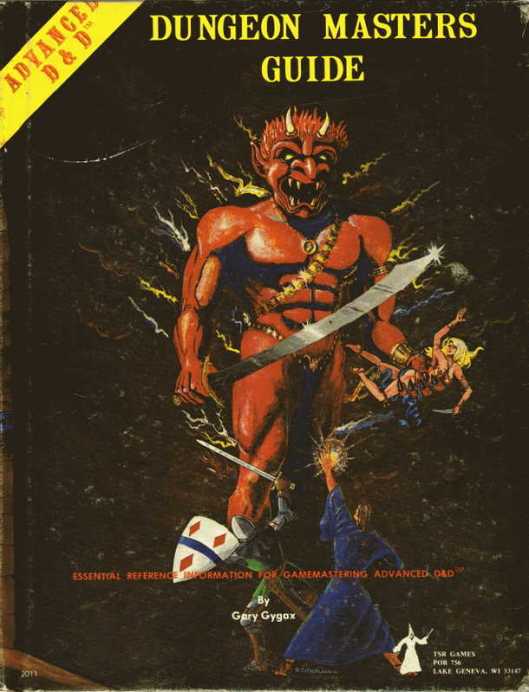
dmg1e

5th edition has thankfully put real armor on the women, and the illustrators have broadened the color palette for illustrations, including (at last) for dwarves, elves, halflings, and all the other good-aligned creatures that might take up arms against a sea of goblins:
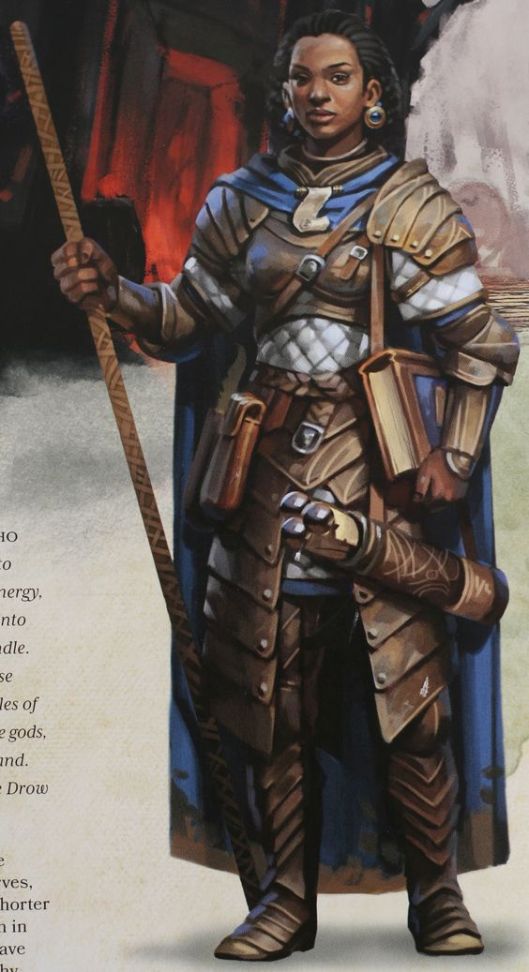
5thedfemale

Heath, Chip, and Dan Heath. Switch: How to Change Things When Change Is Hard. I’m generally skeptical of self-help books (especially those that are given to me at work), but I really loved the authors’ light tone here, as well as the well-researched underpinnings for what they were suggesting (hint: it’s in the title). I’m going to try these precepts in my own life and at work.

Kawasaki, Guy, and Shawn Welch. APE: How to Publish a Book. One of the best books on writing that I’ve ever encountered. Very different from the Brenda Ueland/John Gardner types of writing books, this one really focuses on the business end of publishing and promoting a book. I’ve built my publishing plan for Stranger Bird around these guys’ suggestions.

Hamilton, Alexander, John Jay, and Hames Madison: The Federalist Papers. Reading these fabulous essays was a bit of a slog, owing to the authors’ 18th century style. They were also at times hilarious: I wish I had counted the number of times Hamilton accuses the opponents of the constitution of wantonness, calumny, affectation, or speciousness (in the end he half-apologizes for his “intemperances of expression”). More importantly, though, I was struck by the genius of how the Constitution was framed, how an entire government could be brought about with so few moving parts in it. Of the three authors, Madison was my favorite: a gentle author, brilliant and deeply read, but also horribly compromised by his own slaveowning. Here (and elsewhere) we learn about Madison’s wish that slavery be abolished as inimical to a republican form of government; yet, like Jefferson and almost all the other founders, he did not free his own slaves in his lifetime or in his will. His Federalist 54, where he tries to explain the Three-Fifths Compromise, is one of the most fascinating and troubling things I’ve read from any of the founders. I have another take on these remarkable essays here.

Miéville, China. The City and the City.  I liked this book pretty well, though it suffered somewhat in comparison to Chabon’s The Yiddish Policemen’s Union, which I had read the month prior. Miéville turns in an interesting murder mystery in one of the most compelling imagined settings I’ve encountered recently, a double city in the Balkans somewhere where the inhabitants of each half are required by law not to see the inhabitants of the other half. Equal parts Kafka and Philip K Dick, this book offers a thought-provoking meditation on life in the Balkanized spaces of the world, the Jerusalems and Berlins and El Paso-Juárez double places.

Newton, Cam. Deep Work. I loved this book on first reading, though as Newton’s ideas have sat with me some of them haven’t aged well. I definitely agree with his overall thesis, though: that people who are able to focus for long periods of time on truly “deep work” (i.e. work that would be hard for others to do) can find themselves in great demand. This kind of focus is an increasingly rare skill. It is definitely having an effect on my work and home life.

Rulfo, Juan. Pedro Páramo. This slim story took me forever to finish, pokey as I am at reading in Spanish. I found the style much more accessible than Fuentes’ style in Artemio Cruz, and Rulfo’s story is both hilarious and frightening, like a gothic Poe tale retold by a Mexican John Kennedy Toole. The story was difficult, too, though—lots of unannounced time shifts, POV shifts, moments where it was unclear whether the speaker was living or dead. I may well teach this book sometime for my sci-fi and fantasy class. Anyone who liked the movie Coco should read this darker take on the subject.

Garamendi--de Pedro Paramo

Photo: “De Pedro Paramo 1/3,” Antonio Garamendi


Potosi Picked Up!

18 Monday Sep 2017

Posted by Joe in Advertising, Beta Readers, Musings and ponderation, My Fiction, Science Fiction, Stories, Stranger Bird, The Time of Troubles, YA fantasy

≈ 3 Comments

Tags

Analog Science Fiction and Fact, books, fantasy, literature, mythopoesis, racism, sci-fi, Science Fiction, self-publication, Stories

I’m happy to announce that the great science fiction magazine Analog has picked up my story “Potosí” for publication. “Potosí” will be the fifth story I’ve had appear in Analog, and by far the longest story (nearly 10,000 words) I’ve ever placed in a professional market.

As I wrote elsewhere, “Potosí” is set in a near future where corporations and countries squabble over the solar system’s vast mineral rights. It’s also a meditation on white supremacy and terrorism, an attempt to explain today’s world in new and striking clothes–much the same way that Star Trek explains the Cold War and Forbidden Planet explores World War II survivors’ guilt.

It’s been a good (and busy) week for my writerly life. One of my recent stories (another Analog pick-up called “Proteus”) is getting some very nice attention, and my quest to publish my first young adult fantasy novel, Stranger Bird, continues apace. I’m hoping for a publication date of November 3–keep watching the transom for that.

There’s also much more that I want to share here on The Subway Test, and I’m sure I’ll have some longer musings and ponderations here soon, but for now I’m pretty busy just keeping on top of my sci fi and fantasy writing.

From Poetry to Science Fiction

27 Tuesday Jun 2017

Posted by Joe in Book reviews, fantasy, Literary criticism, Musings and ponderation, My Fiction, Science Fiction, Stories

≈ Leave a comment

Tags

B. J. Novak, books, fantasy, literature, poetry, readers, sci-fi, Science Fiction

While on a road trip yesterday, my wife and I listened to B.J. Novak’s hilarious and touching story “J. C. Audetat, Translator of Don Quixote.” J.C. is a skilled and thoughtful poet in an age that doesn’t value poetry (that is to say, our age). He finds fame instead by translating, first Don Quixote, and then other great works, each to greater acclaim, even as his translations grow ever more absurd. I won’t say much more about the story for fear of giving away the joke—it really is a marvelous story.

Part of why I was so touched by the story was how much I recognized myself in the character of J.C. Not that I’ve ever been famous—rather, J.C.’s inner struggle with writing poetry for small literary magazines that practically no one reads called up an old personal struggle of mine.

Not long after I started college I knew I wanted to be some kind of writer, and at that time I wrote short fiction, poetry, and creative non-fiction pretty much in equal measure. Towards the end of my time at college, though, during a tough and lonely time in my life I listened to a cassette tape recording of a Robert Bly reading called “Poetry East and West,” and I decided, precipitously, that I would devote myself to poetry for the rest of my life.

I was not at that time a good poet. I became one over time, but I wrote quite a few bad poems before I wrote a single good one, and I wrote many more bad ones after that first good one. It was some years before I any knack at all for writing good ones.

What attracted me to poetry in the first place was its almost total disdain for market forces. Nobody will pay you to write a poem, and so you are free to write whatever you like, to dig down to the bedrock of existence, beneath those composting strata of life’s trivialities that we spend so much time buying and selling.

That way of writing and living still appeals to me. But it was only after years of writing poems that it dawned on me why nobody will pay you to write a poem: because nobody reads poetry much. To be a poet today is to walk away from readers and towards an absolute experience, like a monk or yogi or hermit. I could shut myself up in my cabin, in the manner of Robert Francis or Bashō or Emily Dickinson, and pour myself into work that few people would see, living a full life in conversation with an indifferent world, like a man calling down into an empty canyon or a sparrow singing for a mate in a supermarket parking lot. That would be a painful way to live, but it would be a life defined by the coolness of an uncompromised vision.

I don’t think I’m cool enough to be an artist of that type. It’s hard to imagine throwing my voice down a canyon for years like that. I want people to read my work, to ask me questions about it, to tell me how they reacted to it. This desire is not the same as the desire for fame—the idea of being famous gives me the willies. Rather, what I want is a conversation, a person who reads something I’ve written and says that was meaningful to me or I’ve been nagged by this question about your main character and I have to ask you. And to have that conversation, I need a reader.

I chose to write science fiction and fantasy because I thought they were genres I could write in, and at the time I was exploring the idea I thought fantasy and science fiction could use a more serious literary treatment than they have usually gotten in recent decades. (The fact that the world is full of literary science fiction and fantasy writers shows how dated my understanding of those genres was, as well as how many writers have been working the same hustle I hoped to, only years before it had ever occurred to me).

Someday I may hole up in the cabin and write poetry for the rest of my life. But not right now. Right now, I’m grateful to have a handful of readers. Every once in a while someone will email me about how much they got out of a story of mine, or with a question about something that didn’t make sense to them, and it’s that feedback from a few readers that keeps me writing.

The New Yorkering of Science Fiction

14 Wednesday Jun 2017

Posted by Joe in Book reviews, HPIC, Literary criticism, Musings and ponderation, Science Fiction

≈ 2 Comments

Tags

fandom, fantasy, Laura Miller, literature, marketing, sci-fi

A couple of weeks ago one of my writing group comrades passed along to me this Laura Miller article from Slate on the incursion of “literary novelists” into the field of science fiction. I often find the premise of such articles cringeworthy–that there are good, serious writers out there who used to write good, serious fiction about failing marriages and suburban malaise but who now have decided, who knows why, to write crap about lasers and robots with big boobs.

Hajime Sorayama--Sexy Robot

Hajime Sorayama, Sexy Robot–photo credit Moody Man

Miller’s article is more nuanced than that–it acknowledges that the line between literary fiction and science fiction has always been blurry, and that calling a book “literary fiction” is no more a guarantee of its quality than calling a book “science fiction” guarantees that it is trash. Miller’s basic argument is that life is changing so quickly now that a contemporary story is dated almost before it is finished: if I am a literary novelist writing about a Tinder romance that goes sour, who knows what online romance trend will have replaced Tinder by the time I finish my book five years later? Wouldn’t it be better for me, then, to imagine a near-future dating app, so that when my book comes out I seem “buoyantly dystopic” and “a literary polymath” to reviewers?

I don’t dispute Miller’s reasoning: I hadn’t thought about it before, but surely some of the near-futuristic “serious fiction” out there is meant as a commentary on the pace of change in our lives and how maddening it is for us to try and keep up with it all.

But I’d like to suggest another hypothesis to explain the huge influx of Columbia MFA grads and New Yorker raconteurs into the slums of science fiction. Part of the shift, I’m sure, is that the last two generations of writers have grown up watching science fiction movies and TV with good production values and believable special effects. Science fiction was often regarded as shlocky in the pre-CGI era, and certainly before the breakthrough of Star Wars, partly because so many sci fi movies looked so clunky and fake. (Of course, there were excellent exceptions in the years before Star Wars, movies like 2001:A Space Odyssey, Forbidden Planet, and George Pal’s War of the Worlds, but these were rare glints of gold in a sea of Plan 9 From Outer Space dross).

Today, however, it’s possible for even a modestly-budgeted TV show–to say nothing of a big budget movie–to have the kind of truly believable special effects on which good sci fi viewing depends. And the existence of commercially successful, well-made science fiction movies catalyzes the creation of more such work, attracting writers and filmmakers with serious artistic chops–no one needs feel ashamed anymore that they like science fiction (at least the highbrow literary “speculative fiction” of Margaret Atwood or Michael Chabon).

One might argue that the crossover popularity of a writer like Vonnegut is what opened the floodgates to good science fiction. I disagree: Vonnegut was regarded for most of his career as a literary oddball, someone who would be a major writer if only he didn’t write science fiction. And Vonnegut’s popularity in the seventies did not facilitate the mainstream popularity of other science fiction greats like Ursula Le Guin and Stanislaw Lem (both of whom, thank goodness, have since received some of the attention they deserve).

The fact is that until recently, practically the only speculative writers who were unequivocally welcomed into the literary canon were authors from the non-English speaking world: people like Kafka and Borges, and later García Márquez and Calvino. And some would still argue that their inclusion in the canon is proof that what they were writing was something other than sci fi or fantasy–if you want to make a college English professor flip out, try calling “The Metamorphosis” or “The Library of Babel” a science fiction story.

Am I bitter about it? I suppose I must be–why else would I write 700 more words in defense of science fiction writers? In the long run, though, if David Foster Wallace and Jennifer Egan get the highbrow readers to crack a science fiction novel, if that brings them to look, eventually, at Octavia Butler or John Crowley, then who am I to complain?


A Story for the Time of Troubles

31 Wednesday May 2017

Posted by Joe in Musings and ponderation, My Fiction, Science Fiction, The Time of Troubles, Utopia and Dystopia

≈ 1 Comment

Tags

Asteroid Mining, racism, sci-fi, Stories

I’ve been intending to write a story about asteroid mining for some years now. Last week I put the finishing touches on my best attempt at the topic: what started last year as a first draft of about 3,000 words plumped up over the course of a year into a 10,000 word dreadnought of a story (actually a novelette, for those of you interested in the preposterous nomenclature of fiction) about terrorism, white supremacists, and a floating mountain of pure platinum.

There aren’t many science fiction magazines that will take a story of that length, so if it isn’t picked up it may not see print until I publish a collection of my own stories. But I do hope that it is printed before then, partly because so much of what the story became bubbled up out of my struggling with the political climate of the last year.

While the terrorist enemy of the day is ISIS, science fiction looks beyond today’s social structures, refracting the view of today’s enemies and power relations into a new image that arrests our attention with its logic. What I’ve attempted to do is not exactly a bravura leap of imagination: it’s pretty easy today to see parallels between the medievalist Islamic terrorists of ISIS and their reactionary Christian, white supremacist counterparts. The greatest parallel between them is that for all the hostility they seem to have for one another, their common enemy is liberalism: both groups hate the world of globalized commerce and its perceived moral relativism; both are willing to kill innocent people in order to restore what they believe to be the proper–and long-insulted–social order.

Robert Thivierge

Photo Credit: Robert Thivierge

In the last few weeks it’s been comforting to watch the total shambolic ineptitude of the Trump administration. I have some faith that Trump’s vision of a hyper-nationalist, authoritarian America will fall apart over the next two to three years, if only because Trump and his cronies seem so intent on committing impeachable offenses (and crimes) in plain view. However, Trump’s incompetence will not dismiss the anger and hatred of some of his hardest-core supporters, the white supremacists and neo-fascists who have been so emboldened by Trump’s behavior. In fact, I’ve wondered whether Trump’s inability to govern, his failure to encourage the passage of legislation even with a pliant Republican congress eager to pass tax cuts and repeal Obamacare, may lead to even greater violence and frustration among Trump’s hardest core.

When I sat down to start this latest story, called “Potosí,” over a year ago, the thought of a white supremacist terror group seemed far-fetched, a hearkening back to the worst days of the KKK. Today I wonder whether the story is a little too prescient.


Meditations on Tabby’s Star

08 Monday May 2017

Posted by Joe in Musings and ponderation, Science, Science Fiction, SETI

≈ 1 Comment

Tags

Dyson Spheres, Dyson Swarms, sci-fi, SETI, Stapledon Spheres, Tabby's Star

This month’s issue of Scientific American has a good article summarizing the mystery of Tabby’s Star. (it’s behind a paywall, but this SciAm blog post has a rundown of the discovery). I remember talking briefly about Tabby’s Star in fall of 2015 during a reading. I remember thinking at the time that the mystery of it all would be batted away soon enough, that the star’s mysterious dimming pattern would be explained mundanely–perhaps invoking some novel phenomenon which would excite astrophysicists, but which would not become the subject of any science fiction stories to come.

A year and a half later, no such invocation has yet appeared. Humanity has discovered a star whose light emissions defy every existing rational explanation. That’s big. For me as a science fiction writer, it’s exciting to hear serious astronomers considering the possibility of the star’s mysterious dimming as the result of orbiting alien megastructures. I have to remind myself that the extraterrestrial intelligence explanation is really no more plausible than any of the explanations that do not depend on aliens–swarms of comets, a circumstellar disc, an orbiting black hole.

Whatever the explanation turns out to be–and I will say here what I said in 2015: I don’t think it’s aliens–the mere fact that an alien megastructures explanation is being considered seriously fills me with glee. It is the nature of human intelligence to reach out in all directions, seeking fellowship with like minds. Whether we do this by putting up a profile on OkCupid or a handprint on the walls of Lascaux, we are seeking fellows. I wish that Tabby’s Star, over a thousand light years away, is flocked with gigantic solar panels, because such a project could only be undertaken by creatures who–however more powerful than we they may be–think in ways that we can recognize.

Stormy Signals--Andy Smith

Photo Credit: “Stormy Signals,” by Andy Smith

Much of my own fiction has revolved around this idea. Perhaps all of it has. But two stories of mine especially, “A Murmuration of Starlings” and “Full Fathom Five,” are devoted to the longing of intelligent creatures to connect with one another. And I know I have not exhausted the subject–perhaps there is another such story slouching towards the Bethlehem of my keyboard this year.


“Proteus” Is In Print!

22 Saturday Apr 2017

Posted by Joe in My Fiction, Science Fiction, Stories, The Time of Troubles, Utopia and Dystopia

≈ 1 Comment

Tags

Analog Science Fiction and Fact, monsters, sci-fi, terraforming, transhumanism, utopia, Venus

My latest story, “Proteus,” is out in the May/June issue of Analog Science Fiction and Fact! On the spectrum of my work, “Proteus” is closer to the hard sci-fi  pole–hence its appearance in Analog, widely regarded as one of the preeminent publishers of the hard stuff.

“Proteus” is the second of my stories set in the John Demetrius cycle, set (so far as I can imagine) about 100-200 years in humanity’s future. The whole cycle takes up questions of our coming experiment with transhumanism, as well as a kind of meditation on the nature of utopia and dystopia–I’ve tried to create a world like our own, in which utopia and dystopia coexist in different parts of the world and for different people at the same time. “Proteus” was also an immensely fun story to write–it involved a good deal of research into the terraforming of Venus and the nature of any possible human colony on Venus.

Analog on MAX

Photo credit Carlyn Eames

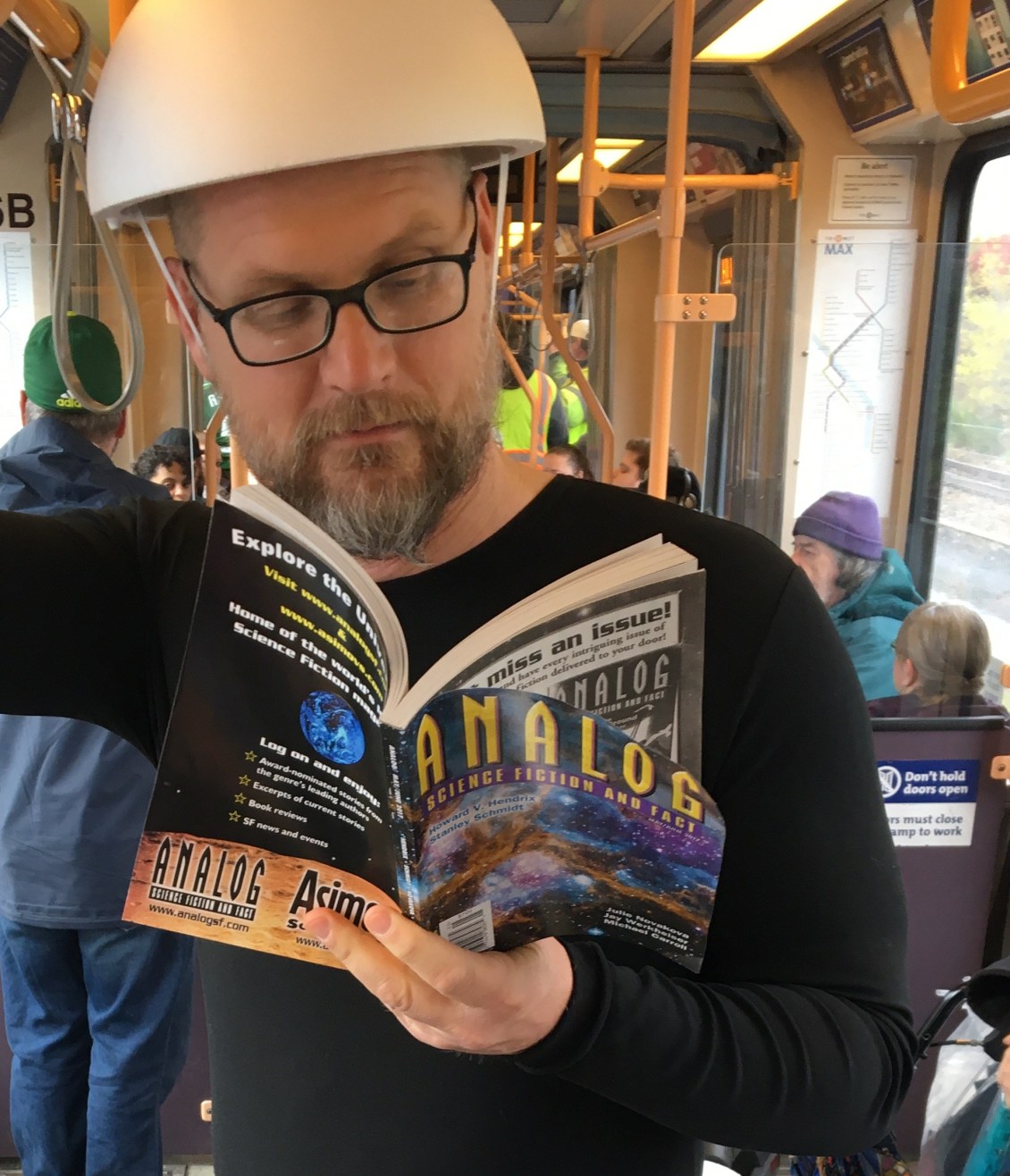
To get a promotional shot for the blog, my wife obligingly took a couple of pictures on our way to The March for Science this morning. I’m dressed as the most terrifying greenhouse gas on the planet, old silent-but-deadly methane. And given the name of my blog, I thought it best for her to take the photo on the MAX train, Portland’s closest analog to a true subway.


Analog on MAX2

It’s hard out here for a simple hydrocarbon. Photo credit Carlyn Eames

Analog can be purchased wherever fine science fiction magazines are sold, including at the 800-pound Amazonian gorilla.


Reading in Hood River!

23 Monday Jan 2017

Posted by Joe in Journeys, My Fiction, Science Fiction, Stories

≈ 1 Comment

Tags

fantasy, marketing, readings, sci-fi

My Bloggish Friends:

I’m happy to invite you to a reading I’m giving at the beautiful AniChe Cellars tasting room in Hood River, Oregon. AniChe Cellars has dolled up an old Depression-era bank at 301 Oak Street in Hood River, well worth seeing. Come taste some ridiculously good wine in ridiculously scenic Hood River while I read a ridiculous story or two.

Saturday, January 28, at 5:00–I’d love to see you!

The Year In Reading: 2016

28 Wednesday Dec 2016

Posted by Joe in Literary criticism, Reading Roundup, Stories

≈ 2 Comments

Tags

books, Reading Roundup, sci-fi

At the end of 2015, I posted a roundup of what I had read that year, with a mini-review of each book. The post went over quite well, so I thought I would reprise this heavy year’s reading as well. Here’s the piebald mix:

Adler-Olson, Jussi The Keeper of Lost Causes.  I’m not normally a fan of mystery stories, but I was entertained enough by this example of Nordic crime fiction to keep reading and to finish it. The conceit of torturing someone through increasing the atmospheric pressure in a cell made out of a pressure vessel was both interesting and creepy, and the vibe of the book spurred my to try writing a sci fi murder mystery of my own. (The draft of that story has been disappointing, but I will see if it’s salvageable)

Bradbury, Ray. The Martian Chronicles.  This story cycle had a few truly excellent works in it (I’m thinking especially of the first three Mars expeditions). Other tales seemed emotionally lame—either overwrought or full of implausible motivations. Much as War of the Worlds seemed like a meditation on British Imperialism, this book seems like a metaphor for the conquest of the American West, as well as an early work on nuclear apocalypse. I’m glad I read this book—and I feel it gives me some external validation to keep going with my own story series on John Demetrius—but overall I felt a bit flat about the experience.

Calvino, Italo. The Baron in the Trees.  One of the sweetest, most heart-warming books I’ve ever read. Baron Cosimo di Rondo climbs a tree during a temper tantrum when he is twelve years old and he never comes down. For the next fifty-odd years, through the height of the Enlightenment, the French Revolution, and the disappointments of Napoleon, Cosimo reads, philosophizes, carries on love affairs, and corresponds with the great minds of his day, all from his home in the branches. Calvino, for much of his youth a communist, apparently wrote this book as a response to the Soviet repression of the Hungarians in 1956 (an event which caused him to leave the communist party and never join another). It’s a story of how one can keep to one’s philosophical commitments in the face of the many let-downs that the world has in store for us.

Catmull, Ed. Creativity, Inc.  What an inspiring book: this account of what it takes to run a creative company (in this case, two companies–Pixar and Disney Animation) filled me with ideas for my work at my own college and for my creative work as well. Catmull is big-hearted, generous, modest, and also committed to excellence in his work. I’m so glad my wife put me on to this book; I never would have sought it out myself.

Cline, Ernest: Ready Player One. This gift from my sister was a very enjoyable little read. The writing was in some ways terrible—Cline trades in clichés and underwriting—but the story is quite well-plotted and gave me many geeky moments with its references to D&D, old 80s movies and music, and early video/computer games like Zork. Good fluffy fun.

Fuentes, Carlos. La Muerte de Artemio Cruz. After four attempts over the course of six years, I have finally finished this short, sad work. I’m a very slow reader in Spanish under the best of circumstances, and this work, written with Faulknerian paragraph-sentences, unclear points of view, and unannounced time shifts, really put my creaky Spanish to the test. Yet in spite of its brevity, it’s a monumental novel, the history of Mexico in miniature, a chronicle of thwarted ambitions and broken promises and, underneath all that, an indomitable dignity. The Wikipedia page for the novel claims that the book was heavily influenced by Citizen Kane, and I can dig that, but just as much I see the influence of The Sound and the Fury and As I Lay Dying. It’s a poignant and unflinching look back at the life of a tough, bad hombre.

Grossman, Lev. The Magicians. I had seen a lot of good buzz around this series, but I found this book pretty hard to like. The characters were so, so privileged and self-involved, so jaded and irresponsible with their powers, that it seemed like nobody had anything on the line in this book. The characters seemed far more Jay McInerney than J.K. Rowling—I just never felt invested in any of them.

Holdstock, Robert: Mythago Wood. While interesting and sometimes fascinating, this book was ultimately a big disappointment to me. I loved the idea of a primeval forest with its own mythopoetic, psychological characters drifting out of it like ghosts. Shades of Solaris, there. However, the dialogue was pretty wooden, and I was shocked at how many plot points were totally contrived or were abandoned so carelessly (I know that the book is one of a series, but still—there’s no excuse for the lame non-explanation of Keeton’s leaving, nor the off-handed dismissal of the three following warriors who had barely figured in the story up to that point). I don’t remember who put Holdstock in the same league as LeGuin, Crowley, and Marion Zimmer Bradley, but this book does not lend much support to that claim.

Liu, Cixin: The Three Body Problem. I have mixed feelings about this one. The story is a truly original first contact tale, and I was blown away by the episodes that involved computing (both the episodes in the Three Body game and the creation of the sophon). However, I also found the characterizations wooden and the characters’ motivations at times truly unbelievable. How much of that stems from the translation, or from the different aesthetic of Chinese fiction, and how much of my trouble stems from the weak writing that afflicts so much science fiction?

Palmer, Parker. Let Your Life Speak.  I’m surprised that it has taken me so long to read Parker Palmer, probably the most famous living Quaker in the United States. This book seemed to take the form of half a dozen loosely-related Pendle Hill Pamphlets, most of them inspiring or heartening, and none of them useless. This is a great book about vocation, looking at our work through the lens of how we can best serve others and live out of our deepest identities. This may on the face of it sound totally contrary to the advice of another book I loved, So Good They Can’t Ignore You, but I would call these books complementary: Cam Newton’s focus was on building skills and getting paid for them, while Palmer’s seems to be on discernment about what our gifts are and how to use those gifts to serve others. Palmer is a true Hufflepuff—I needed his advice as I struggle with my own Hufflepuffery.

Sorokin, Vladimir. Day of the Oprichnik.  Near-future sci fi from one of contemporary Russia’s most celebrated authors. In the Russia of the 2020s, a Francisco Franco-esque figure has taken power, re-instituting the Tsardom and the ostentatious rites of the Orthodox Church. The oprichnina—Sorokin takes the name from the secret police of Ivan the Terrible—go about knocking heads, terrorizing people, and taking some weird-ass drugs.  The book is one part Atwood’s The Handmaid’s Tale one part Gogol’s Dead Souls, with a dash of Burgess’ A Clockwork Orange thrown in. Violent, intense, and a solid read.

Stapledon, Olaf. Star Maker. One of the oddest works of sci fi I’ve ever encountered. This read more like an extended essay or history than like a true story. Yet this history of the universe as told through the eyes of hive mind energy beings was quite imaginative and often interesting. I can see how Stapledon influenced Stanislaw Lem, Arthur C. Clarke, and Freeman Dyson, among many others.

Tolstoy, Leo. Anna Karenina.  One of the great reading experiences of my life. Slower than War and Peace—Anna Karenina took me about three months to finish—but I was amazed by the large-heartedness of the book. There were practically no unsympathetic characters at the end (except for the pharisaical religious woman who insinuates herself into Karenin’s life, I can’t think of a truly unsympathetic character). Even Karenin becomes, halfway through the book, a figure of deep love and pity. I was happy to see the book end—it’s a real emotional drain to read it—but I was amazed by Tolstoy’s powers of characterization here, as well as his plotting (the book reads like a collection of about 40 linked short stories).

OLYMPUS DIGITAL CAMERA

Wells, H.G. The War of the Worlds.  So different from the film treatments. But such a story! I can see why Wells was so influential. I love how the narrator characterized himself as a writer “on philosophical themes.” The whole book seems like an allegory for the failings of British Imperialism—one of the best sci fi stories I’ve ever read.

Witwer, Michael: Empire of Imagination. This was a fluffy, entertaining history of the creation of Dungeons & Dragons by Gary Gygax. I didn’t realize exactly how much of a rockstar Gygax had been in the 80s (nor how much of the rockstar lifestyle he copied). I did know something of the rags-to-riches-to-rags arc of his story, but there were some wonderful details here, as well as a bit of redemption in Gygax’s later years (even if the telling of it seemed a bit contrived). A fun memory trip.

Zinn, Howard. A People’s History of the United States. I wrote a longer review of this book a couple of weeks ago.  While I was familiar with every period Zinn wrote about in People’s History, I don’t think I had ever seen all these periods stitched together into a single overarching vision. Basically, Zinn’s contention is that the true history of the United States is not defined by the actions of presidents and congresses who have worked at practically every turn to enrich a tiny economic elite–by preserving slavery, by massacring the natives, by invading Mexico and Cuba and The Philippines, by overthrowing democratically elected governments in Guatemala and Chile and Iran. Rather, American history is made up of the often overlooked struggles of the oppressed, the working class, the unrepresented. It is a history of people fighting, over centuries sometimes, to be included in the opening phrase of the Constitution: “We the People.” It’s an inspiring–if sometimes flawed–vision. I believe that what it offers, in a crowded field of history texts, is a truly alternative analysis of the history of the nation.

Pitkin’s New Fiction

16 Sunday Oct 2016

Posted by Joe in A Place for my Stuff, My Fiction, Science Fiction, Stories

≈ Leave a comment

Tags

Hungary, sci-fi, tachyonic antitelephones, The Pauli Principle

I’m happy to pass along the news that one of my favorite stories, “Count Eszterházy’s Harmonium,” has come out in this quarter’s edition of Kaleidotrope. This was my first attempt at an epistolary story, and I think it turned out pretty well. I have written so little fiction about my time in Hungary, and I had a great time imagining the waning days of Hungary’s life as a world power in this piece. I invite you to read, and I hope you enjoy!

← Older posts
Newer posts →

Subscribe

  • Entries (RSS)
  • Comments (RSS)

Archives

  • November 2025
  • September 2025
  • August 2025
  • July 2025
  • May 2025
  • April 2025
  • March 2025
  • January 2025
  • December 2024
  • October 2024
  • September 2024
  • August 2024
  • June 2024
  • May 2024
  • April 2024
  • March 2024
  • February 2024
  • January 2024
  • December 2023
  • October 2023
  • August 2023
  • July 2023
  • June 2023
  • April 2023
  • March 2023
  • May 2022
  • August 2021
  • June 2021
  • January 2021
  • October 2020
  • May 2020
  • March 2020
  • February 2020
  • January 2020
  • July 2019
  • June 2019
  • December 2018
  • October 2018
  • July 2018
  • May 2018
  • April 2018
  • January 2018
  • December 2017
  • November 2017
  • September 2017
  • August 2017
  • July 2017
  • June 2017
  • May 2017
  • April 2017
  • March 2017
  • February 2017
  • January 2017
  • December 2016
  • November 2016
  • October 2016
  • August 2016
  • July 2016
  • June 2016
  • May 2016
  • March 2016
  • February 2016
  • January 2016
  • December 2015
  • November 2015
  • October 2015
  • July 2015
  • May 2015
  • March 2015
  • February 2015
  • January 2015
  • December 2014

Categories

  • A Place for my Stuff
  • Advertising
  • Artificial Intelligence
  • Beta Readers
  • Biology
  • Book reviews
  • Curious Fictions
  • Dungeons and Dragons
  • Exit Black
  • fantasy
  • Games
  • HPIC
  • Journeys
  • Let's All Admire That Fantastic Can
  • Lit News
  • Literary criticism
  • Musings and ponderation
  • My Fiction
  • Pacifica
  • Politics
  • Reading Roundup
  • Science
  • Science Fiction
  • Science Fiction Writers of America
  • SETI
  • Stories
  • Stranger Bird
  • The Ideal Vehicle
  • The Time of Troubles
  • Uncategorized
  • Utopia and Dystopia
  • Welcome
  • YA fantasy

Meta

  • Create account
  • Log in

Authors

  • Joe's avatar

Blog at WordPress.com.

  • Subscribe Subscribed
    • The Subway Test
    • Join 144 other subscribers
    • Already have a WordPress.com account? Log in now.
    • The Subway Test
    • Subscribe Subscribed
    • Sign up
    • Log in
    • Report this content
    • View site in Reader
    • Manage subscriptions
    • Collapse this bar
 

Loading Comments...