A few months ago, my wife and I picked up an old LP of the Stevie Wonder masterpiece Innervisions from a record store in Hood River. It’s maybe my favorite Stevie Wonder album, and it definitely has my favorite Stevie Wonder song, “Higher Ground.”
My wife and I start most mornings playing one side of a record while we get ready for work, and last Wednesday, feeling beat down by the killing of Renee Good and the apparently bottomless appetite that the Trump administration and the MAGA crowd have for brutalizing people that don’t agree with them—or who in in many cases just look like they maybe weren’t born here—I felt like I would do well to listen to “Higher Ground.”
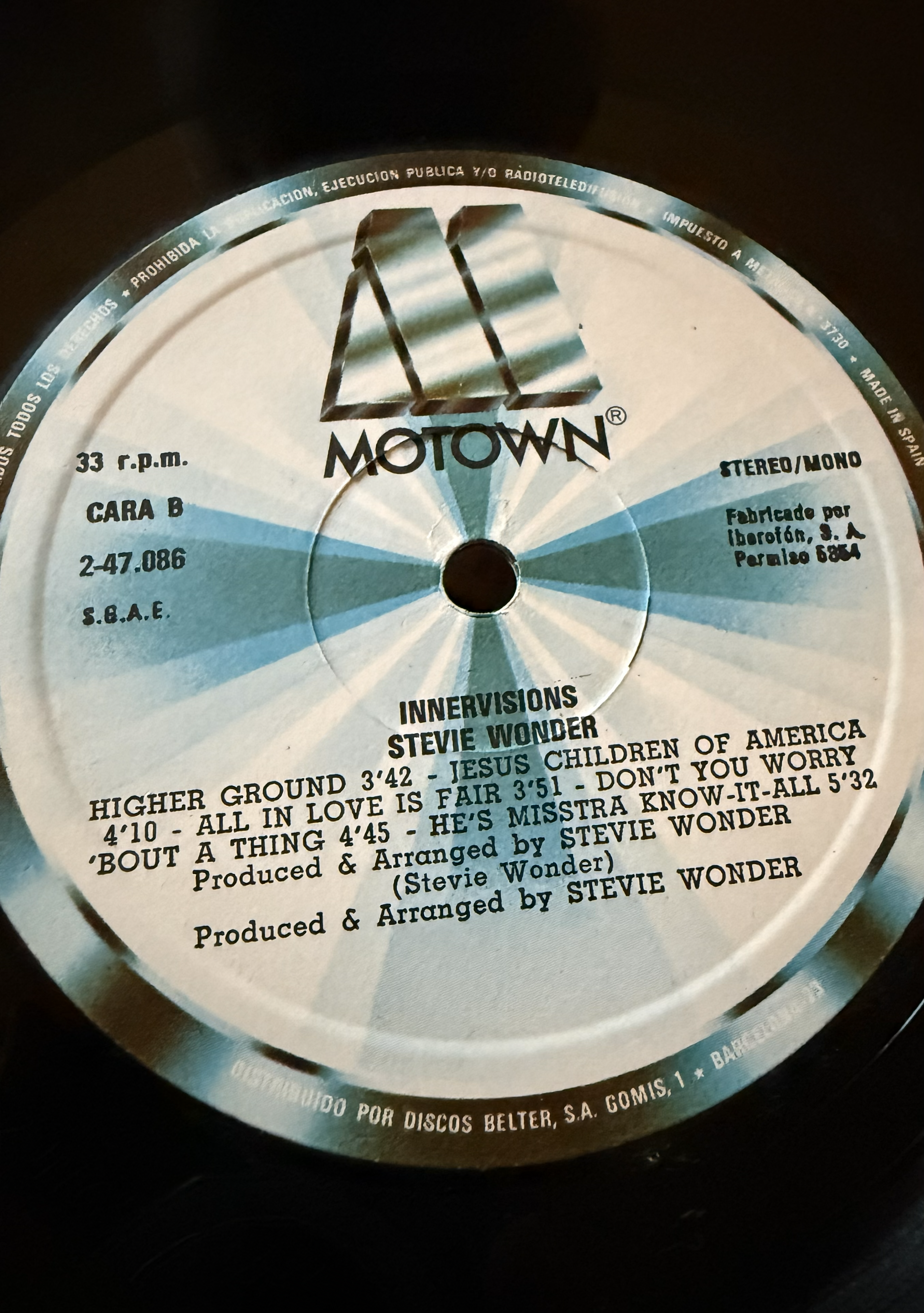
But when I dropped the record onto the turntable, I noticed something on the record that I hadn’t seen before:
My first thought on really looking at the label was “why the hell does it say Cara B?” That’s when I realized that we had bought a 1973 Spanish pressing of the record! And about thirty seconds after I figured that out, it occurred to me: this album was pressed in Barcelona when Spain was still a fascist dictatorship, during the final years of the Franco regime.
Something about that sight gave me an odd jolt of hope: that even a repressive authoritarian like Franco—head of one of the longest-lived right wing dictatorships in the 20th century—couldn’t keep out the liberating voice of Stevie Wonder. And neither can a predator and thug like Trump, nor the predators and thugs who work for him, prevent people from liberating themselves. Don’t give up, people.
Here’s the song of the moment for me: sleepers, just stop sleeping.
In my department (and I think in just about every department in every college), the number one discussion in meetings and email discussions for the last three years has been what to do about AI. The main question–sometimes it seems like the only question in my department–has been “how do we AI-proof our classes?”
I get it: students can have ChatGPT cook up a paper for them on any subject in a few seconds. The paper can be well-written enough to get an A if the student asks for that. If the student is too worried about getting caught, they can have ChatGPT serve up a B- or C+ paper instead. While most of us teaching ENGL101 in America have some nose for papers that don’t quite smell like student-written work, any teacher who says they can unfailingly sniff out AI-written prose is lying, at least to themselves if not to you.
So yeah, our teaching lives are different now. Almost everyone who liked being a teacher before, say, 2023 doesn’t like what’s happening now. It occurred to me not long ago that if I had begun my teaching career in 1923 or even 1933, I could have completed a thirty year teaching career without having to live through many (or even any) cataclysmic technological changes. There would have been major social changes to navigate–the Great Depression, WWII, the GI Bill, widespread entry of women in colleges, desegregation–but the technology of teaching and classroom learning wasn’t radically different between 1933 and 1963. Had I started in 1933, I would not have been forced by technological change to reinvent my teaching practice every few years.
When I really did start teaching, though, was 1993. The technological changes we’ve seen since then have been massive. Not all of my students were even using word processors in those first few years–I still took in typewritten papers every once in a while. For that matter, I still distributed handouts that I had made on a mimeograph machine from 1993-95. From then to now, I’ve taught through the total hegemony of the word processor, the internet classroom, YouTube, Khan Academy, social media, learning management systems, the smart phone (as well as the tablet and the ubiquitous Chromebook) before I had ever heard of ChatGPT. And all of those developments have had deep implications for the way I do my work.
But ChatGPT and all its logorrheic LLM siblings have deeper implications still. They are cataclysmic for the work I do.
My colleagues are intelligent and sweet-natured, and I am lucky to be working with them. But, despite their voluble commitment to political progressivism, we all can be some of the most emotionally conservative people around, at least when we all get in a room together. Is there a way we can, you know, find a way to keep teaching the way we’ve been teaching?Let’s just do that! our department seems to be saying, at least if you read our meeting minutes.
I can bitch, and have bitched, about the fact that I have to upend my entire teaching practice to accommodate a tool that will write competent prose and summarize any reading in a matter of seconds. It’s all the more galling that the tool comes to us by way of Elon Musk, Mark Zuckerberg, and the rest of their techbro robber baron buddies and their shareholders. But this is the way creative destruction works: in an open market, entire systems of wealth and production are continually being destroyed by new technology. And if I can’t see ways to use LLMs to support my teaching practice, I’m going to get chewed up and spit out all the more quickly in the coming years.
So for now, until the computers kick me out of the classroom, here are some of the ways that I’ll be trying to deal with the new regime: taking advantage of the many blessings of AI where I can, minimizing its malign influence whenever possible. I offer these as a starting point for conversation with my colleagues and my students.
Speak Frankly with Students: If my and my colleagues’ stated feelings about AI are any guide, students are getting mixed messages about use cases for AI. And even if we educators weren’t giving mixed messages, students are certainly receiving mixed messages from the culture at large, from the techno-utopian advertising they see from Google and Apple and Meta to creepy cautionary tales like M3gan. Given that my job as a teacher of rhetoric is to help people understand how arguments work, and given that one of the main functions of LLMs is to confect natural-sounding arguments, part of my job now involves helping students consider LLM use cases. I’m far from an LLM hater, despite some of the obvious losses that LLMs present for my work as a writer and teacher of writing. But I’m also deeply skeptical about any utopia that Google et al. are selling. For now, I expect my students not to use LLMs to create text that they pass off as their own. They can expect me not to use LLMs to grade their work. Only one of these expectations is realistic; I know that as a result of their anxiety, laziness, or cluelessness, some students will be trying to pass LLM content off as their own work. I’ll speak to that issue below.
Stop Grading Students; Give Them a Fair Assessment Instead: I’ve been arguing that we should get rid of letter grades since long before I ever heard what an LLM was, but LLMs have only made grade grubbing and credentialism more acute: if it’s so easy to get an A by cheating, why would any student accept a C? And if everyone is getting an A, why do we have grades at all? Replace the anti-educational grading system we have with a straightforward, outcomes-based pass/no pass system based on in-person competency testing. These tests can look like a lot of different things, not just essay tests. But they might especially be essay tests, handwritten in a Blue Book or typed on a computer with a lockout browser. (To that end, by the way, many of my colleagues, especially in the math department, argue that our college needs a proctored testing center. I have no doubt that we will have one sooner or later. But my college has never been a leading-edge institution; we’ll have our testing center only after several other colleges in the state system have started one and the practice becomes an official, shiny Best Practice with our State Board for Community and Technical Colleges).
Implement a No Devices Classroom. One of the central goals of education is to help students cultivate cognitive endurance: “the ability to sustain effortful mental activity over a continuous stretch of time.” I have no doubt that this goal is made more difficult when students have ad libitum access to multiple screens and information feeds in the classroom. And while the research is equivocal for students as a whole, for lower performing students–those who are over-represented in open door community colleges–the research suggests that device bans help students to stay focused on their classwork. If someone is listening to Spotify on their earbuds, managing a text thread, checking TikTok every 5-7 minutes, and squeezing in a round of Candy Crush during down time in the class (however a student might define “down time”), should I be surprised that they are having trouble identifying the main idea of the paragraph we’re all supposed to be looking at?
One may reasonably ask what AI in the classroom has to do with this fractured attention economy. It’s related in two ways: first, the companies selling AI as an edtech that students should be using in the classroom are often the same companies that benefit from having students constantly plugged in to multiple streams of data simultaneously. Secondly, I believe there is a benefit to having students at least sometimes exert their minds without the cognitive prosthesis of AI, the same way that you’ll get in shape faster riding an old-school “acoustic” bicycle than riding an e-bike (and much, much faster than riding a motorcycle). I’ll admit that this second claim is more vibes-based, and I’ll be happy to revise it in light of high quality research findings. But for now, common sense tells me that it helps for students sometimes to have only their minds to rely on.
Here’s a very simple example. One of the best ways that a person can prove to someone else that they understand something they’ve read is to summarize that reading. For that matter, summarizing is one of the best ways to prove to yourself that you understand what you’re reading. It’s a foundational tool for managing information, as well as a vital step in making a rhetorical analysis, an academic response, a literary analysis, a research paper, and a whole bunch of other academic assignments. It’s also one of the more difficult skills for a person to learn, especially with readings that are challenging. If I assign students to summarize a tough article, it’s a lot to ask that they struggle for an hour or more with a task that a computer could do for them in ten seconds. I can hardly blame some of them for having ChatGPT serve up a summary for them if I assign it as homework. However, if we write the summary together in the classroom–which has the advantage of our being able to puzzle out together the writer’s organizational schema and the main ideas of paragraphs–we might actually write a true human summary together. That only works when there is one part of our lives where AI is not a constant background (or foreground) presence.
Use LLMs Outside of the Classroom. I’m not ready yet to require that students use LLMs outside of the class–lots of students, especially the more thoughtful ones, are deeply skeptical of LLMs for a lot of reasons. However, I am starting to look for parts of my teaching that I think can be safely off-loaded to AI and which I can recommend to students. One of the big use cases is grammar and punctuation instruction, a part of my teaching that I used to love but which has gotten steadily crowded out by changes to our department’s approach to curriculum.
ChatGPT is a potentially awesome teacher of sentence grammar. As I tell my students, beyond all the debates in lefty spaces about “Standard Edited English” being a tool of colonialism and white supremacy, there’s great value in being able to understand how sentences are put together, how parts of sentences like phrases and clauses interact. One can say a great deal with nothing more than simple declarative sentences. However, understanding how an appositive or an absolute phrase works (whether or not you know the names for those structures) will make it possible to say and write–and think–ideas that are much, much more subtle, as well as much harder to formulate with only declarative sentences. Explaining grammar and punctuation is one of the few areas of life where I claim to have real expertise; nevertheless, I think that ChatGPT is better than I am at it, and it’s certainly more tireless at it.
One of the assignments I’ve been giving, and which I plan to use even more widely this term, is to have students upload a paragraph of a reading we are studying (or sometimes a paragraph of their own writing) to the LLM of their choice, with the instructions that the LLM quiz the student on how the sentences are constructed. Sometimes I have LLM quiz students on the types of clauses that are appearing in each sentence; at other times I have the students try to classify sentences as simple, complex, compound, or compound-complex; at other times I have the LLM test students on the placement of commas or other punctuation in their writing. I do this not because I want students to memorize the nomenclature of clauses and punctuation but because the activity forces students to pay attention to the way sentences are constructed, the same way that musicians learn to pay attention to chord progressions and photographers learn to study the composition of a shot. And not only does ChatGPT know at least as much as I do about sentence grammar and punctuation, but it’s infinitely patient. There are similar huge gains available to us if we use LLMs as reading comprehension aids, as critical readers for students’ rough drafts, as explainers of historical and sociocultural context. I wrote about this phenomenon of LLMs-as-the-Computer-from-Star Trek here.
In fact, practically the only way I want students not to use LLMs is as creators of content that is to be graded. Of course, that’s one of the only things that some students seem to want to use LLMs for, and that’s one of the main reasons to retire this 18th century grading system we inherited from Yale University. As I tell my students multiple times a term, if they are coming to college because they hope a degree leads to a job, they’re only going to get hired to to one of two things: 1. a job the employer would prefer not to do (e.g. toilet cleaning) or 2. a job the employer is not able to do themselves. And if the student has never developed skills that the employer doesn’t already have, they’re going to get the toilet cleaning job. And why go to college for that? As I tell my students, if what you know how to do at the end of your mystical journey in college is to have ChatGPT write a report for you, no one is going to hire you to do that. Every employer in America already knows how to have ChatGPT write a report for them.
Teach In Person. Notwithstanding 30-odd years of advertising and boosterism that online classes were the wave of the future, I’ve always been an online learning skeptic. I wasn’t impressed by the online classes I took as a student; in the few online courses I taught before the pandemic, I was troubled by how many students seemed to struggle who in my professional estimation probably would have done ok in a face to face class. And nothing I saw as an online-only teacher during the pandemic disabused me of my original skepticism. On the contrary, I think at our college we’re still adjusting to student populations who were subjected to the tender mercies of all-online education for a year-plus.
At this point of human history, when everything I know or might ever know is available for free through LLMs, I have nothing to offer students beyond a human face. But there is still some value in having a human face: we are highly evolved to interact with actual physical human beings. Face to face classes aren’t the only modality that ever makes sense–I would argue that online learning is appropriate for some students (particularly more experienced and self directed students) and for some classes–but for a general education course like ENGL101 at a community college, I believe there should be a presumption of some in-person learning.
What does this preference have to do with LLMs? While of course it’s easier to ascertain that a student, rather than an LLM bot, is doing the classwork when you can actually see the student doing the classwork, the main reason for preferring face to face learning has nothing to do with enforcing some academic honesty regime. Rather, the main advantage of face to face classes in our current LLM world is that most people still like seeing other people and like being seen by them. It’s shocking and sad how often my students confide in me that what they really hope for out of college is to make a friend. Some of them may already have the supposed companionship of an AI therapist or an AI girlfriend, but what they really want is other human beings: old fashioned sacks of meat with smiles and unexpected phobias who don’t respond to their every question with the words That’s a very perceptive question, Dylan, and it gets to the heart of blah blah blah…
If you’re out of school, think back to your own school days. What specific instruction, principles, or words of wisdom do you remember from your own classes? If you’re like me, you can barely remember anything: I know that school taught me certain habits of mind and an ethos around using inquiry to explore reality, but beyond that, I forgot nearly everything twenty minutes after the final exam. But I bet there are some people from your classes that you remember. Some of them could be your best friends today. You might even have married one or two of them. That doesn’t happen much in an online class, and it doesn’t happen at all with solitary LLM-driven instruction.
Just like most everyone else who works with a computer, I am facing a job that has changed radically. What I tried to communicate to students for the first 25 years of my career was that reading and writing are valuable, salable skills in their own right. I’m not so sure of that anymore: an LLM can write in any genre and on any subject better than a typical college graduate, and it has read–and digested–far more than any single human being could be expected to have read.
But having said all that, I believe a human teacher of reading and writing has something to offer students. Reading and writing are still the training regimen by which a person learns to think. Whether or not anyone ever pays you to write or read an argument, learning to make an argument yourself remains one of the most important things you can learn to do. Argument is the process by which you make your thinking clear to others, but just as importantly, it’s the way you make your thinking clear to yourself. However ChatGPT has changed things in the classroom, and will continue to change things, it hasn’t abolished this essential reality of our lives.
One of the most celebrated poets in America right now, Danez Smith, came to my college to read last week. My job, as a utility infielder on Clark College’s creative writing committee who happens to live near the airport, was to pick up Danez and drive them to their hotel downtown.
The pick-up was a breeze–Danez has clearly done this kind of thing many times–and I was pleased when they got in the car at how easygoing they seemed, as well as how I was not coming off (in my own mind, anyway) as too star-struck.
As I drove, we chatted about America’s two main Portlands–Danez is living in Portland, ME right now–and they pressed me on my mixed feelings about my own Portland (i.e. a great American city driven to a terminally twee nonconformity by, among other things, the show Portlandia). We talked about the amazing restaurant town that Portland, OR, has become, and I was overjoyed to hear that Danez would be eating at Gado Gado, a brilliant Indonesian place in my neighborhood.
And then, while describing to Danez what the gado gado dish consists of, I took the wrong exit on to I-84–instead of the westbound, towards downtown, I took the eastbound, towards Utah. I’ve driven from the airport to I-84 hundreds of times, so I am not sure what made me take the wrong exit just then: maybe my poor memory for foods was taxing my brain as I tried to remember what was in gado gado, or maybe I was more star-struck than I realized.
In any event, the wrong exit I took was one of the worst wrong exits I could take in the whole benighted Portland metro freeway system. Exits do exist on I-84 eastbound between Portland and Utah, but really there are a lot fewer than you would think. I got off the freeway at 122nd street and started making a loop down to the butt end of Sandy Boulevard, where I knew I could get back on to I-205 and thence to westbound I-84. We talked about family, about the trouble that comes for our loved ones at the end of their lives (and, by extension, for us one day). I navigated expertly after my breathtaking blunder back to the freeway, got us back on, and we were back on the track. Danez looked up at one of the exit signs and said “Wait, wasn’t that where we got off the freeway last time?”
Indeed it was, Danez Smith, indeed it was. I’ve just taken 15 minutes of your life force at the end of a very long travel day for you. Forgive me.
The next day, Danez read like a dream. They came up in the slam tradition, and they have a theater background to boot, and it shows: each poem was like some incantation, a crazy pile-up of language that blew us all away. Part of me wished that I was one of the shell-shocked 19 year-olds from Intro to Literature sitting in the audience, encountering their first poetry reading the way I took in mine from William Stafford in 1989. You poor suckers, I wanted to say to them, it’s never going to get better than this. If you go to a thousand more readings, you’ll always be thinking about this one.
Danez is a better and younger poet than me. I had to remind myself of something I tell my creative writing students every term to help them get past the anxiety and professional jealously that comes from reading the work of someone better than you: that both Jimi Hendrix and Neil Young were at Woodstock–in fact, they arrived together in the same hot-wired truck–and that not one of the 500,000 people at Woodstock would have said that Neil Young was the more talented guitarist of the two. But Jimi Hendrix’s greatness does not make Neil Young less great, and Neil Young is no less singular a talent just because he had to share the stage with someone as incandescent as Jimi Hendrix. (Of course, in this extended analogy, I am neither Jimi Hendrix nor Neil Young, but rather an accomplished and nearly unknown player like Dave Schramm or, even more aptly, like a member of the fictional band the Late Greats from the Wilco song).
Here’s Danez’s most famous poem, one they didn’t read last week, but one that will give you a taste of what we heard. Good Jimi Hendrix energy–we were lucky to catch it at Clark College, “The Harvard of Two-Year Colleges,” in scenic Vancouver, Washington:
I mean this in both the “free speech” and “free beer” senses of the term: I use The Subway Test to say what I want, and I have no intention of charging you for my words of wisdom.
I have nothing against the Heather Cox Richardsons and Matt Yglesiases and Paul Krugmans of the Substack world– on the contrary, I love what they are doing, and I’m glad they get financial support for it. And I have a soft spot, or at least an “oh, buddy, bless your heart” compassion, for the thousands of people on Substack with a tiny following who are trying to tease those singles or tens of readers into some stream of income for themselves.
But I have a decent job that I like doing, at least most days, and I get paid enough teaching first year composition at a community college to keep body and soul together. I write slowly, and I know that a paid readership wouldn’t improve me on that score. If I had, say, 14 paid subscribers to please with a regular feuilleton of my own wit and incisive commentary, the pressure to please them would not improve my writing, increase my happiness, or add anything of value to your lives.
But for all that, if you read something here that makes you think, “I like that Pitkin–that slowpoke speaks my mind,” there are other ways you can support me.
A like on one of my posts is nice. A comment is even better.
And if you really want to give me some money, feel free to buy my novel Stranger Bird. It’s a charming YA fantasy written during the height of the Harry Potter Industrial Complex–in reaction to those heady times, I looked back to the older style of YA fantasy that Ursula Le Guin, Lloyd Alexander, and Richard Adams were practicing back in the 1960s and 70s. The result is literally magical.
Or, if you’re not so sure about YA fantasy, you could spring for Exit Black, my 2024 meditation on space tourism which is really a meditation on violence, techbros, and American predators and prey. There’s also a great audiobook version of this one, read by the incomparable Catalina Hoyos.
Or, if you really want to support me, start an independent publishing house of impeccable good taste and artistic daring, and pick up Pacifica to be published in your catalog. That’s my top support tier: if you spend thousands of dollars on me, you’ll have a publishing house with at least one title. That one is a reach goal.
I’ve been gathering ideas for a fourth novel, and almost the only thing I know about it is that I want to write a noir detective story. Everything else is sketched out in the faintest outlines: I know the protagonist will be a woman because I try to switch between male and female protagonists with each new novel. Also, the woman’s adult son will figure prominently in the plot. So will a guitar.
Beyond that, I don’t know a lot. I don’t think the protagonist will be a professional detective–in this, the story will be more like Graham Greene’s Our Man in Havana or Eric Ambler’s A Coffin for Dimitrios than like Raymond Chandler or Dashiell Hammett. Oh, and the story will be set in Portland.
Portland’s White Stag sign in September 2016. Photo by Steve Morgan.
Why Portland? Well, besides the fact that I’ve lived here for 25 years and know the city pretty well, I’m struck by many of Portland’s noir qualities. The city grew fast over the last 30 years. There’s a lot of money here. One doesn’t need to look very far to find public corruption. Add to that the city’s darkness and drizzle and fog for six months of the year (or seven or nine months), and the atmospherics are great for noir.
But my decision to set the book in Portland got me thinking: what are the great noir cities? Los Angeles is the type specimen because of Raymond Chandler and his spiritual progeny, from Chinatown and LA Confidential to The Big Lebowski. Apparently, then, one doesn’t need a foggy, rainy city as a noir setting (though I was surprised at how often chandler has it raining in The Big Sleep–I’ve never seen so many rainy days in the real LA). Los Angeles in Chandler’s 1930s was still a boomtown: my paternal grandfather’s family had migrated to LA sometime around 1920, I think, on a strength of an advertisement for the city that claimed that in California “the only man who isn’t thriving is the undertaker.” A lot of people from all over the country came in those years, and the mixing of a native Latine population with Blacks of the Great Migration and White Okies and immigrants from all over Asia made for a welter of changing social mores, violence, and resentment. Add to that a land rush of mostly White speculators and the artistic gold rush of Hollywood, and all the ingredients for noir were there: cynicism, corruption, a sense that with enough money all outrages and abominations were permissible.
But many of these boomtown dynamics seem to have smoothed out in LA somewhat over the last 100 years. I don’t think of LA so much as a noir city now–by the time you get to The Big Lebowski, set in the early 1990s, the vibe is more farce than noir.
I don’t know–maybe I haven’t spent enough time in Southern California lately. I’d be happy to hear from Angelinos about the noir qualities of contemporary LA. But what does make a city ripe for the noir? As I think of cities that I have some familiarity with, it’s not hard to put them in noir and not-noir buckets: Seattle and San Francisco, definitely noir. Salt Lake City and Phoenix, not noir. Las Vegas, not noir (at least not today, I feel–1950s Las Vegas is a different thing). Reno, by contrast, strikes me as totally noir. Mexico City is very noir (Grim Fandango, anyone?) while London is not. Budapest, noir. Vienna, not noir–at least not since the days of The Third Man.
What do you think? Where are the under-appreciated noir cities today? How big does a noir city have to be? It’s hard for me to imagine a noir set in the country–that’s the realm of the gothic–but can you have suburban noir? College town noir? I feel great about setting this new novel in Portland, since it’s the first and maybe only time in my life I’ll be doing that. But I’m curious what great noir cities I’m leaving out.
He was all alone in the long decline Thinking how happy John Henry was That he fell down dying When he shook it and it rang like silver He shook it and it shined like gold He shook it and he beat that steam drill baby Well a bless my soul Well a bless my soul He shook it and he beat that steam drill baby Well bless my soul what’s wrong with me
Gillian Welch, “Elvis Presley Blues”
Almost exactly two years ago, I wrote my first reflection on ChatGPT here at The Subway Test. I chose what I thought was a provocative title for it, cheekily suggesting that I had used a large language model chatbot to compose my latest novel, Pacifica. But I had done nothing of the kind: most of the post reflected on the bland, hallucinatory prose that ChatGPT was pumping out to fulfill my requests, and I ended my post with a reflection on John Scalzi’s review of AI:
“So, for now, I agree with John Scalzi’s excellent assessment: ‘If you want a fast, infinite generator of competently-assembled bullshit, AI is your go-to source. For anything else, you still need a human.’ That’s all changing, and changing faster than I would like, but I’m relieved to know that I’m still smarter than a computer for the next year or maybe two.”
Well, it’s been two years. How am I feeling about AI now?
For a start, I’ve certainly been using AI a great deal more. And I’m increasingly impressed by the way that it helps me. Most days, I ask ChatGPT for help understanding something: whether I’m asking about German grammar or about trends of thought in economics or about the historical context of some quote from Rousseau, ChatGPT gives me back a Niagara of instruction. While much of the information comes straight from Wikipedia–which is to say I could have looked it up myself–ChatGPT is like a reader who happens to know every Wikipedia page backwards and forwards and can identify exactly what parts of which entries are of use to me.
More importantly, ChatGPT’s instruction is interactive. I can mirror what ChatGPT tells me, just as I might with a human teacher, and ChatGPT can tell me how close I am to understanding the concept. Here, for example, is part of an exchange I had with ChatGPT while I was trying to make sense of the term “bond-vigilante strike” (which I had never heard before Donald Trump’s ironically named Liberation Day Tariffs):
In conversations like these, ChatGPT is like the computer companion from science fiction that I have fantasized about ever since I first watched Star Trek and read Arthur C. Clarke. It’s patient with me, phenomenally well-read, eager to help. I had mixed feelings about naming my instance of ChatGPT, and ChatGPT had a thoughtful conversation with me about the benefits and drawbacks of my naming it. (In the end, I did decide to give it a name: Gaedling, which is a favorite Old English word, misspelled by me, meaning “companion.”) Gaedling remains an it, but the most interesting it I have ever encountered: I feel like the Tom Hanks character in Cast Away, talking to Wilson the volleyball, except that the volleyball happens to be the best-read volleyball in the history of humanity–and it talks back to me.
In general, though, I’m still very picky about having Gaedling produce writing for me. While I am happy to have AI take over a lot of routine writing, I’m having trouble imagining a day when I would have a chatbot produce writing on any subject that I care about. Ted Chiang has drawn a distinction here between “writing as nuisance” and “writing to think.” I have found this framework extremely useful in my own life and in how I talk about AI with my students. There is so much writing in our lives that serves only a record-keeping or bureaucratic function: minutes from meetings, emails about policy changes, agendas and schedules. If ChatGPT can put together a competently-written email on an English department policy change in ten seconds, why should I, or anyone, spend ten minutes at it?
But a novel or a poem or a blog post is not “writing as nuisance.” I write those things to explore this mysterious phenomenon we’re all sharing: if you are a human being, I’m writing to share myself with you. I’m writing to say to someone I will probably never meet “isn’t this a funny thing, our all being here on this planet together?” Or to reach out to someone not yet born and say to them “you are not alone,” the way Herman Melville and Cervantes and Emily Dickinson spoke to me at the critical moment. Gaedling can help me understand whether I got the Rousseau quote right, but I don’t want it writing this post for me: this post is a record of my own brain trying to make sense of itself. It’s my handprint on the wall of the cave, saying I was here. Why would I ask a computer to generate a handprint for me?
More and more often, as I look at the great engine of AI chugging out content as quickly as people are able to ask for it, I wonder about what it means for me to keep practicing my writing. I can still write better than ChatGPT can–at least I think I’m better, if by “better” I mean “fresher” or “more interesting” or “more unexpected.” But it took me hours to write the piece you are reading, not the seven seconds it would have taken Gaedling to write something almost as good and probably comparable in the eyes of most readers. I feel like John Henry racing the steam drill. In this version of the story, though, the steam drill has already left John Henry far behind, leaving the man to die of exhaustion without even the consolation of having won the contest that one last time. But I suppose, to be fair, I have the greater consolation of having survived my encounter with the steam drill, at least so far. And I have my solidarity with you, fellow human. We’re all John Henry now.
That was my publisher’s note to me when we learned that Exit Black cracked the top ten best sci fi audiobooks in 2024 at Discover Sci-Fi. I’m super stoked: while I would have loved for Exit Black to take the #1 spot, of course, there’s no shame losing out to the likes of Adrian Tchaikovsky narrating his own book and Jeff VanderMeer having his work read by Bronson Pinchot. Carolina Hoyos is a hell of a reader, and I was very lucky to have gotten to work with her.
I loved every step of this project with Blackstone Publishing, and to make my Captain Obvious Statement of the Day: Blackstone knows audiobooks. Thanks so much to all of you who voted and all of you who listened. And, if you haven’t listened yet, if you ever feel a hankering for a tale about a bunch of techbros getting their comeuppance, Exit Black couldn’t be more timely.
As a Portlander, I have to contend with the reality of Powell’s City of Books. It’s the largest independent bookstore in the world, and as you might imagine it has a mighty footprint on the Portland literary scene. A friend who worked there told me about 20 years ago that 40% of Amazon’s book orders actually go through Powell’s. I doubt that that is still the case today, but it gives you some idea of the size of the place, as well as the indirect role Powell’s played in the rise of Amazon. One of Portland’s most popular tourist destinations, Powell’s City of Books is its own Portlandia sketch.
For many years, basically from the time I started writing fiction in my thirties, I had a lot of trouble going into Powell’s. Part of the dread I felt was simple cognitive overload. But I was also contending with two related kinds of self-loathing in the City of Books, one as a reader and one as a writer.
As a reader, I would feel depressed in City of Books to come into contact with all the great books that I hadn’t read and would likely never read. As a writer, I would despair that of the tens of thousands of titles that were on the shelves on any given day, nothing I had written had ever shown up there. In my foolishness, the place had become a visual metaphor for two ways I felt I had come up short as a human being.
Eventually the feeling passed, probably just because I got older. It doesn’t upset me so much anymore that I don’t have that many more books to read in my future. Even if I live a fantastically long life, it seems unlikely that I have more than 2000 books left to read, and the number could be far, far lower than that. The key, as my friend and bandmate John Governale has shown me, is not to try to read all the good books out there, but rather just to remember that there is always a great book out there for me–I don’t need to spend any time reading a bad one.
As for the fact that my stuff had never shown up on the shelves of Powell’s City of Books, I eventually got over myself there, too. I think that as I got better as a writer, I started to find more joy in just writing well (as distinct from winning awards or getting prestigious publications or big book contracts). I still love to get published, but even more than that I love the feeling of putting together a story that really works.
As I tell my students and my kids, there are lots of situations where you start getting good at something right around the time that you don’t have to do that thing anymore. And there was a similar feeling of irony for me when I went into Powell’s City of Books last week and found that my latest novel, Exit Black, is indeed on the shelves there. I still prefer the smaller independent bookstores in my life–Broadway Books, White Oak Books, Annie Bloom’s–but it is a nice feeling to know that a tourist in Portland who wanted to find my work for some reason could find Exit Black right in the Gold Room of Powell’s City of Books, section 722.
I was invited recently to present a workshop at one of Oregon’s wonderful creative writing conferences–the Compose Creative Writing Conference at Clackamas Community College (perhaps the hosts tried to come up with a seventh word starting with c- for the title, but six must have been all they could fit in). After the honor of being invited wore off, I realized that I would have to actually, you know, present something at the CCWC at CCC.
I decided to present a session on reducing infodump in speculative fiction. Did I choose this topic because I’ve been widely praised for my taut, sleek stories? I wish. Actually, if anything the opposite is true: during the early years of my fiction career, I got so many rejections along the lines of “this story is well-written, but it takes forever to get to its point. There’s so much infodump here that I was barely able to get to page 8.”
The best thing I can say about infodump in my writing is that editors don’t complain about it in my stories nearly as often now. So I figure that I’ve either learned to deal with it or editors are just tired of giving me notes on it.
As you probably know already, infodump refers to bogging down the flow of a story with tedious explanation. And, while writers of any genre can fall into the habit, it’s an especially common problem in speculative fiction. If you’ve ever read a bad fantasy novel (or watched a bad sci fi movie), you have surely seen some infodump along these lines:
Scientist: I sequenced the DNA sample you brought me. Whoever provided it has some snips that I’ve never seen in a human genome before.
Captain: Snips?
Scientist: ‘Single nucleotide polymorphisms.’ As you know, captain, all sexually reproducing creatures on Earth–including humans–inherit two copies of each gene, one from the mother, and one from the father. These genes determine everything from eye color to explainexplainexplain continue explaining for four pages explainexplainexplain I hope you did well in middle school biology…
For me, infodump is even worse in fantasy than in science fiction. In SF, there’s at least the possibility that what’s being infodumped actually will teach you something real about how planetary motion works or what the principle of competitive exclusion is. In fantasy, the infodump often amounts to nothing more than 20 pages of the author’s fever-dream journal entries about a fictional queen who lived 800 years before the story takes place and what she did to curse the elven sword that is the McGuffin for this whole heptalogy of novels…
What causes infodump? Why should you be wary of the phrase “as you know” in your writing? And how do you reduce infodump in your novel? Well, if you want the whole story, come see me at the CCWC on Saturday the 18th! Or, if you’re not a Portland person, drop me a line: I’m always happy to talk F/SF with book clubs, writing groups, bookish nerds, random drunks, and people on a secret mission.
For now, I’ll just say that two factors that contribute to infodump are 1. writers’ mistrust of the reader’s ability to follow along, and 2. writers who get lost for hours (or months, or decades) in worldbuilding before they ever get around to actually writing their story.
I may say more on the subject soon, but as you know, I have been working on reducing my infodump.
Outside of the summertime, I rarely get decent stretches of time to write. During the school year, I feel lucky when I can squeeze in 20 minutes to write at the beginning of the day. For me, that kind of time is maybe enough to work on revisions, especially of short pieces, but I’ve had no luck writing novels in those tiny dribs and drabs.
A couple of years ago, after my bitching about that state of affairs for the 6,813th time, my wife wisely proposed that I take a few writing retreats throughout the year–little two-day stints where I can write for hours at a time.
Right after new year’s day, I had my first retreat of the year: over two days, I wrote in a swath across the central Willamette Valley–Corvallis, Monmouth, Salem. I knocked out about 4,000 words of a short story I have been working on and allowed myself to feel, briefly, like writing is the main thing I do.
I spent a good part of the retreat in the Hamersly Library of Western Oregon University. I hadn’t been to Monmouth since I was a little fellow, when my dad taught English at Western Oregon (back when the place was still called the Oregon College of Education). Classes hadn’t started at WOU yet, so I was able to walk around this campus which I would have been too young to remember, listening for my dad’s ghost lingering around the older buildings.
Portrait of the author with his father, ca. 1972
No librarians challenged me when I walked in to the Hamersly (why would they? Librarians are the most welcoming bureaucrats on Earth), and I was able to find the perfect nook to write in. It’s worth giving thanks for libraries: like the DNA of our culture, libraries are both the metaphor for the entire human enterprise as well as the literal encoder of that enterprise. The Hamersly wasn’t built until 2000, long after my dad stopped teaching in Monmouth, but I may as well have seen my dad’s shade there, walking among the stacks. I was reminded of one of my favorite poems from Philip Larkin, my favorite librarian poet:
New eyes each year Find old books here, And new books, too, Old eyes renew; So youth and age Like ink and page In this house join, Minting new coin.







 The Subway Test