• About
  • My Fiction
  • Reviews

The Subway Test

~ Joe Pitkin's stories, queries, and quibbles regarding the human, the inhuman, the humanesque.

The Subway Test

Category Archives: The Time of Troubles

Facebook delenda est

27 Thursday Dec 2018

Posted by Joe in Musings and ponderation, Politics, The Time of Troubles, Uncategorized, Utopia and Dystopia

≈ 3 Comments

Tags

#deletefacebook, dystopia, Facebook, resolutions

I’ve spent months away from The Subway Test and from social media in general, deep in the burrows of a new writing project. And, as exciting as that new project has been (it’s so exciting that I can’t really tell you much about it), I have missed the writing practice that I had before, working on short stories, my novel Pacifica, and the odd blog post that most people read when I cross-post it to Facebook.

But regarding Facebook, I have had another reason for my radio silence: I just haven’t known how to respond to the mounting news about what a monstrous company Facebook is. On the face of it, I’m not sure it should be such a hard decision for me to leave Facebook (and its horrible little sister, Instagram): a company that seems devoted to permitting, even encouraging, the spread of political disinformation, up to and including disinformation that drives genocide, is a company I want nothing to do with.

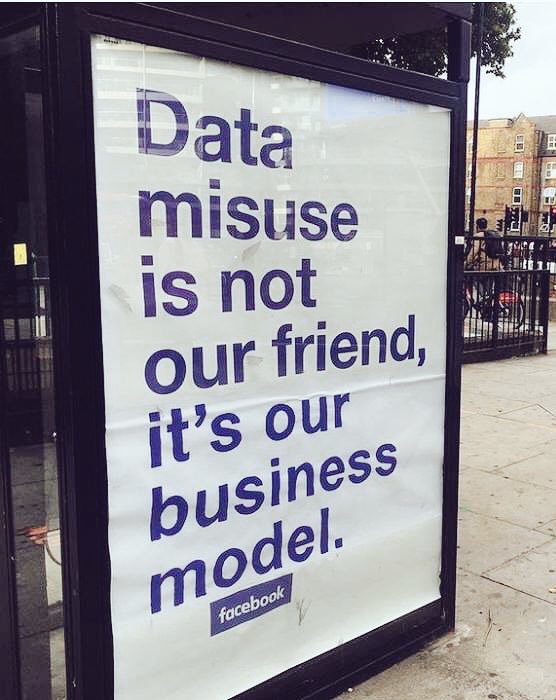
Copyright Adbusters

One of the only reasons I’ve had trouble leaving is that I don’t normally think of Facebook the company when I’m connecting with friends over Facebook the platform. That is, until about six months ago I was doing a fair amount of compartmentalization regarding my Facebook feelings: I would hear the news about Facebook’s business practices with mounting disgust, then log on and hand out a bunch of likes and haha faces and hearts to my friends’ pictures and memes and political links. Part of me knew that Facebook’s poetic PR language about connecting the world was just so much corporate bullshit. But then I would get on Facebook and act like all of that bullshit was true.

That’s because Facebook has very effectively built a business model which exploits our love for our friends and family. There’s nothing inherently wrong with such a business model: a thousand major companies, from Hallmark to Hasbro to TGIFridays, monetizes our desire to connect with people we love. But I do expect such a company, if it claims to be devoted to connecting me with my loved ones, not sell my personal data to political dirty tricks operations, to voter suppression outfits, to election oppo researchers. And I definitely expect such a company to step in when their platform is being used to encourage genocide.

So, please consider this my last post on Facebook. If you are reading this post on that platform, know that I will miss you. You I like. But so long as Facebook continues under its current leadership, with its mix of smarmy public apologies accompanied by no meaningful change in policy, I won’t be back. As a small potatoes writer who would like to have more exposure, I do understand that leaving Facebook behind will mean cutting off one of the few channels by which most people see my work. But the internet is a big place–there will still be lots of places that an interested reader can find me.

If you happen to be an interested reader, feel free to subscribe to my blog, The Subway Test –you can also find the blog simply by googling “Joe Pitkin.” Until then, I’ll say goodbye and deactivate my accounts on New Year’s Day.

I’m open to coming back someday. In fact, I’ll be happy to come back to Facebook and Instagram if the company will take meaningful action to clean up its act. For starters, the Board of Directors needs to fire Mark Zuckerberg and Sheryl Sandberg. I know that Zuckerberg can go ahead and fire the board in return–he is after all the majority shareholder in Facebook–but the board needs to grow a spine and do its job. If Zuck wants to fire the board in return, let him go ahead and do that: at the very least his doing so will make public what a morally bankrupt human being he is. If the board is able to replace Facebook’s top executives with people who will shepherd a transformation at Facebook, creating a company with meaningful privacy policies, meaningful informed consent about how our data is used, and a serious effort to clamp down on disinformation and incitement, Facebook could be fun again.

Goodbye until then–much love to you, friends!


The Author Gratefully Acknowledges

06 Saturday Oct 2018

Posted by Joe in My Fiction, Politics, Science, Science Fiction, Stories, The Time of Troubles

≈ Leave a comment

Tags

Bill Gates, hard sci fi, Politics, sci-fi, Science Fiction, social justice, Stories

My story “Potosí” recently came out in Analog, and it’s gotten lots of the positive and negative attention that I had hoped it would. In the case of this story, I looked forward to some negative attention, as “Potosí” is a not-so-veiled indictment of the Trumpian worldview, and some readers of science fiction, unfortunately, are also white supremacists. (This is not to say, by the way, that everyone who hated the story is a white supremacist. People could have any number of reasons for disliking the story; however, a few people who hated it had objections which were rooted in a white supremacist worldview).

I’ve also been happy with how the story looks in Analog. Even though the magazine is print-only, it’s still nice in this internet age to see one’s name in print. However, I do have one regret about how the piece looks: my bio was omitted from the end of the story. That’s normally not a big deal at all for me–I suspect the editors left it off for space-saving reasons, and the folks at Analog have done more than just about anyone to promote my work. They were even kind enough to run a full page biosketch on me a couple of years ago. But there was a line in my bio for this story that I really wanted to appear in the magazine. Here is is:

“The author gratefully acknowledges the assistance of Phil Ekstrom in working out the physics of this story.”

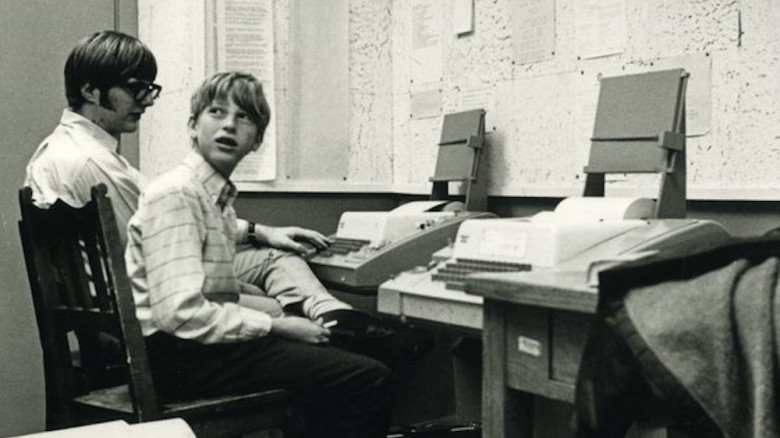
Phil is a friend of mine whose knowledge of physics not only exceeds my own (that’s an exceedingly easy accomplishment), but his knowledge of physics also exceeds my knowledge of any field at all, including writing. He’s a man of great accomplishment in a wide number of fields of physics and engineering; while it’s hardly his greatest achievement, some will recognize his work in the photo below: Phil was one of the people who wired up the young Bill Gates’ and Paul Allen’s first computer.

young gates and allen

A teenage Bill Gates looks to the top of an imagined stack of 100 billion dollar bills –Getty Images

“Potosí” involves a decent amount of classical mechanics–most of the story takes place in the microgravity of a small asteroid being pushed this way and that by space tugs, mass drivers, and the imaginary forces of human greed and anger. I’m reasonably good at describing  the greed and anger part, but I needed a lot of help with the physical forces. I can tell Phil has years of experience explaining things to undergraduates of varying talent; he certainly needed to call on those skills in order to explain my story to me.

The story has some (I hope small) violations of physical laws, where I did a little handwaving in order to accomplish an artistic goal. But to the extent that “Potosí” is any example of hard sci-fi–as opposed to the science fantasy of Star Wars or the kilomoles of handwavium in Star Trek–I have Phil Ekstrom to thank for giving the story some semblance of rigor. Thanks, Phil.

The Big Red Carpet

14 Tuesday Nov 2017

Posted by Joe in Politics, The Time of Troubles

≈ Leave a comment

Tags

2018 Elections, Checks and Balances, Impeachment, Politics, The Federalist Papers

Lots of people smarter than me have written about how Trump is a pushover in international negotiations: Trump’s two week sojourn in Asia brought out a round of such analyses here, here, and here. But for me our current president’s addiction to flattery and fawning appeared in his remarks about the red carpet treatment Trump (and, well, America) was given:

“It was red carpet like nobody, I think, has probably ever received. And that really is a sign of respect, perhaps for me a little bit, but really for our county. And I’m really proud of that.”

red carpet

photo courtesy of The White House

It’s hard to watch our country get played for a bunch of suckers by the government of China, of Russia, of really any nation with leadership savvy enough to understand Trump’s fragility and neediness. I just happened to have stumbled across James Madison’s sentiments on the matter, written back in 1788:

Every nation, consequently, whose affairs betray a want of wisdom and stability, may calculate on every loss which can be sustained from the more systematic policy of their wiser neighbors. But the best instruction on this subject is unhappily conveyed to America by the example of her own situation. She finds that she is held in no respect by her friends; that she is the derision of her enemies; and that she is a prey to every nation which has an interest in speculating on her fluctuating councils and embarrassed affairs.

–Madison, Federalist #62

Madison’s remedy for our “fluctuating councils and embarrassed affairs” was a brand new constitution. What’s our remedy today?

Hint: the remedy is in the Constitution!

Potosi Picked Up!

18 Monday Sep 2017

Posted by Joe in Advertising, Beta Readers, Musings and ponderation, My Fiction, Science Fiction, Stories, Stranger Bird, The Time of Troubles, YA fantasy

≈ 3 Comments

Tags

Analog Science Fiction and Fact, books, fantasy, literature, mythopoesis, racism, sci-fi, Science Fiction, self-publication, Stories

I’m happy to announce that the great science fiction magazine Analog has picked up my story “Potosí” for publication. “Potosí” will be the fifth story I’ve had appear in Analog, and by far the longest story (nearly 10,000 words) I’ve ever placed in a professional market.

As I wrote elsewhere, “Potosí” is set in a near future where corporations and countries squabble over the solar system’s vast mineral rights. It’s also a meditation on white supremacy and terrorism, an attempt to explain today’s world in new and striking clothes–much the same way that Star Trek explains the Cold War and Forbidden Planet explores World War II survivors’ guilt.

It’s been a good (and busy) week for my writerly life. One of my recent stories (another Analog pick-up called “Proteus”) is getting some very nice attention, and my quest to publish my first young adult fantasy novel, Stranger Bird, continues apace. I’m hoping for a publication date of November 3–keep watching the transom for that.

There’s also much more that I want to share here on The Subway Test, and I’m sure I’ll have some longer musings and ponderations here soon, but for now I’m pretty busy just keeping on top of my sci fi and fantasy writing.

The Founding Bloggers

23 Wednesday Aug 2017

Posted by Joe in Book reviews, Literary criticism, Musings and ponderation, Politics, Reading Roundup, The Time of Troubles

≈ 1 Comment

Tags

Alexander Hamilton, books, Hamilton, James Madison, John Jay, Lin-Manuel Miranda, Politics, The Federalist Papers, Trump

When a musical like Hamilton comes along, a rational response to the buzz is for folks to, you know, want to see Hamilton. Others might be overwhelmed enough by the positive press to look to Hamilton‘s source material, the gargantuan Ron Chernow biography of the man on the ten dollar bill.

Others, the cheapskates and musical theater philistines, might turn instead to The Federalist Papers.

Yes, I started reading The Federalist Papers because I heard Hamilton rapping on NPR for a minute and I realized that I hadn’t really read anything Hamilton had written.

I suppose if I’m really honest with myself, I do have to admit that fear for the future of America, at least as much as Lin-Manuel Miranda, is really what sent me to The Federalist Papers. As I watch the current president’s bumbling yet earnest assault on the Constitution–his flouting of the emoluments clause, his apparent ignorance of the establishment clause, his barrelling through each conversation as though the separation of powers didn’t exist–I realize that I don’t know enough about the document that the president is trying to subvert.  I have read the Constitution, and I’ve sure been going back to my pocket copy a lot lately, but like a powerless fanboy, I want to know more, to know it better. And The Federalist Papers, I’ve been told, are the inspired commentary on the US Constitution, the brilliant liner notes to that Sergeant Pepper’s Lonely Hearts Club Band of legislation.

I’m about a third of the way through so far, and it’s very slow going. All three of the authors–Alexander Hamilton, James Madison, and John Jay–learned to write in an age when a man showed his genius by teasing each sentence into a froth. Each sentence has a multi-layered, architectural quality, like the 18th century wigs that Hogarth lampoons in Five Orders of Perriwigs.

William_Hogarth_-_The_Five_Orders_of_Perriwigs

By William Hogarth – Scanned from The genius of William Hogarth or Hogarth’s Graphical Works, Public Domain, https://commons.wikimedia.org/w/index.php?curid=2714934

Of the three, John Jay is the most straightforward of the writers, the one least inclined to pile on the relative clauses. Imagine my dismay, then, to learn that John Jay wrote by far the fewest of the papers–only five of the 85–before illness forced him to give up the project. Hamilton, who wrote by far the most of the papers, is also the hardest to read. Every sentence of Hamilton’s is like listening to a Yngwie Malmsteen guitar solo: his paragraphs are spattered with commas, packed with dependent clauses that double back on themselves and seem to eat their own tails. And they are also filled with some of the most brilliant and vigorous writing I’ve ever seen.

This sentence, from Federalist #29, is typical Hamilton:

There is something so far-fetched and so extravagant in the idea of danger to liberty from the militia, that one is at a loss whether to treat it with gravity or with raillery; whether to consider it as a mere trial of skill, like the paradoxes of rhetoricians; as a disingenuous artifice to instil prejudices at any price; or as the serious offspring of political fanaticism.

Wow–I had to crawl through this sentence few times before I could tell what Hamilton was actually arguing: that militias are no danger to public liberty. However, one look at the rigging of this sentence is enough to warn me not to treat his ideas with raillery. A sentence like this demands to be treated with gravity.

I was also fascinated to see, in this sentence and elsewhere, how current Hamilton’s ideas are. Dust off the perriwig of his prose, and you can see that we are still  debating “the idea of danger to liberty from the militia” in this era of Cliven Bundy.

But what has impressed me the most so far about these letters is the high-wire act their authors pulled off. The three men, all writing under a single pseudonym–“Publius”–managed to pump out 85 of these essays over just ten months. That’s one letter every three or four days, each one a Niagara of commentary intended, I imagine, to bury the Constitution’s opponents under a flood of historical references, musings on American geography, and speculations on human behavior.

The newspapers these essays appeared in, The New York Packet and the Independent Journal, were two of that enormous flock of early American newspapers. I remember reading somewhere that most such papers had a circulation of about 1000. Publius was, in other words, much like an early blogger: a pseudonymous team of writers with a tiny audience, writing their asses off to produce brilliant content several times a week.

Dilettante that I am, I have nothing comparable to offer the country here at The Subway Test. I post a couple of times per month, sometimes about politics but usually not. Usually my topic is, in Homer Simpson’s words, “what some nerd thinks about Star Trek.” Yet I can reach back those 230 years to the brilliance of Publius and see that I am pushing my little cart up the great track they laid. If you want to resist the depredations of the current presidency, you have to educate yourself. Read The Federalist Papers. It is one of those books that will comfort you with the underlying genius of the republic. More importantly, it will help you understand what the hell you are defending when you stand up to the current president.

A Story for the Time of Troubles

31 Wednesday May 2017

Posted by Joe in Musings and ponderation, My Fiction, Science Fiction, The Time of Troubles, Utopia and Dystopia

≈ 1 Comment

Tags

Asteroid Mining, racism, sci-fi, Stories

I’ve been intending to write a story about asteroid mining for some years now. Last week I put the finishing touches on my best attempt at the topic: what started last year as a first draft of about 3,000 words plumped up over the course of a year into a 10,000 word dreadnought of a story (actually a novelette, for those of you interested in the preposterous nomenclature of fiction) about terrorism, white supremacists, and a floating mountain of pure platinum.

There aren’t many science fiction magazines that will take a story of that length, so if it isn’t picked up it may not see print until I publish a collection of my own stories. But I do hope that it is printed before then, partly because so much of what the story became bubbled up out of my struggling with the political climate of the last year.

While the terrorist enemy of the day is ISIS, science fiction looks beyond today’s social structures, refracting the view of today’s enemies and power relations into a new image that arrests our attention with its logic. What I’ve attempted to do is not exactly a bravura leap of imagination: it’s pretty easy today to see parallels between the medievalist Islamic terrorists of ISIS and their reactionary Christian, white supremacist counterparts. The greatest parallel between them is that for all the hostility they seem to have for one another, their common enemy is liberalism: both groups hate the world of globalized commerce and its perceived moral relativism; both are willing to kill innocent people in order to restore what they believe to be the proper–and long-insulted–social order.

Robert Thivierge

Photo Credit: Robert Thivierge

In the last few weeks it’s been comforting to watch the total shambolic ineptitude of the Trump administration. I have some faith that Trump’s vision of a hyper-nationalist, authoritarian America will fall apart over the next two to three years, if only because Trump and his cronies seem so intent on committing impeachable offenses (and crimes) in plain view. However, Trump’s incompetence will not dismiss the anger and hatred of some of his hardest-core supporters, the white supremacists and neo-fascists who have been so emboldened by Trump’s behavior. In fact, I’ve wondered whether Trump’s inability to govern, his failure to encourage the passage of legislation even with a pliant Republican congress eager to pass tax cuts and repeal Obamacare, may lead to even greater violence and frustration among Trump’s hardest core.

When I sat down to start this latest story, called “Potosí,” over a year ago, the thought of a white supremacist terror group seemed far-fetched, a hearkening back to the worst days of the KKK. Today I wonder whether the story is a little too prescient.


I Marched for Science

26 Wednesday Apr 2017

Posted by Joe in Musings and ponderation, Politics, Science, The Time of Troubles

≈ 2 Comments

Tags

scientific literacy, sociology of science, The March for Science

March for Science2

Photo credit–Carlyn Eames

I’m not a professional scientist. I do have enough training to work as a lab tech if there’s ever some neo-Maoist Cultural Counter-Revolution where we’re all rounded up and forced to work in research facilities–it goes without saying that that won’t be happening during this administration. I’d be reluctant to call myself a scientist because I have published no peer reviewed papers, and my field work is competent at best (and often in graduate school I wasn’t at my best).  Having said that, I have actually worn a lab coat and safety goggles as a part of my job–for a week here and there, anyway–and I  have all the love for the scientific enterprise that an enthusiastic amateur science fiction author can have.

Across the republic, the streets were filled with people like me last Saturday at the March for Science. Well, based on the signs people were carrying, I’m sure that a lot of the marchers were bona fide scientists–at least bona fide lab techs and grad students. And, while there has been a healthy debate within the sciences about whether this kind of public advocacy is helpful or harmful to the cause of science, put me down as one who believes it’s valuable for scientists and science-lovers to stand up and be counted.

MArch for Science1

I appreciate a properly footnoted sign. Photo credit–the lovely Carlyn Eames

There has been push-back from some scientists–this article at Slate is a typical example–that the march was an orgy of uninformed and misinformed pro-science good-feelery from non-scientists. That is, according to Dr. Jeremy Samuel Faust, the folks marching mostly don’t understand science enough. If marchers did understand the state of science, with its almost guild-like patronage system, its rampant data mining and cherry picking, its Potemkin peer review, they wouldn’t be so eager to draw up witty signs and march in its defense.

Faust does have a point: I suspect few of the people on the march this weekend understand what statistical significance really refers to, and even fewer would be ready to talk about the many misuses of p<.05 that researchers engage in because they’re trying to score a publication (or, more likely, because most scientists are not statisticians and often use statistical tools in ways they were not intended).

And yes, that’s a problem. But that’s not what the march is about. One can support the scientific enterprise, be willing to march in the rain for it, without knowing everything about science. None of the marchers, even the scientists, have a full understanding of all of the sciences humans engage in. The geologists on the march don’t know any more than I do about high energy physics, and the high energy physicists know less about environmental biology than I do.

Many of the scientists out there, even the duffers like me, know that there are deep problems with the sociology of science, with the misuse of methods and publication and statistical analysis. But something the marchers all had in common, scientists and non-scientists alike, was a support for the idea underlying science: that the scientific method can be used to describe our environment and make useful predictions. Faust is right that the scientific method is a roundly abused idea even within the sciences, to say nothing of non-scientists. But one can love and support a good idea without understanding it fully.  Whether any individual marcher can be picked out of the crowd and made to follow the scientific method to Dr. Faust’s satisfaction is beside the point.

The scientific enterprise is flawed, just as representative democracy is flawed. I marched because I believe in the idea of science (and, for that matter, representative democracy). The way to reform the institution of science is the same as the way to reform the republic: it will be saved by people who care for and love those institutions. Science and civil society won’t be reformed if we roll over when the administration attempts to hobble the EPA or reverse even modest US actions to counter climate change.

“Proteus” Is In Print!

22 Saturday Apr 2017

Posted by Joe in My Fiction, Science Fiction, Stories, The Time of Troubles, Utopia and Dystopia

≈ 1 Comment

Tags

Analog Science Fiction and Fact, monsters, sci-fi, terraforming, transhumanism, utopia, Venus

My latest story, “Proteus,” is out in the May/June issue of Analog Science Fiction and Fact! On the spectrum of my work, “Proteus” is closer to the hard sci-fi  pole–hence its appearance in Analog, widely regarded as one of the preeminent publishers of the hard stuff.

“Proteus” is the second of my stories set in the John Demetrius cycle, set (so far as I can imagine) about 100-200 years in humanity’s future. The whole cycle takes up questions of our coming experiment with transhumanism, as well as a kind of meditation on the nature of utopia and dystopia–I’ve tried to create a world like our own, in which utopia and dystopia coexist in different parts of the world and for different people at the same time. “Proteus” was also an immensely fun story to write–it involved a good deal of research into the terraforming of Venus and the nature of any possible human colony on Venus.

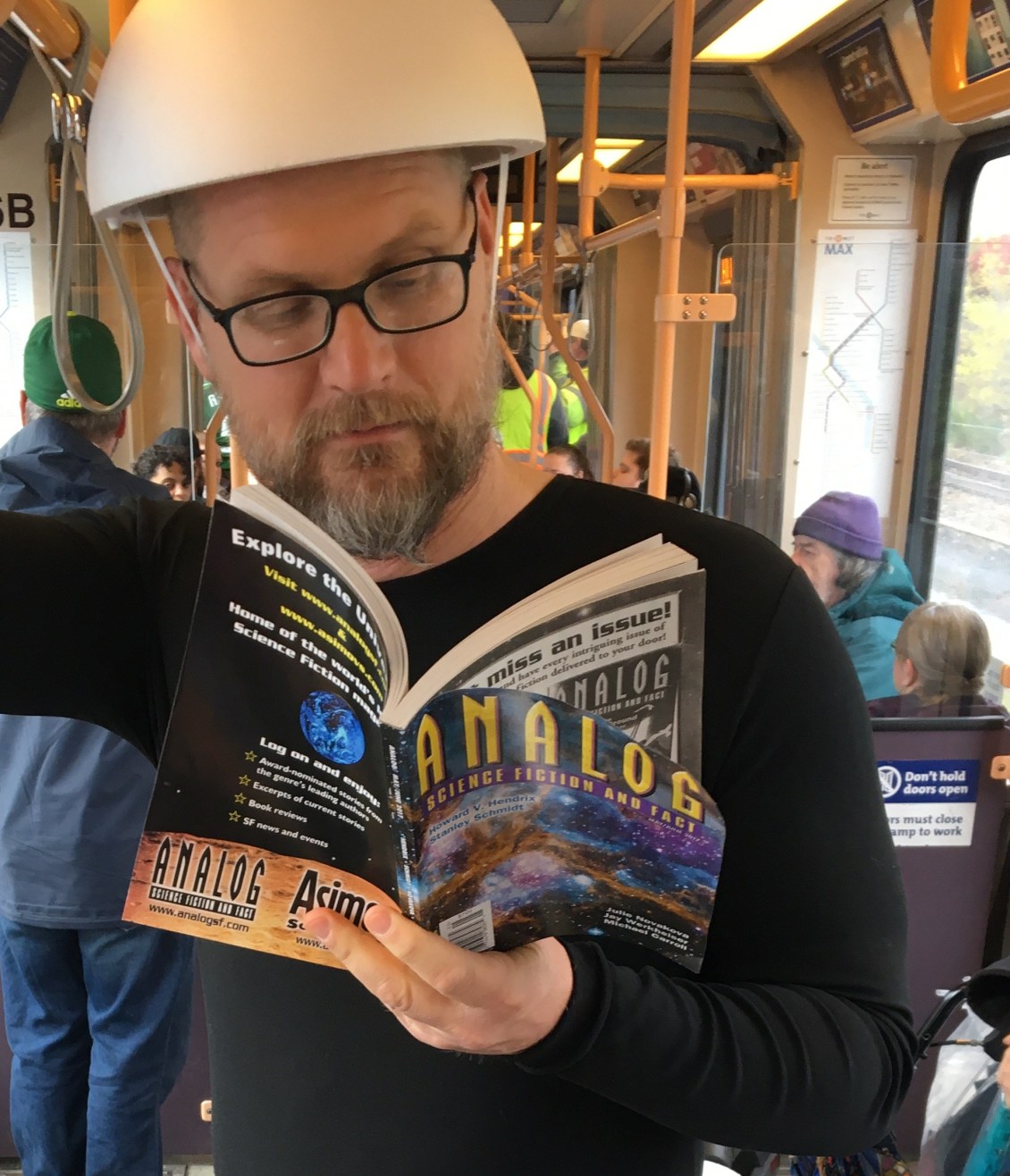
Analog on MAX

Photo credit Carlyn Eames

To get a promotional shot for the blog, my wife obligingly took a couple of pictures on our way to The March for Science this morning. I’m dressed as the most terrifying greenhouse gas on the planet, old silent-but-deadly methane. And given the name of my blog, I thought it best for her to take the photo on the MAX train, Portland’s closest analog to a true subway.


Analog on MAX2

It’s hard out here for a simple hydrocarbon. Photo credit Carlyn Eames

Analog can be purchased wherever fine science fiction magazines are sold, including at the 800-pound Amazonian gorilla.


Retiring Mr. Methane

17 Monday Apr 2017

Posted by Joe in Advertising, The Time of Troubles

≈ 2 Comments

Tags

marketing, profile photos, The March for Science

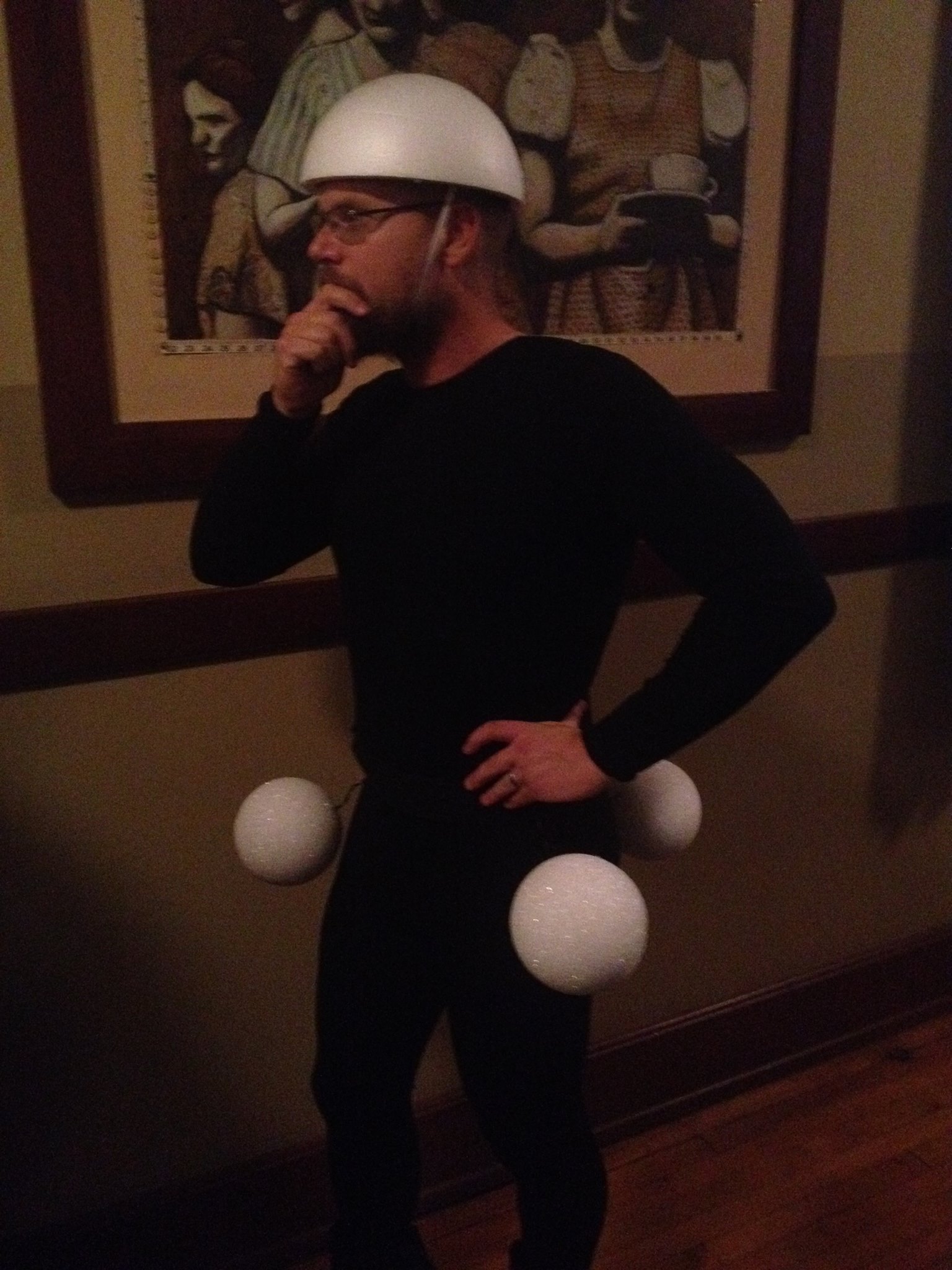
It is with mixed emotions that I retire my current profile photo for this blog: good old Mr. Methane:

methane

This is one of my favorite pictures of myself, taken by my wife on Halloween 2015. I thought I did a decent job making myself into a ball-and-stick model of the most frightening greenhouse gas on the planet. And the picture captures what I’ve always considered the essential ridiculousness of my writing enterprise.

But, I suppose if I want people to take my writing seriously, I might get more of the right kinds of attention if my profile pic doesn’t show a man in a black body suit and Styrofoam deedle balls.

And, I’ve been lucky to work with a truly talented photographer, Pat Rose, who took the most flattering photos of me I’ve ever encountered. The one I call “Smiley Joe” will go on the back cover of Stranger Bird when it comes out:

Joe Stranger Bird cover photo

And for the blog itself, I’ll be using another of Pat’s fabulous shots, the one I don’t have a name for yet:

Joe web profile photo

I’m open to any names you want to suggest. “Oddly intense sci-fi man?” “Half-light Raconteur?” Really, he needs a name.

And old Mr. Methane? My wife had the genius idea that I should pull the old costume out for the March for Science. If I can wear a black bodysuit and stand up for civil society? What more could I want out of the weekend?

The Seeds of Trump’s Undoing

14 Tuesday Feb 2017

Posted by Joe in Musings and ponderation, Politics, The Time of Troubles

≈ Leave a comment

Tags

Electoral Fraud, Putin, Russia, Trump, Watergate

I’ve been working on a couple of long blog posts that I have wanted to finish for a while. However, I back-burnered them all today as I digested the news of Michael Flynn’s resignation as Trump’s national security advisor. I was reminded of something I told my wife on the night of the election, and which I have repeated many times since: the seeds of Trump’s undoing are right in front of us.

I was not making a prophecy. I had simply been reading the news which was available to us since before the election, such as this groundbreaking piece by Mother Jones veteran David Corn. Many have suspected for months that Donald Trump was receiving aid from a hostile foreign power, a power determined to manipulate the outcome of the presidential election.

There are many Republicans in Congress who have circled their wagons around Trump because he is one of their team, because presumably they see some advantage to themselves in protecting the president. But even within the famously disciplined Republican Party there are increasing calls for investigations, not four weeks into Trump’s presidency, into “what did the president know, and when did he know it?”

The echoes of Watergate are obvious, but facile. Our current national nightmare is a great deal worse than Watergate: we are talking about an enemy state, ruled by an anti-democratic strongman, subverting our electoral process in order to bring a favored candidate to power. And Trump, Putin’s favored candidate, has been artlessly, bafflingly open about his desire to reward Putin for the help.

Today on CNN, Democratic congressman Seth Moulton called out the elephant in the room: the support of an enemy state’s agenda at the expense of the interests of your own country is, by definition, treason.

There is chaos and trouble ahead. In the same way that I wonder about my parents’ and grandparents’ stances in 1974, our kids and grandkids will ask about how we acted, and what we did, during the time we’re living through.

← Older posts
Newer posts →

Subscribe

  • Entries (RSS)
  • Comments (RSS)

Archives

  • November 2025
  • September 2025
  • August 2025
  • July 2025
  • May 2025
  • April 2025
  • March 2025
  • January 2025
  • December 2024
  • October 2024
  • September 2024
  • August 2024
  • June 2024
  • May 2024
  • April 2024
  • March 2024
  • February 2024
  • January 2024
  • December 2023
  • October 2023
  • August 2023
  • July 2023
  • June 2023
  • April 2023
  • March 2023
  • May 2022
  • August 2021
  • June 2021
  • January 2021
  • October 2020
  • May 2020
  • March 2020
  • February 2020
  • January 2020
  • July 2019
  • June 2019
  • December 2018
  • October 2018
  • July 2018
  • May 2018
  • April 2018
  • January 2018
  • December 2017
  • November 2017
  • September 2017
  • August 2017
  • July 2017
  • June 2017
  • May 2017
  • April 2017
  • March 2017
  • February 2017
  • January 2017
  • December 2016
  • November 2016
  • October 2016
  • August 2016
  • July 2016
  • June 2016
  • May 2016
  • March 2016
  • February 2016
  • January 2016
  • December 2015
  • November 2015
  • October 2015
  • July 2015
  • May 2015
  • March 2015
  • February 2015
  • January 2015
  • December 2014

Categories

  • A Place for my Stuff
  • Advertising
  • Artificial Intelligence
  • Beta Readers
  • Biology
  • Book reviews
  • Curious Fictions
  • Dungeons and Dragons
  • Exit Black
  • fantasy
  • Games
  • HPIC
  • Journeys
  • Let's All Admire That Fantastic Can
  • Lit News
  • Literary criticism
  • Musings and ponderation
  • My Fiction
  • Pacifica
  • Politics
  • Reading Roundup
  • Science
  • Science Fiction
  • Science Fiction Writers of America
  • SETI
  • Stories
  • Stranger Bird
  • The Ideal Vehicle
  • The Time of Troubles
  • Uncategorized
  • Utopia and Dystopia
  • Welcome
  • YA fantasy

Meta

  • Create account
  • Log in

Authors

  • Joe's avatar

Blog at WordPress.com.

  • Subscribe Subscribed
    • The Subway Test
    • Join 143 other subscribers
    • Already have a WordPress.com account? Log in now.
    • The Subway Test
    • Subscribe Subscribed
    • Sign up
    • Log in
    • Report this content
    • View site in Reader
    • Manage subscriptions
    • Collapse this bar
 

Loading Comments...