
• About
  • My Fiction
  • Reviews

The Subway Test

~ Joe Pitkin's stories, queries, and quibbles regarding the human, the inhuman, the humanesque.

The Subway Test

Tag Archives: book review

Three books that have affected me this year

17 Wednesday Sep 2025

Posted by Joe in Book reviews, Musings and ponderation, Politics, Reading Roundup, The Time of Troubles

≈ 3 Comments

Tags

Abundance, Anne Applebaum, Autocracy Inc., book review, books, Daron Acemoglu, democracy, Derek Thompson, Ezra Klein, history, James Robinson, Politics, Why Nations Fail

I’ll begin with the obvious: we can’t defend the republic simply by reading books. Reclaiming and repairing American democracy will require mass protest, creative civil disobedience, and serious political organization.

But let’s not minimize the importance of a shared text for the cohesion of a political movement: from The Bible to Common Sense to Uncle Tom’s Cabin, defenders of American democracy in the past found solidarity and a shared language through a text held in common. And beyond that, a book often serves as an extended argument for or against a cause, an intellectual defense of an idea that needs defenders. Most Americans haven’t read The Federalist, but anyone who has read it has access to the first and most brilliant exegesis for the Constitution itself.

I don’t expect any of the books below to have the impact of Common Sense. But I got a great deal out of reading each of them, and I think our movement would be better off if more defenders of constitutional democracy were aware of the ideas here. My reasons for choosing to read them were idiosyncratic, but I want to evangelize for each of these books to you. While they aren’t the only good books I’ve read this year, they each in their own way offer an argument for meeting the current authoritarian moment in the United States.

Autocracy, Inc.: The Dictators Who Want to Run the World, by Anne Applebaum: I get the impression that this book is a compilation of pieces that Applebaum has written in The Atlantic, some of which were extended in this book. Nevertheless, I really recommend taking in her argument all at once here. According to Applebaum, the anti-democratic regimes of the world—from Putin’s Russia and Xi’s China all the way to Maduro’s Venezuela and Mnangagwa’s Zimbabwe—have banded together into a kind of mutual aid society. That is, regimes that see democracy as a threat to their survival are helping one another to evade sanctions, to foment an anti-democratic disinformation network, and to sabotage the democracies of the world. This network of autocrats and strongmen has accomplished a great deal to undermine democracy already, and I came away from this little book believing that the struggle against Vladimir Putin and Xi Jinping is inextricable from the struggle to resist Donald Trump. It’s not totally clear yet how the forces of democracy will succeed at restoring civil society’s fortunes; however, success begins with understanding the nature of the forces attacking us. In a dark time, I take heart in Applebaum’s dedication of the book “for the optimists.” To paraphrase John Lennon, she’s not the only one.

Abundance, by Ezra Klein and Derek Thompson. I picked this up after it seemed like every lefty blogger–and a lot of non-lefties–couldn’t stop talking about it. I find the book’s thesis straightforward and compelling: according to Klein and Thompson, America has lost its initiative to build housing, transportation projects, and energy infrastructure, and progressives bear at least some responsibility for that state of affairs. In the name of environmental protection, labor unionism, and racial justice (a trifecta the authors refer to as “everything bagel liberalism”), we on the left have deployed environmental impact statements, restrictive zoning ordinances, and other restrictions on property use, often with the self-serving secondary purpose of boosting property values in blue cities.

As a progressive, labor unionist, and committed environmentalist, I find this thesis challenging. However, it’s hard to deny that NIMBY attitudes have slowed the construction of affordable housing in many putatively progressive West Coast cities, and these same attitudes have slowed or stalled many energy generation projects, even some solar and wind installations, to say nothing of nuclear energy capacity. On the right, Tyler Cowen has argued that organized labor and environmental groups are the two primary culprits in this slowdown. I would like to hold out the possibility that opposition to more environmentally friendly infrastructure, energy generation, and housing is not baked into the recipe of the labor and environmental movements, but this book issues a challenge to us on the left to support, rather than oppose, a society which builds more for its members. One of the personal goals I’ve set myself over the coming year is to investigate ways that the abundance agenda–which I believe I endorse–can be reconciled with the values of organized labor, social equity, environmental protection, and ecological restoration that I also support. Of course, all life is a series of trade-offs, and not every virtuous goal can be maximized simultaneously. I want to seek out practical compromises for the coming restoration of democracy that will move society forward, and this book is a great call for that.
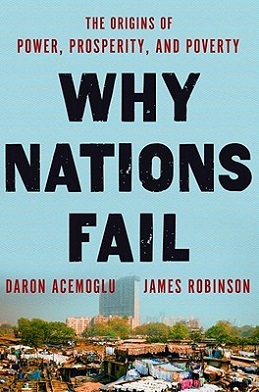
Why Nations Fail: the Origins of Power, Prosperity, and Poverty, by Daron Acemoglu and James Robinson. I spoke of the explanatory power of this remarkable book in an earlier post on democracy. The timing of its coming into my life was a bit random: I saw it sitting on the bookshelf of the drummer in my band about a week after Donald Trump’s 2024 victory, and I guess I was sensitized to the title. And, knowing John to be a well read guy–one of the two best-read drummers I’ve ever played with–I figured I would give the book a spin. Acemoglu and Robinson are two-thirds of a Nobel prize-winning team of economists for their work studying “the importance of societal institutions for a country’s prosperity,” to quote the The Royal Swedish Academy of Sciences. And this book, which struck me as both readable and magisterial in its scope, has helped me more than anything I have read before to articulate why democracy delivers peace, happiness, prosperity, and well-being better than any other form of government yet tried.

In a time when many Americans on the political right are growing fascism-curious (when they are not out-and-proud tiki torch-carrying fascists); and in a political moment when some on the left are so committed to ideological purity around questions of race, gender, Israel, and capitalism that they would rather lose elections than work with centrists, I found this book wise, humane, and ultimately hopeful. I hope more of my fellow Americans will read it.
Freaking Out in Powell’s City of Books

30 Monday Dec 2024

Posted by Joe in Exit Black, Musings and ponderation, Science Fiction

≈ 3 Comments

Tags

book review, books, Exit Black, fiction, independent bookstores, marketing, Powell's City of Books, reading, sci-fi, Science Fiction, writing

As a Portlander, I have to contend with the reality of Powell’s City of Books. It’s the largest independent bookstore in the world, and as you might imagine it has a mighty footprint on the Portland literary scene. A friend who worked there told me about 20 years ago that 40% of Amazon’s book orders actually go through Powell’s. I doubt that that is still the case today, but it gives you some idea of the size of the place, as well as the indirect role Powell’s played in the rise of Amazon. One of Portland’s most popular tourist destinations, Powell’s City of Books is its own Portlandia sketch.

For many years, basically from the time I started writing fiction in my thirties, I had a lot of trouble going into Powell’s. Part of the dread I felt was simple cognitive overload. But I was also contending with two related kinds of self-loathing in the City of Books, one as a reader and one as a writer.

As a reader, I would feel depressed in City of Books to come into contact with all the great books that I hadn’t read and would likely never read. As a writer, I would despair that of the tens of thousands of titles that were on the shelves on any given day, nothing I had written had ever shown up there. In my foolishness, the place had become a visual metaphor for two ways I felt I had come up short as a human being.

Eventually the feeling passed, probably just because I got older. It doesn’t upset me so much anymore that I don’t have that many more books to read in my future. Even if I live a fantastically long life, it seems unlikely that I have more than 2000 books left to read, and the number could be far, far lower than that. The key, as my friend and bandmate John Governale has shown me, is not to try to read all the good books out there, but rather just to remember that there is always a great book out there for me–I don’t need to spend any time reading a bad one.

As for the fact that my stuff had never shown up on the shelves of Powell’s City of Books, I eventually got over myself there, too. I think that as I got better as a writer, I started to find more joy in just writing well (as distinct from winning awards or getting prestigious publications or big book contracts). I still love to get published, but even more than that I love the feeling of putting together a story that really works.

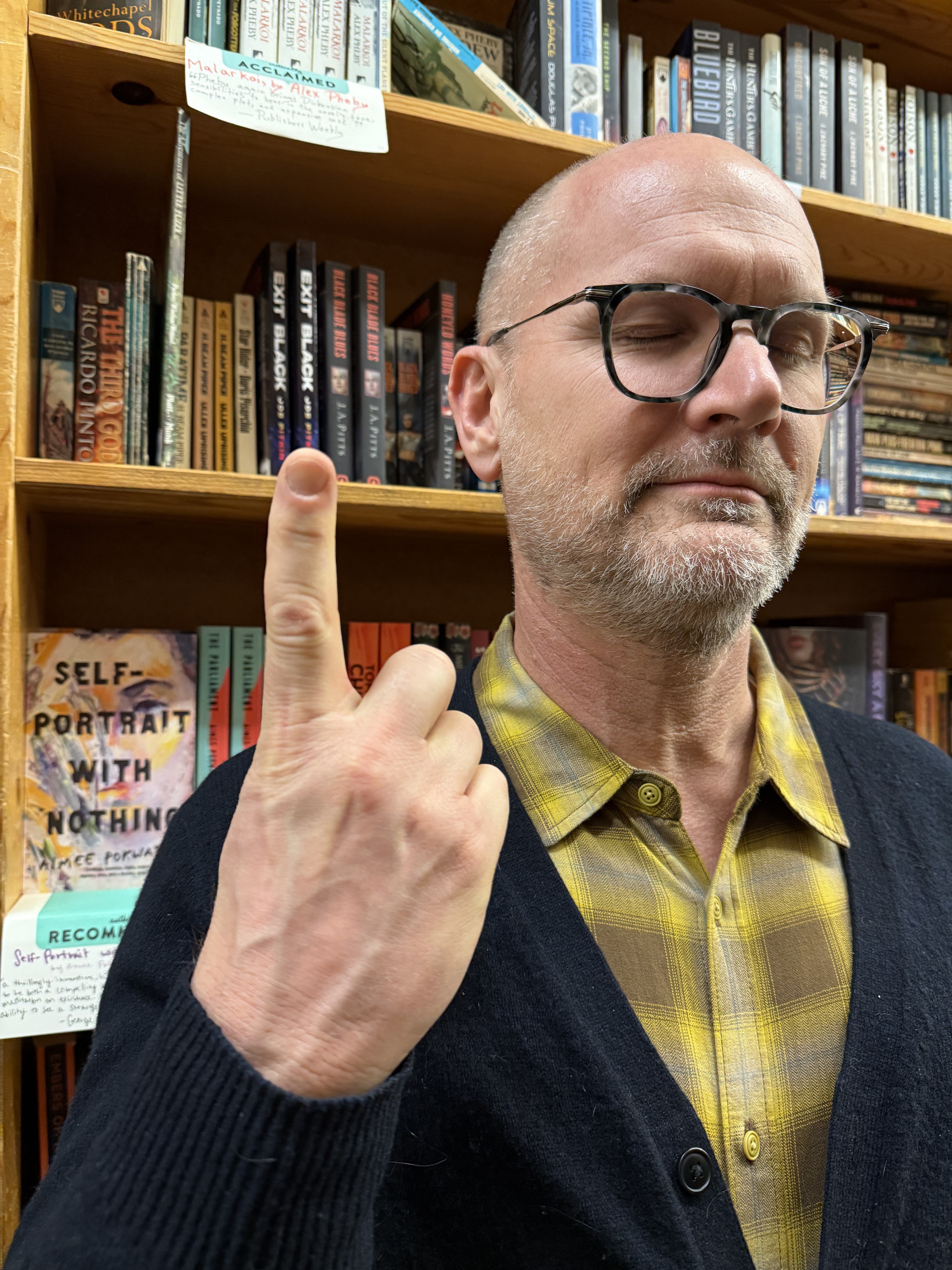
As I tell my students and my kids, there are lots of situations where you start getting good at something right around the time that you don’t have to do that thing anymore. And there was a similar feeling of irony for me when I went into Powell’s City of Books last week and found that my latest novel, Exit Black, is indeed on the shelves there. I still prefer the smaller independent bookstores in my life–Broadway Books, White Oak Books, Annie Bloom’s–but it is a nice feeling to know that a tourist in Portland who wanted to find my work for some reason could find Exit Black right in the Gold Room of Powell’s City of Books, section 722.

“As you know, Captain:” the Perils of Infodump

06 Monday May 2024

Posted by Joe in Advertising, Exit Black, fantasy, Lit News, Literary criticism, My Fiction, Science, Science Fiction, Stories, YA fantasy

≈ 2 Comments

Tags

book review, Book reviews, books, Compose Creative Writing Conference 2024, F/SF, fantasy, infodump, sci-fi, Science Fiction, writing

I was invited recently to present a workshop at one of Oregon’s wonderful creative writing conferences–the Compose Creative Writing Conference at Clackamas Community College (perhaps the hosts tried to come up with a seventh word starting with c- for the title, but six must have been all they could fit in). After the honor of being invited wore off, I realized that I would have to actually, you know, present something at the CCWC at CCC.

I decided to present a session on reducing infodump in speculative fiction. Did I choose this topic because I’ve been widely praised for my taut, sleek stories? I wish. Actually, if anything the opposite is true: during the early years of my fiction career, I got so many rejections along the lines of “this story is well-written, but it takes forever to get to its point. There’s so much infodump here that I was barely able to get to page 8.”

The best thing I can say about infodump in my writing is that editors don’t complain about it in my stories nearly as often now. So I figure that I’ve either learned to deal with it or editors are just tired of giving me notes on it.

As you probably know already, infodump refers to bogging down the flow of a story with tedious explanation. And, while writers of any genre can fall into the habit, it’s an especially common problem in speculative fiction. If you’ve ever read a bad fantasy novel (or watched a bad sci fi movie), you have surely seen some infodump along these lines:

Scientist: I sequenced the DNA sample you brought me. Whoever provided it has some snips that I’ve never seen in a human genome before.

Captain: Snips?

Scientist: ‘Single nucleotide polymorphisms.’ As you know, captain, all sexually reproducing creatures on Earth–including humans–inherit two copies of each gene, one from the mother, and one from the father. These genes determine everything from eye color to explainexplainexplain continue explaining for four pages explainexplainexplain I hope you did well in middle school biology…

For me, infodump is even worse in fantasy than in science fiction. In SF, there’s at least the possibility that what’s being infodumped actually will teach you something real about how planetary motion works or what the principle of competitive exclusion is. In fantasy, the infodump often amounts to nothing more than 20 pages of the author’s fever-dream journal entries about a fictional queen who lived 800 years before the story takes place and what she did to curse the elven sword that is the McGuffin for this whole heptalogy of novels…

What causes infodump? Why should you be wary of the phrase “as you know” in your writing? And how do you reduce infodump in your novel? Well, if you want the whole story, come see me at the CCWC on Saturday the 18th! Or, if you’re not a Portland person, drop me a line: I’m always happy to talk F/SF with book clubs, writing groups, bookish nerds, random drunks, and people on a secret mission.

For now, I’ll just say that two factors that contribute to infodump are 1. writers’ mistrust of the reader’s ability to follow along, and 2. writers who get lost for hours (or months, or decades) in worldbuilding before they ever get around to actually writing their story.

I may say more on the subject soon, but as you know, I have been working on reducing my infodump.

Towards 100 Readers

19 Thursday Apr 2018

Posted by Joe in Book reviews, Literary criticism, My Fiction, Stranger Bird

≈ 1 Comment

Tags

book review, fantasy, self-publication, Stranger Bird, YA fantasy

It was a lovely surprise to see that someone new has given my book a review on Amazon. It was doubly surprising that the reviewer compared my work to Ursula Le Guin’s–for a fantasy writer, that’s like having your guitar solo likened to Jimmy Page’s work.

And triply surprising was that this review came from someone I don’t know personally. I’ve gotten several sweet and glowing reviews from friends and family who have read Stranger Bird, but it’s a different kind of cool feeling to get a review from someone who has no friendship with me to maintain. (I consider her a friend anyway).

reading sb

When I set out to self-publish Stranger Bird, I hoped out loud on this blog that I would find 100 readers for the book. A number of people–represented most vociferously by my wife–found that a preposterous and too-modest goal. I always answered that I like goals that I have some reasonable hope of meeting. What I didn’t consider when I made my rash pronouncement, however, is that it’s a lot easier for me to know how many books I’ve sold or given away than it is to know how many people have actually read the book.

I do know that I’ve moved 100 books into people’s hands. More than 100, actually. I feel increasingly optimistic that 100 people will, sooner or later, read Stranger Bird. But even sweeter than knowing how many copies are out there is that someone I don’t know at all has read the book and liked it.

Subscribe

  • Entries (RSS)
  • Comments (RSS)

Archives

  • November 2025
  • September 2025
  • August 2025
  • July 2025
  • May 2025
  • April 2025
  • March 2025
  • January 2025
  • December 2024
  • October 2024
  • September 2024
  • August 2024
  • June 2024
  • May 2024
  • April 2024
  • March 2024
  • February 2024
  • January 2024
  • December 2023
  • October 2023
  • August 2023
  • July 2023
  • June 2023
  • April 2023
  • March 2023
  • May 2022
  • August 2021
  • June 2021
  • January 2021
  • October 2020
  • May 2020
  • March 2020
  • February 2020
  • January 2020
  • July 2019
  • June 2019
  • December 2018
  • October 2018
  • July 2018
  • May 2018
  • April 2018
  • January 2018
  • December 2017
  • November 2017
  • September 2017
  • August 2017
  • July 2017
  • June 2017
  • May 2017
  • April 2017
  • March 2017
  • February 2017
  • January 2017
  • December 2016
  • November 2016
  • October 2016
  • August 2016
  • July 2016
  • June 2016
  • May 2016
  • March 2016
  • February 2016
  • January 2016
  • December 2015
  • November 2015
  • October 2015
  • July 2015
  • May 2015
  • March 2015
  • February 2015
  • January 2015
  • December 2014

Categories

  • A Place for my Stuff
  • Advertising
  • Artificial Intelligence
  • Beta Readers
  • Biology
  • Book reviews
  • Curious Fictions
  • Dungeons and Dragons
  • Exit Black
  • fantasy
  • Games
  • HPIC
  • Journeys
  • Let's All Admire That Fantastic Can
  • Lit News
  • Literary criticism
  • Musings and ponderation
  • My Fiction
  • Pacifica
  • Politics
  • Reading Roundup
  • Science
  • Science Fiction
  • Science Fiction Writers of America
  • SETI
  • Stories
  • Stranger Bird
  • The Ideal Vehicle
  • The Time of Troubles
  • Uncategorized
  • Utopia and Dystopia
  • Welcome
  • YA fantasy

Meta

  • Create account
  • Log in

Authors

  • Joe's avatar

Blog at WordPress.com.

  • Subscribe Subscribed
    • The Subway Test
    • Join 144 other subscribers
    • Already have a WordPress.com account? Log in now.
    • The Subway Test
    • Subscribe Subscribed
    • Sign up
    • Log in
    • Report this content
    • View site in Reader
    • Manage subscriptions
    • Collapse this bar
 

Loading Comments...