• About
  • My Fiction
  • Reviews

The Subway Test

~ Joe Pitkin's stories, queries, and quibbles regarding the human, the inhuman, the humanesque.

The Subway Test

Tag Archives: marketing

Freaking Out in Powell’s City of Books

30 Monday Dec 2024

Posted by Joe in Exit Black, Musings and ponderation, Science Fiction

≈ 3 Comments

Tags

book review, books, Exit Black, fiction, independent bookstores, marketing, Powell's City of Books, reading, sci-fi, Science Fiction, writing

As a Portlander, I have to contend with the reality of Powell’s City of Books. It’s the largest independent bookstore in the world, and as you might imagine it has a mighty footprint on the Portland literary scene. A friend who worked there told me about 20 years ago that 40% of Amazon’s book orders actually go through Powell’s. I doubt that that is still the case today, but it gives you some idea of the size of the place, as well as the indirect role Powell’s played in the rise of Amazon. One of Portland’s most popular tourist destinations, Powell’s City of Books is its own Portlandia sketch.

For many years, basically from the time I started writing fiction in my thirties, I had a lot of trouble going into Powell’s. Part of the dread I felt was simple cognitive overload. But I was also contending with two related kinds of self-loathing in the City of Books, one as a reader and one as a writer.

As a reader, I would feel depressed in City of Books to come into contact with all the great books that I hadn’t read and would likely never read. As a writer, I would despair that of the tens of thousands of titles that were on the shelves on any given day, nothing I had written had ever shown up there. In my foolishness, the place had become a visual metaphor for two ways I felt I had come up short as a human being.

Eventually the feeling passed, probably just because I got older. It doesn’t upset me so much anymore that I don’t have that many more books to read in my future. Even if I live a fantastically long life, it seems unlikely that I have more than 2000 books left to read, and the number could be far, far lower than that. The key, as my friend and bandmate John Governale has shown me, is not to try to read all the good books out there, but rather just to remember that there is always a great book out there for me–I don’t need to spend any time reading a bad one.

As for the fact that my stuff had never shown up on the shelves of Powell’s City of Books, I eventually got over myself there, too. I think that as I got better as a writer, I started to find more joy in just writing well (as distinct from winning awards or getting prestigious publications or big book contracts). I still love to get published, but even more than that I love the feeling of putting together a story that really works.

As I tell my students and my kids, there are lots of situations where you start getting good at something right around the time that you don’t have to do that thing anymore. And there was a similar feeling of irony for me when I went into Powell’s City of Books last week and found that my latest novel, Exit Black, is indeed on the shelves there. I still prefer the smaller independent bookstores in my life–Broadway Books, White Oak Books, Annie Bloom’s–but it is a nice feeling to know that a tourist in Portland who wanted to find my work for some reason could find Exit Black right in the Gold Room of Powell’s City of Books, section 722.
Shepherd: My Favorite Alternative to Goodreads!

25 Monday Mar 2024

Posted by Joe in Advertising, Book reviews, Exit Black, Lit News, Literary criticism, Musings and ponderation, My Fiction

≈ 6 Comments

Tags

Amazon, books, Goodreads, marketing, sci-fi, Science Fiction, Shepherd

I’ve been hunting for years for a better book recommendation system than Goodreads (and its corporate owner, Amazon). One site that I think really shows promise is Shepherd: it’s better-curated, less compromised, more values-driven. And I’m honored to announce that I have been invited to make a Shepherd recommendation myself. Mine is called “The best fantasy-science fiction books that explore class and inequality,” and I’d love to have people take a look at it.

I’m grateful to have a website taking on the Goodreads/Amazon juggernaut. Goodreads is one of those ideas that struck me as having so much promise when it came out: it seemed (at first, anyway) a place where everyone could share ideas about the books they love. But, far from being a democracy of bibliophiles, Goodreads is a crass book marketing system that has proven easy to game and to abuse, from review bombing to pay-for-reviews to careless and anonymous one-star reviews just for the lulz.

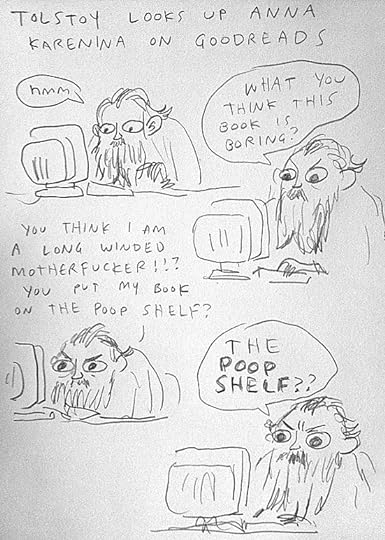
And, while my Goodreads reviews for Exit Black have been decent–more good reviews than bad, and a number of reviews from people who must have actually read the book–I am a little suspicious of a review site where The Martian has a higher rating than Madame Bovary and where only 42% of Anna Karenina reviewers gave that book 5 stars. Seriously?

Cartoon credit: Kate Beaton, Hark! A Vagrant

I accept that for better and worse, Goodreads and Amazon are the ways that authors have to market their books. I don’t have to like that state of affairs, but I do accept it. However, I’m always on the lookout for something better, something more humane, something not yet made grubby by millions of people on the make for a quick buck or trash-talking for the dopamine hit of a bunch of likes. Shepherd might not last. But for now, I really like the way they approach books and the people who write and read them. I hope you’ll go check it out!

Towards 1000 Readers

28 Sunday Jan 2024

Posted by Joe in Book reviews, Exit Black, Lit News, Musings and ponderation, My Fiction, Science Fiction

≈ 6 Comments

Tags

books, Exit Black, fiction, marketing, readers, sci-fi, Science Fiction

Not long after I published my first novel, Stranger Bird, I mused on this blog about how many people might one day read my book. I realized quickly that it would always be tough for me to know, since the number of people who have Stranger Bird on their shelves will always be higher than the number who actually read it. Exhibit A for this argument is my own TBR pile, which has 34 books in it, most of them better than Stranger Bird, and many of which I will probably never get to, TBR piles being what they are in my life.

Here is the dream I had for Stranger Bird back then: I hoped that the book would one day have 100 readers. That excellent book has something like 16 reviews on Amazon right now, so my guess is that 100 readers is a decent ball park estimate for how many people have read, or will read, Stranger Bird.

Why am I bringing this up now, six years later? Because my new novel Exit Black, is traditionally published, with an actual marketing and promotion team working on it, with actual advanced reader copies and early reviews. I want to hope that a lot more people will read this new book. But what is a realistic hope? 10,000 readers? 100,000?

That seems like a lot of readers for an obscure science fiction writer who mostly works as a community college English instructor. For now, let me amplify my dreams by a single, ambitious order of magnitude: I hope that 1000 people will read, and love, Exit Black. I’ll never know how many will actually read it, but if Blackstone sells that many copies, or somewhat more than that, I will nurse the belief that a thousand people will read Exit Black.

I’d love for my number of readers to increase by an order of magnitude with each new book: 10,000 readers for Pacifica when it comes out, 100,000 for unnamed novel #4. At that rate, the entire population of Earth will be reading my ninth novel when I publish it, and then I can die knowing that I was the Colleen Hoover of my generation.

(I suppose that Colleen Hoover herself is the Colleen Hoover of my generation, but whatever).

Anyway, I’m sure that the Earth’s ecosystems have some carrying capacity for readers of Joe Pitkin books and that the population will level out at some limit long before I reach ten billion readers. I don’t have to worry about that right now. Right now, I’m hustling to get a thousand.

That Barnes & Noble Feeling

23 Monday Oct 2023

Posted by Joe in Advertising, Exit Black, My Fiction, Science Fiction

≈ 7 Comments

Tags

Barnes & Noble, books, Exit Black, marketing, sci-fi, Science Fiction

A long, long time ago, children, before everyone was self-publishing books on Amazon, before millions of people were writing fan fiction on their smart phones and publishing it to Wattpad, the bookstore chain Barnes & Noble represented (to certain lefty NPR-listening types, anyway) everything that was wrong with the publishing industry. Barnes & Noble stores were proliferating across the strip malls of America like massive commercial toadstools, and many people saw the local Barnes & Noble as a kind of Wal-Mart of books: a destroyer of independent bookstores and hometown loveliness. (If what I’m describing sounds like a plot point from the old 1998 rom-com You’ve Got Mail, that’s because the bookstore mega-chain in the movie was a not-so-subtle portrait of the real Barnes & Noble of the time.)

Fast forward 25 years, and Barnes & Noble seems more like the underdog now, trying to reinvent itself amidst the moribund shells of America’s hollowed-out malls, hustling to stay alive beneath the crushing shadow of Amazon. I was no lover of Barnes & Noble back in the You’ve Got Mail days, and I still try to buy all of my books at the many fine independent bookstores of Portland, but I have to admit that I have a soft spot for Barnes & Noble as it holds on for dear life.

So, it felt weird seeing my name on the Barnes & Noble website offering Exit Black for presale. I have to admit that I feel proud that a book I wrote will be sitting on a shelf in an actual, physical bookstore next to the Starbucks.

I hope I’ll be seeing Exit Black at a whole lot of Portland spots–can I interest you, Broadway Books? How about you, Annie Bloom? But there is an unexpected thrill to seeing my name come up on the website of that once-maligned mall standby, good old Barnes & Noble. If I get a chance to do a reading or a signing at one, I’m going.

How to Comp

15 Tuesday Aug 2023

Posted by Joe in Advertising, HPIC, Musings and ponderation, My Fiction, Pacifica, Utopia and Dystopia

≈ 13 Comments

Tags

books, marketing, publishing, query letters, sci-fi, Science Fiction, utopia

I’ve known for a long time that writing is a business. But knowing that writing is a business is no guarantee that one knows how the business works. There’s good circumstantial evidence that for the past 20+ years, I haven’t had the foggiest idea about what I’m doing.

Where my writing career is concerned, I’ve tried to follow Steve Martin’s exhortation to be “so good they can’t ignore you.” But what that quote elides is that it’s still up to the writer to give the audience a chance not to ignore you. I could be as good a writer as Emily Dickinson, but if I don’t know how to get people’s attention, my career could still end up like, well, Emily Dickinson’s.

I’m facing this challenge as I go out for a literary agent for my third novel, Pacifica. (I have an excellent agent, Scott Veltri, for TV and movie projects, which is the hope for my novel Exit Black. But Pacifica is not on the list of 10,000 books I would think of for a movie tie-in). As anyone who has ever gone out for an agent knows, a query letter is one of the writer’s few early opportunities to show their understanding of writing as a business. And one of the things I’ve only recently gotten a feel for is the importance of comps for the novel I’m trying to sell.

Comps–short for comparative titles–are a short list of recent books that are similar to the novel you’re selling. And there are apparently rules, or at least norms, regarding the art of good comps. Here are the ones I’ve picked up at conference panels, in writing guides, and intuition:

  • Pick no more than three books (though apparently one of the books can be a movie or tv program)
  • Pick recent, commercially successful works, but
  • Avoid comparing your work to that of literary A-listers (e.g. no Annie Proulxes or Cormac McCarthys)

Are these the rules? If I knew, more people would probably be reading my writing. If you have better intel on how comps work, please jump in the comments or feel free to DM me! I can tell you what wasn’t working for me, though:

  • Not offering a list of comps in my query letter
  • Comparing my work to Ursula K. Le Guin’s (though I don’t think I’m wrong! Read Stranger Bird yourself and you be the judge)
  • Dissing other writers’ work (at the time I was lathered up about what I called the Harry Potter Industrial Complex)

None of these remarks got me an agent, and I suspect now that that was because my approach showed that I didn’t understand how the publishing business works. Agents and publishers want to know comps for a simple reason: they want to know what has already sold well that is similar to the book you are selling. It doesn’t matter if your book is the most exquisitely constructed exploration of the human heart since Anna Karenina–an agent wants to know if your novel will sell.

Is that a mercenary attitude? Maybe. Is it a rule that you must have comps? Absolutely not. But there’s also no rule that says I have to wear pants to a job interview. If I want to wear jorts to my next job interview, that’s my right as an American. However, wearing jorts to an interview will foreclose on just about every job offer outside of a very small set of jorts-positive jobs, many for which a 53 year-old man wouldn’t be an attractive candidate anyway.

My last unsuccessful job interview. Photo credit Carlyn Eames

So, what am I pitching as my comps for Pacifica? My three are Gabrielle Zevin’s Tomorrow, and Tomorrow, and Tomorrow; Anthony Doerr’s Cloud Cuckoo Land, and Russell Brand’s The Magic Kingdom–three very different books (and one of them I wasn’t even crazy about). But they’re three recent, commercially successful books, each with a passing resemblance to my book about a guy who has a religious vision playing video games which spurs him to found several increasingly ridiculous, polyamorous intentional communities. I guess that’s not exactly a concept which sells itself. Hopefully the comps will help me market it.

A New Version of the Old Mug

16 Sunday Jul 2023

Posted by Joe in Advertising, Biology

≈ 9 Comments

Tags

Exit Black, head shot, marketing, Pat Rose, portraiture, sci-fi, Science Fiction, that strumpet Fame

I decided to go in for a new head shot recently. It’s been over six years since my most recent head shots, and not only have I gotten more wizened over that time, but I also have a new book coming out in the next few months.

As with my last photos, my new head shot is he work of the incomparable Pat Rose. You can check out her amazing work here: she’s an institution of Portland portraiture. Having my photo taken by her feels a lot like I imagine sitting for a painted portrait would feel, and at the end of it all she produces an image that is wonderful and painterly as though Jan Van Eyck had painted me.

So, in honor of the coming Exit Black (and of my advancing age), I give you “Portrait of Joe Pitkin, aged 52”. . .

I call it “Bold and Brash”

30 Sunday Apr 2023

Posted by Joe in A Place for my Stuff, Advertising, Exit Black, Musings and ponderation, My Fiction, Pacifica

≈ 3 Comments

Tags

Bold and Brash, marketing, sci-fi, Science Fiction, Spongebob, Squidward, Stories, that strumpet Fame

I experienced a weird constellation of three events last week. First, my editor, my agent, and I hashed out the jacket copy for my upcoming novel, Exit Black. It was weird to realize that I was basically helping write ad copy for a book that I labored over for two years. Second, I sent out a query to a literary agent for the book I drafted after Exit Black, called Pacifica. (My current excellent and extant agent, Scott, works on film and TV projects, and Pacifica definitely isn’t movie material, so I am looking for a bookish agent as well).

And third, I was driving down Broadway in Portland when I saw this bumper sticker ahead of me:

Millennials and Zoomers–and their parents who might have watched Spongebob Squarepants with them twenty years ago–will recognize this as Squidward Tentacles’ self portrait, “Bold and Brash.” I was happily shocked to see it on a bumper sticker. And I realized when I saw it that this publication process I am experiencing with my books is drawing up all of my deeply Squidwardian impulses: my vanity, my hunger for approval, my inner conflict about how art intersects with commerce. Squidward, c’est moi.

If you need a blast from the past, or you somehow never saw the original, here is a clip of me Squidward from the episode “Artist Unknown:”

The Penultimate Stranger Bird

04 Tuesday Jul 2017

Posted by Joe in Beta Readers, fantasy, Journeys, My Fiction, Stranger Bird

≈ 1 Comment

Tags

books, editing, fantasy, marketing, Stranger Bird

As followers of The Subway Test have read before, I’m publishing a fantasy novel called Stranger Bird this year. Working with my estimable friend Erica Thomas at Works Progress Agency, we’ve landed on a launch date of mid-October. And so begins my final editing slog, getting the manuscript ready for layout. I’m surprised at how many little things (and even a couple of big things) I’m changing in response to the feedback of my beta readers and my awesome copy-editor, Ann Eames. Thanks, beta buddies!

If you’re reading this, I’m grateful that you’re reading. And if you like fantasy, I hope you’ll take a look at Stranger Bird when it’s ready.

The New Yorkering of Science Fiction

14 Wednesday Jun 2017

Posted by Joe in Book reviews, HPIC, Literary criticism, Musings and ponderation, Science Fiction

≈ 2 Comments

Tags

fandom, fantasy, Laura Miller, literature, marketing, sci-fi

A couple of weeks ago one of my writing group comrades passed along to me this Laura Miller article from Slate on the incursion of “literary novelists” into the field of science fiction. I often find the premise of such articles cringeworthy–that there are good, serious writers out there who used to write good, serious fiction about failing marriages and suburban malaise but who now have decided, who knows why, to write crap about lasers and robots with big boobs.

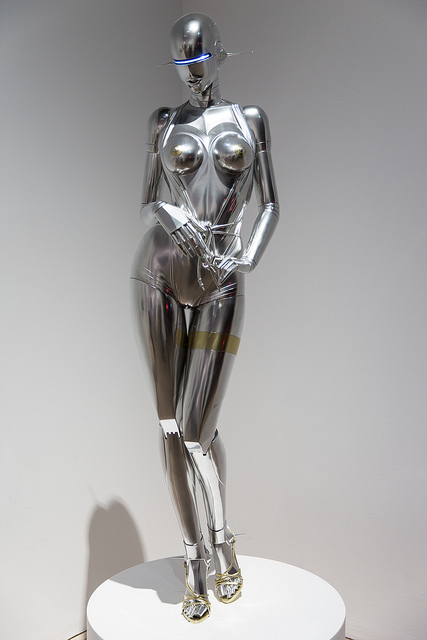
Hajime Sorayama--Sexy Robot

Hajime Sorayama, Sexy Robot–photo credit Moody Man

Miller’s article is more nuanced than that–it acknowledges that the line between literary fiction and science fiction has always been blurry, and that calling a book “literary fiction” is no more a guarantee of its quality than calling a book “science fiction” guarantees that it is trash. Miller’s basic argument is that life is changing so quickly now that a contemporary story is dated almost before it is finished: if I am a literary novelist writing about a Tinder romance that goes sour, who knows what online romance trend will have replaced Tinder by the time I finish my book five years later? Wouldn’t it be better for me, then, to imagine a near-future dating app, so that when my book comes out I seem “buoyantly dystopic” and “a literary polymath” to reviewers?

I don’t dispute Miller’s reasoning: I hadn’t thought about it before, but surely some of the near-futuristic “serious fiction” out there is meant as a commentary on the pace of change in our lives and how maddening it is for us to try and keep up with it all.

But I’d like to suggest another hypothesis to explain the huge influx of Columbia MFA grads and New Yorker raconteurs into the slums of science fiction. Part of the shift, I’m sure, is that the last two generations of writers have grown up watching science fiction movies and TV with good production values and believable special effects. Science fiction was often regarded as shlocky in the pre-CGI era, and certainly before the breakthrough of Star Wars, partly because so many sci fi movies looked so clunky and fake. (Of course, there were excellent exceptions in the years before Star Wars, movies like 2001:A Space Odyssey, Forbidden Planet, and George Pal’s War of the Worlds, but these were rare glints of gold in a sea of Plan 9 From Outer Space dross).

Today, however, it’s possible for even a modestly-budgeted TV show–to say nothing of a big budget movie–to have the kind of truly believable special effects on which good sci fi viewing depends. And the existence of commercially successful, well-made science fiction movies catalyzes the creation of more such work, attracting writers and filmmakers with serious artistic chops–no one needs feel ashamed anymore that they like science fiction (at least the highbrow literary “speculative fiction” of Margaret Atwood or Michael Chabon).

One might argue that the crossover popularity of a writer like Vonnegut is what opened the floodgates to good science fiction. I disagree: Vonnegut was regarded for most of his career as a literary oddball, someone who would be a major writer if only he didn’t write science fiction. And Vonnegut’s popularity in the seventies did not facilitate the mainstream popularity of other science fiction greats like Ursula Le Guin and Stanislaw Lem (both of whom, thank goodness, have since received some of the attention they deserve).

The fact is that until recently, practically the only speculative writers who were unequivocally welcomed into the literary canon were authors from the non-English speaking world: people like Kafka and Borges, and later García Márquez and Calvino. And some would still argue that their inclusion in the canon is proof that what they were writing was something other than sci fi or fantasy–if you want to make a college English professor flip out, try calling “The Metamorphosis” or “The Library of Babel” a science fiction story.

Am I bitter about it? I suppose I must be–why else would I write 700 more words in defense of science fiction writers? In the long run, though, if David Foster Wallace and Jennifer Egan get the highbrow readers to crack a science fiction novel, if that brings them to look, eventually, at Octavia Butler or John Crowley, then who am I to complain?


Retiring Mr. Methane

17 Monday Apr 2017

Posted by Joe in Advertising, The Time of Troubles

≈ 2 Comments

Tags

marketing, profile photos, The March for Science

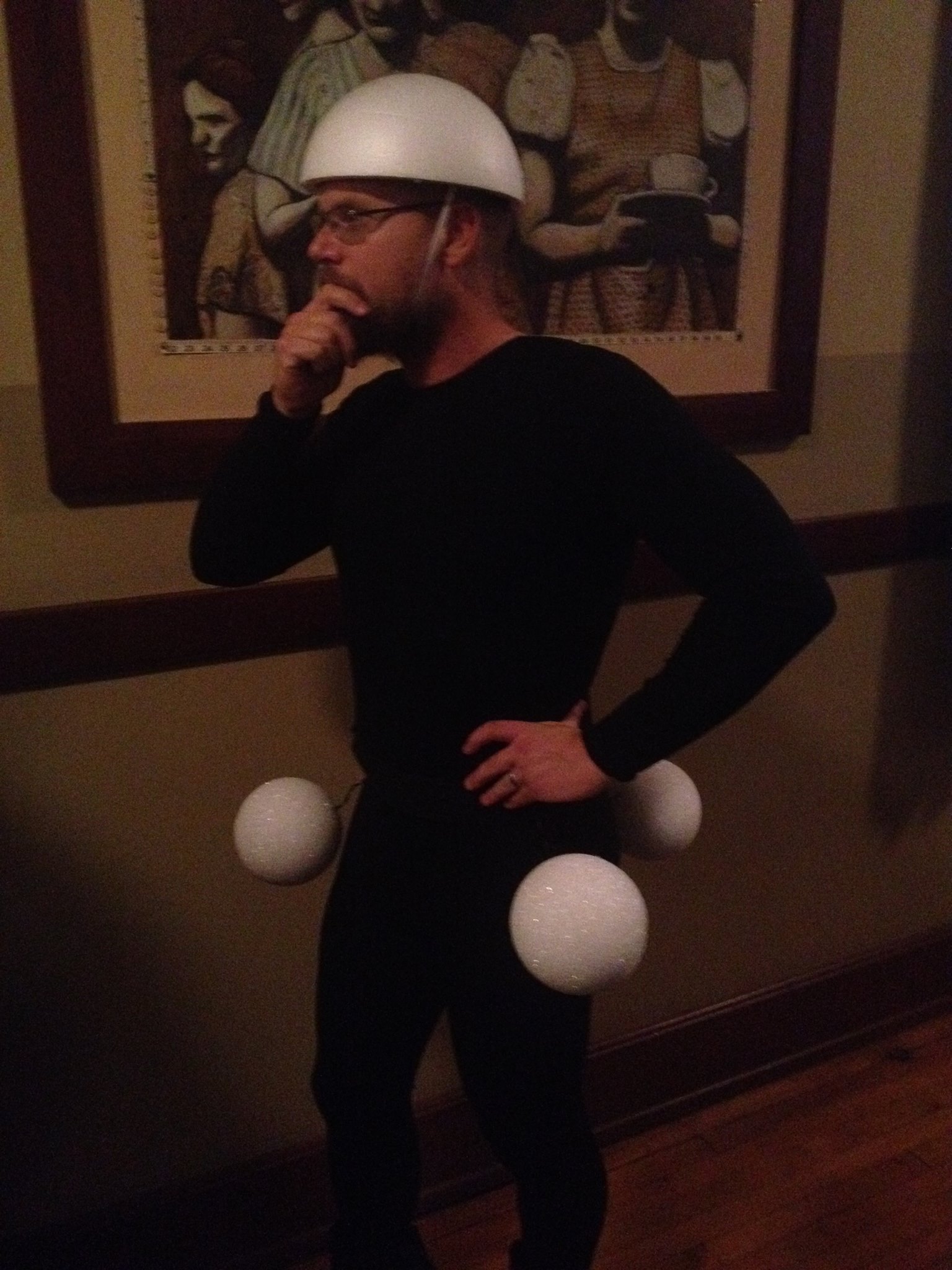
It is with mixed emotions that I retire my current profile photo for this blog: good old Mr. Methane:

methane

This is one of my favorite pictures of myself, taken by my wife on Halloween 2015. I thought I did a decent job making myself into a ball-and-stick model of the most frightening greenhouse gas on the planet. And the picture captures what I’ve always considered the essential ridiculousness of my writing enterprise.

But, I suppose if I want people to take my writing seriously, I might get more of the right kinds of attention if my profile pic doesn’t show a man in a black body suit and Styrofoam deedle balls.

And, I’ve been lucky to work with a truly talented photographer, Pat Rose, who took the most flattering photos of me I’ve ever encountered. The one I call “Smiley Joe” will go on the back cover of Stranger Bird when it comes out:

Joe Stranger Bird cover photo

And for the blog itself, I’ll be using another of Pat’s fabulous shots, the one I don’t have a name for yet:

Joe web profile photo

I’m open to any names you want to suggest. “Oddly intense sci-fi man?” “Half-light Raconteur?” Really, he needs a name.

And old Mr. Methane? My wife had the genius idea that I should pull the old costume out for the March for Science. If I can wear a black bodysuit and stand up for civil society? What more could I want out of the weekend?

← Older posts

Subscribe

  • Entries (RSS)
  • Comments (RSS)

Archives

  • November 2025
  • September 2025
  • August 2025
  • July 2025
  • May 2025
  • April 2025
  • March 2025
  • January 2025
  • December 2024
  • October 2024
  • September 2024
  • August 2024
  • June 2024
  • May 2024
  • April 2024
  • March 2024
  • February 2024
  • January 2024
  • December 2023
  • October 2023
  • August 2023
  • July 2023
  • June 2023
  • April 2023
  • March 2023
  • May 2022
  • August 2021
  • June 2021
  • January 2021
  • October 2020
  • May 2020
  • March 2020
  • February 2020
  • January 2020
  • July 2019
  • June 2019
  • December 2018
  • October 2018
  • July 2018
  • May 2018
  • April 2018
  • January 2018
  • December 2017
  • November 2017
  • September 2017
  • August 2017
  • July 2017
  • June 2017
  • May 2017
  • April 2017
  • March 2017
  • February 2017
  • January 2017
  • December 2016
  • November 2016
  • October 2016
  • August 2016
  • July 2016
  • June 2016
  • May 2016
  • March 2016
  • February 2016
  • January 2016
  • December 2015
  • November 2015
  • October 2015
  • July 2015
  • May 2015
  • March 2015
  • February 2015
  • January 2015
  • December 2014

Categories

  • A Place for my Stuff
  • Advertising
  • Artificial Intelligence
  • Beta Readers
  • Biology
  • Book reviews
  • Curious Fictions
  • Dungeons and Dragons
  • Exit Black
  • fantasy
  • Games
  • HPIC
  • Journeys
  • Let's All Admire That Fantastic Can
  • Lit News
  • Literary criticism
  • Musings and ponderation
  • My Fiction
  • Pacifica
  • Politics
  • Reading Roundup
  • Science
  • Science Fiction
  • Science Fiction Writers of America
  • SETI
  • Stories
  • Stranger Bird
  • The Ideal Vehicle
  • The Time of Troubles
  • Uncategorized
  • Utopia and Dystopia
  • Welcome
  • YA fantasy

Meta

  • Create account
  • Log in

Authors

  • Joe's avatar

Blog at WordPress.com.

  • Subscribe Subscribed
    • The Subway Test
    • Join 143 other subscribers
    • Already have a WordPress.com account? Log in now.
    • The Subway Test
    • Subscribe Subscribed
    • Sign up
    • Log in
    • Report this content
    • View site in Reader
    • Manage subscriptions
    • Collapse this bar
 

Loading Comments...