• About
  • My Fiction
  • Reviews

The Subway Test

~ Joe Pitkin's stories, queries, and quibbles regarding the human, the inhuman, the humanesque.

The Subway Test

Category Archives: Book reviews

Three books that have affected me this year

17 Wednesday Sep 2025

Posted by Joe in Book reviews, Musings and ponderation, Politics, Reading Roundup, The Time of Troubles

≈ 3 Comments

Tags

Abundance, Anne Applebaum, Autocracy Inc., book review, books, Daron Acemoglu, democracy, Derek Thompson, Ezra Klein, history, James Robinson, Politics, Why Nations Fail

I’ll begin with the obvious: we can’t defend the republic simply by reading books. Reclaiming and repairing American democracy will require mass protest, creative civil disobedience, and serious political organization.

But let’s not minimize the importance of a shared text for the cohesion of a political movement: from The Bible to Common Sense to Uncle Tom’s Cabin, defenders of American democracy in the past found solidarity and a shared language through a text held in common. And beyond that, a book often serves as an extended argument for or against a cause, an intellectual defense of an idea that needs defenders. Most Americans haven’t read The Federalist, but anyone who has read it has access to the first and most brilliant exegesis for the Constitution itself.

I don’t expect any of the books below to have the impact of Common Sense. But I got a great deal out of reading each of them, and I think our movement would be better off if more defenders of constitutional democracy were aware of the ideas here. My reasons for choosing to read them were idiosyncratic, but I want to evangelize for each of these books to you. While they aren’t the only good books I’ve read this year, they each in their own way offer an argument for meeting the current authoritarian moment in the United States.

Autocracy, Inc.: The Dictators Who Want to Run the World, by Anne Applebaum: I get the impression that this book is a compilation of pieces that Applebaum has written in The Atlantic, some of which were extended in this book. Nevertheless, I really recommend taking in her argument all at once here. According to Applebaum, the anti-democratic regimes of the world—from Putin’s Russia and Xi’s China all the way to Maduro’s Venezuela and Mnangagwa’s Zimbabwe—have banded together into a kind of mutual aid society. That is, regimes that see democracy as a threat to their survival are helping one another to evade sanctions, to foment an anti-democratic disinformation network, and to sabotage the democracies of the world. This network of autocrats and strongmen has accomplished a great deal to undermine democracy already, and I came away from this little book believing that the struggle against Vladimir Putin and Xi Jinping is inextricable from the struggle to resist Donald Trump. It’s not totally clear yet how the forces of democracy will succeed at restoring civil society’s fortunes; however, success begins with understanding the nature of the forces attacking us. In a dark time, I take heart in Applebaum’s dedication of the book “for the optimists.” To paraphrase John Lennon, she’s not the only one.

Abundance, by Ezra Klein and Derek Thompson. I picked this up after it seemed like every lefty blogger–and a lot of non-lefties–couldn’t stop talking about it. I find the book’s thesis straightforward and compelling: according to Klein and Thompson, America has lost its initiative to build housing, transportation projects, and energy infrastructure, and progressives bear at least some responsibility for that state of affairs. In the name of environmental protection, labor unionism, and racial justice (a trifecta the authors refer to as “everything bagel liberalism”), we on the left have deployed environmental impact statements, restrictive zoning ordinances, and other restrictions on property use, often with the self-serving secondary purpose of boosting property values in blue cities.

As a progressive, labor unionist, and committed environmentalist, I find this thesis challenging. However, it’s hard to deny that NIMBY attitudes have slowed the construction of affordable housing in many putatively progressive West Coast cities, and these same attitudes have slowed or stalled many energy generation projects, even some solar and wind installations, to say nothing of nuclear energy capacity. On the right, Tyler Cowen has argued that organized labor and environmental groups are the two primary culprits in this slowdown. I would like to hold out the possibility that opposition to more environmentally friendly infrastructure, energy generation, and housing is not baked into the recipe of the labor and environmental movements, but this book issues a challenge to us on the left to support, rather than oppose, a society which builds more for its members. One of the personal goals I’ve set myself over the coming year is to investigate ways that the abundance agenda–which I believe I endorse–can be reconciled with the values of organized labor, social equity, environmental protection, and ecological restoration that I also support. Of course, all life is a series of trade-offs, and not every virtuous goal can be maximized simultaneously. I want to seek out practical compromises for the coming restoration of democracy that will move society forward, and this book is a great call for that.
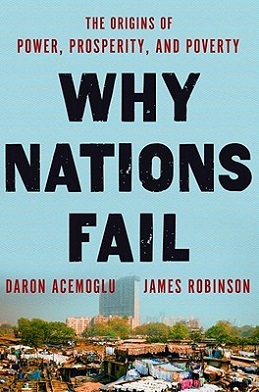
Why Nations Fail: the Origins of Power, Prosperity, and Poverty, by Daron Acemoglu and James Robinson. I spoke of the explanatory power of this remarkable book in an earlier post on democracy. The timing of its coming into my life was a bit random: I saw it sitting on the bookshelf of the drummer in my band about a week after Donald Trump’s 2024 victory, and I guess I was sensitized to the title. And, knowing John to be a well read guy–one of the two best-read drummers I’ve ever played with–I figured I would give the book a spin. Acemoglu and Robinson are two-thirds of a Nobel prize-winning team of economists for their work studying “the importance of societal institutions for a country’s prosperity,” to quote the The Royal Swedish Academy of Sciences. And this book, which struck me as both readable and magisterial in its scope, has helped me more than anything I have read before to articulate why democracy delivers peace, happiness, prosperity, and well-being better than any other form of government yet tried.

In a time when many Americans on the political right are growing fascism-curious (when they are not out-and-proud tiki torch-carrying fascists); and in a political moment when some on the left are so committed to ideological purity around questions of race, gender, Israel, and capitalism that they would rather lose elections than work with centrists, I found this book wise, humane, and ultimately hopeful. I hope more of my fellow Americans will read it.

We’re #8! We’re #8!

13 Monday Jan 2025

Posted by Joe in Advertising, Book reviews, Exit Black, Lit News, My Fiction, Science Fiction

≈ 10 Comments

Tags

Blackstone, books, Carolina Hoyos, Discover Sci-Fi, Exit Black, fiction, sci-fi, Science Fiction, writing

That was my publisher’s note to me when we learned that Exit Black cracked the top ten best sci fi audiobooks in 2024 at Discover Sci-Fi. I’m super stoked: while I would have loved for Exit Black to take the #1 spot, of course, there’s no shame losing out to the likes of Adrian Tchaikovsky narrating his own book and Jeff VanderMeer having his work read by Bronson Pinchot. Carolina Hoyos is a hell of a reader, and I was very lucky to have gotten to work with her.

I loved every step of this project with Blackstone Publishing, and to make my Captain Obvious Statement of the Day: Blackstone knows audiobooks. Thanks so much to all of you who voted and all of you who listened. And, if you haven’t listened yet, if you ever feel a hankering for a tale about a bunch of techbros getting their comeuppance, Exit Black couldn’t be more timely.

My Best Reads of 2024

11 Wednesday Dec 2024

Posted by Joe in Book reviews, Exit Black, Literary criticism, Musings and ponderation, My Fiction, Reading Roundup, Science Fiction

≈ Leave a comment

Tags

books, sci-fi, sci-fi thriller, Science Fiction, Shepherd, Thriller

As you may remember from former posts, I’m a big fan of the book site Shepherd. And, like many of the writers on that site, I was invited by Shepherd founder Ben Fox to talk about my three favorite books of 2024. I was game, partly because I’m happy for any opportunity to link to my own book of this year, Exit Black–I believe it’s one of this year’s best thrillers on economic inequality that you’ll read this year.

I’m not sure what my choices say about me besides the fact that I do a lot of reading outside the genres I write in, but here were my three faves of this year: Edith Wharton’s The Age of Innocence, Toni Morrison’s Jazz, and Laurent Binet’s Civilizations. Why did I love them so? Check out my Shepherd page to find out!

Shepherd: My Favorite Alternative to Goodreads!

25 Monday Mar 2024

Posted by Joe in Advertising, Book reviews, Exit Black, Lit News, Literary criticism, Musings and ponderation, My Fiction

≈ 6 Comments

Tags

Amazon, books, Goodreads, marketing, sci-fi, Science Fiction, Shepherd

I’ve been hunting for years for a better book recommendation system than Goodreads (and its corporate owner, Amazon). One site that I think really shows promise is Shepherd: it’s better-curated, less compromised, more values-driven. And I’m honored to announce that I have been invited to make a Shepherd recommendation myself. Mine is called “The best fantasy-science fiction books that explore class and inequality,” and I’d love to have people take a look at it.

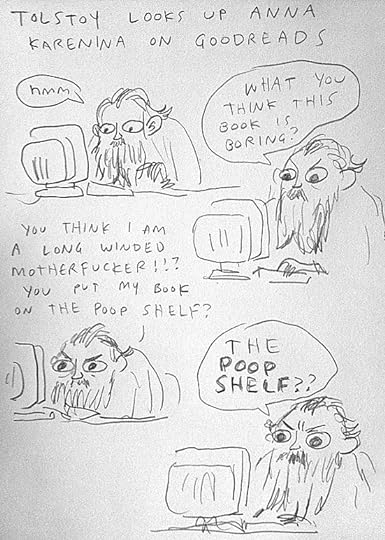
I’m grateful to have a website taking on the Goodreads/Amazon juggernaut. Goodreads is one of those ideas that struck me as having so much promise when it came out: it seemed (at first, anyway) a place where everyone could share ideas about the books they love. But, far from being a democracy of bibliophiles, Goodreads is a crass book marketing system that has proven easy to game and to abuse, from review bombing to pay-for-reviews to careless and anonymous one-star reviews just for the lulz.

And, while my Goodreads reviews for Exit Black have been decent–more good reviews than bad, and a number of reviews from people who must have actually read the book–I am a little suspicious of a review site where The Martian has a higher rating than Madame Bovary and where only 42% of Anna Karenina reviewers gave that book 5 stars. Seriously?

Cartoon credit: Kate Beaton, Hark! A Vagrant

I accept that for better and worse, Goodreads and Amazon are the ways that authors have to market their books. I don’t have to like that state of affairs, but I do accept it. However, I’m always on the lookout for something better, something more humane, something not yet made grubby by millions of people on the make for a quick buck or trash-talking for the dopamine hit of a bunch of likes. Shepherd might not last. But for now, I really like the way they approach books and the people who write and read them. I hope you’ll go check it out!

My Author Interview With Avis Adams

18 Monday Mar 2024

Posted by Joe in Advertising, Book reviews, Exit Black, Literary criticism, Musings and ponderation

≈ Leave a comment

Tags

books, Exit Black, sci-fi, Science Fiction, Your Next Favorite Author

I had every intention of publishing my interview with fellow Willamette Writer (and fellow community college teacher) Avis Adams when she published it almost two weeks ago. Then the end of winter term descended over me like a weighted blanket made of student essays and departmental emails. Now that I have finally wriggled out from under its sweaty embrace, I can give a little more attention to this blog, to promoting Exit Black, and to all things literary.

So, many thanks to Avis for cooking up some delightful interview questions and for offering such a warm reading of my book. Check out her review and my interview at her wonderful blog, Your Next Favorite Author.

Exclusive Interview: “Exit Black” Author Joe Pitkin

20 Tuesday Feb 2024

Posted by Joe in Advertising, Book reviews, Exit Black, Lit News, Musings and ponderation, My Fiction, Science Fiction

≈ 14 Comments

Tags

exclusive interview, Exit Black, Paul Semel, paulsemel.com, sci-fi, sci-fi thriller, Science Fiction, science fiction reviews

It’s publication day for my latest novel, Exit Black, and I was happy to see that the excellent and tireless arts and entertainment journalist Paul Semel chose today to publish our exclusive interview about the book. You can read the interview here: check it out to see why space tourism is the perfect metaphor for economic inequality, as well as who I would cast in an Exit Black movie! I’m still a little tickled that Paul calls it an “exclusive interview”–I mean, it is an exclusive interview, but he makes it sound like I’ve been playing hard to get all these years.

Hard to get?

Towards 1000 Readers

28 Sunday Jan 2024

Posted by Joe in Book reviews, Exit Black, Lit News, Musings and ponderation, My Fiction, Science Fiction

≈ 6 Comments

Tags

books, Exit Black, fiction, marketing, readers, sci-fi, Science Fiction

Not long after I published my first novel, Stranger Bird, I mused on this blog about how many people might one day read my book. I realized quickly that it would always be tough for me to know, since the number of people who have Stranger Bird on their shelves will always be higher than the number who actually read it. Exhibit A for this argument is my own TBR pile, which has 34 books in it, most of them better than Stranger Bird, and many of which I will probably never get to, TBR piles being what they are in my life.

Here is the dream I had for Stranger Bird back then: I hoped that the book would one day have 100 readers. That excellent book has something like 16 reviews on Amazon right now, so my guess is that 100 readers is a decent ball park estimate for how many people have read, or will read, Stranger Bird.

Why am I bringing this up now, six years later? Because my new novel Exit Black, is traditionally published, with an actual marketing and promotion team working on it, with actual advanced reader copies and early reviews. I want to hope that a lot more people will read this new book. But what is a realistic hope? 10,000 readers? 100,000?

That seems like a lot of readers for an obscure science fiction writer who mostly works as a community college English instructor. For now, let me amplify my dreams by a single, ambitious order of magnitude: I hope that 1000 people will read, and love, Exit Black. I’ll never know how many will actually read it, but if Blackstone sells that many copies, or somewhat more than that, I will nurse the belief that a thousand people will read Exit Black.

I’d love for my number of readers to increase by an order of magnitude with each new book: 10,000 readers for Pacifica when it comes out, 100,000 for unnamed novel #4. At that rate, the entire population of Earth will be reading my ninth novel when I publish it, and then I can die knowing that I was the Colleen Hoover of my generation.

(I suppose that Colleen Hoover herself is the Colleen Hoover of my generation, but whatever).

Anyway, I’m sure that the Earth’s ecosystems have some carrying capacity for readers of Joe Pitkin books and that the population will level out at some limit long before I reach ten billion readers. I don’t have to worry about that right now. Right now, I’m hustling to get a thousand.

Towards 100 Readers

19 Thursday Apr 2018

Posted by Joe in Book reviews, Literary criticism, My Fiction, Stranger Bird

≈ 1 Comment

Tags

book review, fantasy, self-publication, Stranger Bird, YA fantasy

It was a lovely surprise to see that someone new has given my book a review on Amazon. It was doubly surprising that the reviewer compared my work to Ursula Le Guin’s–for a fantasy writer, that’s like having your guitar solo likened to Jimmy Page’s work.

And triply surprising was that this review came from someone I don’t know personally. I’ve gotten several sweet and glowing reviews from friends and family who have read Stranger Bird, but it’s a different kind of cool feeling to get a review from someone who has no friendship with me to maintain. (I consider her a friend anyway).

reading sb

When I set out to self-publish Stranger Bird, I hoped out loud on this blog that I would find 100 readers for the book. A number of people–represented most vociferously by my wife–found that a preposterous and too-modest goal. I always answered that I like goals that I have some reasonable hope of meeting. What I didn’t consider when I made my rash pronouncement, however, is that it’s a lot easier for me to know how many books I’ve sold or given away than it is to know how many people have actually read the book.

I do know that I’ve moved 100 books into people’s hands. More than 100, actually. I feel increasingly optimistic that 100 people will, sooner or later, read Stranger Bird. But even sweeter than knowing how many copies are out there is that someone I don’t know at all has read the book and liked it.

Review of The Origins of Creativity

14 Saturday Apr 2018

Posted by Joe in Biology, Book reviews, Musings and ponderation, Science Fiction

≈ Leave a comment

Tags

biology, E.O.Wilson, Edward O. Wilson, Lascaux, Literary criticism, Science Fiction, STEM, The Origins of Creativity, Willendorf Venus

Edward O. Wilson’s latest book, The Origins of Creativity, is a return to the trails Wilson explored almost 20 years ago in Consilience: The Unity of Knowledge. In both books, Wilson attempts to bridge the gulf between the sciences and the humanities which has opened over the last century or more. Wilson makes a heroic effort in The Origins of Creativity (touchingly so, given that the great scientist is nearly ninety years old and has given the book some of  the touches of a final work). In the end I was unpersuaded by his exertions, but I am grateful for his return to a theme which is so meaningful for me personally. And, if Wilson’s proclamation of a coming Third Renaissance doesn’t quite convince me, I believe that Wilson still does us yeoman’s service in making an attempt to unify the humanities and the sciences.

Wilson’s starting point is uncomfortable, though obvious, for English teachers everywhere: the science, technology, engineering, and mathematics (STEM) fields have far outstripped the humanities in the public funds they receive, and STEM fields have been vastly more successful at producing lucrative jobs for college graduates. Elected officials regard the arts & humanities as luxuries whose comparatively tiny public budgets are often hard to justify.

Wilson’s diagnosis of the problem is that the humanities are stuck in the cultural cul-de-sac of present day. As Wilson puts it: “The main shortcoming of humanistic scholarship is its extreme anthropocentrism. Nothing, it seems, matters in the creative arts and critical humanistic analyses except as it can be expressed as a perspective of present-day literate cultures.”

While I do think that much of what goes on in the humanities is culturally blinkered, I’m not exactly sure how one would go about making the humanities less anthropocentric. The purpose of art is to explore what it means to be a human being–the humanities are anthropocentric by definition.

It is true that, with the exception of some artists working in the genre of science fiction, most artists and humanities scholars are not deeply educated around science. To put it another way, I think most scientists know way more about the humanities than most humanities scholars do about science. However, I’m not sure how our becoming more literate about evolutionary psychology and paleontology will make artists less anthropocentric. Art is one of the most anthropocentric activities on earth.

Would it help bridge the gulf between the arts and the humanities if the arts expressed something other than “a perspective of present-day literate cultures?” Maybe, but I don’t see it.  True, we would probably gain something by being better educated about the deep, biologically-driven ways that the lives of “present-day literate cultures” are related to the lives of the Lascaux Cave painters and the sculptor of the Venus of Willendorf. It does help us to recognize (and I think most present-day literate people do recognize) that those paleolithic artists were just like us in their humanity–their emotional lives were just as rich and subtle as Margaret Atwood’s. And, I do suppose that realization helps us in humanity’s most pressing moral challenge, that of seeing all humans across time and space as part of a single family, our common fate tied to the health of the ecosystem in which we live.  

Lascaux II

But this realization will not by itself bridge the gulf between the humanities and the sciences. That gulf is there because there is simply too much information to keep tabs on in the sciences for any human being to become an expert in more than a very small number of fields. It may be that our species is gathering scientific insights so quickly now that it’s impossible for a single human to become a true expert even in a single field as broad as chemistry or biology.

I’ll be the first to argue that artists could afford to learn a lot more about STEM fields. After all, science and technology are some of the most important organizing principles of human existence today. But whatever art we produce will still be to a certain extent time-bound: we make the art we do to give our lives a some kind of shape that makes sense to us. Our art remains bound in time and place because the human condition binds us to the time and place we live in.


The Founding Bloggers

23 Wednesday Aug 2017

Posted by Joe in Book reviews, Literary criticism, Musings and ponderation, Politics, Reading Roundup, The Time of Troubles

≈ 1 Comment

Tags

Alexander Hamilton, books, Hamilton, James Madison, John Jay, Lin-Manuel Miranda, Politics, The Federalist Papers, Trump

When a musical like Hamilton comes along, a rational response to the buzz is for folks to, you know, want to see Hamilton. Others might be overwhelmed enough by the positive press to look to Hamilton‘s source material, the gargantuan Ron Chernow biography of the man on the ten dollar bill.

Others, the cheapskates and musical theater philistines, might turn instead to The Federalist Papers.

Yes, I started reading The Federalist Papers because I heard Hamilton rapping on NPR for a minute and I realized that I hadn’t really read anything Hamilton had written.

I suppose if I’m really honest with myself, I do have to admit that fear for the future of America, at least as much as Lin-Manuel Miranda, is really what sent me to The Federalist Papers. As I watch the current president’s bumbling yet earnest assault on the Constitution–his flouting of the emoluments clause, his apparent ignorance of the establishment clause, his barrelling through each conversation as though the separation of powers didn’t exist–I realize that I don’t know enough about the document that the president is trying to subvert.  I have read the Constitution, and I’ve sure been going back to my pocket copy a lot lately, but like a powerless fanboy, I want to know more, to know it better. And The Federalist Papers, I’ve been told, are the inspired commentary on the US Constitution, the brilliant liner notes to that Sergeant Pepper’s Lonely Hearts Club Band of legislation.

I’m about a third of the way through so far, and it’s very slow going. All three of the authors–Alexander Hamilton, James Madison, and John Jay–learned to write in an age when a man showed his genius by teasing each sentence into a froth. Each sentence has a multi-layered, architectural quality, like the 18th century wigs that Hogarth lampoons in Five Orders of Perriwigs.

William_Hogarth_-_The_Five_Orders_of_Perriwigs

By William Hogarth – Scanned from The genius of William Hogarth or Hogarth’s Graphical Works, Public Domain, https://commons.wikimedia.org/w/index.php?curid=2714934

Of the three, John Jay is the most straightforward of the writers, the one least inclined to pile on the relative clauses. Imagine my dismay, then, to learn that John Jay wrote by far the fewest of the papers–only five of the 85–before illness forced him to give up the project. Hamilton, who wrote by far the most of the papers, is also the hardest to read. Every sentence of Hamilton’s is like listening to a Yngwie Malmsteen guitar solo: his paragraphs are spattered with commas, packed with dependent clauses that double back on themselves and seem to eat their own tails. And they are also filled with some of the most brilliant and vigorous writing I’ve ever seen.

This sentence, from Federalist #29, is typical Hamilton:

There is something so far-fetched and so extravagant in the idea of danger to liberty from the militia, that one is at a loss whether to treat it with gravity or with raillery; whether to consider it as a mere trial of skill, like the paradoxes of rhetoricians; as a disingenuous artifice to instil prejudices at any price; or as the serious offspring of political fanaticism.

Wow–I had to crawl through this sentence few times before I could tell what Hamilton was actually arguing: that militias are no danger to public liberty. However, one look at the rigging of this sentence is enough to warn me not to treat his ideas with raillery. A sentence like this demands to be treated with gravity.

I was also fascinated to see, in this sentence and elsewhere, how current Hamilton’s ideas are. Dust off the perriwig of his prose, and you can see that we are still  debating “the idea of danger to liberty from the militia” in this era of Cliven Bundy.

But what has impressed me the most so far about these letters is the high-wire act their authors pulled off. The three men, all writing under a single pseudonym–“Publius”–managed to pump out 85 of these essays over just ten months. That’s one letter every three or four days, each one a Niagara of commentary intended, I imagine, to bury the Constitution’s opponents under a flood of historical references, musings on American geography, and speculations on human behavior.

The newspapers these essays appeared in, The New York Packet and the Independent Journal, were two of that enormous flock of early American newspapers. I remember reading somewhere that most such papers had a circulation of about 1000. Publius was, in other words, much like an early blogger: a pseudonymous team of writers with a tiny audience, writing their asses off to produce brilliant content several times a week.

Dilettante that I am, I have nothing comparable to offer the country here at The Subway Test. I post a couple of times per month, sometimes about politics but usually not. Usually my topic is, in Homer Simpson’s words, “what some nerd thinks about Star Trek.” Yet I can reach back those 230 years to the brilliance of Publius and see that I am pushing my little cart up the great track they laid. If you want to resist the depredations of the current presidency, you have to educate yourself. Read The Federalist Papers. It is one of those books that will comfort you with the underlying genius of the republic. More importantly, it will help you understand what the hell you are defending when you stand up to the current president.

← Older posts

Subscribe

  • Entries (RSS)
  • Comments (RSS)

Archives

  • November 2025
  • September 2025
  • August 2025
  • July 2025
  • May 2025
  • April 2025
  • March 2025
  • January 2025
  • December 2024
  • October 2024
  • September 2024
  • August 2024
  • June 2024
  • May 2024
  • April 2024
  • March 2024
  • February 2024
  • January 2024
  • December 2023
  • October 2023
  • August 2023
  • July 2023
  • June 2023
  • April 2023
  • March 2023
  • May 2022
  • August 2021
  • June 2021
  • January 2021
  • October 2020
  • May 2020
  • March 2020
  • February 2020
  • January 2020
  • July 2019
  • June 2019
  • December 2018
  • October 2018
  • July 2018
  • May 2018
  • April 2018
  • January 2018
  • December 2017
  • November 2017
  • September 2017
  • August 2017
  • July 2017
  • June 2017
  • May 2017
  • April 2017
  • March 2017
  • February 2017
  • January 2017
  • December 2016
  • November 2016
  • October 2016
  • August 2016
  • July 2016
  • June 2016
  • May 2016
  • March 2016
  • February 2016
  • January 2016
  • December 2015
  • November 2015
  • October 2015
  • July 2015
  • May 2015
  • March 2015
  • February 2015
  • January 2015
  • December 2014

Categories

  • A Place for my Stuff
  • Advertising
  • Artificial Intelligence
  • Beta Readers
  • Biology
  • Book reviews
  • Curious Fictions
  • Dungeons and Dragons
  • Exit Black
  • fantasy
  • Games
  • HPIC
  • Journeys
  • Let's All Admire That Fantastic Can
  • Lit News
  • Literary criticism
  • Musings and ponderation
  • My Fiction
  • Pacifica
  • Politics
  • Reading Roundup
  • Science
  • Science Fiction
  • Science Fiction Writers of America
  • SETI
  • Stories
  • Stranger Bird
  • The Ideal Vehicle
  • The Time of Troubles
  • Uncategorized
  • Utopia and Dystopia
  • Welcome
  • YA fantasy

Meta

  • Create account
  • Log in

Authors

  • Joe's avatar

Blog at WordPress.com.

  • Subscribe Subscribed
    • The Subway Test
    • Join 143 other subscribers
    • Already have a WordPress.com account? Log in now.
    • The Subway Test
    • Subscribe Subscribed
    • Sign up
    • Log in
    • Report this content
    • View site in Reader
    • Manage subscriptions
    • Collapse this bar
 

Loading Comments...